
Uncategorized
Why Choose Eco-Friendly Purifiers: Cleaner Home, Healthier Living

Apr
TL;DR:
- Eco-friendly purifiers use energy-efficient designs and long-lasting filters, reducing costs and environmental impact.
- They match or outperform traditional units in filtration, noise levels, and filter lifespan while saving money long-term.
- Proper placement, sizing, and pairing with ventilation strategies are essential for optimal health benefits.
Traditional purifiers look like a bargain at the checkout counter. But months later, when you’re buying yet another filter replacement, watching your electricity bill climb, and tossing out plastic cartridges, the real cost becomes clear. Eco-friendly air and water purifiers flip that script entirely. They’re engineered to deliver powerful filtration with up to 45% lower energy consumption, longer-lasting components, and materials that don’t quietly pollute landfills. If your family spends money on health and home wellness, understanding the full picture of eco-friendly purification is one of the most practical decisions you can make this year.
Table of Contents
- What makes a purifier eco-friendly?
- Core health and wellness benefits
- Eco-friendly versus traditional purifiers: Cost and performance comparison
- Real-world considerations: Pollution, technology limitations, and practical tips
- The overlooked truth: Choosing eco-friendly means planning for your real risks
- Explore reliable solutions for eco-friendly purification
- Frequently asked questions
Key Takeaways
| Point | Details |
|---|---|
| Reduced lifetime costs | Eco-friendly purifiers save money long-term by lowering energy and filter replacement costs. |
| Enhanced home wellness | These purifiers cut allergens and contaminants for safer indoor air and water. |
| Smaller environmental footprint | Eco-friendliness means less waste and more sustainable usage through smarter designs. |
| Smart technology advantages | Features like eco-mode and washable filters maximize efficiency and minimize maintenance. |
| Context matters most | Choose a purifier based on your home’s pollution, size, and water source for best results. |
What makes a purifier eco-friendly?
The term “eco-friendly” gets applied to everything from yoga mats to paper straws, so it’s fair to ask what it actually means for a water or air purifier. In this context, the label has real, measurable criteria that separate genuinely sustainable models from greenwashed marketing.
The foundation is energy efficiency. Eco-friendly purifiers typically carry Energy Star certification, which means they meet strict efficiency standards set by the U.S. Environmental Protection Agency. Many models include eco-mode settings that automatically lower fan speed and power draw when indoor air quality is already good. Smart sensors monitor real-time conditions, so the unit isn’t running at full blast unnecessarily. This kind of energy-efficient purification directly translates to smaller electricity bills and a smaller carbon footprint.
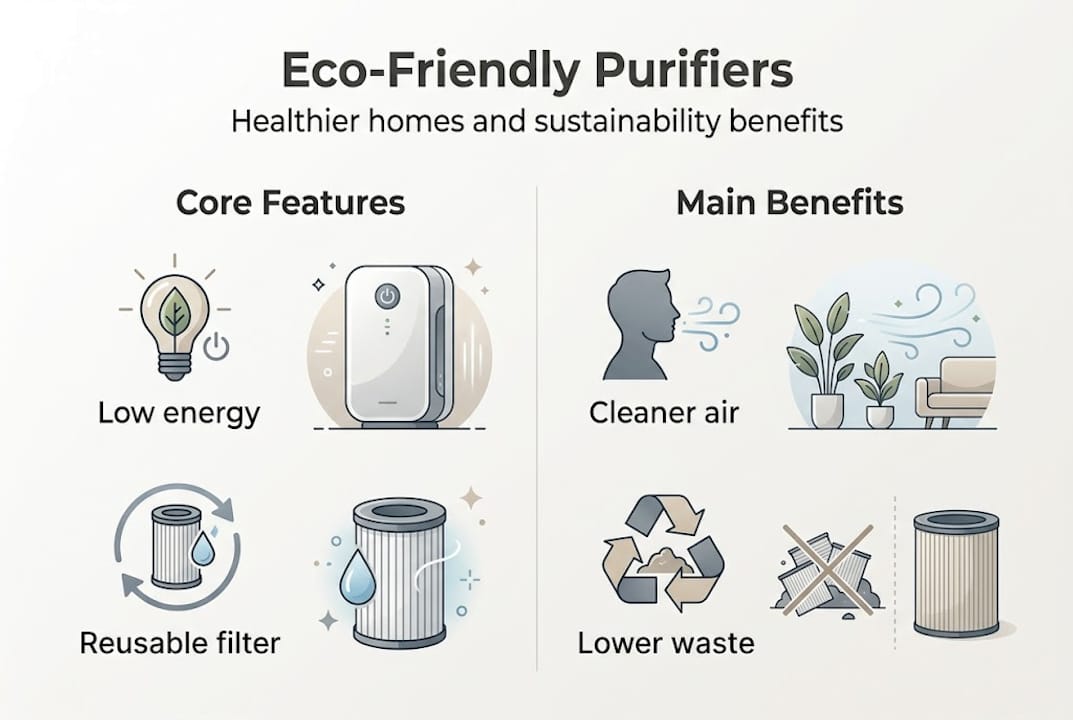
The second pillar is filter design. Traditional purifiers use disposable HEPA filters that go straight into the trash every few months. Eco-friendly alternatives often include washable pre-filters, longer-life main filters rated for 12 to 18 months instead of three to six, and filter media made from recycled or sustainably sourced materials. Eco-friendly air purifiers use energy-efficient designs, sustainable materials, and features like washable or long-life filters to reduce energy consumption and waste. That means fewer trips to the store, less packaging, and significantly less plastic in the recycling bin or landfill.
The third pillar is materials and construction. Eco-conscious manufacturers are moving toward BPA-free plastics, recyclable housing materials, and minimal use of VOC-emitting components in the unit itself. Some brands also design their purifiers for easier disassembly and recycling at end of life.
Here’s a quick summary of what to look for:
- Energy Star certification or equivalent EU energy label
- Eco-mode or smart auto-sensing settings
- Washable pre-filters and long-life main filters (12 months or more)
- Recyclable housing and BPA-free materials
- Clear filter disposal and recycling guidance from the manufacturer
- UV sanitization that doesn’t rely on chemical additives
Understanding energy efficient filtration also means recognizing that efficiency isn’t about compromise. The best eco models actually outperform older traditional units on noise levels, filtration speed, and filter lifespan simultaneously.
Pro Tip: Before purchasing, check whether the manufacturer offers a filter take-back or recycling program. This one detail separates genuinely eco-conscious brands from those simply using the label for marketing purposes.
Core health and wellness benefits
Once we understand what defines eco-friendly purifiers, we can focus on their direct impact on home wellness. This is where the conversation shifts from environmental values to personal health outcomes, and the evidence is compelling.
For air purification, the primary health concern in most homes is particulate matter, specifically PM2.5. These are particles smaller than 2.5 microns that penetrate deep into lung tissue. Sources include cooking, outdoor pollution drifting indoors, pet dander, dust mites, and mold spores. Eco-friendly air purifiers with true HEPA filtration capture 99.97% of particles at 0.3 microns, the hardest size to trap. The difference is that eco models maintain this performance with less energy and longer filter integrity, so you’re not running a degraded filter for months because you forgot to replace a short-life unit.
For water purification, the stakes are equally clear. Municipal water in the U.S. and parts of Europe regularly contains trace chlorine byproducts, heavy metals like lead and copper from aging pipes, microplastics, and in some regions, agricultural runoff including nitrates. Eco-friendly under-sink and countertop water purifiers use multi-stage filtration, often combining activated carbon, sediment filters, and UV sterilization to address these contaminants without wasting excessive water or electricity.
Key wellness outcomes that families consistently report after switching to eco-friendly purifiers include:
- Reduction in seasonal allergy symptoms, especially during spring and fall
- Fewer respiratory infections in children, particularly when PM2.5 sources are controlled
- Better-tasting drinking water that encourages higher daily water intake
- Less skin irritation in households where tap water has high chloramine content
- Improved sleep quality from cleaner nighttime air in bedrooms
Purification health benefits extend well beyond comfort. For families with asthma, COPD, or infants in the home, reducing allergens and airborne contaminants is a clinically meaningful intervention.
Stat to consider: Indoor air can be two to five times more polluted than outdoor air, according to the EPA. In tightly insulated modern homes, air purification isn’t optional wellness spending. It’s a structural necessity.
Eco-purifiers prioritize sustainability while matching or exceeding the traditional health benefits of conventional units, making them ideal for wellness-focused families who don’t want to trade environmental responsibility for effective filtration. That’s the real win here. You don’t have to choose between doing good for your family and doing good for the planet.
Eco-friendly versus traditional purifiers: Cost and performance comparison
To empower your decision, let’s examine the numbers behind eco-friendly versus traditional purifier choices. The sticker price comparison favors traditional models upfront. A basic traditional air purifier might cost $80 to $120, while an eco-friendly Energy Star model typically starts around $150 to $250. That gap feels significant at the register. Over three years, however, the math reverses sharply.
Traditional purifiers cost less upfront but carry higher operating costs and generate more waste. Energy Star eco models cost more initially but save $30 to $60 per year on electricity alone, and longer filter life means fewer replacement purchases annually.
Here’s a side-by-side comparison of typical model families over a three-year period:
| Feature | Traditional purifier | Eco-friendly purifier |
|---|---|---|
| Upfront cost | $80 to $120 | $150 to $250 |
| Annual energy cost | $60 to $90 | $30 to $50 |
| Filter replacements per year | 3 to 4 | 1 to 2 |
| Filter cost per year | $60 to $120 | $30 to $60 |
| 3-year total estimated cost | $480 to $690 | $390 to $550 |
| Filters disposed per year | 3 to 4 | 1 to 2 |
| Smart/eco mode | Rarely | Standard |
The numbers show that eco-friendly purifiers reach their break-even point within 12 to 18 months for most households, after which they deliver ongoing savings every single year.
Here are four practical steps to get the most from your investment:
- Calculate your filter replacement frequency. If you currently replace filters four times per year, switching to a long-life eco model immediately cuts that to once, saving both money and the inconvenience of ordering and installing replacements.
- Enable eco or auto mode. Studies on purifier power testing confirm that smart modes reduce energy draw by 20 to 40% without measurable loss in air quality outcomes for moderate indoor conditions.
- Right-size the unit for your room. Running an oversized traditional unit wastes energy. An appropriately sized eco model in auto mode uses only what’s needed.
- Track your filter lifespan. Most eco models have filter-life indicators. Replacing filters exactly when needed rather than on a fixed calendar schedule maximizes filter value and minimizes waste.
Cost-saving purification tips go beyond the unit itself. Pairing an eco-friendly purifier with proper home ventilation and humidity control creates compounding savings because the purifier works less to achieve the same air quality target.
Pro Tip: When evaluating purifier features, don’t just compare CADR (Clean Air Delivery Rate). Compare CADR per watt. A high CADR with low wattage is the signature of a genuinely efficient machine.
Real-world considerations: Pollution, technology limitations, and practical tips
Beyond cost and health, practical realities matter. Most guides present eco-purifiers as a universal answer. They’re excellent tools, but they’re not magic, and knowing their limits helps you use them more effectively.
High outdoor pollution is the most common edge case. If you live near a highway, industrial zone, or experience seasonal wildfire smoke, your indoor purifier faces a much heavier load. High outdoor PM2.5 levels above 10 micrograms per cubic meter sustained over time can exceed what a single purifier can fully address indoors, especially if windows or doors open frequently. In these situations, you need to combine purification with better sealing and strategic ventilation during low-pollution windows, typically early morning in urban areas.
Reverse osmosis water systems raise a specific eco concern. Traditional RO units waste three to four gallons of water for every one gallon of purified output. That ratio is hard to justify environmentally. Tankless RO systems minimize waste significantly, with modern low-ratio units achieving 1:1 or even better. If water scarcity matters to your household or community, this is the detail that separates genuinely eco-conscious water purification from simply having a filter.

Here’s a practical data reference for common purification scenarios:
| Condition | Recommended approach | Notes |
|---|---|---|
| Outdoor PM2.5 below 10 µg/m³ | Eco air purifier on auto mode | Most efficient scenario |
| Outdoor PM2.5 above 35 µg/m³ | Purifier plus sealed windows | Add weatherstripping |
| Crowded rooms or events | Boost mode plus ventilation | CO2 buildup also a concern |
| Tap water with heavy metals | Multi-stage RO or activated carbon | Test water first |
| High chlorine or chloramine | Activated carbon stage sufficient | RO not always necessary |
| Gases, VOCs, radon | Activated carbon plus ventilation | HEPA alone doesn’t capture gases |
Additional practical tips for eco-focused families:
- Test your tap water before choosing a filtration method. A simple home test kit costs $20 to $30 and tells you exactly what you need to filter, so you’re not over-investing in unnecessary stages.
- Place air purifiers strategically. A unit in the bedroom running on low overnight often delivers more health benefit than a unit in a large open plan living area running at maximum.
- Don’t rely on purification alone for VOCs or radon. These require either source removal, activated carbon filtration, or genuine ventilation. Emerging air purification technology is improving on this, but chemical gases behave differently from particulates.
“In moderate pollution environments, eco-purifiers excel cost-effectively. In high-pollution or edge cases, pairing them with ventilation strategy is essential for full-spectrum protection.”
Tracking air purification trends in 2026 also reveals that manufacturers are rapidly closing the technology gaps. Newer models now include multi-pollutant sensors that detect VOCs, CO2, and humidity alongside PM2.5, giving your purifier more intelligence about when to work harder and when to rest.
The overlooked truth: Choosing eco-friendly means planning for your real risks
Here’s the part of the eco-purifier conversation most articles skip entirely. Eco-friendly is a design philosophy, not a guarantee. Buying a certified efficient purifier doesn’t automatically protect your family if the unit is the wrong size, the wrong technology for your specific water source, or placed in the wrong room.
We see it often. A family in an urban apartment buys a beautiful eco-certified air purifier, places it in the living room, and wonders why their child’s bedroom allergies persist. The answer is simple: the unit isn’t in the right location. Another family near a rural agricultural area installs an eco water filter designed for chlorine reduction, not nitrate removal, because they assumed all filters are equivalent.
The most responsible way to approach this isn’t just asking “is it eco-friendly?” It’s asking “is it eco-friendly AND right for my actual situation?” Use the air purifier selection workflow to assess room size, local air quality data, and specific contaminant concerns before committing to a model.
Eco-friendly and effective aren’t in conflict. But they require intentionality. The families who see the biggest health improvements are the ones who match the technology to their specific indoor environment, not the ones who simply buy the highest-rated eco label available.
Explore reliable solutions for eco-friendly purification
Your home’s air and water quality deserve solutions built on science, not guesswork.
Start with the water purification process to understand which filtration stages your household actually needs. Then explore the full air purifier guide to match unit capacity to your room size and pollution level. For families who want filtered and chilled water on the kitchen counter without an under-sink installation, the countertop water purifier range offers eco-friendly filtration with zero plumbing required. Every Coway model comes with free delivery, professional installation, and ongoing maintenance support, so you don’t have to figure this out alone.
Frequently asked questions
Do eco-friendly purifiers perform as well as traditional models?
Eco-purifiers match or exceed traditional health benefits while lowering energy use and filter waste, making them a practical upgrade rather than a compromise.
Are eco-friendly purifiers cost-effective long term?
Although eco-friendly purifiers cost more upfront, Energy Star models save $30 to $60 per year on electricity, and longer filter life adds further savings that offset the initial price within about 12 to 18 months.
In which situations do eco-purifiers struggle?
High outdoor pollution levels and crowded spaces can exceed a single unit’s capacity, and not all models address gases or radon effectively, so strategic ventilation is sometimes a necessary partner.
How can families reduce water waste with purifiers?
Tankless or low-ratio RO systems dramatically minimize water waste compared to traditional RO units, making them the right choice for eco-focused households.
What features should I prioritize in an eco-friendly purifier?
Look for Energy Star certification, washable or long-life filters, and recyclable housing materials, since these features together reduce both ongoing costs and environmental impact over the unit’s lifetime.
Recommended
- Eco-Friendly Filtration: Health And Environmental Impact – Coway Water Purifier
- Why Choose Home Air Purifier: Complete Guide – Coway Water Purifier
- How to Select Air Purifier for Healthy Home Air Quality – Coway Water Purifier
- Eco-Friendly Water Purification Guide for Healthy Homes – Coway Water Purifier
