
Uncategorized
Sediment Filtration Explained: Clearer Water for Your Home
Apr
TL;DR:
- Sediment filters physically remove large particles like sand, rust, and silt from water.
- They act as a first line in multi-stage systems, but do not ensure microbiological safety.
- Proper selection, maintenance, and understanding their limits are crucial for effective water protection.
Not all water filters work the same way, and that distinction matters enormously for families who want genuinely clean drinking water. Many homeowners assume any filter on the market will handle all the gunk in their pipes, but sediment filtration is a very specific process with real limits and real strengths. Getting those two things confused leads to false confidence in your water quality. This article breaks down exactly how sediment filtration works, where it fits in a complete home purification system, how to pick the right filter for your household, and how to keep it performing at its best for years.
Table of Contents
- Understanding sediment filtration: The basics
- How sediment filtration fits into home water purification
- Choosing the right sediment filter: Key factors for families
- Maintenance, common pitfalls, and optimization
- The overlooked truth about sediment filtration in home water safety
- Explore advanced solutions for home water filtration
- Frequently asked questions
Key Takeaways
| Point | Details |
|---|---|
| Pore size is critical | The micron rating of a sediment filter determines which particles are removed and affects overall water clarity. |
| Filtration is a first step | Sediment filtration removes large particles but should always be paired with other purification methods for safe drinking water. |
| Routine maintenance matters | Regular filter replacement and monitoring helps optimize performance and ensures water stays clear. |
| Choose wisely by testing | Assess your water source and sediment levels before selecting a filter to best match your household’s needs. |
Understanding sediment filtration: The basics
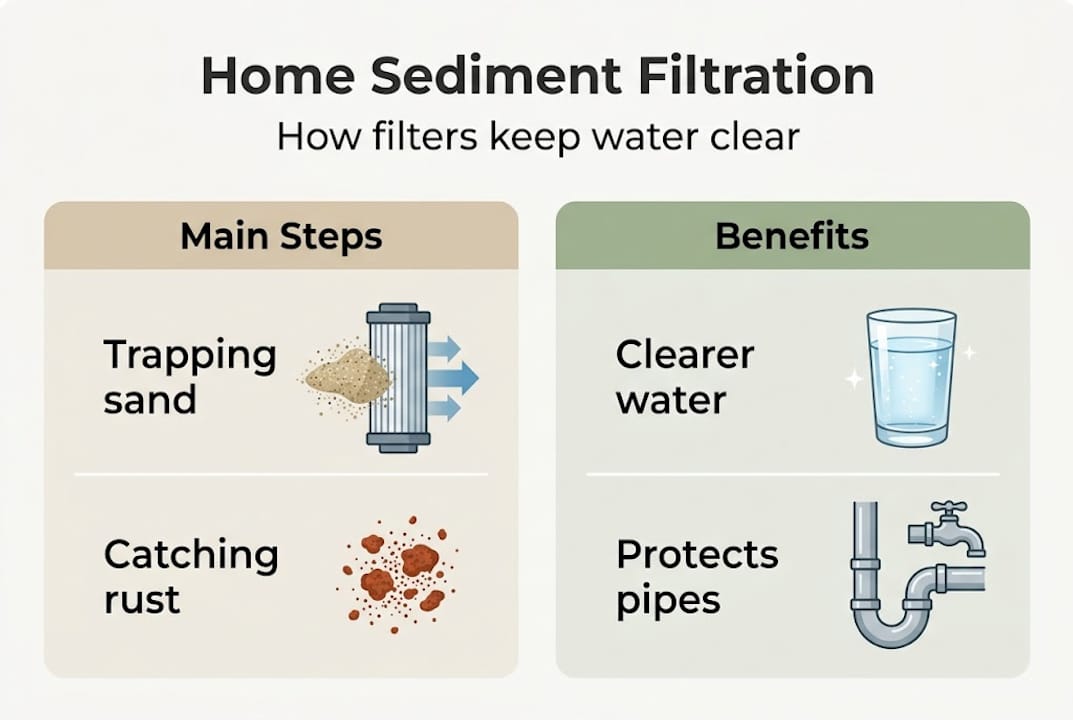
Sediment filtration is exactly what the name suggests. It is a physical process that removes solid particles suspended in water by passing that water through a porous filter medium. Think of it like a very fine mesh strainer, except instead of catching pasta, it catches rust flakes, sand grains, silt, and other visible or near-visible debris floating in your tap water.
The key concept here is the micron rating. A micron is one millionth of a meter, and the micron rating of a filter tells you the smallest particle size that filter will reliably trap. Sediment filters capture particles based on pore size so water passes through freely while anything larger than those pores gets blocked and held inside the filter media. A 50-micron filter removes large sand particles but lets finer silt pass through. A 1-micron filter is far more selective and captures much smaller debris.
Here is a quick look at the types of particles sediment filters typically remove:
- Sand and grit: Common in well water and older municipal systems, these are among the largest particles and the easiest to trap
- Silt and clay: Finer particles that give water a cloudy or brownish color
- Rust and scale: Come from corroding iron pipes, especially in homes with older plumbing
- Organic debris: Leaves, algae fragments, and decaying organic material from surface water sources
- Sediment from hot water heaters: Mineral buildup that breaks loose and flows through household pipes
Each of these particles does real damage if left unchecked. Rust particles stain your laundry and dishes. Sand and grit wear out appliance seals and valves faster. Silt builds up in water heaters and reduces their efficiency significantly over time.
“Cloudiness in water almost always signals a particle problem. A good sediment filter is the first line of defense, but it only attacks particles, not chemistry or biology.”
Getting your water filtration setup right from the start means choosing a sediment filter that matches what is actually in your water, not just the most affordable option on the shelf.
Pro Tip: If your water comes from a private well, have it tested for turbidity (the technical term for cloudiness caused by suspended particles) before buying any filter. The test results will tell you which micron rating you actually need, which prevents you from overspending on a fine filter when a coarser one would do the job just fine.
How sediment filtration fits into home water purification
Understanding sediment filtration makes it easier to see where it fits in a complete home water treatment solution. The short answer is this: sediment filtration almost always comes first.
In a multi-stage purification system, the sequence of treatment stages matters as much as the stages themselves. If you run water with heavy sediment through an activated carbon filter or a reverse osmosis membrane before removing the particles, those expensive downstream components clog up fast and wear out prematurely. Sediment filtration acts as the guardian of every stage that follows it.
Here is how a typical multi-stage home water purification system is organized:
- Sediment pre-filter: Removes large physical particles like sand, rust, and silt
- Activated carbon filter: Removes chlorine, chloramines, volatile organic compounds (VOCs), and taste-and-odor compounds
- Ultrafiltration or reverse osmosis membrane: Removes dissolved solids, heavy metals, and very fine contaminants
- Post-carbon polishing filter: Final taste and odor refinement before drinking
- UV sterilization stage (in premium systems): Kills any surviving bacteria, viruses, and other microorganisms
Each stage targets a different category of contamination. Sediment filtration handles the physical. Carbon handles chemicals. Membranes handle dissolved solids. UV handles biology. You can see why skipping or misplacing any one stage causes problems.
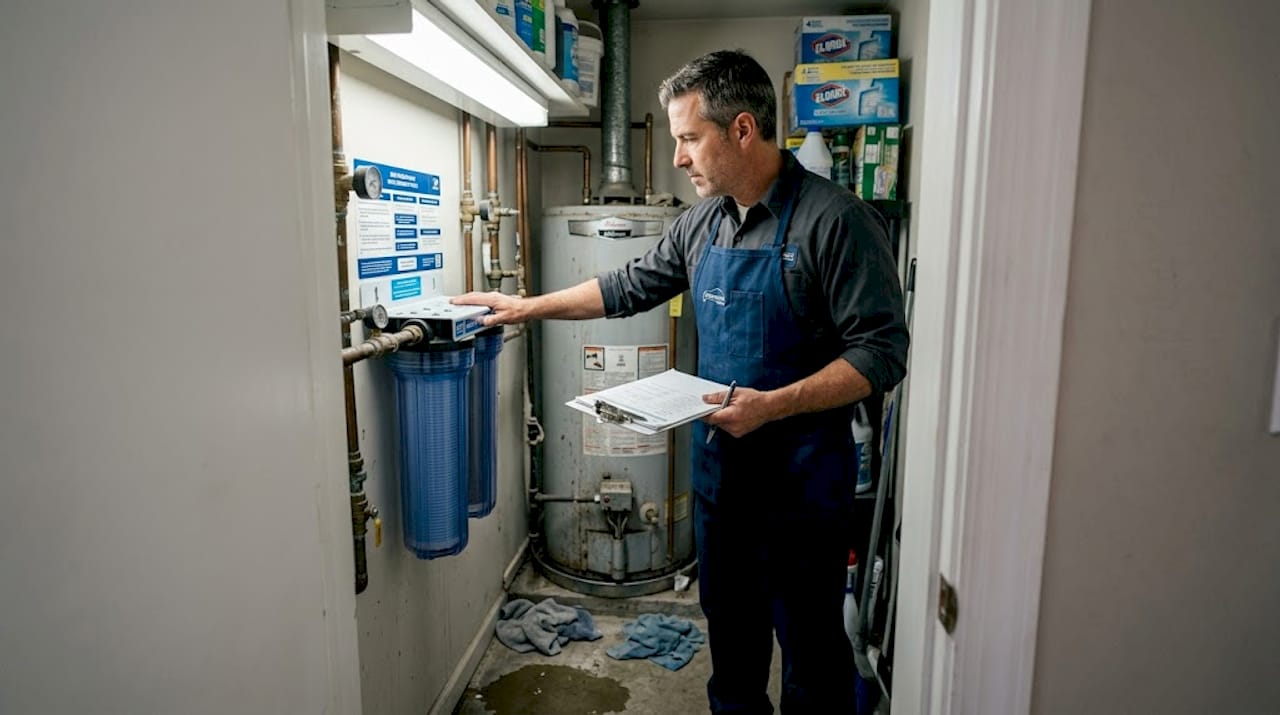
A critical point that many homeowners miss: large particles can be removed by sedimentation, but cloudiness from small suspended or dissolved substances may require coagulation plus filtration, and many microorganisms still require an additional disinfection step. In practical terms, a sediment filter alone will not make your water biologically safe, even if it looks crystal clear after filtering.
| Purification stage | What it removes | Handles biology? |
|---|---|---|
| Sediment filter | Sand, rust, silt, debris | No |
| Activated carbon | Chlorine, VOCs, odors | Partially (some cysts) |
| Reverse osmosis | Heavy metals, dissolved solids | Limited |
| UV sterilization | Bacteria, viruses, protozoa | Yes |
Following a solid home water filtration checklist helps you verify that all necessary filtration stages are in place and working in the right order. Skipping any step based on assumptions about your local water supply is a common and costly mistake.
Choosing the right sediment filter: Key factors for families
After understanding where sediment filtration fits in the process, it is important to know how to select the right filter for your specific needs. The market offers several distinct types, and the wrong choice means either wasting money or getting inadequate filtration.
Main types of sediment filters for homes:
- Spun polypropylene filters: Made by spinning polypropylene fibers around a core; they offer good depth filtration and are affordable, with ratings from 1 to 100 microns
- Pleated polyester filters: Washable and reusable, with a large surface area; ideal for higher-flow households but generally limited to coarser filtration (5 to 50 microns)
- String-wound filters: Layered cotton or polyester thread wound tightly around a core; excellent for gradual sediment loading across multiple particle sizes
- Melt-blown polypropylene filters: Uniform pore structure with no fiber migration; strong performers in fine filtration applications down to 1 micron or less
Micron rating selection is where most families go wrong. The pore size determines effectiveness for each filter, and choosing too fine a rating for heavily sediment-laden water means your filter clogs in days rather than months. Choosing too coarse a rating means fine particles pass straight through and damage downstream components.
| Filter type | Micron range | Best use case | Reusable? |
|---|---|---|---|
| Spun polypropylene | 1 to 100 | General whole-house pre-filtration | No |
| Pleated polyester | 5 to 50 | Higher flow, moderate sediment | Yes |
| String-wound | 1 to 75 | Mixed particle sizes, well water | No |
| Melt-blown polypropylene | 0.5 to 50 | Fine filtration, RO pre-filter | No |
Key factors to weigh when choosing a filter for your household include your water source (municipal versus well), the average turbidity of your incoming water, your household’s daily water usage volume, and how often you are willing to perform maintenance. A busy family of five needs a higher-capacity filter than a couple in a small apartment.
Understanding your specific water quality parameters before purchasing saves both time and money in the long run. A simple water test kit or a professional test report gives you the data to match a filter precisely to your situation.
If you want to go beyond basic sediment removal, exploring a microfiltration guide or learning about nano filtration removal options can help you understand the next tier of filtration technology available for home use.
Pro Tip: Start with a 5-micron sediment filter as a good middle-ground choice for most homes on municipal water. If you find it clogs quickly, step up to a 20-micron filter and add a 5-micron filter downstream of it. This two-filter approach extends overall filter life dramatically.
Maintenance, common pitfalls, and optimization
Once you’ve chosen a filter, ongoing care will help you get the best results and avoid unnecessary issues. Sediment filters are low-maintenance compared to most appliances, but they are not zero-maintenance. Ignoring them defeats the entire purpose of having a filtration system.
Routine maintenance comes down to monitoring and timely replacement. Most standard sediment filter cartridges need replacement every three to six months, though this varies significantly based on incoming water quality. A household with high iron and rust content may need monthly replacements. The clearest sign that a filter needs attention is a drop in water pressure throughout your home.
Common mistakes homeowners make with sediment filters include:
- Running the filter too long past its service life: A clogged filter can rupture, releasing trapped particles back into the water supply
- Choosing the wrong housing size: Undersized filter housings restrict flow and reduce water pressure dramatically
- Skipping the pre-filter when installing an RO system: This single mistake dramatically shortens the life of a reverse osmosis membrane
- Not turning off water before cartridge changes: Even experienced homeowners forget this step and end up with a flooded cabinet
- Assuming clear water means the filter is working well: Clear water after filtration is correct, but you need to track pressure drop, not just water appearance
How to optimize your sediment filter’s lifespan:
- Install a whole-house pre-filter before point-of-use filters to reduce the load on finer cartridges
- Track your replacement dates in a calendar or phone reminder app
- Check your water pressure monthly using an inexpensive gauge from a hardware store
- Use food-safe silicone grease on filter housing O-rings during cartridge changes to prevent leaks
- Keep one spare cartridge on hand so you never have a gap in filtration coverage
Learning about DIY purification methods can also help you handle basic maintenance tasks with confidence. Understanding filtration efficiency ratings lets you compare replacement cartridges accurately and avoid counterfeit or substandard products sold online.
One area often overlooked is the microbiological risk in water systems that can actually worsen when a sediment filter sits unchanged for too long. A saturated filter becomes a breeding ground for bacteria, which is the opposite of what you installed it to achieve.
Pro Tip: If your filter housing has a flush valve, use it every two to four weeks to purge trapped sediment without replacing the cartridge. This simple step can extend cartridge life by 30 to 50 percent in moderate-sediment water conditions.
The overlooked truth about sediment filtration in home water safety
Here is something we wish more families understood before spending money on water treatment: sediment filtration is powerful, but it is frequently given too much credit for doing things it physically cannot do.
We see this pattern often. A family installs a sediment filter, the water looks noticeably clearer, and they conclude their water is now safe. That conclusion feels logical but carries real risk. Clear water is not the same as safe water. Many microorganisms require a second disinfection step even after thorough filtration, and dissolved chemical contaminants like nitrates, lead, and PFAS compounds pass through sediment filters completely unchallenged.
Sediment filtration is genuinely foundational. Without it, the rest of your system suffers. But treating it as the whole solution rather than the first step creates a false sense of security that can harm your family’s health over time.
The most effective approach is a layered one. Work through a complete home filtration checklist to make sure every relevant contamination category is addressed. Do not let the simplicity of sediment filtration lead you to underestimate the complexity of comprehensive water safety.
Explore advanced solutions for home water filtration
For those ready to transform their water quality, the right tools and guidance make the transition straightforward. If this article clarified how sediment filtration works and where it fits, the logical next step is understanding the full water purification process explained in complete detail.
Coway’s lineup of filtration products is built around multi-stage purification that starts with sediment removal and extends through carbon filtration, ultrafiltration, and UV sterilization. The countertop ice water purifier is a standout option for families wanting advanced filtration without a complex installation. Browse the full range of countertop water purifiers to find the system that matches your household’s specific needs. Every unit ships with free delivery and professional installation.
Frequently asked questions
What types of particles does sediment filtration remove from home water?
Sediment filters remove suspended solids like sand, silt, rust, and dirt based on particle size; the filter pore rating determines the smallest particle that gets trapped.
Does sediment filtration make water safe from bacteria and viruses?
No; sediment filters do not reliably remove bacteria or viruses, and many microorganisms require an additional disinfection method like UV treatment for proper microbiological safety.
How do I know which sediment filter to choose for my home?
Select based on your water source, incoming sediment levels, and the filter’s micron rating; a professional water test gives you the clearest guidance for making the right choice.
Can sediment filters be used alone for drinking water?
Sediment filters improve water clarity but should never be the sole treatment method; pairing them with carbon filtration and disinfection steps is essential for genuinely safe drinking water.
What is micron rating and why is it important?
Micron rating defines the size of particles a filter can capture; a lower rating means a finer filter that blocks smaller particles, and pore size determines how thoroughly the filter performs across different water conditions.
Recommended
- Smart Filtration Explained: How Smart Water Systems Protect Your Home – Coway Water Purifier
- Complete Water Filtration Process Guide for Homeowners – Coway Water Purifier
- Advanced Filtration Technology: Cleaner Home Wellness – Coway Water Purifier
- Advanced Water Filtration Guide for Healthier Homes – Coway Water Purifier
