
Uncategorized
How to Select the Right Air Purifier for a Healthier Home
Apr
TL;DR:
- Properly sized HEPA air purifiers effectively remove airborne particles like dust, allergens, and viruses.
- Placement, continuous operation, and maintenance are critical for maximizing purifier performance and health benefits.
- Focus on proven filtration technology and correct sizing rather than expensive features like ionizers or ozone generators.
The air inside your home can be two to five times more polluted than outdoor air, and most families never realize it. Dust mites, pet dander, smoke particles, mold spores, and even viruses circulate through your rooms invisibly, triggering allergies, disrupting sleep, and stressing respiratory systems. Choosing an air purifier sounds straightforward until you face a wall of technical specs, competing certifications, and marketing buzzwords. This guide cuts through the noise, giving you a clear, practical framework to evaluate, size, and choose an air purifier that genuinely protects your family’s health.
Table of Contents
- Understanding air purifier basics and your air quality needs
- Sizing your air purifier: Understanding CADR and room coverage
- Essential features: Filtration, safety, and maintenance
- Placement, usage, and maximizing purification benefits
- Evaluating effectiveness: Results, monitoring, and next steps
- A smarter way to shop: What most guides miss about air purifier selection
- Ready for cleaner air? Explore expert-approved solutions
- Frequently asked questions
Key Takeaways
| Point | Details |
|---|---|
| Right sizing is essential | A correctly sized air purifier based on CADR and room size is crucial for effective air cleaning. |
| Choose safe filtration | Always select HEPA-based purifiers and avoid those that emit ozone for maximum health benefits. |
| Placement and continuous use | Placing your purifier correctly and running it consistently maximizes clean air in your home. |
| Monitor and verify results | Check for reduced dust and symptoms to confirm your purifier is working as intended. |
Understanding air purifier basics and your air quality needs
Air purifiers have surged in popularity, and for good reason. But before you buy one, you need to know exactly what problem you’re solving. Indoor air carries a surprising mix of pollutants, and different purifiers tackle different threats.
Common indoor pollutants include:
- Dust and dust mites (settle on surfaces but also float in air)
- Pet dander (tiny protein flakes from skin, fur, and saliva)
- Pollen (seasonal, enters through windows and clothing)
- Smoke particles (from wildfire events, cooking, or tobacco)
- Mold spores (thrive in humid spaces like bathrooms and basements)
- Viruses and bacteria (submicron particles requiring high-grade filtration)
Knowing your specific concern shapes every decision that follows. A family with asthma needs different specs than a household dealing with wildfire smoke season.
The gold standard for particle removal is the True HEPA filter (High Efficiency Particulate Air). A certified True HEPA filter captures 99.97% of particles as small as 0.3 microns, which covers dust, pollen, dander, mold, and many viruses. Activated carbon layers handle odors and gases, but they won’t trap particles on their own.
One critical point most sellers skip: air purifiers supplement but cannot replace ventilation and source control. Removing the source of pollution (like a leaking HVAC system or a pet sleeping on furniture) always comes first. Purifiers then handle what remains airborne. They’re most powerful for particles under 1 micron, like viruses and fine smoke, when paired with HEPA filtration and a strong smoke CADR rating.
Start by identifying your primary concern. Are you dealing with seasonal allergies? Wildfire smoke? A new baby in the house? Your answer determines the filter type and power level you actually need. You can learn more about starting points for healthy home air quality before comparing specific models.
Pro Tip: Before purchasing, spend one week noting when allergy symptoms are worst (morning vs. evening, certain rooms vs. others). That data tells you where to prioritize your first purifier placement.
Sizing your air purifier: Understanding CADR and room coverage
Once you understand your air quality needs, it’s time to match purifiers to your actual living spaces. The single most important spec for sizing is CADR, or Clean Air Delivery Rate.
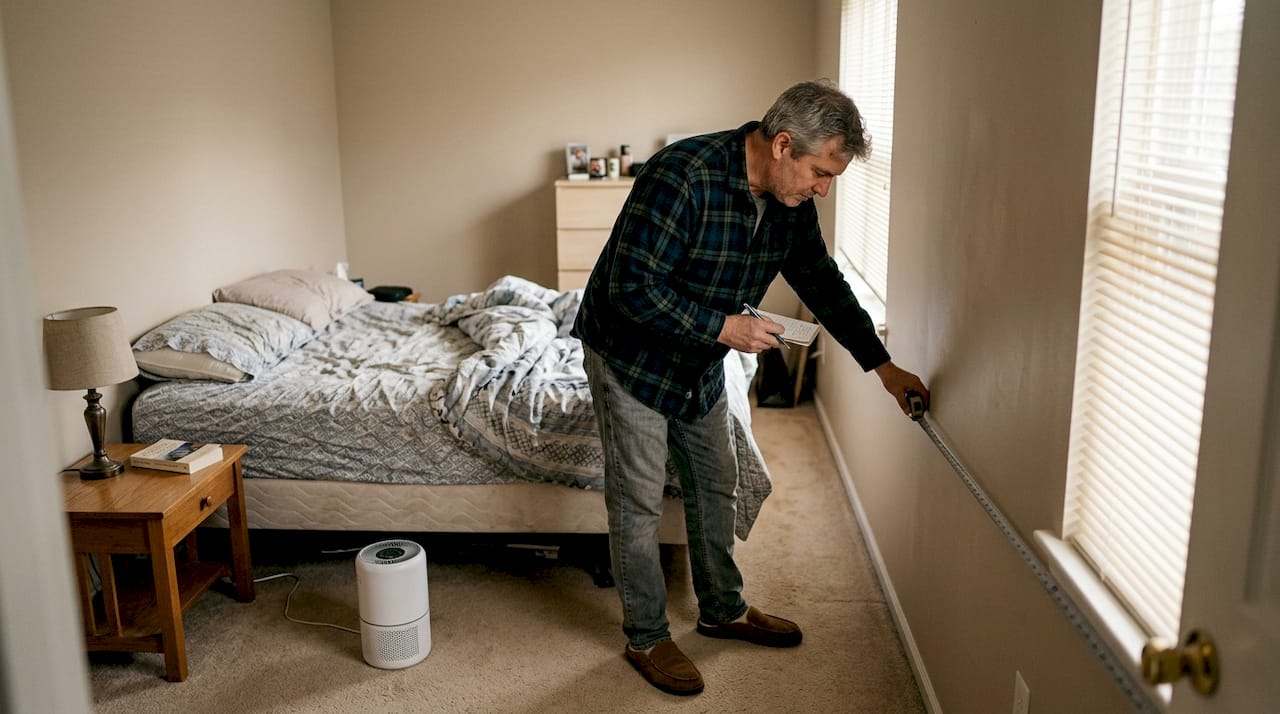
CADR measures how quickly a purifier delivers clean, filtered air into a room, expressed in cubic feet per minute (CFM). It’s tested across three pollutant types: smoke, dust, and pollen. Smoke CADR is the most critical because smoke particles are the smallest and hardest to capture.
Here’s the sizing formula recommended by the EPA:
- Measure your room’s square footage (length x width).
- Multiply by 0.66 (two-thirds).
- That result is your minimum smoke CADR.
For example, a 300 sq ft living room needs at least a smoke CADR of 200. A 450 sq ft open-plan space needs 300 or higher. The EPA recommends targeting 4 to 5 air changes per hour (ACH) for effective particle removal, and a properly sized CADR achieves this consistently.
For allergy sufferers or households in wildfire-prone regions, go above the minimum. Aim for a CADR that’s roughly equal to your room’s square footage, not just two-thirds of it.
| Room size | Minimum smoke CADR | Recommended CADR (allergy/smoke) |
|---|---|---|
| 150 sq ft (bedroom) | 100 | 150+ |
| 300 sq ft (living room) | 200 | 300+ |
| 450 sq ft (open plan) | 300 | 450+ |
| 600 sq ft (large space) | 400 | 600+ |
ACH also varies by use case. Bedrooms benefit most from 4+ ACH during sleep hours, while living areas with higher activity may need 5 or more to stay ahead of fresh pollutants entering the space.
Third-party resources like real-world performance tests confirm that many purifiers underperform at low fan speeds despite impressive spec sheet numbers. Always check tested CADR at multiple fan settings, not just maximum speed. Our detailed air purifier selection resource breaks this down model by model.
Essential features: Filtration, safety, and maintenance
Matching size is crucial, but choosing the right features can make or break overall effectiveness and safety for your family.
Filtration technology is the core of any purifier. True HEPA is non-negotiable for particle removal. Beyond HEPA, an activated carbon layer handles volatile organic compounds (VOCs) and odors from cooking, cleaning products, and off-gassing furniture. You can explore must-have features in detail before narrowing your choices.
Here’s where many buyers go wrong: they choose purifiers with ionizers, ozone generators, or UV-C lights as the primary filtration method. Ionizers and ozone generators produce ozone as a byproduct, a known lung irritant that worsens asthma and can damage airways. The EPA explicitly warns against purchasing any device that emits ozone, even in small amounts, for home use.
“The safest air purifier for your home uses certified True HEPA mechanical filtration as its core technology, with no ozone-producing add-ons.”
Here’s a quick comparison to guide your decision:
| Technology | Effective for particles | Ozone risk | Recommended |
|---|---|---|---|
| True HEPA filter | Yes | None | Yes |
| Activated carbon | Gases/odors only | None | Yes (combined) |
| Ionizer (standalone) | Partial | High | No |
| UV-C light (standalone) | No | Moderate | No |
| Ozone generator | No | Very high | Never |
Maintenance is a real cost that’s easy to overlook. Most HEPA filters need replacement every 6 to 12 months, costing between $30 and $80 depending on the model. Carbon filters may need changing every 3 to 6 months. Factor this into your total annual budget, not just the upfront price.
Other features worth checking:
- Auto mode with air quality sensors (adjusts fan speed automatically)
- Low noise output (especially for bedroom units, ideally under 35 dB on low)
- Filter replacement indicators (so you never miss a change)
- Energy efficiency rating (look for Energy Star certified models)
For households managing allergies, understanding how filtration supports removing allergens at home can help you prioritize the right filter combination.
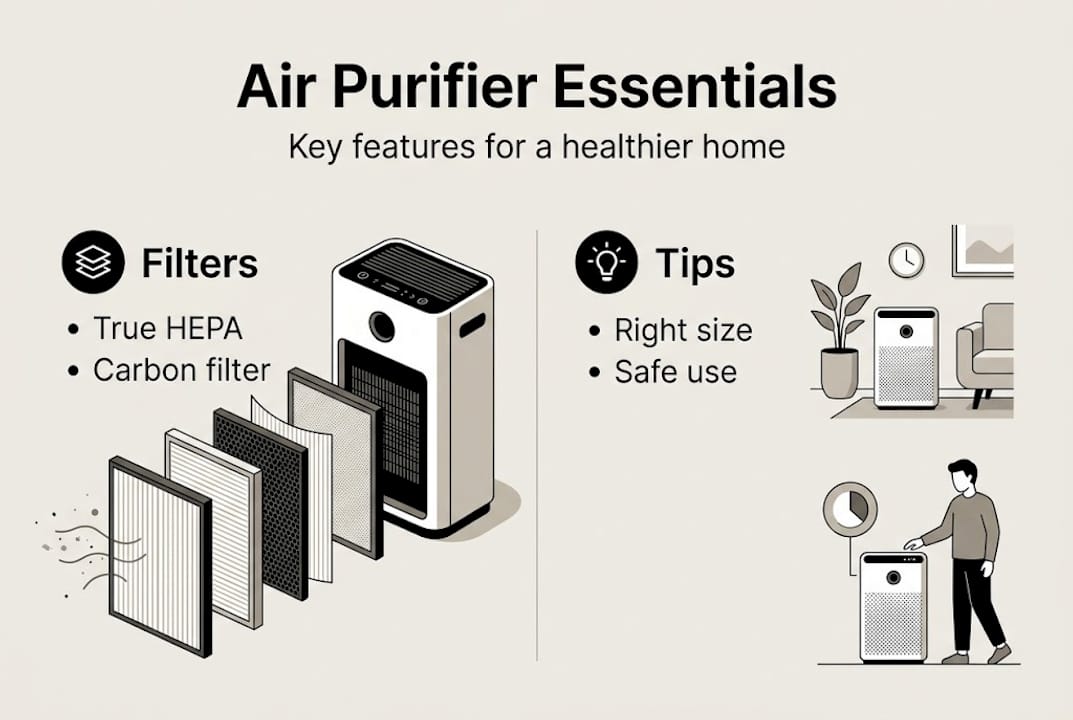
Pro Tip: When comparing purifier costs, calculate the 3-year total cost of ownership: purchase price plus 3 years of filter replacements. A cheaper unit with expensive filters often costs more long-term.
Placement, usage, and maximizing purification benefits
Even the best purifier needs to be set up and used properly to make a real difference in your indoor air. Placement and operating habits are where most households leave significant performance on the table.
Follow these steps for optimal results:
- Place it centrally in the room. Avoid corners and closets. The unit needs open airflow on all sides.
- Keep it 6 to 12 inches from walls and furniture. Restricted intake dramatically reduces efficiency.
- Run it continuously on auto or high mode. Occasional use barely makes a dent. The EPA’s combined strategy calls for running purifiers continuously alongside ventilation and source control for meaningful air quality improvement.
- Prioritize the room where you spend the most time. For most families, that’s the bedroom, especially overnight when respiratory exposure is highest.
- Don’t place it near pollution sources. A purifier next to a litter box or cooking stove will burn through its filter faster and may not handle peak pollution spikes.
“Running your purifier only when you notice dust is like wearing a seatbelt only when you think an accident is coming. Consistent use is what delivers health results.”
Integrate your purifier with other strategies. Open windows during low-pollution hours to refresh the air, use exhaust fans while cooking, and control indoor humidity between 30 to 50% to prevent mold growth. Air purifiers work best as part of a broader home air purification routine, not as a standalone fix.
Common mistakes to avoid: running on the lowest fan speed all the time, blocking the unit with curtains or furniture, and forgetting to close windows during wildfire smoke events. Each of these reduces performance significantly. For allergen-specific strategies, see how purifiers support allergen removal with air purifiers across different room types.
Pro Tip: Use your purifier’s built-in air quality indicator as a daily health check. If it consistently reads poor air quality despite running, it’s a signal to investigate a pollution source like HVAC mold, a gas leak, or a ventilation issue.
Evaluating effectiveness: Results, monitoring, and next steps
Once your air purifier is up and running, monitoring results keeps your air and investment working at their best. Improvement can be subtle at first, but there are concrete signs to watch for.
Signs your purifier is working:
- Less visible dust settling on furniture and surfaces
- Reduced morning allergy symptoms (congestion, itchy eyes)
- Fewer asthma flare-ups or coughing episodes at night
- Improved sleep quality, especially for children
- Air quality sensor shows consistent green or good readings
For a more data-driven view, track your symptoms weekly for the first month. Simple journaling works. Note which days feel better and correlate them with fan settings, room location, and outdoor conditions.
Manufacturer claims often reflect lab conditions at maximum fan speed. Third-party tests offer more reliable benchmarks. For example, Wirecutter’s lab tests specifically emphasize low-speed performance and long-term reliability, with models like the Coway Mighty consistently rated for clearing rooms quickly and quietly. Those results match what everyday users report under real home conditions.
| Performance indicator | What to look for | Red flag |
|---|---|---|
| Dust on surfaces | Significantly less after 2 weeks | No change after 1 month |
| Allergy symptoms | Noticeable reduction in 2 to 4 weeks | Same or worsening symptoms |
| Air quality sensor | Mostly green/good readings | Frequent poor readings |
| Filter condition | Light gray after 3 months | Black or clogged within 6 weeks |
If results are disappointing, troubleshoot before assuming the unit is faulty. Check filter installation, confirm the room CADR match, and look for nearby pollution sources. Consider whether you need a second unit for an additional room rather than upgrading a single model.
For allergy-specific guidance, reviewing allergy symptom relief strategies can help you refine your approach. And if you want to streamline your process with a quick checklist, these selection workflow tips make it faster to identify the right upgrade path.
A smarter way to shop: What most guides miss about air purifier selection
Here’s the uncomfortable truth: most people buying air purifiers in 2026 are paying a premium for features that don’t improve the air they breathe. Ionizer modes, UV lights, smart app integrations, and sleek design often command a 30 to 50% price increase over a well-built HEPA unit with strong CADR ratings.
We’ve seen it repeatedly: buyers choose a top-tier model, run it on low speed to keep noise down, place it in a corner, and wonder why their allergies persist. Meanwhile, a properly-sized, mid-range unit run consistently on auto mode in a central location outperforms the expensive one in every measurable way.
The science is clear. Proven mechanical HEPA filtration, correct sizing, and consistent daily use are the three factors that actually move the needle on indoor air quality. Everything else is secondary. Check science-backed purifier recommendations if you want models that pass this test without the inflated price tag.
Buy for performance fundamentals. Run it properly. Replace filters on schedule. That approach beats chasing premium features every single time.
Ready for cleaner air? Explore expert-approved solutions
You now have the framework to shop with confidence: the right filtration technology, correct CADR sizing, safe feature selection, proper placement, and a clear way to verify results. The next step is finding a purifier that checks every box without compromise.
At Coway, we back our air purifiers with transparent specs, real filtration technology, and no ozone-producing gimmicks. Browse our comprehensive selection guide to match models to your room and health goals, or go straight to our Coway air purifier collection to compare options side by side. If you want a hands-on walkthrough before deciding, our step-by-step air purification checklist walks you through every decision from room sizing to filter schedules.
Frequently asked questions
How do I calculate the right CADR for my room?
Multiply your room’s square footage by 0.66 to get your minimum smoke CADR. A 300 sq ft room needs at least a smoke CADR of 200, per EPA guidelines.
Are air purifiers with ionizers or ozone safe?
No. Ozone-emitting devices irritate the lungs, worsen asthma, and are specifically warned against by the EPA for home use.
Where should I place my air purifier for the best results?
Place it centrally in the room, 6 to 12 inches from walls, free from furniture or curtain obstructions, and run it continuously on auto or high mode.
How can I tell if my air purifier is actually working?
Reduced dust accumulation, fewer allergy symptoms, and consistent green readings on your air quality sensor are all strong indicators of solid performance. Third-party testing results also confirm reliable models that deliver these results.
Do air purifiers eliminate all indoor pollutants?
No. They excel at capturing airborne particles but cannot replace source control and ventilation, which remain essential parts of a complete indoor air quality strategy.
Recommended
- How to Select Air Purifier for Healthy Home Air Quality – Coway Water Purifier
- Streamline Air Purifier Selection Workflow for a Healthier Home – Coway Water Purifier
- Best air purifier 2026: health-focused selection guide – Coway Water Purifier
- Why Inspect HVAC Filters for Healthier Homes
