
Uncategorized
Filtration Boosts Staff Wellness: 45% Less PM2.5
Apr
TL;DR:
- Workplace filtration addresses invisible indoor air and water contaminants that impact staff health.
- MERV13+ filters, HEPA, activated carbon, and UV-C are key technologies for effective filtration.
- Monitoring and maintenance of filtration systems ensure measurable health and productivity benefits.
Most workplace wellness programs put their budget into standing desks, mindfulness apps, and catered lunches. These perks are visible, easy to photograph, and satisfying to announce. What they rarely address are the invisible threats circulating through the HVAC ducts and coming out of the break room tap. Research confirms that air purifiers cut PM2.5 by 45% and PM10 by 53% across work shifts, yet most HR leaders have never seen those numbers in a wellness proposal. This guide cuts through the noise and gives you a practical, evidence-backed framework for using air and water filtration to drive real, measurable improvements in staff health and productivity.
Table of Contents
- Why filtration matters for workplace wellness
- How air and water filtration solutions work
- Tailoring filtration strategies to specific workplaces
- Measuring, maintaining, and maximizing return on filtration
- A smarter approach to staff wellness: what most programs miss
- Next steps: Enhance your workplace wellness with filtration
- Frequently asked questions
Key Takeaways
| Point | Details |
|---|---|
| Filtration is essential | Both air and water filtration are critical for reducing workplace health risks and promoting staff productivity. |
| Tailored solutions work best | Every workplace should match filtration technologies and practices to its specific risk factors and staff needs. |
| Evidence supports action | Research shows filtration systems can cut harmful particles by over 45 percent and support measurable wellness outcomes. |
| Monitor and maintain | Maintaining and monitoring filtration systems ensures ongoing effectiveness and maximizes ROI. |
Why filtration matters for workplace wellness
Airborne and waterborne contaminants are not dramatic, visible hazards. They accumulate quietly, and their effects show up gradually as increased sick days, lower cognitive scores, and more frequent headaches. That slow burn is exactly why they stay off the wellness radar for so long.
The health risks are well-documented. Poor indoor air quality (IAQ) triggers asthma, respiratory inflammation, and chronic fatigue. Cognitive decline linked to elevated CO2 and fine particulate matter (PM2.5, particles smaller than 2.5 micrometers) has been measured in controlled office studies. On the water side, contaminants ranging from heavy metals to microbial pathogens contribute to gastrointestinal illness and undermine the hydration staff needs to stay focused and energized throughout the day.
“The EPA recommends combining source control, enhanced ventilation, and air cleaners with MERV13+ filtration as a layered strategy to reduce health risks including asthma and headaches in indoor environments.”
MERV (Minimum Efficiency Reporting Value) is a standardized filter rating. MERV13 captures particles as small as 0.3 to 1 micron, which covers most bacteria, smoke, and fine dust. That rating is the floor recommended by the EPA for most occupied buildings.
Maintaining healthy office air quality is not just a facilities management concern. It belongs squarely in your wellness strategy. Understanding air purifiers in businesses shows that organizations with clean air report measurably lower absenteeism and higher staff satisfaction scores.
Common hidden pollution sources in workplaces include:
- Laser printers and photocopiers releasing ultrafine toner particles
- HVAC systems distributing mold spores, dust mites, and dander
- Off-gassing from carpets, paint, and furniture (volatile organic compounds)
- Plumbing systems with aging pipes introducing lead or chlorine byproducts
- External air infiltration carrying wildfire smoke, pollen, and vehicle exhaust
- Cleaning products releasing aerosolized chemical irritants
With the importance of air and water quality clear, it’s vital to examine exactly how filtration works in workplaces.
How air and water filtration solutions work
Understanding the technology behind filtration helps you evaluate vendor claims and make informed purchasing decisions. The core mechanisms are straightforward once you strip away the marketing language.
Air filtration technologies:
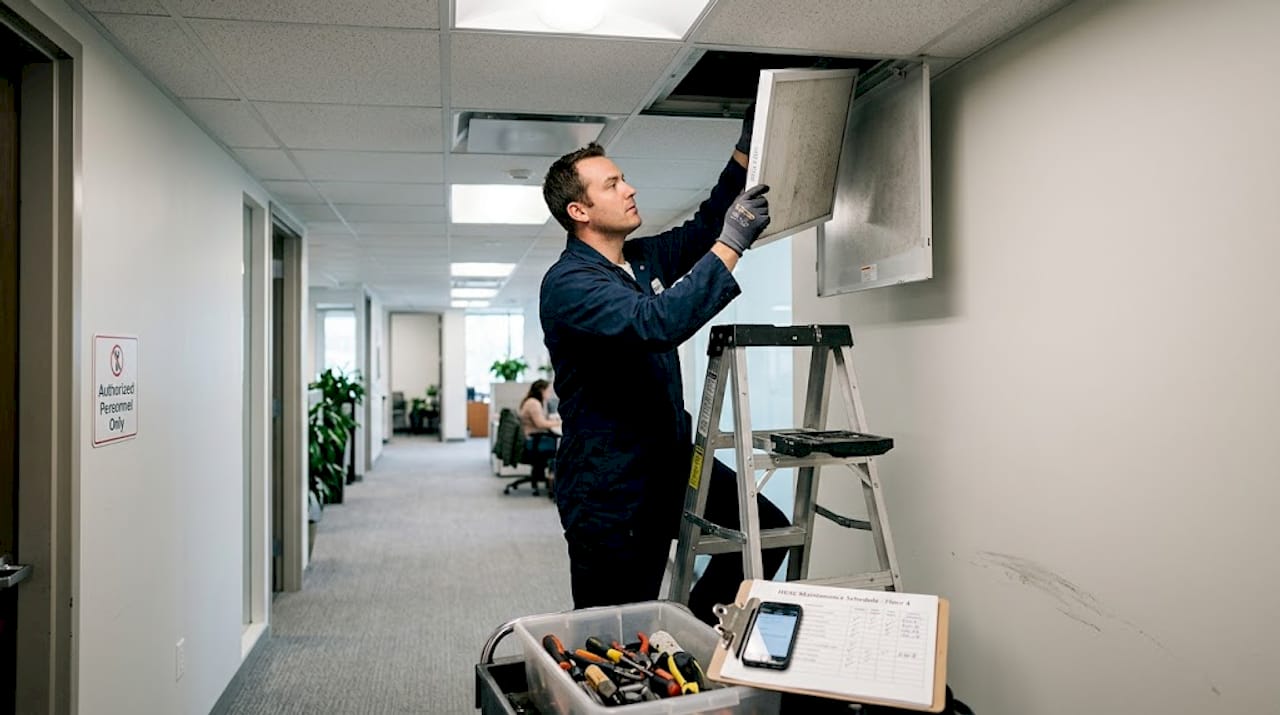
HEPA (High Efficiency Particulate Air) filters capture 99.97% of particles at 0.3 micrometers, making them the gold standard for sensitive environments. MERV13+ filters are less dense but more compatible with most HVAC systems, offering strong protection without restricting airflow enough to damage equipment. Activated carbon layers adsorb gases and odors, including volatile organic compounds that HEPA alone cannot trap. UV-C light chambers neutralize biological contaminants like bacteria and mold spores that pass through filtration stages. Air filtration traps particles and aerosols through a combination of these methods, whether deployed as HVAC upgrades, portable purifiers, or continuous fan operation.
Water filtration technologies:
Sediment filters remove large particles like rust, sand, and silt. Activated carbon stages then reduce chlorine, pesticides, and organic compounds that affect taste and safety. Multi-stage systems combine these with ion exchange resins or reverse osmosis membranes to strip heavy metals and dissolved solids. UV-C treatment at the point of use eliminates residual microbial contamination. For improving office air quality and water quality simultaneously, pairing a certified air purifier with a point-of-use water filter addresses the two most overlooked wellness variables in one program.
| Technology | Application | Key benefit | Limitation |
|---|---|---|---|
| HEPA filter | Air | Captures 99.97% particles at 0.3um | Not suited for all HVAC systems |
| MERV13+ | Air (HVAC) | Broad particle removal, system-compatible | Less effective on gases/odors |
| Activated carbon | Air and water | Removes gases, VOCs, chlorine, odors | Requires periodic replacement |
| UV-C light | Air and water | Neutralizes biological contaminants | Does not remove particles |
| Multi-stage reverse osmosis | Water | Removes dissolved solids and metals | Higher upfront cost, slower flow |
A typical workplace filtration setup follows these steps:
- Audit current HVAC filter ratings and replace with MERV13+ at minimum
- Install certified portable air purifiers in high-occupancy zones
- Add point-of-use water filtration at kitchen and break room taps
- Schedule filter replacement cycles and log service dates
- Measure baseline PM2.5, CO2, and water quality before and after installation
Pro Tip: Monitor CO2 and PM2.5 levels with low-cost sensors placed at desk height. This gives you real data to evaluate whether your system is performing, and it builds credibility with leadership when reporting wellness outcomes. Integrating these sensors with your boost workplace hydration program creates a complete baseline for staff health tracking.
Tailoring filtration strategies to specific workplaces
Since not all workplaces face the same risks, let’s look at how to match filtration solutions to different needs.
A quiet corporate office has different risks than a commercial kitchen, a medical clinic, or a manufacturing floor. Getting filtration right means matching the solution to the actual threat profile, not buying a single product and hoping it covers all cases.
| Workplace type | Primary risk | Recommended air filter | Water filtration priority |
|---|---|---|---|
| Open-plan office | VOCs, CO2, PM2.5 | MERV13+, portable HEPA | Activated carbon point-of-use |
| Commercial kitchen | Grease aerosols, smoke | HEPA with activated carbon | Sediment plus carbon |
| Medical clinic | Biological pathogens | HEPA, UV-C, positive pressure | UV-C multi-stage |
| Manufacturing floor | Industrial particulates | MERV15+ or industrial HEPA | Sediment, reverse osmosis |
| Wildfire-adjacent site | Fine smoke, PM2.5 spike | MERV13+ sealed system, HEPA portable | Standard carbon |
For hospitals and clinics, HEPA filtration combined with positive pressure systems and UV-C treatment meets ASHRAE guidelines for sensitive populations. High-occupancy buildings facing wildfire smoke events need sealed MERV13+ systems that prevent unfiltered air infiltration during peak smoke hours.
For air optimization best practices in heat-exposed environments like outdoor worksites or hot kitchens, water filtration becomes even more critical because dehydration risk rises sharply. At those sites, hydration for staff wellness should incorporate filtered water stations with accessible electrolyte options.
Common mistakes organizations make with filtration programs:
- Under-sizing portable air purifiers relative to room volume (check CADR ratings)
- Installing high-grade filters without verifying HVAC fan capacity to handle the added resistance
- Ignoring airflow monitoring, allowing dead zones where contamination builds up
- Purchasing uncertified products that do not meet ASHRAE or EPA performance standards
- Skipping filter replacement schedules, which can turn filters into contamination sources
Pro Tip: In roles with significant heat exposure, pairing a filtered water station with electrolyte supplements at the point of use is a low-cost, high-impact intervention that goes beyond simple hydration to support actual physiological performance under stress.
Measuring, maintaining, and maximizing return on filtration
To make filtration investments sustainable and effective, organizations must monitor and maintain systems over time.
Installing filtration hardware is the easy part. Sustaining the gains requires discipline around measurement, maintenance, and managing realistic expectations with leadership.
Key performance metrics to track:
- PM2.5 and PM10 concentration levels at workstation height
- CO2 levels as a proxy for ventilation adequacy (target below 1,000 ppm)
- Absenteeism rates by department and building zone
- Staff-reported symptoms via periodic health surveys
- Water quality test results for filtered and unfiltered taps
- Filter replacement logs to ensure maintenance compliance
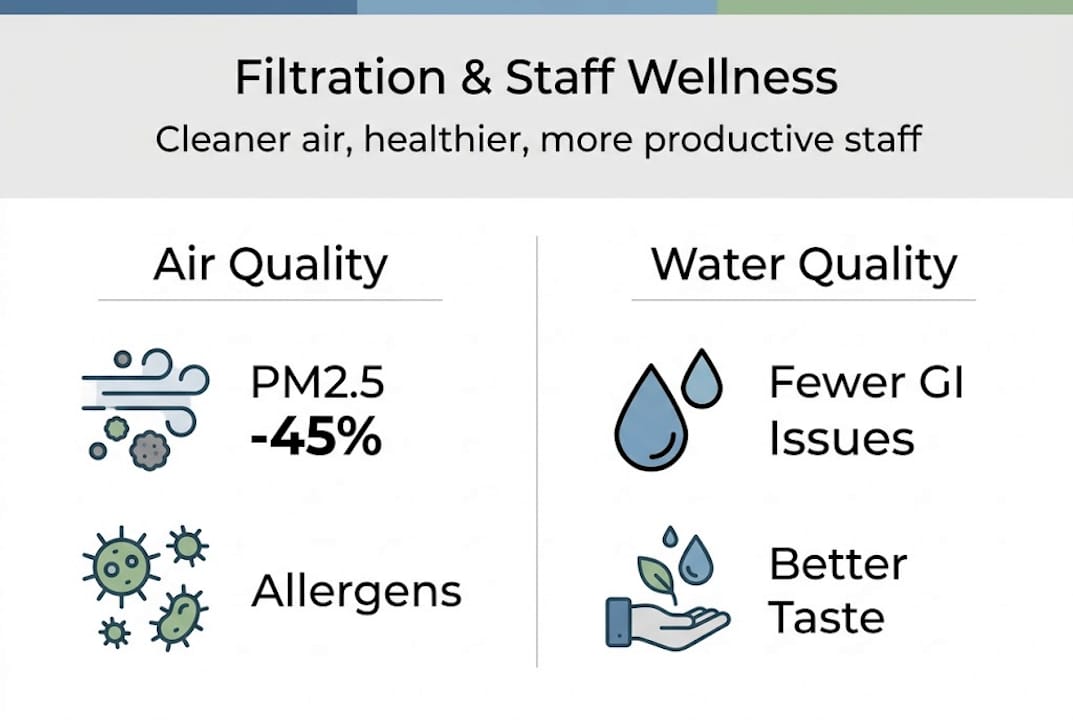
Regular maintenance keeps systems performing at rated efficiency. Follow these steps:
- Replace MERV13+ HVAC filters every 60 to 90 days in occupied buildings
- Service portable air purifiers per manufacturer guidance, typically every 6 to 12 months
- Test point-of-use water filter output quarterly for pH, chlorine, and turbidity
- Log all service events and correlate with sensor readings to identify performance drops
- Conduct annual professional IAQ audits to validate sensor data and catch system gaps
The ROI case is solid. Reduced absenteeism alone can offset filtration costs within the first year for mid-size organizations. Filtration combined with monitored ventilation delivers measurable energy savings without significant performance tradeoffs compared to air conditioning only, reinforcing the financial case for program expansion.
That said, filtration is not a cure-all. Filtration supplements rather than replaces source control and ventilation as EPA’s primary IAQ strategies. If your building has a mold problem or a VOC-emitting renovation happening, filtration buys time but does not fix the root cause.
Real-world obstacles are real. Budget constraints, competing vendor claims, and integration complexity are legitimate barriers. The path through them is to anchor your program to third-party standards from ASHRAE and the EPA, use sensor data to validate claims, and present leadership with understanding indoor air quality resources that translate technical metrics into business outcomes.
A smarter approach to staff wellness: what most programs miss
Most wellness programs measure success by participation rates and employee satisfaction surveys. Those metrics are useful, but they miss the environmental baseline that determines how healthy a workplace actually is before any program intervention begins.
Here is the uncomfortable reality: you can offer unlimited gym memberships and weekly meditation sessions, but if your staff is breathing elevated PM2.5 for eight hours a day, you are working against yourself. No amount of lifestyle programming compensates for chronic low-level pollution exposure.
We find that organizations which treat air and water quality as measurable infrastructure, tracked with the same rigor as occupancy or energy use, achieve more durable wellness outcomes. Using air safety checklists and independent standards over vendor marketing creates accountability that perks-based programs simply cannot. The organizations that get this right stop asking “what wellness programs can we offer?” and start asking “what is the actual quality of the environment our staff works in today?”
Next steps: Enhance your workplace wellness with filtration
If you’re ready to move from insight to action, Coway’s certified air and water purification solutions are built for exactly the kind of evidence-based wellness programs described in this guide. From countertop water purifiers to high-capacity air purifiers with multi-stage filtration, every product is designed to meet the health standards your staff depends on.
Start by reviewing how to understand water purification technology before evaluating solutions, then use Coway’s detailed resource to choose air purifiers matched to your specific workplace profile. Your staff’s health outcomes are measurable. Make filtration the foundation.
Frequently asked questions
What type of air filter is best for office buildings?
MERV13+ filters are recommended by the EPA for most offices because they capture the fine particles and biological contaminants most likely to affect staff health and cognitive performance.
How much can air purifiers reduce particulate exposure for staff?
Deployed correctly, air purifiers reduce PM2.5 by 45% and PM10 by 53% across full work shifts, making them one of the highest-impact interventions available to wellness coordinators.
Why is water filtration important for staff wellness?
Filtered water eliminates contaminants that cause gastrointestinal illness and taste issues that discourage adequate hydration. In heat-exposed roles, electrolyte-rich filtered water is critical to physiological safety, not just comfort.
Do filtration systems replace ventilation and source control?
No. Filtration supplements ventilation and source control rather than replacing them. EPA guidance is clear that filtration works best as a third layer in a complete IAQ strategy, not as a standalone fix.
Recommended
- Filtration’s Role in Family Health: 15% Fewer GI Illnesses – Coway Water Purifier
- Role of Filtration in Health – Why It Matters – Coway Water Purifier
- Advanced Filtration Technology: Cleaner Home Wellness – Coway Water Purifier
- How filtration supports sustainable, healthy homes in 2026 – Coway Water Purifier
- Is Your Home Healthy? Take Your Indoor Air Quality Seriously
