
Uncategorized
Air purifier selection guide for healthier home in 2026
Mar
Choosing the right air purifier feels overwhelming when faced with countless models making bold claims about cleaning your indoor air. Many homeowners struggle to decode technical specs like CADR ratings or determine which filter types actually tackle their specific air quality problems. This guide cuts through the confusion by explaining the practical steps you need to match a purifier to your room size and health goals, ensuring you invest in a solution that delivers measurable improvements to your home’s air quality.
Table of Contents
- Prerequisites: Understanding CADR And Room Size
- Step 1: Assess Indoor Air Problems And Room Size
- Step 2: Core Components: Filter Types And Their Efficacy
- Step 3: Maintenance And Safety Considerations
- Step 4: Common Mistakes To Avoid When Selecting And Using Air Purifiers
- Step 5: Expected Outcomes: Measurable Air Quality Improvements
- Discover Coway’s Air Purification Solutions
Key takeaways
| Point | Details |
|---|---|
| CADR rating must match your room size for effective purification | A purifier with insufficient CADR leaves pollutants circulating and wastes your investment |
| HEPA filters capture 99.97% of tiny airborne particles including allergens and viruses | Essential for removing pet dander, dust mites, pollen, and respiratory droplets |
| Activated carbon filters remove odors and VOCs like smoke and kitchen smells | Critical for households dealing with cooking odors, tobacco smoke, or wildfire impacts |
| Regular filter maintenance preserves purifier performance and safety | Replace filters every 6 to 12 months to prevent reduced airflow and pollutant rerelease |
| Avoid undersized units and neglecting noise levels to ensure user satisfaction | Proper sizing and tolerable sound output encourage consistent use for optimal air quality |
Prerequisites: Understanding CADR and room size
Before choosing an air purifier, you need to understand two foundational concepts that determine whether a unit will actually clean your air effectively. The Clean Air Delivery Rate measures how quickly a purifier removes smoke, dust, and pollen from your indoor environment. The Clean Air Delivery Rate (CADR) provides standardized scores that help you compare models objectively, with typical recommendations of CADR 150 for small rooms under 200 square feet, 260 for medium rooms up to 400 square feet, and 300 plus for larger spaces.
Measuring your room dimensions accurately ensures you select a purifier with adequate capacity. Multiply the length by the width to calculate square footage, then match that number to the purifier’s coverage area listed in the product specifications. For rooms with high ceilings or open floor plans, you may need to calculate volume by including height, which increases the air mass the purifier must process. Selecting the right air purifier starts with this sizing exercise because insufficient CADR leads to poor performance and wasted investment.
Key sizing considerations include:
- Small rooms (under 200 sq ft): CADR 150 cfm minimum
- Medium rooms (200 to 400 sq ft): CADR 260 cfm minimum
- Large spaces (over 400 sq ft): CADR 300+ cfm or multiple units
- Open floor plans: Consider multiple purifiers or commercial-grade models
Understanding various types of home air purifiers helps you recognize how CADR ratings apply across different technologies and price points. Once you grasp these fundamentals, you can assess your specific indoor air challenges and match them to the appropriate purifier capacity.
Step 1: Assess indoor air problems and room size
Identifying your primary air quality challenges guides you toward the right purifier features and filtration technologies. Common indoor pollutants include allergens like pollen and pet dander, smoke from cooking or wildfires, and volatile organic compounds released by furniture, paint, and cleaning products. Each pollutant type requires specific filtration approaches, so pinpointing your main concerns prevents buying a unit that addresses the wrong problems.
Matching your purifier coverage area and CADR rating to your measured room size ensures the unit processes air quickly enough to make a noticeable difference. Using an air purifier with CADR matching room size ensures faster pollutant reduction, with high-quality purifiers clearing 90% of smoke particles within 15 minutes in lab conditions. For open floor plans or rooms larger than 400 square feet, you face a choice between installing multiple smaller units or investing in a single purifier with higher capacity.
Follow this stepwise assessment process:
- Measure your room’s length and width to calculate square footage
- Identify your top three indoor air pollutants based on symptoms or visible issues
- Select a purifier with CADR coverage at least matching your room size
- Consider air exchange rates: aim for at least 4 to 5 complete air changes per hour
Proper sizing dramatically impacts how quickly you notice air quality improvements. A correctly sized unit running at medium speed often outperforms an undersized purifier straining at maximum capacity, which also generates more noise and accelerates filter wear. Understanding why you need a home air purifier clarifies how these specifications translate into real health benefits for your household.
Step 2: Core components: filter types and their efficacy
The filter technology inside your air purifier determines which pollutants it can effectively remove from your indoor environment. HEPA filters capture 99.97% of particles as small as 0.3 microns, effectively reducing allergens, dust mites, pet dander, and viral droplets from indoor air. This makes HEPA filtration essential for anyone dealing with allergies, asthma, or respiratory sensitivities triggered by airborne particles.
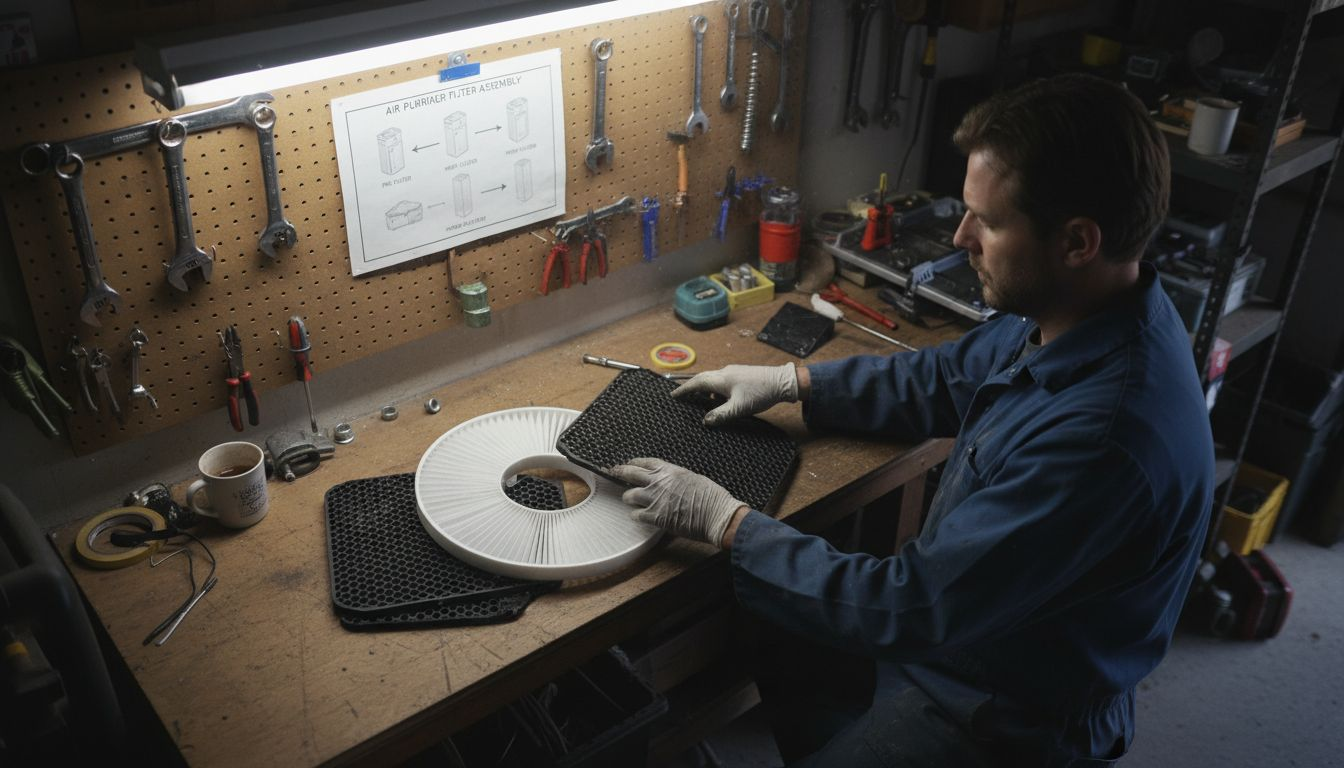
Activated carbon filters serve a completely different purpose by adsorbing gases and odors rather than trapping particles. Activated carbon effectively adsorbs odors and VOCs, making them critical when dealing with kitchen smells, tobacco smoke, or wildfire smoke. Without carbon filtration, even a high-quality HEPA filter leaves chemical pollutants and unpleasant odors circulating in your home.
| Filter Type | Target Pollutants | Effectiveness | Replacement Frequency |
|---|---|---|---|
| HEPA | Allergens, dust, pet dander, viruses | 99.97% of particles ≥0.3 microns | 6 to 12 months |
| Activated Carbon | Odors, VOCs, smoke, chemical fumes | Adsorbs gases and odors | 3 to 6 months |
| Pre-filter | Large particles, hair, lint | Captures visible debris | Monthly cleaning |
| UV-C | Bacteria, viruses, mold spores | Supplemental disinfection | Bulb replacement yearly |
Pro Tip: Combine HEPA and activated carbon filters to address both particulate matter and gaseous pollutants, providing comprehensive protection against the full spectrum of indoor air contaminants your household faces.
Understanding different types of home air purifiers helps you recognize how these core filter technologies integrate into various purifier designs. Some manufacturers add ionizers or UV-C lights as supplemental technologies, but HEPA and activated carbon remain the foundational filters that deliver measurable air quality improvements. Exploring essential filtration technologies reveals how these components work together to create healthier indoor environments.
Step 3: Maintenance and safety considerations
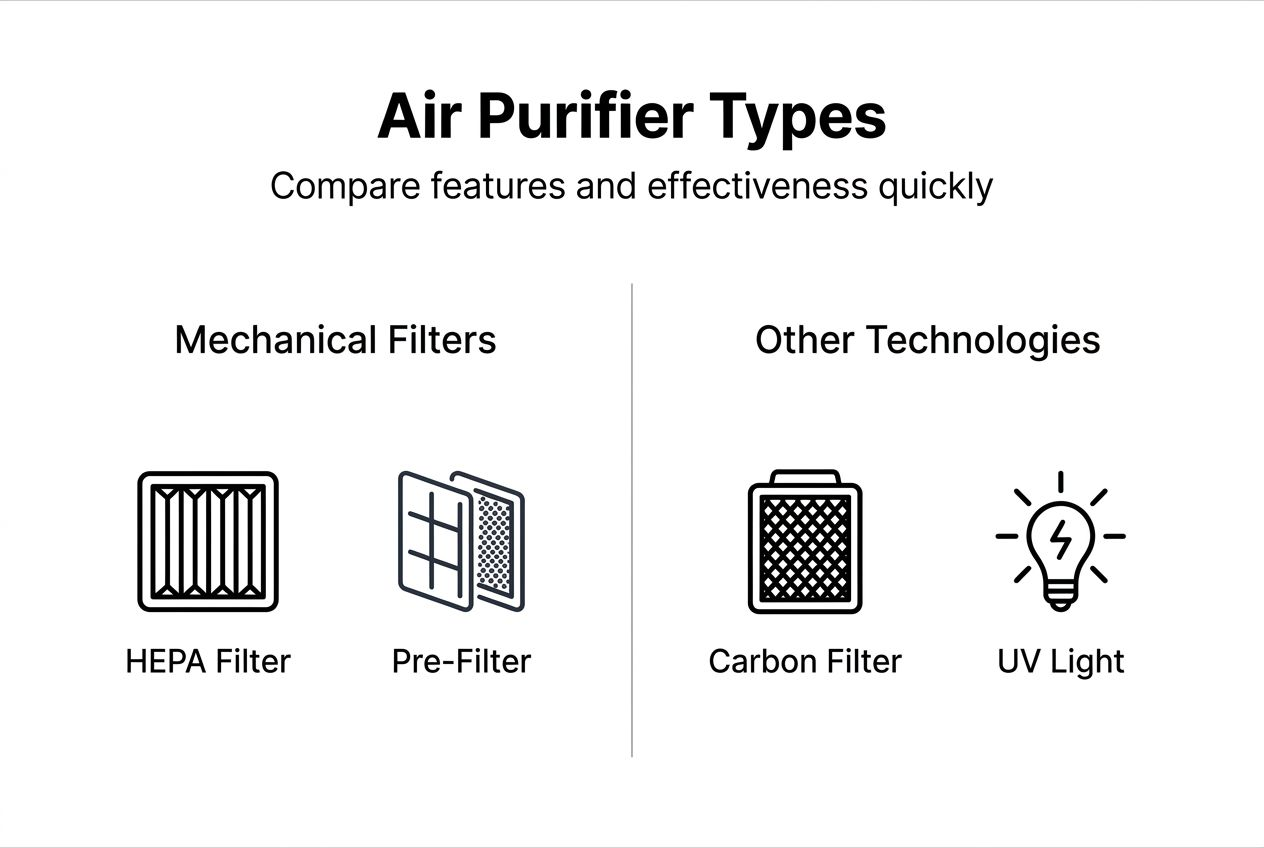
Regular filter replacement maintains your purifier’s efficiency and prevents the device from becoming a source of indoor air pollution itself. HEPA filters require replacement every 6 to 12 months depending on usage intensity and indoor pollution levels, with some advanced models offering washable or longer-lasting filters. Activated carbon filters typically need more frequent replacement, often every 3 to 6 months, because their adsorption capacity becomes saturated faster than HEPA filters clog with particles.
Recognizing signs that filters need changing helps you maintain optimal performance between scheduled replacements. Reduced airflow from vents, return of odors the purifier previously eliminated, visible dirt accumulation on filter surfaces, or unusual sounds all indicate declining filter condition. Many modern purifiers include filter change indicators that monitor runtime hours or airflow resistance, removing guesswork from maintenance schedules.
Safety certifications protect your household from potential health risks associated with certain purification technologies. Look for CARB-certified units to ensure the purifier does not generate harmful ozone as a byproduct of ionization or other processes. Ozone exposure can irritate lungs and worsen respiratory conditions, making certification verification crucial before purchasing any air purification device.
Pro Tip: Set calendar reminders or smartphone alerts for filter replacement dates based on manufacturer recommendations, then adjust the schedule based on your actual usage patterns and local air quality conditions.
Maintenance best practices include:
- Clean pre-filters monthly with a vacuum or rinse under water
- Wipe exterior surfaces weekly to prevent dust buildup
- Place purifiers at least 6 inches from walls for proper airflow
- Keep units away from curtains, furniture, or obstructions
- Unplug during filter replacement to ensure safety
Following step-by-step filter maintenance procedures extends your purifier’s lifespan and ensures consistent air quality improvements. Understanding why regular purifier maintenance matters reinforces how these simple tasks protect your investment and your family’s respiratory health.
Step 4: Common mistakes to avoid when selecting and using air purifiers
Buying an air purifier too small for your room ranks as the most frequent error that compromises purifier effectiveness. An undersized unit runs continuously at maximum fan speed trying to keep up with your room’s air volume, wearing out filters faster while still leaving pollutants circulating. This mistake stems from focusing on purchase price rather than matching technical specifications to your space’s actual requirements.
Ignoring noise levels causes many homeowners to abandon their purifiers or run them less frequently than needed for optimal air quality. Noise levels increase with fan speed, with units producing 55 to 65 decibels at full speed, but oversized units allow operation at lower fan speeds for more tolerable sound levels during typical use. Reading decibel ratings in product specifications and reviews helps you avoid units that will disrupt sleep or concentration.
Neglecting filter maintenance gradually transforms your purifier from an air quality solution into a problem. Saturated filters lose efficiency, allowing pollutants to pass through, while extremely clogged filters can release trapped contaminants back into your indoor air. Some users assume the purifier continues working effectively as long as it powers on, missing the declining performance that occurs between filter changes.
Simple fixes prevent these common errors:
- Always measure your room and select CADR ratings that exceed minimum recommendations
- Choose quieter models or larger units that perform adequately at lower speeds
- Set automatic reminders for filter replacement at manufacturer-recommended intervals
- Verify CARB certification and safety features before purchasing
- Avoid budget models that lack replacement filters or use proprietary consumables
Purchasing decisions driven solely by price or appearance without examining technical specifications guarantee disappointment. Understanding why homeowners need air purifiers clarifies which features matter most for your health goals. Reviewing comprehensive selection guidance helps you prioritize specifications over superficial factors when comparing models.
Step 5: Expected outcomes: measurable air quality improvements
Properly selected and maintained air purifiers deliver substantial reductions in indoor pollutants within measurable timeframes. PM2.5 and allergen reduction exceeds 90% within hours of proper purifier use, with noticeable air quality improvements often occurring within the first day of operation. These laboratory-validated results translate into real-world benefits when you match purifier capacity to room size and run the unit consistently.
Air quality improvements happen gradually as the purifier processes your room’s air volume multiple times per hour. You may notice reduced dust accumulation on surfaces within the first week, while allergy symptom relief often requires several days of continuous operation as airborne allergen concentrations decline. Long-term benefits accumulate over weeks and months as the purifier maintains consistently lower pollutant levels than your home experienced previously.
| Pollutant Type | Reduction Percentage | Typical Timeline | Health Impact |
|---|---|---|---|
| PM2.5 particulates | 90%+ | 4 to 8 hours | Reduced respiratory irritation |
| Allergens (pollen, dander) | 85-95% | 1 to 3 days | Fewer allergy symptoms |
| VOCs and odors | 70-85% | 2 to 5 days | Improved air freshness |
| Smoke particles | 90%+ | 15 minutes to 2 hours | Better breathing comfort |
Potential health improvements from sustained purifier use include:
- Reduced frequency and severity of allergy symptoms
- Improved sleep quality due to cleaner breathing air
- Decreased asthma trigger exposure and symptom episodes
- Lower respiratory irritation from dust and pet dander
- Enhanced overall respiratory function and comfort
“High-efficiency air purifiers significantly improve indoor air quality when properly sized and maintained, with clinical studies documenting measurable reductions in airborne allergens and corresponding improvements in respiratory symptoms for sensitive individuals.”
Learning how air purifiers remove allergens explains the mechanisms behind these measurable outcomes. Understanding air purifier selection outcomes helps you set realistic expectations for the timeline and magnitude of improvements you should experience after implementing these guidelines.
Discover Coway’s air purification solutions
Now that you understand the essential criteria for selecting an effective air purifier, exploring proven solutions from trusted manufacturers helps you move from knowledge to action. Coway offers advanced air purifiers featuring HEPA and activated carbon filtration technologies that address the full spectrum of indoor air quality challenges discussed throughout this guide.
Coway’s product lineup includes models sized for various room dimensions, from compact units for bedrooms to high-capacity purifiers for large living spaces and open floor plans. Each model incorporates the maintenance indicators and quiet operation features that prevent the common mistakes many homeowners make when selecting and using air purifiers. Exploring Coway’s air purifier collection lets you compare specifications and match technical capabilities to your specific indoor air quality needs.
Pro Tip: Review detailed guides on air purifier types and allergen removal capabilities to identify which Coway models best address your household’s primary air quality concerns.
Coway benefits include:
- Proven HEPA and activated carbon filtration technologies
- User-friendly designs with intuitive controls and filter indicators
- Comprehensive support and readily available replacement filters
- Models sized and rated for diverse room dimensions and air quality needs
FAQ
What is Clean Air Delivery Rate (CADR) and why does it matter?
CADR measures how quickly a purifier removes smoke, dust, and pollen from indoor air, expressed in cubic feet per minute. Matching CADR to your room size ensures the unit processes air fast enough to deliver noticeable pollutant reduction within hours rather than days.
How often should I replace air purifier filters?
Replace HEPA filters every 6 to 12 months depending on how heavily you use the purifier and your local air quality conditions. Activated carbon filters typically need replacement every 3 to 6 months as they become saturated with odors and VOCs. Following proper filter maintenance schedules preserves purifier efficiency and prevents pollutant rerelease.
Can I use one purifier for multiple large rooms?
One unit rarely provides adequate coverage for multiple large spaces or open floor plans because air circulation limitations prevent effective pollutant removal throughout the entire area. You need either multiple purifiers positioned strategically or a single high-CADR commercial-grade unit specifically rated for your total square footage. Consulting an air purifier buying checklist clarifies sizing requirements for complex layouts.
Do activated carbon filters remove all air pollutants?
Activated carbon filters excel at adsorbing odors, VOCs, and gaseous pollutants but do not capture fine particles like allergens, dust, or viral droplets. Combining activated carbon with HEPA filtration provides comprehensive air cleaning that addresses both particulate and gaseous contaminants. Understanding different purifier types explains how multiple filter technologies work together for optimal results.
Recommended
- How to Select Air Purifier for Healthy Home Air Quality – Coway Water Purifier
- 7 Must-Have Air Purifier Features for Healthier Homes – Coway Water Purifier
- Emerging Air Purification Trends 2025: Smart, Sustainable Solutions – Coway Water Purifier
- Why Choose Home Air Purifier: Complete Guide – Coway Water Purifier
- Tips para mejorar tu energía zodiacal y bienestar en 2026 | Lunaris
