
Uncategorized
Smart Filtration Explained: How Smart Water Systems Protect Your Home

Apr
TL;DR:
- Smart filtration uses sensors and automation to monitor water quality continuously.
- It offers real-time alerts, predictive maintenance, and remote monitoring for increased safety.
- Most families benefit from smart systems due to enhanced reliability, convenience, and long-term cost savings.
Most homeowners assume a water filter is either working or it isn’t. Change the cartridge every six months, done. But that thinking has a serious gap: traditional filters can’t tell you when your water quality drops between changes, when flow rates fall off, or when something unusual happens overnight. Smart filtration closes that gap with sensors, automation, and real-time feedback that standard systems simply can’t provide. In this article, you’ll learn exactly what smart filtration is, how it works, why it matters for your family’s health, and how to choose the right system for your home.
Table of Contents
- What is smart filtration?
- How do smart filtration systems work?
- Key benefits of smart water filtration for families
- Smart filtration versus traditional filtration: What’s the difference?
- Choosing and maintaining a smart filtration system
- A hard truth: Why smart filtration is more than a gadget upgrade
- Take the next step: Find your smart filtration solution
- Frequently asked questions
Key Takeaways
| Point | Details |
|---|---|
| Comprehensive protection | Smart filtration provides automated, real-time monitoring for safer drinking water at home. |
| Convenient maintenance | Smart systems deliver timely alerts and easy-to-follow service reminders, reducing hassle for homeowners. |
| Long-term savings | Predictive maintenance and efficient operation can lower costs and extend the life of your filtration investment. |
| Decision clarity | A side-by-side comparison helps you choose the right filtration technology for your family’s needs. |
What is smart filtration?
Smart filtration is automated, connected home water purification. It combines standard filtration media, think activated carbon, reverse osmosis membranes, or ceramic filters, with sensors, digital controls, and often a smartphone app. The result is a system that doesn’t just filter water passively. It actively monitors what’s happening inside the filter and in your water at every stage.
Traditional filters work on a schedule. You replace the cartridge after a set number of months or gallons, and in between, you’re essentially working blind. The filter could be clogged, bypassed, or past its useful life, and you’d never know until you noticed a taste change or read a scary report about your local water supply. That’s a significant blind spot for any family that relies on filtered water daily.
Advanced water filtration bridges that gap by adding intelligence to the filtration process. As one peer-reviewed study explains, smart filtration adds sensors, automation, and real-time feedback to existing water filtration media. That’s the core distinction: smart filtration isn’t a different kind of filter. It’s a smarter way to manage and monitor the same filtration process.
Think of it this way. A traditional filter is like a smoke alarm with no battery indicator. It might protect you, or it might have stopped working weeks ago and you just don’t know yet. Smart filtration is like a full home security system that sends you a notification the moment something needs attention.
Here’s what most smart filtration systems include:
- Water quality sensors that track turbidity, TDS (total dissolved solids), pH, and contaminant levels
- Flow rate monitors that detect pressure drops or blockages before they become problems
- Filter life tracking based on actual usage, not just a calendar countdown
- Leak detectors that alert you before a small drip becomes a flooded cabinet
- Mobile app integration so you can check your water quality from anywhere
“Smart filtration doesn’t replace good filter media. It makes that media work better by giving you the visibility to act on real data, not guesswork.”
For families who prioritize health, this visibility is the whole point. You shouldn’t have to wonder whether your water is safe today.
How do smart filtration systems work?
Understanding what smart filtration means sets the stage for exploring how these systems actually operate in your home. The process sounds complex, but it follows a logical sequence once you see it step by step.
Here’s how water moves through a typical smart filtration system:
- Water enters the system from your main supply line and passes through a pre-filter that removes sediment and larger particles.
- Primary filtration occurs, using carbon blocks, RO membranes, or UV chambers to eliminate chemicals, pathogens, and dissolved solids.
- Sensors scan the water before and after filtration, measuring TDS, pressure, flow rate, and sometimes temperature or bacterial activity.
- The control unit processes that data, comparing it against preset thresholds to determine if water quality is acceptable.
- Alerts or automated actions trigger if anything falls outside normal ranges, whether that’s a filter change reminder, a leak alert, or a system shutoff.
The sensor suite is where smart filtration earns its name. Smart systems use sensors including pressure, flow, TDS, and salt sensors to automate cleaning, regeneration, and alerts. That automation means the system responds to your actual water conditions, not a one-size-fits-all schedule.
| Sensor type | What it monitors | Action triggered |
|---|---|---|
| TDS sensor | Dissolved solids level | Alert if levels spike unexpectedly |
| Flow sensor | Water usage and pressure | Leak detection, filter efficiency check |
| Pressure sensor | Filter media condition | Backwash or replacement reminder |
| UV intensity sensor | Sanitization performance | Alert if UV output drops |
| Temperature sensor | Water temp at output | Adjust system performance |
The most underappreciated feature in smart filtration is predictive maintenance. Most people think of smart features as alerts, a ping when the filter is due. But systems that integrate with IoT in water purifiers go further. They analyze usage trends over time and forecast when issues are likely to occur before you ever notice a problem.
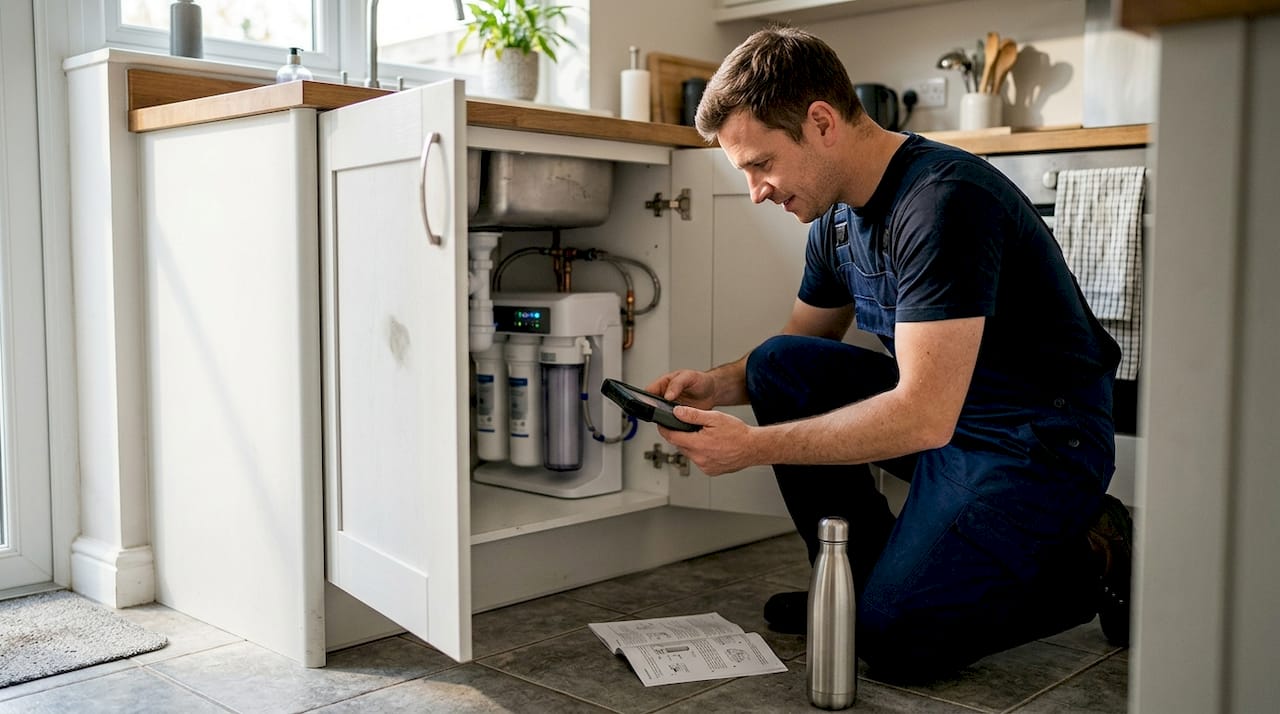
Pro Tip: If you’re evaluating smart systems, ask specifically about predictive maintenance, not just reactive alerts. A system that tells you a filter will fail in three weeks is far more useful than one that only notifies you after it already has.
Key benefits of smart water filtration for families
Now that you know how the technology works, it’s important to look at why these features matter for everyday families.
Water safety comes first. Real-time monitoring and usage-based reminders enhance water quality management in ways traditional filters simply can’t match. When your TDS sensor spikes at 2 a.m. because a pipe upstream broke, you’ll get a notification before your family pours a glass in the morning.
Convenience is real, not just marketing. Forgotten filter changes are one of the most common reasons home filtration systems underperform. Smart systems track actual usage volume and water conditions, so the reminder arrives when you actually need it, not six months after you installed the filter regardless of how much water your family used.
Here’s what health-driven filtration genuinely delivers for busy households:
- Automated maintenance reminders so nothing slips through the cracks
- Remote monitoring so you can check water quality when you’re traveling
- Instant leak alerts that prevent water damage before it spreads
- Usage data that helps you understand your household’s actual water consumption
- Continuous water quality records for peace of mind and documentation
Cost savings are measurable. Catching a filter failure early or detecting a slow leak before it damages cabinetry can save hundreds of dollars. Over a few years, those prevented incidents offset a meaningful portion of the system’s cost.
Pro Tip: Smart systems can reveal surprising inefficiencies. Some households discover they’re using 30 to 40 percent more filtered water than expected, which points to either waste habits or a system leak. That data alone can change behavior and reduce costs.
For families exploring antibacterial filter options, smart monitoring adds an extra layer of confidence that those filters are actively performing as intended.
Smart filtration versus traditional filtration: What’s the difference?
With benefits in mind, it’s time to see how smart filtration stacks up against the systems most homeowners already know.
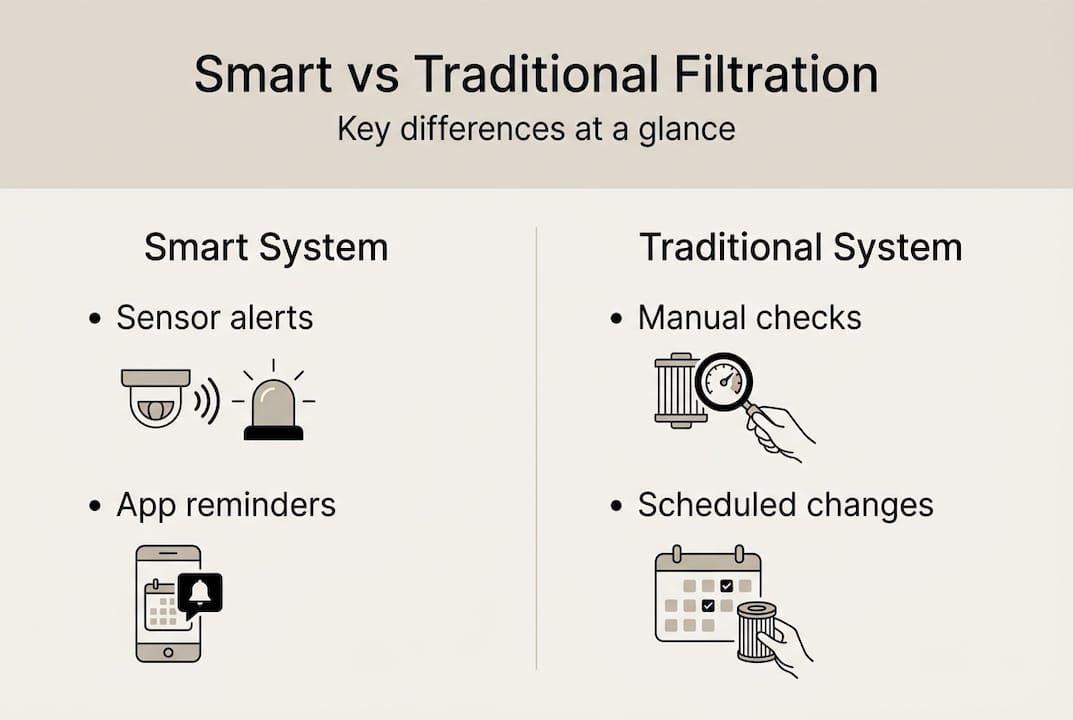
| Feature | Smart filtration | Traditional filtration |
|---|---|---|
| Filter life tracking | Usage-based, automatic | Calendar-based, manual |
| Water quality monitoring | Real-time sensors | None |
| Leak detection | Yes, with alerts | No |
| Remote access | App-connected | No |
| Predictive maintenance | Yes | No |
| Upfront cost | Higher | Lower |
| Ongoing oversight | Minimal | Requires manual checks |
As research confirms, common smart features include automated control, remote monitoring, and predictive maintenance. Traditional filters offer none of these by default.
That said, smart filtration isn’t the right fit for every situation. Here’s who benefits most from each:
Smart filtration is the better choice if you:
- Have a busy household where maintenance reminders get forgotten
- Travel frequently and want remote monitoring while away
- Have young children or elderly family members with specific water quality needs
- Want documentation of water quality over time
- Are concerned about why filters matter beyond just taste
Traditional filtration may still work if you:
- Have a simple, low-volume water use situation
- Are highly disciplined about manual maintenance schedules
- Are on a tight budget with no flexibility for upfront investment
For most families with growing demands and limited time, the scale tips clearly toward smart filtration. And regular filter servicing becomes far easier when the system itself tells you exactly what’s needed.
Choosing and maintaining a smart filtration system
Deciding between smart and traditional options is only the beginning. Getting the most out of your new system depends on smart choices upfront and consistent upkeep over time.
Follow these steps to choose the right system for your home:
- Assess your water quality first. Get a basic water test to identify contaminants specific to your area. This shapes which filtration media you actually need.
- Match features to your lifestyle. If you travel often, prioritize remote monitoring. If you have a large family, look for high-capacity systems with accurate usage tracking.
- Check certifications. Look for NSF/ANSI certification, which confirms the system removes what it claims to remove.
- Plan your installation. Countertop units are usually DIY-friendly. Under-sink or whole-home systems often benefit from professional installation to avoid leaks or plumbing errors.
- Understand your service agreement. Some smart systems include free filter deliveries or service calls. Factor that into your total cost comparison.
As predictive and usage-based alerts become standard in advanced smart filtration, maintenance is shifting from a chore to a background process. But you still need to act on those alerts.
Look for these maintenance features before you buy:
- Filter change notifications sent to your phone
- Leak detection with automatic shutoff valves
- Access to a dedicated service or support team
- Clear app interfaces that show filter life and water quality at a glance
For long-term performance, following a maintenance schedule and applying efficiency tips for purifiers ensures your smart investment keeps paying off year after year.
A hard truth: Why smart filtration is more than a gadget upgrade
There’s a tendency to frame smart filtration as a premium option, nice to have but not necessary. That framing misses something important.
The real cost of inadequate filtration isn’t just bad-tasting water. It’s the filter you forgot to change for nine months. It’s the slow leak that warped your cabinet floor. It’s the spike in contaminants you never detected because nothing was watching. These aren’t edge cases. They’re common, and they’re preventable.
Smart filtration isn’t about technology for its own sake. It’s about eliminating the gaps in a manual system that depends entirely on you remembering to act. For most busy families, that dependency is the weakest link. Automation removes it.
The insight most people miss is this: avoiding one filter-related problem, one leak, one missed replacement, can easily cover years of smart system costs. When you look at it that way, the filtration technology insights point toward one conclusion: smart filtration is quickly becoming the baseline, not the upgrade.
Take the next step: Find your smart filtration solution
If you’re ready to make the upgrade, here’s how to ensure your family enjoys all the benefits of smart filtration effortlessly.
Coway’s lineup of advanced water purifiers is built to do exactly what this article describes: monitor, alert, and protect your household’s water without requiring constant manual attention. Whether you’re curious about how the water purification process works end to end, or you’re ready to explore a specific unit like the countertop ice water purifier, the right starting point is understanding what your home actually needs. Visit the Coway Water Purifier homepage to browse models, compare features, and find a system matched to your household’s real water quality needs.
Frequently asked questions
Can I install a smart filtration system myself?
Many countertop smart filtration systems are designed for straightforward DIY setup, but under-sink or whole-home units often require a licensed plumber to ensure proper connections and avoid pressure issues.
How does smart filtration alert me to water issues?
Most systems send app notifications and usage-based alerts directly to your phone when filters are due for replacement or when water quality readings fall outside acceptable ranges.
What kind of maintenance do smart filtration systems need?
Predictive and usage-based reminders handle most of the scheduling for you, but you’ll still need to physically replace filters and perform occasional system checks when prompted.
Is smart filtration more expensive than traditional filtration?
Smart systems do cost more upfront, but automation and predictive alerts help prevent costly repairs and wasted filter life, making the long-term economics more favorable than the initial price tag suggests.
Recommended
- Advanced Water Filtration Guide for Healthier Homes – Coway Water Purifier
- Advanced Filtration Technology: Cleaner Home Wellness – Coway Water Purifier
- Why Choose Multi-Filter Systems for Home Safety – Coway Water Purifier
- What is Water Filtration? Understanding Its Importance – Coway Water Purifier
