
Uncategorized
Why Choose Multi-Filter Systems for Home Safety

Feb
Finding safe water for your family can feel like a never-ending task when every glass matters. With concerns about everything from chlorine taste to invisible bacteria, American families want solutions that cover every risk. Multi-filter systems use multiple layers of filtration media working together to capture a broad range of contaminants, offering a smarter way to protect your drinking water and indoor air quality without constant maintenance headaches.
Table of Contents
- What Are Multi-Filter Systems?
- Types of Multi-Filter Water Filtration
- How Multi-Filter Systems Ensure Clean Water
- Comparing Multi-Filter Vs. Single Filter Options
- Risks of Poor Filtration and Common Mistakes
Key Takeaways
| Point | Details |
|---|---|
| Multi-Filter Systems Enhance Filtration | Multiple layers improve contamination removal compared to single filters, capturing a broader range of pollutants. |
| Sequential Filtration Provides Comprehensive Protection | Each stage targets specific contaminants, ensuring cleaner water reaches your tap. |
| Longer Filter Lifespan and Cost Efficiency | Multi-filter systems require fewer replacements, spreading the workload and reducing long-term costs. |
| Avoid Common Filtration Mistakes | Regular maintenance and appropriate filter selection are crucial to ensure safety and efficacy. |
What Are Multi-Filter Systems?
Multi-filter systems use multiple layers of filtering media working together to capture different types of contaminants from your water. Instead of relying on a single filter to do all the work, these systems combine different filtration principles and materials to remove a wider range of pollutants.
Think of it like a security checkpoint with multiple inspection stations. The first station screens for large items, the second checks for medium-sized threats, and the third catches the smallest issues. Each layer handles what it does best.
How Multi-Filter Systems Work
Multi-layer filters consist of multiple layers designed to capture contaminants through different mechanisms like adsorption and particle filtration. As water passes through each stage, different contaminants get trapped.
Here’s what happens at each stage:
- First stage: Large particles, sediment, and visible debris get filtered out
- Second stage: Smaller particles and some chemical contaminants are captured
- Final stage: Microscopic particles, chlorine, odors, and tastes are removed
Each layer improves separation efficiency by handling specific types of contaminants. The combination removes far more pollutants than any single filter could manage alone.
Why Multiple Stages Matter for Your Family
Your tap water contains many different contaminants—some large, some microscopic. A single filter simply cannot catch everything effectively. Multiple stages mean better protection across the board.

When you understand the role of filtration stages, you’ll see why progression matters. Water quality improves dramatically at each pass-through.
Multi-filter systems catch contaminants that single-stage systems miss entirely. This matters when you’re filling your child’s water bottle or cooking dinner.
The Real-World Benefit
Your family gets cleaner water without needing to replace filters constantly. The workload spreads across multiple stages, so each filter lasts longer than it would if handling everything alone.
Multiple filtration stages remove a significantly wider range of contaminants compared to single-layer filters, making them more effective for household water safety.
This means fewer replacements, lower costs over time, and consistently better water quality.
Pro tip: Check your system’s filter replacement schedule based on water usage—multi-filter systems often stretch replacement intervals because the workload distributes across stages, saving you money and maintenance hassle.
Types of Multi-Filter Water Filtration
Different multi-filter systems combine various filtration technologies to address multiple water quality issues at once. Each type targets specific contaminants, so choosing the right combination depends on your local water quality and household needs.
The most common approach layers different filter types into a single unit. This strategy maximizes contaminant removal while keeping the system compact and affordable for your home.
Common Filtration Technologies in Multi-Filter Systems
Types of water filters include mechanical, activated carbon, reverse osmosis, and ultraviolet methods. Multi-filter systems often combine several of these into one unit to handle various contamination issues.
Here’s what each technology does:
- Mechanical filters: Remove sediment, dirt, and visible particles
- Activated carbon: Trap chlorine, odors, tastes, and some chemicals
- Reverse osmosis: Eliminate dissolved minerals and microscopic contaminants
- Ultraviolet (UV): Kill bacteria and viruses without chemicals
- Ion exchange: Soften water by removing mineral hardness
When combined strategically, these technologies work together to catch what others miss.
Here’s a side-by-side look at how popular filtration technologies compare:
| Technology | Main Strength | Limitation | Common Use Case |
|---|---|---|---|
| Mechanical Filter | Removes visible debris | Misses dissolved chemicals | Pre-filtration in homes |
| Activated Carbon | Reduces odor, taste | Doesn’t remove minerals | Improving drinking water |
| Reverse Osmosis | Removes dissolved salts | Slower, wastes water | High-purity applications |
| Ultraviolet (UV) | Destroys microbes | No effect on particles | Disinfecting well water |
| Ion Exchange | Softens hard water | Doesn’t remove bacteria | Water softeners |
How Multi-Filter Combinations Work for Your Family
A typical household multi-filter system might use mechanical filtration first, followed by activated carbon, then reverse osmosis. This progression removes progressively smaller particles and different chemical types.
Your water passes through each stage in sequence, getting cleaner at every step. By the time it reaches your glass, multiple contaminant types have been removed.
Multi-filter water filtration systems layer different technologies to target bacteria, protozoa, chemicals, and particulates. This comprehensive approach enhances water safety far better than single-stage systems.
Why Combination Systems Beat Single Filters
No single filter technology removes all contamination types effectively. Mechanical filters miss dissolved chemicals. Carbon filters don’t catch all bacteria. Reverse osmosis removes minerals but wastes water.
Multi-filter systems combine several filtration methods into one unit to maximize contaminant removal and address different water quality issues.
When you layer them strategically, each filter handles what it does best. Your family gets protection against sediment, chemicals, bacteria, and mineral content simultaneously.
This matters because your tap water contains multiple contamination types. A combination approach handles everything effectively.
Pro tip: Ask about the specific filter sequence in any system you consider—the order matters tremendously, as each stage prepares water for the next one, significantly improving overall effectiveness.
How Multi-Filter Systems Ensure Clean Water
Multi-filter systems work by passing water through multiple stages, each targeting different contaminants. This sequential approach creates multiple barriers against pollution, ensuring what reaches your tap is significantly cleaner than what enters the system.
Think of it as a quality control checkpoint. Each stage removes what the previous one missed, progressively improving water purity.
The Sequential Filtration Process
Multi-filter water treatment systems integrate different filtration mechanisms such as adsorption, ion exchange, membrane filtration, and disinfection in layered sequences. Each stage targets specific contaminants that others cannot address effectively.
Here’s what happens as water moves through the system:
- Stage 1: Mechanical filtration traps sediment and visible particles
- Stage 2: Activated carbon removes chlorine, odors, and chemical compounds
- Stage 3: Membrane filtration catches microscopic bacteria and protozoa
- Stage 4: Additional polishing removes remaining dissolved substances
Each layer works harder because it only handles contaminants the previous stage didn’t catch. This focused approach is far more efficient than asking one filter to do everything.
How Multiple Barriers Protect Your Family
Multi-filter systems work by sequentially filtering water through layers that remove different contaminants, providing multiple barriers to contamination. No single contaminant type gets through because the system addresses each one specifically.
If one filter misses something small, the next one catches it. This redundancy means your family gets protected from sediment, chemicals, bacteria, and dissolved minerals simultaneously.
Certification standards guide these systems to meet safety and performance criteria. This ensures effective contaminant reduction across multiple threat categories.
Why This Matters for Your Drinking Water
Your tap water contains a complex mix of threats: visible particles, dissolved chemicals, bacteria, and mineral content. No single filter can address all of them equally well.
These combined processes provide multiple barriers to contamination, significantly improving water quality over single-method filters.
Multi-filter systems eliminate the trade-offs. You don’t sacrifice chemical removal for bacterial protection, or vice versa. Every threat type gets addressed.
This comprehensive approach means your family gets consistently clean, safe drinking water from every tap in your home.
Pro tip: Regular filter replacement keeps each stage working at peak efficiency—mark your calendar for replacements based on your system’s schedule to maintain the protection each stage provides.
Comparing Multi-Filter vs. Single Filter Options
Choosing between multi-filter and single-filter systems comes down to what your family needs from their water. Single filters address one or two contaminant types effectively. Multi-filter systems tackle a much broader range simultaneously.
The real difference shows up when you test the actual water quality your home receives.
The Performance Gap
Multi-layer filters have higher contaminant adsorption capacity compared to single-layer filters at equivalent overall weight. This structural advantage means each multi-filter system removes more impurities from the same volume of water.
Here’s the practical reality:
- Single filters handle sediment OR chemicals OR bacteria, rarely all three equally well
- Multi-filter systems target sediment, chemicals, bacteria, and minerals simultaneously
- Single filters require frequent replacement when they become overwhelmed
- Multi-filter systems distribute the workload, lasting longer between replacements
When one type of contamination overwhelms a single filter, water quality drops fast. Multi-filter systems keep protecting you because each stage handles its specialty.
What Each System Removes Best
Multi-filter water filtration systems outperform single filter units by combining multiple filtration technologies to target a broader range of contaminants. Single filters might remove certain impurities but miss others entirely.
Your household probably has multiple water quality issues. Maybe your area has hard water, chlorine taste, and sediment problems. A single filter picks one battle. Multi-filter systems win all three.
This matters most for families with children who depend on clean water daily.
Cost and Convenience Comparison
Single filters cost less upfront but require more frequent replacements. You’re constantly shopping for new filters and dealing with performance drop-offs between changes.
Multi-filter systems achieve improved filtration performance, such as better particle retention and broader contaminant removal, than single filter options.
Multi-filter systems cost more initially but work harder and last longer. The workload spreads across stages, so replacements happen less often. Your family gets consistent quality without constant maintenance disruptions.
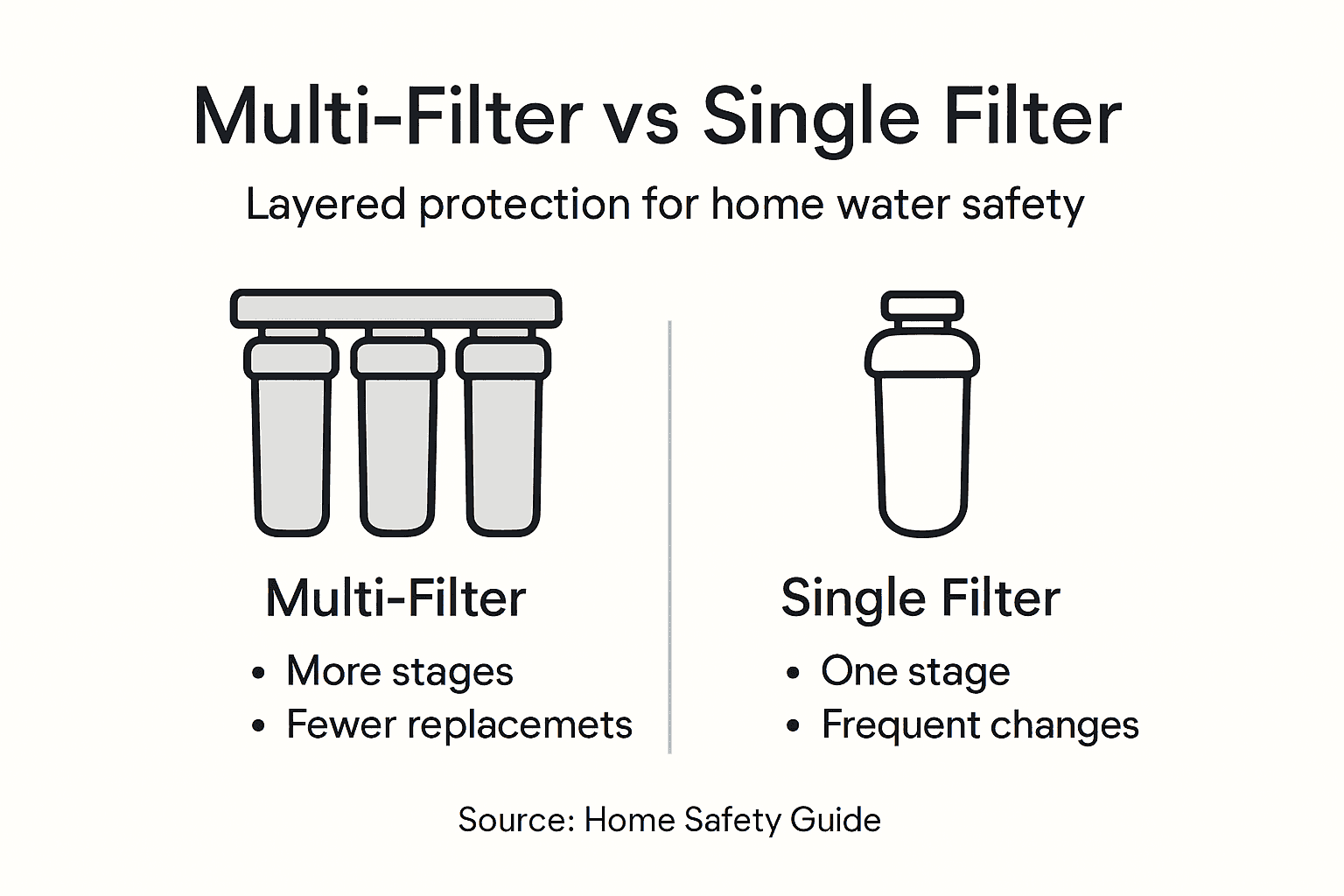
Over five years, multi-filter systems typically cost less and provide better protection.
The chart below contrasts long-term value between single and multi-filter systems:
| Factor | Multi-Filter System | Single Filter System |
|---|---|---|
| Upfront Cost | Higher initial expense | Lower initial price |
| Maintenance | Fewer replacements needed | Frequent changes required |
| Filter Lifespan | Extended, lasts longer | Shorter, wears out faster |
| Overall Protection | Broad contaminant removal | Limited contaminant range |
| Long-Term Cost | Lower over 5 years | Higher over 5 years |
Pro tip: Calculate your true replacement costs by multiplying single-filter price by how many you’d need annually, then compare to multi-filter replacement schedules—multi-filter systems usually win on total cost of ownership.
Risks of Poor Filtration and Common Mistakes
Poor water filtration exposes your family to real health risks. When filters don’t work properly, bacteria, chemicals, and particles slip through into your drinking water. Understanding these dangers helps you avoid costly mistakes.
Many homeowners make filtration choices that seem smart initially but fail when it matters most.
Health Risks From Inadequate Filtration
Poor filtration can lead to microbial contamination and failure to remove hazardous substances, resulting in serious health risks. Your family drinks water daily without realizing contaminants are getting through.
Common health consequences include:
- Bacterial infections from E. coli or other pathogens that single filters miss
- Chemical exposure to chlorine, pesticides, or industrial contaminants
- Parasitic protozoa that cause digestive illnesses in children
- Heavy metal accumulation from lead or other dissolved substances
These threats often show up gradually. You might not notice until someone gets sick. With children, the stakes feel much higher.
Mistakes That Compromise Safety
Most filtration failures come from preventable mistakes. People choose the wrong filter type for their water quality, skip maintenance, or ignore early warning signs of filter damage.
Common mistakes in filtration include using inappropriate filter media size/Structure_and_Reactivity_in_Organic_Biological_and_Inorganic_Chemistry_II%3A_Practical_Aspects_of_Structure_-_Purification_and_Spectroscopy/07%3A_Purification_of_Molecular_Compounds/7.02%3A_Filtration) failing to remove fine particles, and improper filter handling. These errors reduce filtration efficiency and can compromise water safety.
Here’s what people overlook:
- Not replacing filters on schedule
- Ignoring signs of filter damage or leaks
- Choosing filters designed for different contaminants than what’s in their water
- Skipping water testing to know what they’re actually filtering
Why Poor Filtration Costs You More
Cheap or inadequate filters save money upfront but create hidden costs. Water damage from leaking filters, health expenses from contaminated water, and constant replacements add up fast.
Inadequate filter validation, improper maintenance, failure to detect leaks or damage, and inappropriate filter choice all compromise filtration efficacy and safety.
Multi-filter systems prevent these mistakes because each stage catches what previous ones miss. If one filter fails, others keep protecting your family. Single filters offer no such redundancy.
Your children’s health depends on water quality every single day.
Pro tip: Test your water annually through a certified lab to confirm what contaminants you’re actually dealing with—this simple step prevents choosing the wrong filtration system and ensures your investment actually protects your family.
Elevate Your Home Safety with Advanced Multi-Filter Solutions
The article highlights the vital need for multi-filter systems to protect your family from a wide range of contaminants in tap water. You deserve reliable, comprehensive filtration that targets sediment, chemicals, bacteria, and minerals with proven technology and multiple barrier protection. Avoid costly mistakes related to single filters that often miss contaminants or require frequent replacements. Our solution at Coway Water Purifier offers advanced multi-stage filtration enhanced with UV sanitization to ensure your drinking water is safe everyday.
Discover our selection of cutting-edge water purifiers designed to deliver the layered protection your household needs. Visit the Uncategorized Archives – Coway Water Purifier to explore models that combine mechanical, activated carbon, and reverse osmosis technologies. Learn why combining filtration methods significantly improves water quality by visiting our homepage. Act now to secure cleaner, safer water with comprehensive service options like free delivery and installation. Take the step toward peace of mind and health for your family at Coway Water Purifier.
Frequently Asked Questions
What are the advantages of using multi-filter systems for home water safety?
Multi-filter systems provide enhanced protection by using multiple filtration layers that target different contaminants, ensuring cleaner and safer water compared to single filters.
How do multi-filter systems improve water quality?
Multi-filter systems improve water quality by sequentially filtering water through various technologies, removing larger particles, chemicals, bacteria, and dissolved minerals effectively at each stage.
Why is it important to have multiple stages of filtration?
Multiple stages of filtration are crucial because they collectively capture a wider range of contaminants than a single filter could manage, ensuring comprehensive protection for your family’s drinking water.
How often should I replace the filters in a multi-filter system?
The frequency of filter replacement depends on your specific multi-filter system and water usage. Generally, it’s essential to follow the manufacturer’s guidelines to ensure effective filtration and water quality.
Recommended
- Role of Filtration Stages: Improving Home Water Safety – Coway Water Purifier
- Advanced Filtration Technology: Cleaner Home Wellness – Coway Water Purifier
- Certified Filtration: Safeguarding Your Home Health – Coway Water Purifier
- Why Choose Certified Purifiers for Home Safety – Coway Water Purifier
