
Uncategorized
Office Air Quality Tips for a Healthier Workplace
Jun
TL;DR:
- Office air quality improvements focus on enhancing ventilation, controlling humidity, and eliminating pollutant sources. Regular maintenance, source reduction, and proper filtration are crucial for a healthy, productive workspace. Monitoring IAQ with appropriate tools allows proactive management and prevents common issues caused by neglecting fundamental practices.
Office air quality tips are practical actions that reduce indoor pollutants, optimize airflow, and directly improve the health and productivity of everyone who works in the building. Poor indoor air quality (IAQ) is not a minor inconvenience. The EPA identifies indoor air as a leading environmental health risk, and standards like ASHRAE Standard 62.1 exist precisely because offices generate a predictable mix of hazards: CO2 from occupants, VOCs from furniture and cleaning products, particulate matter from printers, and mold spores from moisture. The good news is that most of these problems respond to a structured, layered approach covering ventilation, humidity, source control, and filtration.
1. Optimize office ventilation first

Ventilation is the foundation of any serious air quality management strategy. ASHRAE Standard 62.1 specifies ventilation rates based on both occupancy and floor area, and mechanical ventilation consistently outperforms passive infiltration because it allows you to filter and control incoming air. If your HVAC system is not delivering the right volume of fresh outdoor air, no amount of air freshener or desk plants will fix the underlying problem.
Upgrading to MERV 13 filters or higher is one of the highest-return changes a facilities manager can make. MERV 13 captures fine particles including many airborne pathogens, while lower-rated filters let them pass through freely. Replace filters on the manufacturer’s schedule, not when someone notices the air feels stale.
- Inspect HVAC units at least once a year and replace filters on schedule
- Upgrade to MERV 13 filters where your system supports the static pressure
- Open windows during mild weather to supplement mechanical ventilation
- Consider heat recovery ventilators (HRVs) or energy recovery ventilators (ERVs) for buildings where opening windows is impractical
Pro Tip: Schedule a professional TAB (testing, adjusting, and balancing) inspection for your HVAC system every three years. TAB identifies airflow imbalances that cause some zones to be over-ventilated while others suffocate. Most facilities managers skip this step and then spend years chasing IAQ complaints they cannot explain.
2. Control indoor humidity between 30% and 50%
Humidity is the most underestimated variable in office air quality. Office humidity maintained between 30% and 50% minimizes biological contaminants and keeps occupants comfortable. Levels above 60% create conditions where mold colonies establish themselves inside walls, ceiling tiles, and HVAC ductwork. Levels below 30% dry out mucous membranes, making occupants more susceptible to airborne viruses and causing persistent complaints about dry eyes and scratchy throats.
A digital hygrometer costs under $20 and gives you a real-time reading at any desk. If your HVAC system does not include integrated humidity control, standalone dehumidifiers handle excess moisture in problem areas like server rooms, break rooms, and spaces near exterior walls.
- Use a digital hygrometer to monitor humidity at multiple points in the office
- Run a dehumidifier in areas prone to moisture buildup
- Fix plumbing leaks within 24 hours. Water spills left unaddressed allow mold to colonize wet surfaces rapidly, worsening air quality across the entire floor
- Watch for condensation on windows and a musty smell, both of which signal humidity is already too high
Pro Tip: Condensation on interior windows is not just an aesthetic problem. It tells you the surface temperature and dew point have converged, which means mold growth is likely already starting on nearby porous materials like drywall and carpet.
3. Identify and eliminate pollutant sources
Common office pollutants include VOCs from furniture off-gassing and cleaning products, particulate matter from laser printers and dust, CO2 from occupants, and mold spores from moisture. The EPA ranks source control as the most cost-effective IAQ strategy, ahead of both ventilation upgrades and air filtration. Removing or reducing the source is always more efficient than trying to dilute or filter a contaminant after it has been released.
New office furniture, particularly pressed wood products, releases formaldehyde for weeks after installation. If you are furnishing a new office, choose products certified to CARB Phase 2 or GREENGUARD Gold standards, which set strict limits on formaldehyde and other VOC emissions. Air out new furniture in a well-ventilated space before bringing it into an occupied area.
- Switch to low-VOC or fragrance-free cleaning products and store chemicals in sealed, ventilated cabinets
- Place laser printers in dedicated, well-ventilated rooms rather than in open office areas
- Enforce no-smoking policies within a meaningful distance of building entrances
- Conduct regular vacuuming with HEPA-filter vacuums to reduce dust and allergen accumulation
- Inspect for pest activity, since pest infestations introduce allergens and can require chemical treatments that worsen IAQ
4. Manage CO2 levels from occupant density
Overcrowding raises CO2 concentrations, causing fatigue, reduced concentration, and elevated stress in office workers. This is not a vague wellness concern. CO2 at 1,000 ppm and above measurably impairs decision-making, and many open-plan offices routinely hit that threshold during peak hours without anyone realizing it. A CO2 monitor placed at desk height gives you objective data on whether your ventilation system is keeping pace with occupancy.
The fix is not always architectural. Staggering work schedules, increasing fresh air intake during peak occupancy, and reducing the number of people in enclosed meeting rooms are all practical adjustments that cost nothing. For office wellness strategies that go beyond CO2, a layered approach to IAQ covers the full range of occupant-generated pollutants.
- Install a CO2 monitor at desk height in high-occupancy zones
- Increase HVAC fresh air intake during meetings and peak hours
- Limit meeting room occupancy to what the ventilation system can support
- Stagger work schedules to reduce peak-hour CO2 spikes
5. Choose the right air filtration technology
Air filtration is the third layer in the IAQ hierarchy, after source control and ventilation. HEPA filters combined with activated carbon filters remove fine particles and many VOCs effectively, but they do not replace the first two layers. An air purifier running in a poorly ventilated room with active VOC sources is fighting a losing battle.
When selecting a portable air purifier for an office space, the Clean Air Delivery Rate (CADR) is the most useful single metric. CADR tells you how quickly the unit cleans a given room volume. Match the CADR to the square footage of the space, not to the maximum rating on the box. Carbon filters in high-VOC environments need replacement every one to three months, not annually. Check the air purifier selection guide from Cowayswaterpurifier for a practical breakdown of filter types and replacement schedules.
- Match air purifier CADR to actual room square footage
- Use activated carbon filters in spaces with new furniture, printers, or chemical storage
- Replace carbon filters every one to three months in high-off-gassing environments
- Do not rely on air purifiers to handle radon or carbon monoxide. Those require dedicated detectors and source mitigation
6. Arrange furniture to support airflow
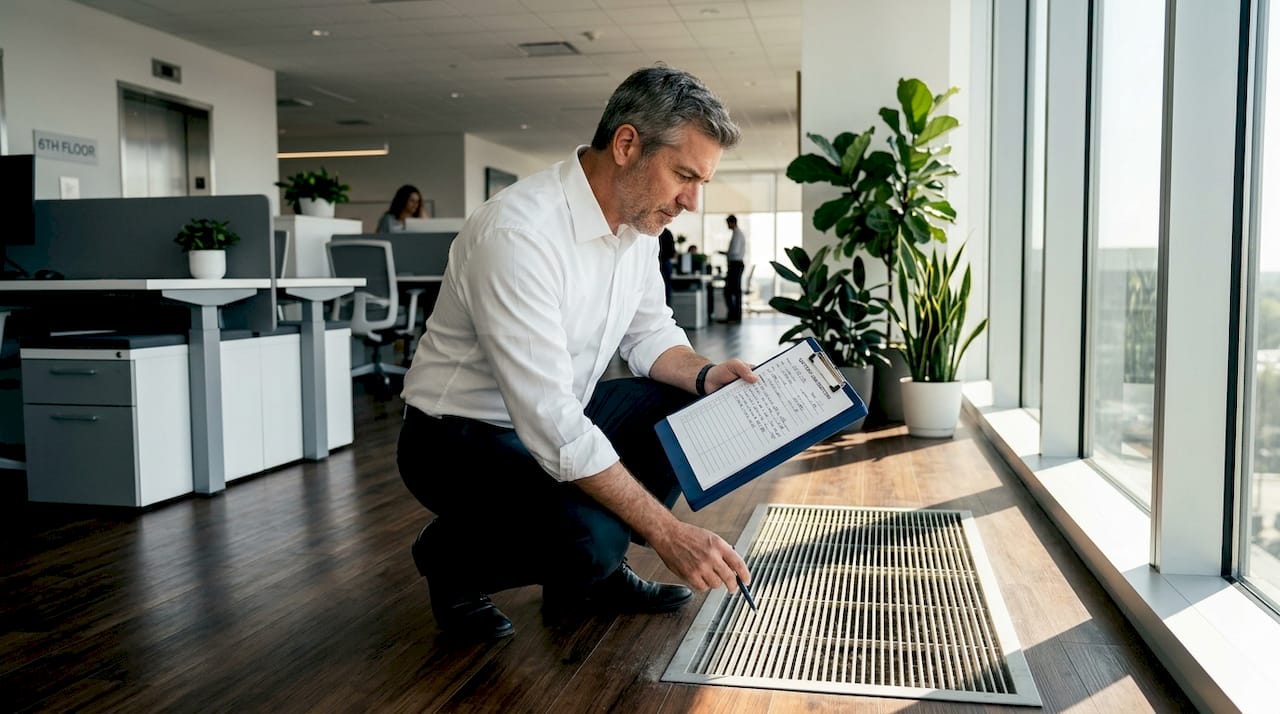
Blocking HVAC supply vents with furniture creates unbalanced airflow pressure and starves adjacent zones of ventilation. This is one of the most common and easily overlooked IAQ problems in offices. A single bookcase placed in front of a supply vent can create a dead zone that affects an entire section of the floor, generating IAQ complaints that facilities teams spend months trying to diagnose through filter changes and HVAC inspections.
Walk the floor with a simple tissue or smoke pencil to check airflow at every vent. If the tissue barely moves, something is blocking or restricting that supply. Rearranging even a single piece of furniture often resolves the problem immediately.
- Keep at least 18 inches of clearance around all HVAC supply and return vents
- Avoid placing tall storage units, cubicle walls, or filing cabinets directly under or in front of vents
- Report water leaks, mold spots, and persistent odors to facilities management within 24 hours
- Use office plants like peace lilies, spider plants, or snake plants as minor IAQ aids, but do not overwater them since wet soil introduces mold spores
7. Manage personal pollutant sources
Strong perfumes, personal heaters, and heavily scented products emit VOCs that worsen indoor air quality for everyone in the space. This is a behavioral issue as much as a technical one, and it requires clear workplace policies rather than just hardware upgrades. A fragrance-free policy in shared workspaces reduces VOC load and also accommodates employees with chemical sensitivities or asthma.
Personal space heaters are a particular problem because they create localized hot spots that alter airflow patterns and can off-gas from their heating elements. If employees need supplemental heat, facilities management should address the root cause in the HVAC system rather than allowing personal heaters to proliferate. For a full checklist of daily IAQ habits that employees can follow without any technical knowledge, Cowayswaterpurifier has a practical resource worth bookmarking.
- Implement a fragrance-free or low-fragrance policy in shared workspaces
- Prohibit personal space heaters where HVAC coverage is adequate
- Store personal food items in sealed containers to prevent odors and pest attraction
- Encourage employees to report IAQ concerns through a clear, non-bureaucratic channel
8. Monitor air quality with the right tools
Checking air quality indoors requires more than a visual inspection. CO2 monitors, hygrometers, VOC sensors, and particulate matter sensors each measure a different dimension of IAQ, and no single device covers all of them. A basic IAQ monitoring kit for a medium-sized office should include at minimum a CO2 monitor and a hygrometer. Facilities teams managing larger buildings benefit from networked sensors that log data over time, making it possible to correlate IAQ spikes with occupancy patterns, weather events, or HVAC failures.
The data from these tools is only useful if someone reviews it regularly and acts on it. Assign a specific person or team to review IAQ readings weekly and set threshold alerts so that problems trigger a response before occupants start complaining. For a step-by-step approach to indoor air improvement, Cowayswaterpurifier outlines how to sequence monitoring, source control, and filtration decisions.
- Deploy CO2 monitors in every enclosed meeting room and high-occupancy zone
- Use a hygrometer to track humidity at multiple points across the floor
- Consider a VOC sensor near printer rooms, chemical storage, and newly furnished areas
- Set automated alerts for CO2 above 1,000 ppm and humidity above 55%
Key takeaways
Good office air quality requires a layered strategy: source control first, ventilation second, and filtration third, with humidity management and behavioral policies running in parallel throughout.
| Point | Details |
|---|---|
| Ventilation is the foundation | Upgrade to MERV 13 filters and schedule TAB inspections every three years to maintain balanced airflow. |
| Humidity must stay between 30% and 50% | Levels outside this range accelerate mold growth or cause respiratory irritation, both of which reduce productivity. |
| Source control beats filtration | Eliminating VOC sources, fixing leaks within 24 hours, and choosing low-VOC products costs less than running air purifiers continuously. |
| HEPA plus carbon filters work together | Match CADR to room size and replace carbon filters every one to three months in high-off-gassing spaces. |
| Furniture placement affects entire zones | Blocking a single supply vent can starve adjacent areas of ventilation and generate IAQ complaints across the floor. |
What most offices get wrong about air quality
I have reviewed IAQ complaints in offices ranging from 10-person startups to 500-seat corporate floors, and the pattern is almost always the same. Management installs an air purifier, maybe two, and considers the problem solved. The HVAC system has not been balanced since the office was built. The filters are on an annual replacement schedule that nobody enforces. And the new furniture that arrived six months ago is still off-gassing formaldehyde into a space with inadequate fresh air intake.
The uncomfortable truth is that air purifiers are the most visible and least effective part of the IAQ equation when the fundamentals are broken. A Coway air purifier with a true HEPA filter and activated carbon layer will genuinely help with residual particles and VOCs. But it cannot compensate for a CO2 level of 1,400 ppm in a packed meeting room or for mold growing inside a wall cavity because a leak was ignored for three weeks.
What actually works is treating IAQ as a facilities management discipline, not a one-time purchase. That means scheduled HVAC maintenance, a humidity monitoring protocol, a clear process for employees to report odors and leaks, and a willingness to spend money on source control before spending it on filtration hardware. The offices I have seen with the best air quality are not the ones with the most expensive equipment. They are the ones where someone is paying attention to the data every week and acting on it before occupants notice a problem.
— Soldierboy
How Coway can support your office air quality goals
If your office has addressed ventilation and source control and you are ready to add a filtration layer, Cowayswaterpurifier offers a range of HEPA and activated carbon air purifiers sized for office environments. Coway’s filtration systems are built around multi-stage filtration that captures fine particles, allergens, and VOCs, with filter replacement reminders built into the units so maintenance does not slip through the cracks.
For offices comparing models by CADR, filter type, and room coverage, the Coway air purifier guide walks through the selection process in practical terms. If you want to browse the full range of available units, the Coway Air Care product catalog lists current models with specifications and pricing. Both resources are worth reviewing before making a purchase decision for a shared workspace.
FAQ
What is the ideal CO2 level for an office?
CO2 levels below 1,000 ppm are the standard target for occupied office spaces. Levels above 1,000 ppm are associated with measurable drops in concentration and decision-making performance.
How often should office HVAC filters be replaced?
Most HVAC filters in office buildings should be replaced every one to three months depending on occupancy and filter type. MERV 13 filters may need more frequent replacement in high-traffic buildings because they capture finer particles and load up faster.
Do indoor plants improve office air quality?
Plants like peace lilies, spider plants, and snake plants offer minor IAQ benefits by absorbing some VOCs, but their effect is too small to substitute for ventilation or filtration. Overwatering plants introduces mold spores, which can worsen air quality.
What is the fastest way to reduce VOCs in an office?
Source elimination is the fastest approach. Remove or air out new furniture, switch to low-VOC cleaning products, and increase fresh air ventilation. Activated carbon air purifiers help with residual VOCs but work best after the primary sources have been addressed.
How do I know if my office has an air quality problem?
Persistent headaches, fatigue, dry eyes, and respiratory irritation that improve when employees leave the building are the classic signs of poor IAQ. A CO2 monitor and hygrometer provide objective data to confirm whether ventilation or humidity is the root cause.
Recommended
- Essential air quality improvement checklist for a healthier home – Coway Water Purifier
- Office Wellness via Air Quality: Healthier Workplaces – Coway Water Purifier
- 8 Indoor Air Quality Tips for a Healthier Home – Coway Water Purifier
- Mastering Air Quality Regulations for Offices: Compliance Made Simple – Coway Water Purifier
