
Uncategorized
Business Water Safety Tips for Managers in 2026

Jun
TL;DR:
- Effective business water safety relies on site-specific hazard assessments, properly fitted PPE, and ongoing staff training. Implementing layered controls like prompt plumbing flushing, documented emergency procedures, and strategic rescue equipment placement significantly reduces water-related risks in workplaces. Regular reviews and maintenance ensure compliance, preventing slow-burn incidents such as Legionella outbreaks or heat-stress emergencies.
Business water safety is a defined set of practices that prevents water-related hazards in workplaces, protects employee and customer health, and keeps your operations compliant with regulatory standards. Most managers treat water safety as a single checklist item. The reality is that effective water quality management in business requires layered controls: risk assessment, personal protective equipment, employee training, and ongoing system maintenance. This article delivers ten specific, practical business water safety tips drawn from OHSE, the EPA, the USDA, and Water Safety Ireland so you can act immediately, not just plan.
1. Business water safety tips start with a site-specific risk assessment
Every water safety program begins with identifying exactly what hazards exist at your specific location. Generic checklists miss site-specific risks. A manufacturing plant near a retention pond faces completely different threats than a restaurant with a walk-in cooler drain or a hotel with a rooftop water tank.
Evaluate these factors during your assessment:
- Water depth and flow rate at any point employees could access
- Entry and exit points near water zones, including emergency egress
- Local wildlife that could create unexpected hazards near outdoor water sources
- Machinery and electrical equipment positioned near water lines or drainage
- Stagnant water zones inside your building’s plumbing that could harbor Legionella
Reassess after any building closure, seasonal change, or operational shift. A one-time assessment is not a safety program. Use your findings to build a written hazard register that feeds directly into your training and equipment decisions. For a structured starting point, the office water quality assessment guide from Cowayswaterpurifier walks through contamination sources specific to commercial settings.
Pro Tip: Document every assessment with date, assessor name, and findings. Regulators treat undocumented assessments as assessments that never happened.
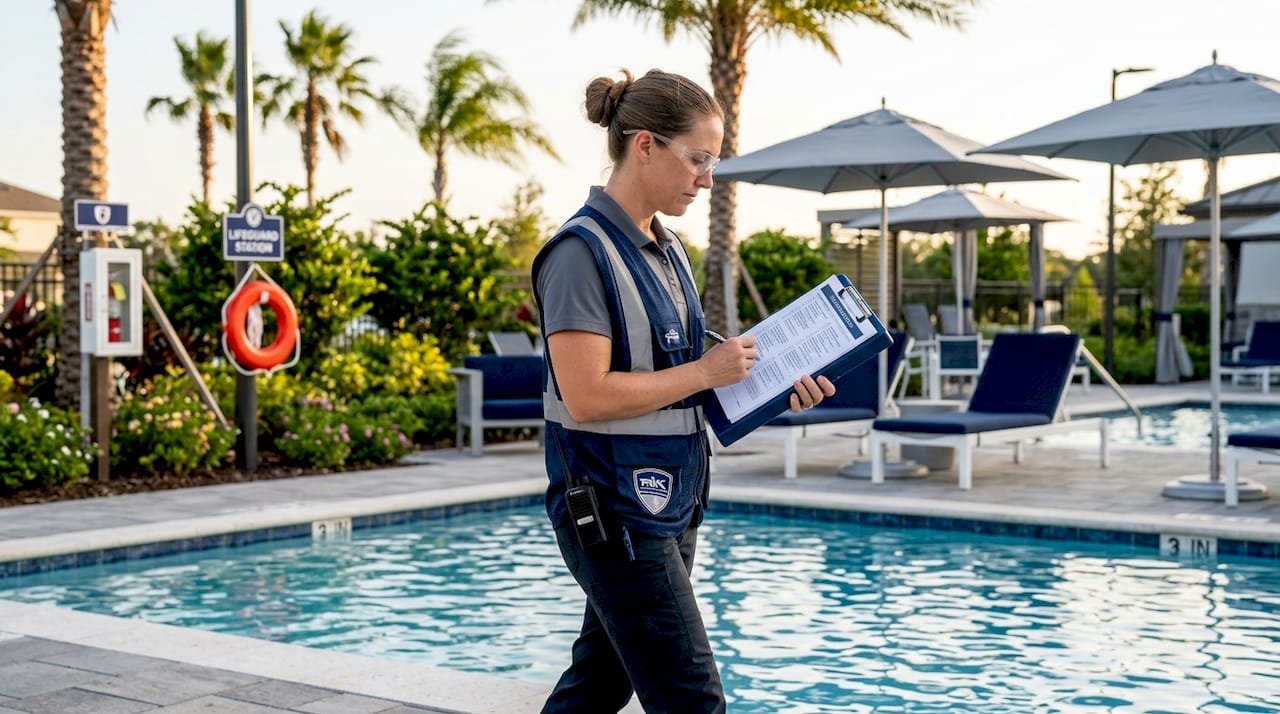
2. Require properly fitted personal flotation devices near open water
All workers near water must wear properly fitted, approved personal flotation devices as part of a layered prevention strategy, according to OHSE. This is not optional guidance. It is the baseline standard for any business where employees work near rivers, docks, pools, tanks, or open drainage systems.
Selecting the right PFD requires matching the device to the task. Consider buoyancy rating, visibility color, and whether the PFD integrates with other required gear like harnesses or high-visibility vests. A PFD that conflicts with a worker’s harness creates a new hazard instead of solving one.
- Inspect PFDs monthly for tears, fading, and hardware integrity
- Fit-test every new employee before their first water-adjacent shift
- Replace any PFD that has been submerged in an actual rescue event, regardless of visible condition
Pro Tip: Store PFDs in a dedicated, labeled cabinet within 10 meters of the water zone. If workers have to search for a PFD, they will skip it under time pressure.
3. Adopt a multi-layered approach to drowning prevention
Drowning prevention is most effective as a multi-layered strategy that integrates hazard assessment, PPE, training, situational awareness, and emergency readiness. No single control eliminates the risk. Businesses that rely on signage alone, or PFDs alone, consistently see higher incident rates than those that stack controls.
The layers work like this: engineering controls such as guardrails, buoys, and physical barriers reduce the chance of a fall. PPE reduces the severity if a fall occurs. Training and situational awareness reduce the chance that a worker makes a poor decision near water. Emergency readiness reduces the time between incident and rescue. Each layer compensates for gaps in the others.
Apply this framework to every water-adjacent role in your business, from kitchen staff managing floor drains to maintenance crews working near outdoor tanks.
4. Train employees with Water Safety Ireland’s certified programs
Water Safety Ireland’s training programs cover workplace water hazards, legal responsibilities, personal safety, and rescue techniques including PFD use through certified theoretical and practical instruction. This is the standard against which your internal training should be measured.
Structure your training program in three phases:
- Awareness training: Every employee who works near water learns to recognize hazards, understand legal obligations, and identify rescue equipment locations.
- Practical rescue drills: Designated safety officers practice non-entry water rescue techniques, throw bag use, and PFD deployment under simulated conditions.
- Emergency communication drills: All staff practice activating the rescue chain, including who calls emergency services, who manages bystanders, and who operates rescue equipment.
Repeat drills at least twice per year. Workers who trained 18 months ago and have not practiced since are not prepared. Schedule drills during shift changes to expose both day and night crews to the same scenarios.
5. Establish off-hours water safety protocols
Off-hours protocols are often overlooked but are critical for workplaces with 24/7 access to water facilities, requiring specific policies for staff using water zones outside typical work periods. A warehouse with a night crew working near a loading dock drainage channel faces the same drowning risk at 2 a.m. as it does at 2 p.m. The difference is that fewer trained people are present.
Write a specific off-hours policy that covers minimum staffing near water zones, mandatory buddy system activation, and supervisor check-in intervals. Post the policy visibly at every water-adjacent work area. Include it in onboarding for any employee assigned to non-standard shifts.
Workers near water must never work alone. Buddy systems and trained rescuers must be present to activate rescue chains immediately. This applies at midnight as much as at noon.
6. Flush your plumbing system after any building closure
Flushing plumbing with both hot and cold water for extended periods prevents hazards from stagnant water in buildings after closures, according to USDA guidance. Stagnant water breeds Legionella, accelerates pipe corrosion, and creates mold conditions inside water lines. These hazards are invisible until someone gets sick.
The USDA specifies flushing hot water at 120°F or above at every outlet. This means every faucet, shower head, drinking fountain, and water dispenser in your facility. A single skipped outlet can recontaminate a system you just spent an hour flushing.
Water system flushing should be a documented, repeatable process covering both hot and cold water at multiple outlets, not a single unconditional event. Build a flushing log that records the date, outlet locations flushed, water temperatures achieved, and the name of the person who performed the work.
For step-by-step guidance on sanitizing drinking water equipment specifically, the water dispenser sanitization guide from Cowayswaterpurifier covers the process in detail.
Pro Tip: Assign flushing responsibilities to a named individual, not a department. Shared responsibility means no one does it.
7. Follow EPA emergency disinfection procedures during water interruptions
Emergency water disinfection requires boiling water for one minute or disinfecting with unscented chlorine bleach to kill pathogens when service is interrupted, according to EPA guidelines. This applies to any business that loses municipal water supply due to a main break, natural disaster, or infrastructure failure.
Boiling and disinfection kill biological organisms but do not remove chemical contaminants. Businesses must not rely solely on these methods during water emergencies where chemical contamination is possible. Keep bottled water reserves or a certified point-of-use purifier available as a backup for drinking water specifically.
Post your emergency water procedures in the break room, kitchen, and near every drinking water source. Employees should not need to search for instructions during an actual emergency.
8. Monitor hydration and heat risk during water-adjacent work
Hydration protocols recommend drinking water every 15 to 20 minutes with electrolytes during extended outdoor water work shifts. This is not just a wellness recommendation. Dehydration impairs judgment, slows reaction time, and increases the risk of a water-related incident. A worker who is heat-stressed near a dock is a safety liability.
Heat risk management near water also requires rest breaks in shade, PPE modifications for high-temperature conditions, and heat index monitoring to prevent heat-related illness. Install a heat index display or use a weather monitoring app at outdoor water work sites. Set a written threshold at which mandatory rest breaks activate.
Pair hydration monitoring with your buddy system. The buddy’s job includes watching for signs of heat stress in their partner, not just watching for falls.
9. Place rescue equipment within 10 to 20 meters of water zones
Rescue equipment placement within 10 to 20 meters of water work zones is the standard OHSE recommends for effective emergency response. Distance is the enemy of rescue. A throw bag stored in a supply closet 50 meters away is useless when someone goes under.
Equip every water-adjacent zone with:
- A throw bag or ring buoy mounted at accessible height
- A reaching pole of at least 4 meters in length
- A waterproof emergency communication device or alarm
- Clear signage showing the nearest rescue equipment location
Water-activated submersion alarms add a critical layer for scenarios where a victim is unconscious and cannot call for help. Emergency detection must account for situations where victims cannot signal, requiring alarms and trained watchers to initiate the rescue chain.
10. Document everything and review your safe drinking water policies annually
Documenting all actions taken for maintaining water quality and safety after closures helps verify reopening procedures and supports regulatory compliance. Documentation is not bureaucracy. It is your legal defense, your training record, and your quality control system in one.
Review your safe drinking water policies at minimum once per year, and immediately after any incident, near-miss, or regulatory change. Include your office water safety checklist in the annual review cycle. Update training materials to reflect any changes in equipment, personnel, or site conditions.
Water quality management in business is not a set-and-forget system. Conditions change, staff turns over, and regulations update. The businesses that stay compliant and incident-free are the ones that treat water safety as an ongoing operational discipline, not a one-time project.
Key takeaways
Effective business water safety requires stacking hazard assessment, PPE, employee training, system maintenance, and documented emergency procedures into a single, continuously reviewed program.
| Point | Details |
|---|---|
| Risk assessment is the foundation | Conduct site-specific hazard evaluations and update them after every closure or operational change. |
| PPE must be fitted and accessible | Approved PFDs stored within 10 to 20 meters of water zones are the minimum standard for water-adjacent roles. |
| Flushing prevents invisible hazards | Flush all outlets at 120°F or above after closures to eliminate Legionella and corrosion risks. |
| Documentation drives compliance | Log every flushing event, drill, and inspection with dates and names to satisfy regulatory requirements. |
| Emergency plans need regular drills | Train both day and off-hours crews twice per year so rescue chains activate without hesitation. |
Why most businesses get water safety wrong
I have reviewed water safety programs across manufacturing, hospitality, and commercial real estate, and the pattern is consistent. Businesses invest in the visible stuff: signage, PFDs hanging on a wall, a laminated emergency contact sheet. Then they skip the invisible stuff: flushing logs, off-hours protocols, heat index monitoring, and annual policy reviews.
The uncomfortable truth is that most water-related incidents at businesses are not dramatic falls into open water. They are slow-burn failures: a Legionella outbreak traced to a water heater that was never flushed after a two-week closure, a heat-stressed worker who made a bad decision near a drainage channel because no one was monitoring the heat index, a night-shift employee who had never been trained because drills only happened during day shifts.
Multi-layered safety works because it closes those gaps. Training without equipment leaves workers unprepared. Equipment without training leaves it unused. Both without documentation leave you exposed legally and operationally. The businesses I have seen handle water incidents well are the ones where a named person owns the program, reviews it on a calendar, and treats every near-miss as a data point rather than a lucky escape.
If you manage a facility with any water-adjacent work, start with the risk assessment, build the layers from there, and review the whole system every 12 months. The cost of doing this right is a few hours per quarter. The cost of getting it wrong is measured in lives and litigation.
— Soldierboy
Clean water starts with the right purification system
Every business water safety program depends on a reliable source of clean drinking water. Cowayswaterpurifier offers a range of water purification systems built for commercial and office environments, from countertop units to under-sink filtration with UV sanitization. If your current setup cannot guarantee pathogen-free drinking water during a supply interruption or after a building closure, it is worth reviewing your options. Explore the water purification process guide to understand which filtration technology fits your facility’s needs, or browse the Coway countertop purifier for a practical, low-installation solution for offices and break rooms.
FAQ
What are the core business water safety tips every manager needs?
The core tips are hazard assessment, PFD use near open water, employee training, plumbing flushing after closures, and documented emergency procedures. OHSE and the USDA both identify these as the minimum controls for workplace water safety.
How often should businesses flush their plumbing systems?
Flush after any extended closure and as part of a routine maintenance schedule. The USDA recommends flushing hot water at 120°F or above at every outlet and documenting each event to verify compliance.
What is the EPA’s guidance for emergency water disinfection?
The EPA requires boiling water for one minute or treating it with unscented chlorine bleach to kill biological pathogens during supply interruptions. Boiling and bleach do not remove chemical contaminants, so businesses should maintain bottled water reserves as a backup.
Do off-hours employees need separate water safety training?
Yes. Workers on night or weekend shifts face the same water hazards with fewer trained people present. WSPS confirms that no worker should be near water alone, and buddy systems must be active regardless of shift time.
How far should rescue equipment be placed from water work zones?
OHSE recommends placing rescue equipment within 10 to 20 meters of any water work zone. Throw bags, ring buoys, and reaching poles must be mounted visibly and accessibly, not stored in a supply room.
Recommended
- Office Water Safety Checklist 2026: 70% Fewer Risks – Coway Water Purifier
- Office Water Pollution: Risks and Solutions for Managers – Coway Water Purifier
- Water quality trends for businesses 2025: compliance guide – Coway Water Purifier
- Essential Water Safety Tips for Families in 2026 – Coway Water Purifier
