
Uncategorized
What is antibacterial filtration? Guide for cleaner water
Apr
TL;DR:
- Standard household filters cannot reliably remove bacteria or viruses from water.
- Antibacterial filtration uses tight membranes and embedded agents to kill or block microbes.
- Proper maintenance and certification are essential for effective home water safety.
Most homeowners assume their water filter is doing a complete job. The filter looks clean, the water tastes fine, and the pitcher or under-sink unit runs without complaint. But standard sediment and carbon filters were never designed to kill or remove bacteria. They trap particles and improve taste, yet bacteria as small as 0.2 microns can slip right through. Waterborne illness affects millions of households every year, and a surprising number of cases trace back to water that passed through a filter people trusted completely. Antibacterial filtration is a different category entirely, and understanding how it works could be the most important home safety decision you make.
Table of Contents
- What is antibacterial filtration and why does it matter?
- How antibacterial filtration works: The main technologies
- Comparing antibacterial filtration methods for homes
- What most people miss: Limitations, pitfalls, and how to choose right
- A fresh perspective: Why the right antibacterial filter is only half the equation
- Explore advanced water purification solutions for your home
- Frequently asked questions
Key Takeaways
| Point | Details |
|---|---|
| Physical removal isn’t enough | True antibacterial filtration also uses antimicrobial agents to inhibit or kill bacteria missed by regular filters. |
| Technology and certification matter | Rely on certified technologies like UF, RO, and silver-infused systems for proven bacteria and virus reduction. |
| Combine, maintain, verify | Best results come from combining technologies, regular maintenance, and checking for NSF/ANSI certification. |
| Limitations exist | No single filter removes every risk, and some types require close attention to possible regrowth or leaching. |
What is antibacterial filtration and why does it matter?
Antibacterial filtration is not simply a tighter version of a standard filter. It refers to technologies that either physically remove bacteria through extremely tight membranes or actively inhibit and kill bacteria using embedded antimicrobial agents. As antimicrobial filtration research confirms, this is a fundamentally different approach from basic sediment or chemical filtration.
A standard carbon block filter, for example, is excellent at pulling out chlorine, sediment, and some heavy metals. What it cannot reliably do is stop Escherichia coli, Legionella, or Cryptosporidium from passing through into your glass. These bacteria are microscopic, and many standard filters simply do not have pores small enough to catch them.
Here is what makes antibacterial filtration distinct:
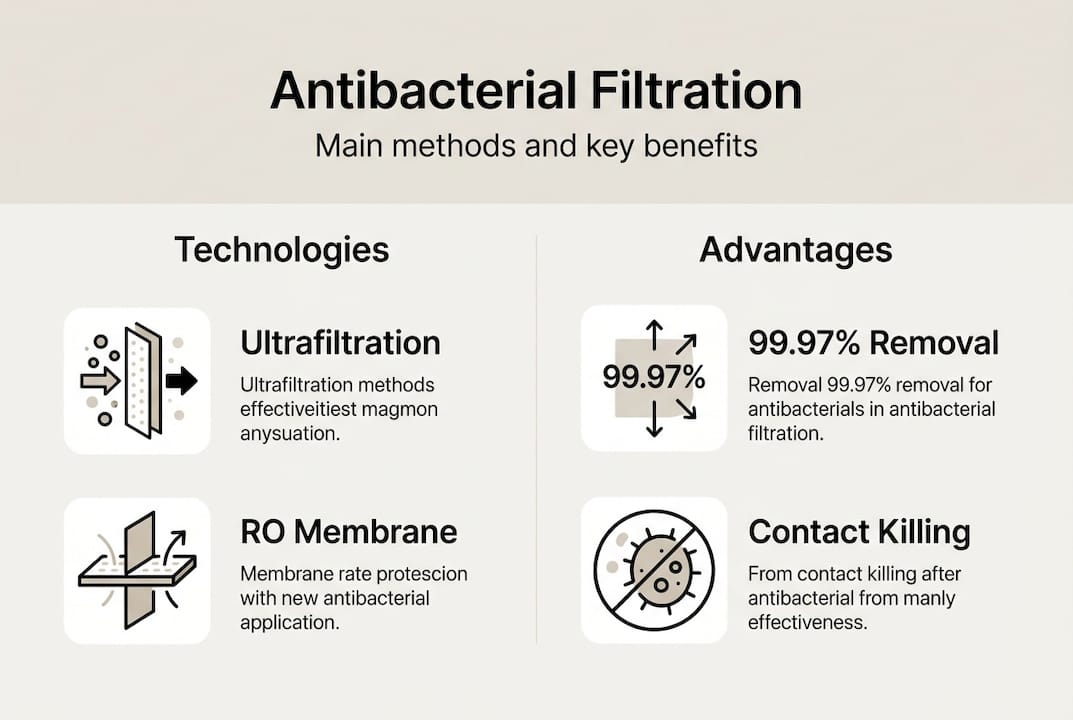
- Physical membrane filtration uses pores as small as 0.01 microns (ultrafiltration) to block bacteria and some viruses
- Antimicrobial agents like silver ions are embedded into filter media to kill bacteria on contact
- Reverse osmosis membranes force water through a semi-permeable barrier, achieving 99%+ bacterial removal
- UV sanitization disrupts bacterial DNA, preventing reproduction
The stakes are real. Waterborne bacteria cause nausea, vomiting, diarrhea, and in vulnerable populations like children and the elderly, serious illness. Many of these pathogens are invisible and odorless, so you cannot rely on your senses to detect them.
“Antibacterial filtration in water filters refers to technologies that either physically remove bacteria via tight membranes or actively inhibit or kill bacteria using embedded antimicrobials.” — Microban, Optimizing Filtration Systems
Ultrafiltration membranes achieve 99.97% bacterial removal in certified systems, while newer antibiotic-infused membranes can reach up to 99.9% microbial kill rates. These numbers matter when you are protecting your family.
How antibacterial filtration works: The main technologies
With this definition established, let’s see how the main antibacterial methods actually work in household filters.
There are four core mechanisms that drive antibacterial filtration, and most high-performing home systems use at least two of them together.
- Physical sieving uses membranes with pores small enough to block bacteria. Ultrafiltration (UF) operates at 0.01 to 0.1 microns. Nanofiltration (NF) and reverse osmosis (RO) go even smaller, blocking viruses and dissolved contaminants.
- Charge-based attraction uses electropositive media that pulls negatively charged bacteria and viruses toward the filter surface, trapping them even when pore size alone would not catch them.
- Contact killing relies on silver ions or antibiotic compounds embedded in the membrane. When bacteria touch the surface, the antimicrobial agent destroys the cell wall or disrupts metabolism.
- Photocatalytic oxidation uses titanium dioxide (TiO2) activated by UV light to generate reactive oxygen species that break down bacteria and organic contaminants.
| Technology | Removal rate | Best use case | Energy needed |
|---|---|---|---|
| Ultrafiltration (UF) | 99.97% bacteria | Under-sink, countertop | Low |
| Reverse osmosis (RO) | 99%+ bacteria and viruses | Whole home, high-risk areas | Moderate |
| Silver-infused carbon | Inhibits regrowth | Pitchers, point-of-use | None |
| Antibiotic membranes | Up to 99.9% kill rate | Advanced under-sink | Low |
| Photocatalytic (TiO2) | Broad spectrum | Combined systems | UV lamp needed |
The antimicrobial strategies for membranes research confirms that combining physical sieving with contact killing produces the most reliable results across varied water conditions. For advanced filtration technology in modern homes, multi-stage systems are now the standard recommendation.
Pro Tip: Know your water source before choosing a method. Clear municipal water may only need UF to handle bacterial risk. Well water or water from aging infrastructure benefits most from RO combined with a silver-infused stage for ongoing inhibition.
Certification matters enormously here. NSF/ANSI standards provide independent proof that a filter performs as claimed. Without certification, a manufacturer’s removal rate is just a marketing number. Always check for filtration trends and updated certification requirements before purchasing.
Comparing antibacterial filtration methods for homes
The main technologies are now clear, but how do they actually stack up for real homes? Here is a side-by-side look.
| Method | Bacteria removal | Virus removal | Chemical reduction | Cost | Maintenance |
|---|---|---|---|---|---|
| UF (0.2 micron) | 99.97% | Partial | No | Low to mid | Filter every 6 months |
| RO | 99%+ | 99%+ | Yes | Mid to high | Annual membrane |
| NF | 99%+ bacteria | Partial | Some | Mid | Annual |
| Silver-infused carbon | Inhibits regrowth | No | Yes (chlorine) | Low | Replace every 2-3 months |
| Antibiotic membrane | Up to 99.9% kill | Partial | No | High | Varies |
| Photocatalytic (TiO2) | Broad spectrum | Yes | Partial | High | UV lamp annually |
As antimicrobial technology research notes, household UF under-sink units with 0.2-micron pores handle bacteria reliably, while RO systems cover both bacteria and viruses at 99% or better. Silver-infused carbon filters add ongoing inhibition that prevents bacterial regrowth inside the filter housing itself.
Here is a quick breakdown of the best fit for common home situations:
- City water users: UF or silver-infused carbon handles most bacterial risk from distribution networks
- Well water households: RO plus UV is the safest combination for unknown bacterial loads
- High-risk areas or immunocompromised family members: Certified RO with antibiotic membrane stage
- Renters or small spaces: Countertop UF or silver-infused pitcher filters offer solid entry-level protection
NSF/ANSI 53 certification covers health-related contaminant reduction. NSF/ANSI P231 is the specific standard for microbiological purification. These are not optional extras. They are the only objective proof a filter does what it claims. You can verify certifications through the NSF water certifications database before buying.
One often overlooked issue is bacterial regrowth. Some filters, particularly those using only physical sieving, can become breeding grounds for bacteria if not replaced on schedule. Silver-infused media helps prevent this by continuously inhibiting growth inside the filter housing. For a deeper compare filtration technologies review, look for systems that address both removal and regrowth prevention. The advanced filtration guide covers this in more detail.
What most people miss: Limitations, pitfalls, and how to choose right
Even the best antibacterial filters are not perfect. Let’s address the biggest misconceptions and what to watch for.
Here are the key limitations that most product pages will not tell you:
- UF membranes block bacteria but are poor against viruses like norovirus, which are smaller than bacterial pores allow
- Post-filtration bacterial regrowth can occur in carbon stages if filter replacement is overdue
- Silver-infused filters may leach silver ions at levels that exceed EPA guidelines if used beyond their rated lifespan
- No antibacterial filter removes every contaminant. Chemical contamination, heavy metals, and viruses each require specific technologies
Here is a practical checklist for choosing the right setup:
- Test your water first. A basic home test kit or a certified lab report tells you what you are actually dealing with. Bacteria, nitrates, and hardness levels all influence which technology fits best.
- Verify NSF/ANSI certification. Do not accept manufacturer claims alone. Check the certification database for the specific model you are considering.
- Understand the maintenance schedule. Every filter has a rated lifespan. Exceeding it does not just reduce performance; it can introduce new contamination.
- Match the method to your source water. City water and well water carry different risks. A filter rated for municipal supply may not handle well water bacterial loads.
- Consider combining technologies. UF plus silver-infused carbon covers both physical removal and ongoing inhibition, which is a stronger approach than either alone.
Pro Tip: Do not assume that a product labeled “antibacterial” is NSF-certified or effective against all contaminants. The label is a marketing term. The certification number is the proof. Always cross-check before buying.
“Regular replacement is not optional. Breakthrough contamination, where bacteria pass through an overloaded or degraded membrane, is a documented risk in systems that are not maintained on schedule.” — antimicrobial insights
The role of filtration technology in long-term home safety depends as much on how you maintain the system as on which system you choose.
A fresh perspective: Why the right antibacterial filter is only half the equation
Most guides stop at technology comparisons, and that is exactly where they let families down. The honest truth is that the gap between a good filter and a safe home is filled by routine, not specs.
We see this pattern repeatedly. A household invests in a certified RO system with a silver-infused stage, checks every box on the technology side, and then skips two filter changes because life gets busy. Six months later, the water quality has slipped back toward where it started. The filter did not fail. The maintenance did.
The best filtration methods are only as effective as the habits built around them. Smart families treat their antibacterial filter as a system with two parts: the certified technology they chose and the scheduled upkeep they commit to. Both matter equally.
Periodic water testing, even after installation, is something most homeowners skip entirely. Testing once a year gives you actual data on whether your filter is performing as expected. It is the difference between assuming you are safe and knowing you are safe.
Explore advanced water purification solutions for your home
Ready to move from understanding to action? Coway offers a range of water purifiers built around the antibacterial filtration principles covered in this guide, from countertop units to full under-sink systems with multi-stage protection.
If you want to understand how each stage of the purification process explained works before you buy, that resource walks through every step in plain language. When you are ready to compare specific models, the top under sink water purifiers page breaks down performance, certification, and maintenance requirements side by side. Visit Coway Water Purifier to browse the full lineup and find the right fit for your family’s water safety needs.
Frequently asked questions
Do I need antibacterial filtration if my city water is already treated?
Even treated city water can pick up bacteria in aging pipes or storage tanks before it reaches your tap. Antibacterial filtration adds a critical layer of protection at the point of use, where bacteria regrowth in distribution networks is a documented risk.
Is silver in water filters safe for long-term use?
Certified silver-based filters are safe within their rated lifespan, but using them beyond that period risks silver ion leaching at levels that exceed EPA guidelines. Always replace on schedule.
How do I know if a water filter is truly antibacterial?
Look for NSF/ANSI P231, 53, or 401 certifications on the product listing. These independently verify performance claims. Not all antibacterial claims are NSF-tested, so the certification number is your most reliable proof.
Can antibacterial filters prevent all types of waterborne illnesses?
No single filter removes every pathogen. Combining certified technologies, such as RO with UV or UF with silver-infused carbon, and maintaining regular replacement schedules gives your family the broadest and most reliable protection available.
Recommended
- Advanced Water Filtration Guide for Healthier Homes – Coway Water Purifier
- How to compare filtration technologies for safer home water – Coway Water Purifier
- Advanced Filtration Technology: Cleaner Home Wellness – Coway Water Purifier
- How filtration prevents disease: homeowner’s guide 2026 – Coway Water Purifier
- Duct Sanitation and Filter Delivery in Tarpon Springs, FL 34689 | Home Therapist
