
Uncategorized
What Is Microfiltration and Its Role in Safer Water

Feb
Finding a reliable way to protect your family’s drinking water can be challenging for American homeowners who prioritize health and wellness. Microfiltration systems offer a practical solution by using precision membranes to trap harmful microorganisms and suspended particles, such as bacteria, clay, and iron deposits. This means your home gains an extra layer of safety where contaminants are screened out before they ever reach your tap, helping you achieve peace of mind while supporting overall household wellbeing.
Table of Contents
- Defining Microfiltration In Home Water Safety
- How Microfiltration Systems Work
- Common Types Of Microfiltration Filters
- Microfiltration Benefits For Health And Wellness
- Comparing Microfiltration To Other Technologies
Key Takeaways
| Point | Details |
|---|---|
| Microfiltration Effectiveness | Microfiltration is a crucial initial step for removing bacteria and suspended solids from household water. It provides essential protection but does not eliminate dissolved chemicals or viruses. |
| Filter Types and Applications | There are two main types of microfiltration filters: surface and depth, each suited for specific contaminant removal needs. Choosing the right type depends on your water quality challenges. |
| Health Benefits | Microfiltration significantly reduces waterborne diseases and protects vulnerable populations, including immunocompromised individuals and children. Regular maintenance ensures continued effectiveness. |
| Comparative Filtration Technologies | Microfiltration offers basic contaminant removal; for more thorough purification, consider technologies like ultrafiltration or reverse osmosis, which target a wider range of contaminants. |
Defining Microfiltration in Home Water Safety
Microfiltration is a specialized water purification process designed to remove microscopic contaminants from household water supplies. This advanced filtration technique uses precision membrane technology to trap particles and microorganisms, providing an essential layer of protection for home water systems.
At its core, microfiltration works through a pressure-driven membrane separation process that physically screens out unwanted elements. The key characteristics include:
- Removes suspended solids larger than membrane pore sizes
- Effectively filters out bacteria and protozoan parasites
- Uses membranes with specific micron-level ratings
- Provides initial purification before more advanced treatment stages
The process targets a range of potential water contaminants, including:
- Suspended particles like clay and silt
- Ferric iron deposits
- Sand and sediment
- Certain pathogenic microorganisms
While microfiltration is powerful, it’s important to understand its limitations. Household microfiltration systems cannot remove dissolved chemical contaminants or viruses, which require additional treatment methods.
Microfiltration represents a critical first line of defense in comprehensive home water safety strategies.
Membrane Technology Details:
- Typical pore sizes range from 0.1 to 10 micrometers
- Filter ratings determine specific contaminant removal capabilities
- Professional certification ensures system effectiveness
Pro tip: Always verify your microfiltration system’s certification and understand its specific filtration capabilities to ensure optimal home water safety.
How Microfiltration Systems Work
Microfiltration systems employ advanced membrane technology to purify household water through a precise mechanical filtration process. Water treatment systems work by forcing water through specialized membranes that physically block contaminants based on particle size and composition.
The core mechanism involves two primary filtering approaches:
- Surface Filters: Trap particles directly on the membrane surface
- Depth Filters: Capture contaminants throughout multiple filter layers
Key operational characteristics include:
- Applying consistent water pressure to move liquid through membranes
- Using precisely engineered pore sizes ranging from 0.1 to 10 micrometers
- Blocking particles larger than membrane openings
- Removing specific contaminants like:
- Clay and silt
- Sand particles
- Iron and manganese deposits
- Some bacterial organisms
Membrane filtration techniques operate most effectively when water undergoes pre-filtering to prevent membrane clogging. This approach ensures maximum filtration efficiency and extends the lifespan of the microfiltration system.
Effective microfiltration requires understanding both the system’s capabilities and its inherent limitations in water treatment.
Filtration Performance Factors:
- Membrane pore size ratings
- Water pressure consistency
- Contaminant concentration
- Pre-treatment processes
Pro tip: Regularly inspect and maintain your microfiltration system to ensure optimal performance and prevent potential contamination.
Common Types of Microfiltration Filters
Microfiltration filters represent a diverse range of water purification technologies designed to address specific contaminant removal needs. Water treatment filters are classified based on their unique design, material composition, and particle removal capabilities.
Two primary microfiltration filter categories exist:
-
Surface Filters:
- Precise, absolute pore size ratings
- Directly block particles on membrane surface
- Optimal for controlling specific bacterial contaminants
- Highly targeted filtration approach
-
Depth Filters:
- Multi-layered filtering media
- Capture particles throughout filter thickness
- Broader contaminant removal range
- More complex internal structure
Key filter classification factors include:
- Micron size rating
- Filtering material composition
- Contaminant removal efficiency
- Maintenance requirements
- Cost-effectiveness
Membrane filtration techniques demonstrate that filter selection depends critically on specific water quality challenges and treatment objectives. Different filter types offer unique advantages for various household water purification scenarios.
Choosing the right microfiltration filter requires understanding your specific water contamination profile and filtration goals.
Filter Selection Considerations:
- Precise contaminant identification
- Water source characteristics
- Budget constraints
- Long-term maintenance needs
- Performance certification standards
Pro tip: Consult a water quality professional to perform a comprehensive water analysis before selecting your microfiltration filter to ensure optimal contaminant removal.
The following table summarizes how different microfiltration filter types suit various household needs:
| Filter Type | Best Application | Lifespan & Maintenance |
|---|---|---|
| Surface Filter | Targeted bacteria control | Needs frequent cleaning |
| Depth Filter | Broad contaminant removal | Longer replacement cycle |
| Hybrid System | Mixed water sources | Requires periodic checks |
Microfiltration Benefits for Health and Wellness
Water safety directly impacts personal health, and microfiltration emerges as a critical technology for protecting household wellness. Water treatment technologies provide a physical barrier against dangerous waterborne contaminants that can compromise human health.
The primary health benefits of microfiltration include:
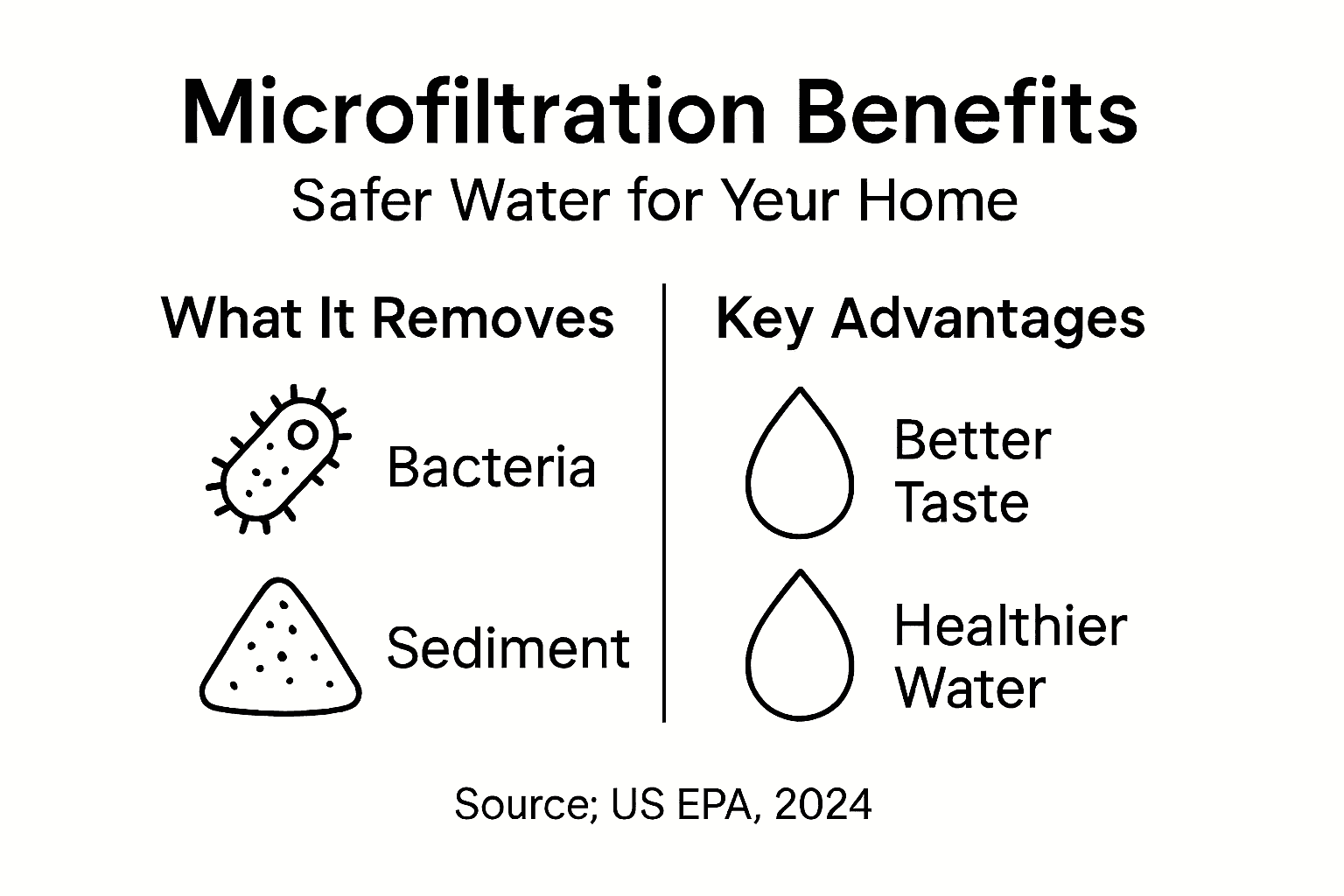
- Removing harmful bacteria and protozoan organisms
- Eliminating suspended solids and potential pathogens
- Reducing risks of waterborne diseases
- Protecting vulnerable population groups
- Preventing gastrointestinal infections
Specific health advantages encompass:
- Protection for immunocompromised individuals
- Safeguarding children’s developing immune systems
- Preventing potential long-term health complications
- Reducing exposure to harmful microorganisms
- Supporting overall bodily wellness
Home water treatment systems play a crucial role in maintaining health by systematically filtering out contaminants that traditional water sources might contain. This process helps mitigate risks associated with unsafe drinking water.
Microfiltration represents a proactive approach to health protection through advanced water purification.
Critical Health Protection Factors:
- Consistent contaminant removal
- Chemical-free filtration process
- Preservation of essential water minerals
- Targeted pathogen elimination
Pro tip: Schedule annual water quality testing to complement your microfiltration system and ensure comprehensive protection against emerging contaminants.
Comparing Microfiltration to Other Technologies
Water filtration technologies represent a spectrum of purification methods, each with unique capabilities and limitations. Membrane filtration processes demonstrate significant variations in contaminant removal based on pore size and technical sophistication.
Key comparative characteristics include:
-
Microfiltration:
- Pore size: ~0.1 micron
- Removes bacteria and protozoa
- Cannot filter viruses or dissolved substances
- Often used as pre-treatment stage
-
Ultrafiltration:
- Pore size: ~0.01 micron
- Removes bacteria and some viruses
- More refined filtration
- Intermediate complexity
-
Nanofiltration:
- Removes organic molecules
- Softens water
- Eliminates divalent ions
- Higher precision filtering
Detailed technology comparison:
- Particle removal capability
- Contaminant types filtered
- Complexity of filtration process
- Cost considerations
- Specific application requirements
Water treatment technologies vary dramatically in their ability to purify water, with each method serving distinct purposes in comprehensive water safety strategies.
Advanced filtration technologies offer progressively more sophisticated contaminant removal mechanisms.
Comparative Filtration Performance:
This table highlights the differences among common water filtration technologies:
| Technology | Main Target Contaminants | Average Cost (Home Use) |
|---|---|---|
| Microfiltration | Bacteria, protozoa | Moderate, $100–$400 |
| Ultrafiltration | Bacteria, some viruses | Higher, $200–$700 |
| Nanofiltration | Organic molecules, ions | High, $300–$900 |
| Reverse Osmosis | Nearly all contaminants | Highest, $400–$1500 |
- Microfiltration: Basic particle removal
- Ultrafiltration: Virus and bacteria filtering
- Nanofiltration: Molecular-level purification
- Reverse Osmosis: Most comprehensive filtration
Pro tip: Consult water quality professionals to determine the most appropriate filtration technology for your specific water source and contamination profile.
Elevate Your Home Water Safety with Trusted Microfiltration Solutions
Understanding the vital role of microfiltration in removing harmful bacteria, protozoa, and suspended solids is the first step toward safer drinking water. If you want to protect your family from waterborne contaminants and enjoy clean, healthy water every day, it is essential to choose a water purifier that uses advanced filtration technology combined with reliable membrane systems. At CowaysWaterPurifier.com you can explore a range of water purification appliances designed to tackle the specific challenges highlighted in microfiltration, such as particle removal and pathogen reduction.
Take control of your household water quality now by visiting CowaysWaterPurifier.com to discover models equipped with precise filtering membranes and additional treatments like UV sanitization. Do not wait until impurities affect your health—invest in effective home water safety solutions today with easy delivery, installation, and maintenance options. Start your journey to safer water by exploring our product lineup and find the perfect purification system that matches your specific needs and water conditions.
Frequently Asked Questions
What is microfiltration in water treatment?
Microfiltration is a water purification process that removes microscopic contaminants, such as bacteria and suspended particles, from household water supplies using precise membrane technology.
How does microfiltration work?
Microfiltration systems use a pressure-driven membrane separation process that filters water through membranes with pore sizes ranging from 0.1 to 10 micrometers, effectively blocking contaminants based on their size.
What are the limitations of microfiltration?
While microfiltration removes suspended solids and certain microorganisms, it cannot eliminate dissolved chemical contaminants or viruses. For complete water treatment, additional methods are required.
How does microfiltration compare to other filtration technologies?
Microfiltration has a pore size of approximately 0.1 microns and primarily removes bacteria and protozoa. In contrast, ultrafiltration (0.01 microns) can remove some viruses, and nanofiltration targets organic molecules and ions, providing increasingly sophisticated levels of purification.
Recommended
- Role of Microfiltration in Safer Home Water – Coway Water Purifier
- Role of Filtration Stages: Improving Home Water Safety – Coway Water Purifier
- Role of Filtration in Health – Why It Matters – Coway Water Purifier
- Understanding the Role of Filtration Technology – Coway Water Purifier
- Understanding What Does IP Rating Mean for Your Devices – buy2fix
