
Uncategorized
Airborne Pollutants Guide: Proven Ways to Boost Home Air Quality
Apr
TL;DR:
- Indoor air can contain 2 to 5 times more pollutants than outdoor air, posing health risks.
- Key pollution sources include VOCs, particulate matter, mold, radon, carbon monoxide, and secondhand smoke.
- Effective strategies involve source control, proper ventilation, and air cleaning, layered for best results.
Most homeowners spend thousands on home upgrades while breathing air that is quietly working against their health. Your indoor air can carry 2 to 5 times more pollutants than the air outside, and most families have no idea. Dust, chemical vapors, mold spores, and invisible gases circulate through your rooms every single day. The good news is that reducing these threats is very achievable once you know what you are dealing with. This guide breaks down the most common indoor airborne pollutants, explains why the problem is more serious than most people realize, and walks you through proven strategies to protect your family and improve your home’s air quality.
Table of Contents
- What are airborne pollutants? The most common indoor contaminants explained
- Why indoor pollution is worse than you think: Surprising benchmarks and health impacts
- Core strategies to reduce airborne pollutants: Source control, ventilation, and air cleaning
- Special scenarios: Radon, mold, wildfire smoke, and high CO2
- What most homeowners get wrong about indoor air quality (and how to do better)
- Take the next step for cleaner air at home
- Frequently asked questions
Key Takeaways
| Point | Details |
|---|---|
| Indoor air is often more polluted | Most homes have 2–5 times higher pollutant levels indoors than outdoors. |
| Source control is key | Eliminating pollution sources is the most effective way to improve indoor air. |
| Combine strategies for best results | Using source control, proper ventilation, and air cleaning together gives the healthiest air. |
| Special cases need extra steps | Radon, mold, and wildfire smoke require targeted testing and solutions. |
| Wellness benefits are significant | Better air means fewer allergies, less asthma, and improved family health overall. |
What are airborne pollutants? The most common indoor contaminants explained
Airborne pollutants are particles, gases, and biological agents suspended in indoor air that your family breathes continuously. Unlike outdoor pollution, which disperses into a vast atmosphere, indoor pollutants get trapped and concentrated inside your home. That makes them far more potent per breath.
Common indoor air pollutants fall into two broad categories: chemical and biological. Understanding both helps you target the right solutions.
The main categories of indoor airborne pollutants:
- Particulate matter (PM2.5 and PM10): Tiny particles from cooking, candles, and tracked-in debris. PM2.5 particles are so small they penetrate deep into lung tissue.
- Volatile organic compounds (VOCs): Chemical gases released by paints, cleaning products, furniture, and adhesives. Formaldehyde is one of the most common.
- Mold and biological contaminants: Spores from mold, bacteria, pet dander, and dust mites thrive in humid, poorly ventilated spaces.
- Radon: A naturally occurring radioactive gas that seeps through foundations. It is odorless and invisible.
- Carbon monoxide (CO) and nitrogen dioxide (NO2): Combustion byproducts from gas stoves, fireplaces, and attached garages.
- Secondhand smoke and wood smoke: Both carry hundreds of toxic compounds that linger on surfaces and in the air long after the source is gone.
As the EPA confirms, the full list of indoor threats includes PM, VOCs, CO, radon, NO2, mold, biological contaminants, secondhand smoke, pesticides, asbestos, formaldehyde, and wood smoke. That is a long list for a space most people consider safe.
| Pollutant | Primary source | Main health concern |
|---|---|---|
| PM2.5 | Cooking, candles, smoke | Lung and heart disease |
| VOCs | Paints, cleaners, furniture | Headaches, liver damage |
| Mold spores | Moisture, leaks | Allergies, asthma |
| Radon | Soil, foundation cracks | Lung cancer |
| CO | Gas appliances, garages | Poisoning, death |
| Formaldehyde | Pressed wood, glues | Respiratory irritation |
“Every home contains a unique mix of these contaminants depending on its age, construction materials, occupant habits, and local environment.”
Learning how indoor pollutants and air purifiers interact is an important first step. But before jumping to solutions, it helps to understand just how serious the exposure really is.
Why indoor pollution is worse than you think: Surprising benchmarks and health impacts
Here is a number that should stop you cold. Americans spend 90% of their time indoors, and indoor pollutant levels are consistently 2 to 5 times higher than what you would breathe outside. That combination is not a minor inconvenience. It is a significant, ongoing health exposure.
Stat to know: Indoor air quality ranks among the top five environmental risks to public health, according to EPA assessments.
The health effects range from annoying to severe. Short-term exposure causes eye irritation, headaches, fatigue, and worsened allergy symptoms. Long-term exposure is linked to asthma development, chronic respiratory disease, heart conditions, and emerging research is connecting poor indoor air to cognitive decline and reduced focus.
Who is most at risk from indoor air pollution:
- Children, whose developing lungs are more vulnerable to particle damage
- Elderly individuals with reduced respiratory reserve
- People with existing asthma, allergies, or immune conditions
- Pregnant women, where fetal exposure to VOCs and PM2.5 is a growing concern
- Anyone who works from home and spends extended hours in the same indoor environment
The indoor air pollution effects on families are not always dramatic or sudden. That is what makes this threat so easy to dismiss. Symptoms often get blamed on seasonal allergies, stress, or aging, when the real culprit is the air inside your home.
The flip side is genuinely encouraging. Homes with clean indoor air report fewer sick days, better sleep quality, and improved concentration. Reviewing a solid indoor air quality guide can help you set a baseline and track real improvements over time. Start with a home air quality checklist to identify your biggest exposure points.

Pro Tip: Place a carbon monoxide detector on every floor of your home and test it monthly. CO poisoning mimics flu symptoms and is often missed until levels become dangerous.
For a broader view of how serious this issue is nationally, the EPA indoor air quality report provides data that puts the scale of the problem into sharp perspective.
Core strategies to reduce airborne pollutants: Source control, ventilation, and air cleaning
The EPA identifies three primary methods for improving indoor air: source control, ventilation, and air cleaning. Each plays a different role, and they work best when combined. But the order matters.
Ranked by effectiveness:
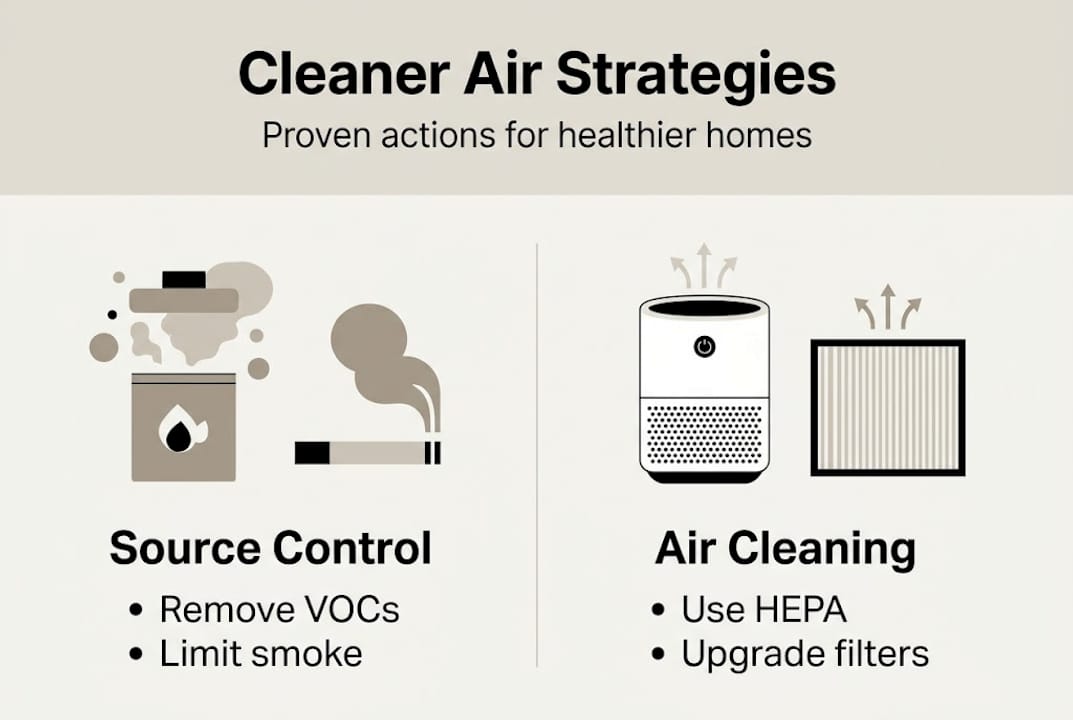
- Source control eliminates or reduces the pollutant at its origin. Switch to low-VOC paints, stop smoking indoors, fix moisture leaks immediately, and vent all combustion appliances outside. This is the most cost-effective step and the one most homeowners skip.
- Ventilation dilutes and removes indoor pollutants by bringing in fresh outdoor air. Open windows when outdoor air quality is good, run bathroom and kitchen exhaust fans during and after cooking, and consider an energy recovery ventilator (ERV) for a whole-home solution.
- Air cleaning uses filters and purifiers to capture particles and gases that remain after source control and ventilation. HEPA filters capture 99.97% of particles at 0.3 microns. MERV 13 or higher filters in your HVAC system significantly reduce fine particle loads throughout the home.
| Strategy | Best for | Cost level | Effort level |
|---|---|---|---|
| Source control | VOCs, smoke, moisture | Low | Medium |
| Ventilation | CO2, general freshness | Low to medium | Low |
| Air cleaning | Particles, allergens | Medium to high | Low |
The indoor air optimization process works best when you treat these three strategies as a layered system rather than standalone fixes. Many homeowners jump straight to buying an air purifier without addressing the sources first, which is like mopping the floor while the faucet is still running.
Pro Tip: Replace your HVAC filter with a MERV 13 rated option and check it every 60 days. A clogged filter does not just stop working. It can actually push more particles back into your air.
For step-by-step implementation, the air quality improvement steps resource walks you through prioritizing changes based on your specific home setup. The EPA guide on core strategies also provides a useful technical reference for understanding filter ratings and ventilation standards.
Special scenarios: Radon, mold, wildfire smoke, and high CO2
Some indoor air threats need more than standard fixes. These four scenarios require specific responses that go beyond swapping filters or opening windows.
Radon is the second leading cause of lung cancer in the United States, and most homeowners have never tested for it. It seeps through foundation cracks from naturally occurring uranium in the soil beneath your home. You cannot smell it or see it. Purchase an EPA-approved radon test kit, leave it in your lowest lived-in level for the recommended period, and send it to a certified lab. If results exceed 4 pCi/L, hire a licensed mitigation contractor to install a sub-slab depressurization system.
Mold becomes a serious problem when indoor relative humidity climbs above 60%. Mold spores are always present in air, but they only colonize and grow when moisture is available. Fix plumbing leaks immediately, run exhaust fans in bathrooms and kitchens, and use a dehumidifier in basements or humid climates. If you see visible mold covering more than 10 square feet, call a professional remediation service rather than attempting DIY cleanup.
Wildfire smoke events are becoming more frequent and more intense. During a smoke event, the EPA recommends keeping windows and doors closed, running a portable HEPA air purifier, and switching your HVAC system to recirculate mode so it does not draw in outdoor smoke. Avoid activities that add indoor particles like frying food, burning candles, or vacuuming without a HEPA-filtered vacuum.
High CO2 in your home is a sign that ventilation is inadequate. In crowded or tightly sealed homes, CO2 from breathing accumulates and causes drowsiness, reduced concentration, and headaches. A simple CO2 monitor (available for under $100) will tell you when to open windows or run your ventilation system.
Pro Tip: Run a radon test every two years, especially after any major renovation or foundation work. Construction disturbance can open new pathways for radon entry.
For more on managing these threats as part of a complete home strategy, the indoor air quality guide covers testing protocols and when professional help is the right call.
What most homeowners get wrong about indoor air quality (and how to do better)
The most common mistake we see is homeowners buying an air purifier as their first and only step. It feels productive. It looks good in the corner of the room. But if you are still using VOC-heavy cleaning sprays, running a gas stove without ventilation, or ignoring a slow bathroom leak, the purifier is fighting a battle it cannot win alone.
The EPA is clear that source control should always come first. No technology compensates for overlooking the root causes of pollution. Air fresheners are arguably the worst offender here. They do not clean air. They add VOCs to it while masking odors.
A genuinely healthy home starts with awareness and honest habits. Walk through your home with a home air quality checklist and identify what you are actually bringing into your air daily. Then layer in ventilation and filtration as supporting tools. That sequence, awareness first, sources second, technology third, is what produces lasting results and real wellness benefits.
Take the next step for cleaner air at home
You now have the knowledge to make meaningful changes to your home’s air quality. The next step is putting it into action with the right tools.
At Coway, we have built our air purification products around the same layered approach this guide describes: advanced HEPA filtration, real-world tested performance, and designs that fit seamlessly into your home. Whether you are ready to choose your first purifier or want to upgrade your current setup, our best air purifier 2026 analysis makes it easy to find the right match. Use our air purifier selection guide to compare models by room size and filtration need, or start with our air purification checklist to confirm you have covered every layer of protection.
Frequently asked questions
What is the single most effective way to reduce indoor airborne pollutants?
Source control is the most effective method, meaning you eliminate or reduce the pollution at its origin before it ever enters your air.
How effective are portable HEPA air purifiers for home use?
A properly sized HEPA purifier can reduce fine particle pollution by 30 to 60% during high-exposure events like wildfires, and HEPA filters capture up to 99.97% of airborne particles.
What should I do during a wildfire to protect my home’s air?
Keep windows and doors closed, run a HEPA air purifier, and set your HVAC to recirculate so it does not pull in smoke from outside until outdoor air quality improves.
Can airborne pollutants really cause long-term health issues?
Yes. Ongoing exposure is linked to asthma, chronic allergies, cognitive effects, and serious illness, as documented in the EPA indoor air quality report.
Is indoor air always worse than outdoor air?
Not always, but in most homes indoor pollutant levels run 2 to 5 times higher than outdoor levels, making indoor air the bigger daily exposure risk for most families.
Recommended
- Step-by-Step Guide to Indoor Air Quality Improvement – Coway Water Purifier
- Air purification checklist: 6 steps for healthier home air – Coway Water Purifier
- Indoor Air Optimization Process for Healthier Homes – Coway Water Purifier
- Spot the signs of poor air quality for a healthier home – Coway Water Purifier
- Air Fresheners | Ozifresh Hygiene Services
