
Uncategorized
What Is Filter Micron Rating? A Homeowner’s Guide

May
TL;DR:
- Choosing the right micron rating depends on the specific contamination to be removed, as finer filters reduce flow and clog faster.
- Absolute ratings provide more reliable particle removal, especially for critical applications like bacteria or cysts, unlike nominal ratings.
Most homeowners assume the smallest micron rating they can find equals the best filter they can buy. That assumption costs people money, reduces water pressure, and sometimes damages their filtration systems. Understanding what is filter micron rating actually means changes how you shop for, use, and maintain every filter in your home. This guide breaks down the micron filter definition in plain terms, shows you which particle sizes matter for real-world contamination, and helps you make smarter choices for your water and air quality without overcomplicating it.
Table of Contents
- Key takeaways
- What is filter micron rating, explained simply
- Micron sizes and what they actually remove
- Why lower micron isn’t always better
- Choosing and maintaining filters the right way
- Common myths about micron ratings
- My honest take after years of watching homeowners get this wrong
- How Cowayswaterpurifier applies this thinking to real products
- FAQ
Key takeaways
| Point | Details |
|---|---|
| Micron measures particle size | One micron equals one-millionth of a meter, setting the scale for what your filter captures. |
| Nominal vs. absolute ratings differ | Nominal filters remove 60–98% of particles; absolute filters guarantee 99.9%+ retention at the stated size. |
| Smaller isn’t always better | Finer micron ratings increase pressure drop, reduce flow, and cause faster clogging in home systems. |
| Multi-stage filtration wins | Pairing a coarse pre-filter with a fine filter protects the system and extends filter life. |
| Micron ratings don’t cover chemicals | A filter’s micron rating tells you about particle removal only, not chemical or taste improvement. |
What is filter micron rating, explained simply
A micron is a unit of measurement. Specifically, one micron equals one-millionth of a meter, which is roughly 1/25,400 of an inch. For comparison, a single strand of human hair measures somewhere between 40 and 90 microns wide. That context matters because most of the harmful particles you want removed from your water or air are far, far smaller than what you can see with the naked eye.
A filter micron rating tells you the smallest particle size that filter is designed to capture. A filter rated at 5 microns stops particles 5 microns or larger from passing through. A filter rated at 0.5 microns works at a finer scale and captures much smaller particles. Here’s where most people get the first part wrong. The micron rating does not tell you how well the filter captures particles at that size. That depends on whether you’re looking at a nominal or absolute rating.
- Nominal micron rating: Captures a percentage of particles at the stated size, typically between 60% and 98% retention. It’s a general target, not a guarantee.
- Absolute micron rating: Captures 99.9% or more of particles at the stated size. This is the stricter, more reliable standard for critical applications.
Most affordable household filters carry nominal ratings. That isn’t automatically bad, but it means you should read filter specs carefully before assuming a “5 micron filter” removes virtually all 5 micron particles.
Pro Tip: When shopping for water filters, look for “absolute” in the spec sheet if you need high confidence in particle removal. Nominal filters work well for general sediment reduction, but absolute filters matter when you’re targeting bacteria or cysts.
Micron sizes and what they actually remove
Understanding micron ratings becomes practical when you connect the numbers to real contaminants. Here’s a comparison of the most common filter micron sizes and what they’re designed to catch.
| Micron rating | Particles captured | Typical use |
|---|---|---|
| 50+ microns | Visible debris, sand, large sediment | Pre-filtration, irrigation |
| 20 microns | Fine sand, rust flakes, large silt | Whole-house pre-filter |
| 10 microns | Silt, clay, smaller rust particles | General household sediment |
| 5 microns | Fine sediment, sand, dirt | Standard drinking water pre-filter |
| 1 micron | Most bacteria, fine particulates | Under-sink water filters |
| 0.3 microns | Fine bacteria, airborne particles | HEPA-grade air filtration |
| 0.1 microns or below | Viruses, some chemical clusters | Specialized or multi-stage systems |
According to filter micron research, 1 micron captures bacteria while 5 micron filters target larger contaminants like sand and rust. So for a homeowner dealing with rust-colored water from older pipes, a 5 or 10 micron sediment filter is often exactly what’s needed. You don’t need to jump to a 0.5 micron filter for that job.

Air filtration follows a related logic. True HEPA filters capture 99.97% of particles at 0.3 microns, which is recognized as the most difficult particle size to trap. Particles smaller than 10 microns are particularly dangerous because they can travel deep into your lungs and even enter your bloodstream. That’s why HEPA filters carry a MERV rating of 17 or higher for verified performance.
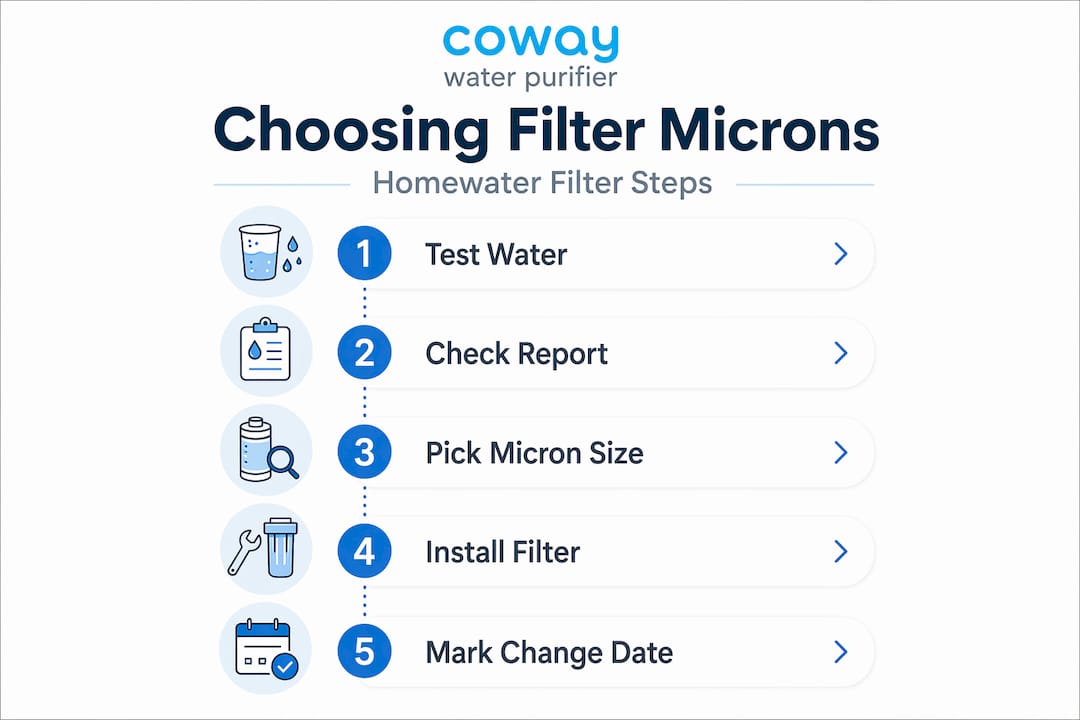
For water filtration, your local water quality report (available from your utility provider) is the single best starting point. If your report shows elevated sediment or turbidity, a 5 to 20 micron filter addresses that efficiently. If you’re on well water with potential bacteria exposure, you want a 1 micron or finer absolute-rated filter followed by UV treatment.
Pro Tip: Get your water tested before choosing a micron rating. Spending money on a 0.2 micron filter when your actual problem is 50 micron sediment just wastes money and kills flow rate.
Why lower micron isn’t always better
This is the part that surprises most homeowners. Going with the finest micron filter available seems like the safest choice. It’s not. Overspecifying fine micron filters leads to excessive pressure drop, reduced water flow, and in extreme cases, filter media tearing or collapse under pressure.
There’s also an important distinction in how micron ratings are actually measured and applied. Micron ratings are not standardized across the filtration industry. Two filters with the same nominal rating from two different manufacturers can perform very differently because the testing methods and the way pore sizes are distributed in the filter media vary. A “5 micron” filter from one brand might outperform a “3 micron” filter from another. This is a critical reason to look beyond the number alone and pay attention to the brand’s testing documentation.
Here’s what happens when you choose a micron rating that’s too fine for your system:
- Water pressure at your tap drops noticeably because the filter restricts flow.
- The filter clogs much faster, requiring more frequent and costly replacements.
- In severe cases, the pressure differential across the filter can cause structural damage to the filter housing or the filter media itself.
- Reduced flow can interfere with appliances that rely on minimum water pressure, like refrigerator filters and water heaters.
Choosing a micron rating is always a balance. The right number isn’t the smallest you can find. It’s the smallest that matches your actual contamination problem without sacrificing system performance.
A much smarter strategy is multi-stage filtration. You start with a coarser pre-filter at 20 or 50 microns to strip out the bulk sediment, then follow it with a 1 micron or sub-micron filter for finer particles. This staged approach protects finer downstream filters from premature loading and extends the entire system’s life significantly. Think of it as a bouncer at the door who stops the obvious troublemakers before they reach the inner room.
Choosing and maintaining filters the right way
Applying filter micron size explained in real life comes down to a clear, repeatable decision process. Here’s how to approach it as a homeowner.
-
Identify your contamination type. Get a water quality test or review your utility’s annual report. For air, check your local air quality index and note whether you have allergy or asthma concerns in the household. Your contamination type determines the micron range you actually need.
-
Match the micron rating to the contaminant. Sediment and sand need 5 to 20 microns. Bacteria calls for 1 micron or below with an absolute rating. Fine airborne allergens and particulates need HEPA-grade filtration. Match the tool to the job.
-
Check your system’s flow rate requirements. Every water purifier or filtration system has a minimum flow rate. Selecting a filter that’s too fine can drop pressure below that threshold. Always confirm the filter’s rated flow alongside its micron rating before purchasing.
-
Plan for multi-stage filtration where possible. If your water has both sediment and bacterial concerns, a single filter trying to do both jobs will clog fast and perform inconsistently. Separate the stages. A coarse sediment pre-filter before a fine filter is the standard approach for good reason.
-
Set a replacement schedule based on micron rating. Finer filters clog faster than coarser ones because they trap more particles per gallon. A 1 micron filter in a home with high sediment load may need replacement every two to three months. A 20 micron pre-filter might last six months. Check your water color and flow rate regularly as early warning signs.
Pro Tip: Write the installation date directly on your filter housing with a permanent marker. You’ll never have to guess when it was last changed, and you’ll notice any accelerated clogging before it becomes a pressure problem.
Common myths about micron ratings
Several persistent myths around understanding micron ratings lead homeowners to make frustrating and expensive mistakes.
- Myth: A lower micron number always means better protection. Not true. It means finer particle capture, but if your water problem is large sediment, a 0.5 micron filter is overkill and will clog within weeks.
- Myth: A micron rating covers chemical removal. It does not. Micron ratings describe particle filtration only, not the removal of chlorine, heavy metals, pesticides, or taste and odor issues. Those require activated carbon or other media types.
- Myth: All filters with the same micron rating perform the same. Filter construction, media type, and testing standards vary widely between manufacturers, meaning filters with identical nominal ratings can deliver very different real-world results.
- Myth: You only need one filter stage. A single filter trying to handle both coarse and fine filtration wears out faster and provides less consistent performance than a two-stage system designed to share the workload.
The importance of filter micron ratings lies not just in knowing the number, but in knowing what that number can and cannot do for your household.
My honest take after years of watching homeowners get this wrong
I’ve seen homeowners spend twice what they needed to on ultra-fine filters while their actual problem was rust particles large enough to see with the naked eye. In my experience, overspecifying a micron rating is one of the most common and costly filtration mistakes people make at home. They grab the smallest number on the shelf, install it, and then call a plumber three months later because their water pressure has tanked.
What I’ve learned is that the multi-stage approach practically never fails. A good coarse pre-filter does the heavy lifting, so the fine filter downstream stays cleaner longer and performs at its rated specification. The systems I’ve seen last the longest and protect health the most consistently are always staged, not single-point.
The other thing I want to push back on is the idea that micron rating is the main thing to look for. It matters, but filter media quality, absolute vs. nominal ratings, and testing standards can change performance dramatically from one product to the next. I’d rather have an absolute-rated 1 micron filter from a reputable brand than a nominal 0.3 micron filter with zero documentation on how that number was measured. Understanding filter ratings and specifications beyond just the micron number is what separates informed buyers from frustrated ones.
— Soldierboy
How Cowayswaterpurifier applies this thinking to real products
If you’ve made it this far, you now know more about micron ratings than most people who’ve owned water purifiers for years. The next step is finding products that actually apply these principles in their design.
Cowayswaterpurifier offers water and air purification systems built around multi-stage filtration logic, where coarse and fine filter stages work together rather than forcing one filter to do everything. Their water purification process guide walks through how different filtration stages remove different particle types, which is exactly the kind of layered approach this article covers. If you want a side-by-side look at how those stages perform in a real product, the countertop ice water purifier is a strong example of balanced filter design for everyday home use. For air quality, the air purifier selection guide covers HEPA-grade micron filtration in detail.
FAQ
What does micron rating mean on a water filter?
A micron rating tells you the smallest particle size, in millionths of a meter, that a filter is designed to capture. A 5 micron filter removes particles 5 microns and larger, including fine sand, rust, and sediment.
Is a 1 micron filter better than a 5 micron filter?
It depends on what you’re filtering out. A 1 micron filter captures finer particles including most bacteria, but it also clogs faster and reduces flow more than a 5 micron filter. For large sediment, a 5 micron filter is often the smarter choice.
What is the difference between nominal and absolute micron ratings?
A nominal rating means the filter captures most particles at the stated size, generally between 60% and 98%. An absolute rating means 99.9% or higher retention, making it the more reliable standard when precision matters.
Does a lower micron rating remove chemicals from water?
No. Micron ratings only describe physical particle removal. Removing chemicals, heavy metals, chlorine, or improving taste requires activated carbon or other specialized filter media, regardless of the micron rating.
What micron rating do HEPA air filters use?
True HEPA air filters are rated to capture 99.97% of particles at 0.3 microns, the most difficult particle size to trap. They typically carry a MERV rating of 17 or higher.
Recommended
- Understand filtration efficiency ratings for healthier homes – Coway Water Purifier
- Why Filter Indoor Air: Complete Homeowner Guide – Coway Water Purifier
- Understanding particulate filtration for healthier home air – Coway Water Purifier
- What Is Microfiltration and Its Role in Safer Water – Coway Water Purifier
