
Uncategorized
Mastering Air Quality Regulations for Offices: Compliance Made Simple

Apr
TL;DR:
- No single federal or EU law mandates office indoor air quality standards; compliance relies on guidelines.
- Key benchmarks include ASHRAE ventilation rates, CO2 below 1000 ppm, and MERV 13 filters.
- Proactive measurement, system upgrades, and occupant engagement are essential for healthier workplaces.
There is no single federal law that tells you exactly what your office air must contain. For office managers and small business owners trying to do the right thing, that reality creates genuine confusion. No specific federal OSHA IAQ standards exist for offices, which means compliance depends on a patchwork of voluntary guidelines, building codes, and general safety obligations. This guide cuts through that noise. Whether you operate in the USA or Europe, you will leave with a clear picture of what applies to you, what the numbers actually mean, and the exact steps to protect your team and your organization.
Table of Contents
- Core air quality regulations: USA vs Europe
- Key standards and benchmarks: What matters for offices
- Practical steps to comply and improve air quality
- Going beyond compliance: Creating a truly healthy workplace
- Our perspective: Why most offices get air quality wrong (and how to get it right)
- Improve your office air quality with advanced solutions
- Frequently asked questions
Key Takeaways
| Point | Details |
|---|---|
| No universal rules | Offices face varying air quality requirements in the USA and Europe, with most standards being guidelines rather than strict law. |
| Essential benchmarks | Focusing on ventilation rates, CO2, PM2.5, and proper HVAC maintenance covers most compliance bases. |
| Practical steps matter | Annual HVAC checks, sensor-based monitoring, and upgraded filters greatly improve office air quality outcomes. |
| Exceed minimums | Going beyond compliance boosts productivity and creates healthier workplaces worth emulating. |
Core air quality regulations: USA vs Europe
With the groundwork set, let’s examine how regulations differ and surprisingly overlap across the USA and Europe.
The first thing most office managers discover is that the regulatory landscape looks very different depending on which side of the Atlantic you are on. In the USA, no federal OSHA office IAQ standard exists. Instead, employers rely on the General Duty Clause, which requires workplaces to be free from recognized hazards. ASHRAE 62.1, a voluntary standard from the American Society of Heating, Refrigerating and Air-Conditioning Engineers, provides ventilation guidelines that many local building codes adopt by reference. That voluntary status is important because it means enforcement is inconsistent and often reactive.
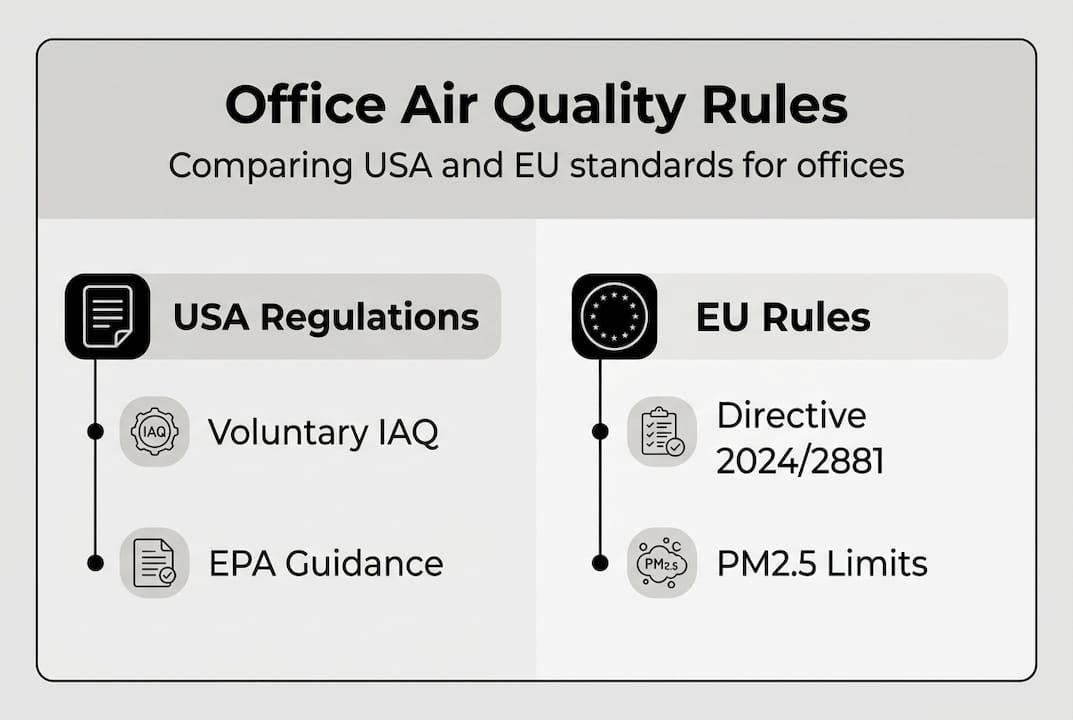
In Europe, the picture is more structured but still fragmented. Directive 2024/2881 governs outdoor PM2.5 and NO2 limits with targets set for 2030. The Energy Performance of Buildings Directive (EPBD) requires each EU member state to establish its own indoor air quality and ventilation standards. So a business in Germany operates under different specific rules than one in Spain, even though both follow the same EU framework.
| Factor | USA | Europe |
|---|---|---|
| Mandatory federal/EU IAQ law | No | No unified standard |
| Key framework | ASHRAE 62.1, General Duty Clause | EPBD, Directive 2024/2881 |
| Enforcement mechanism | OSHA complaint-driven | National regulators |
| Outdoor air limits | EPA NAAQS | Directive 2024/2881 |
| Ventilation guidance | ASHRAE 62.1 | National standards via EPBD |
Both regions share a core concern: protecting occupants from pollutants like PM2.5 (fine particulate matter), CO2, and volatile organic compounds (VOCs). What differs is how that concern is translated into law.
Key pollutants that offices on both sides must address include:
- PM2.5: Fine particles from outdoor infiltration, printers, and cleaning products
- CO2: A proxy for ventilation adequacy and occupant density
- VOCs: Emitted by furniture, adhesives, and cleaning chemicals
- NO2: More relevant near high-traffic areas or parking garages
“The absence of a single enforceable standard does not reduce employer responsibility. It simply shifts the burden to the employer to stay informed and proactive.”
For practical office wellness insights and a deeper look at how air purifiers fit into your compliance strategy, the role of air purifiers in office environments is worth understanding before you finalize any plan.
Key standards and benchmarks: What matters for offices
Once you know the framework, it helps to get clear on the numbers and targets that matter for real-world compliance.
Numbers give you something to measure against. Without them, air quality becomes a vague aspiration. The most important benchmark for offices in the USA comes from ASHRAE 62.1 ventilation rates: approximately 17 CFM (cubic feet per minute) per person, calculated as 5 CFM per person plus 0.06 CFM per square foot at a standard density of 200 square feet per person. The target is a steady-state CO2 level below 1,000 ppm (parts per million). That number matters because CO2 is the easiest real-time proxy for whether fresh air is actually reaching your occupants.
The EPA’s IAQ guidelines emphasize three pillars: source control, ventilation, and filtration. They are not enforceable rules, but they are the foundation of every credible office air quality program.
| Parameter | Recommended target | Standard/Source |
|---|---|---|
| Ventilation rate | ~17 CFM/person | ASHRAE 62.1 |
| CO2 | <1,000 ppm | ASHRAE 62.1 |
| PM2.5 | <12 µg/m³ (annual) | EPA NAAQS |
| Relative humidity | 30% to 60% | ASHRAE 55 |
| Filtration | MERV 13 or higher | EPA/ASHRAE guidance |
A few pollutants deserve special attention:
- CO2 above 1,000 ppm correlates with reduced cognitive performance and increased fatigue
- PM2.5 above 35 µg/m³ (24-hour average) triggers health concerns under EPA standards
- VOCs have no single threshold but are linked to headaches, eye irritation, and long-term respiratory issues
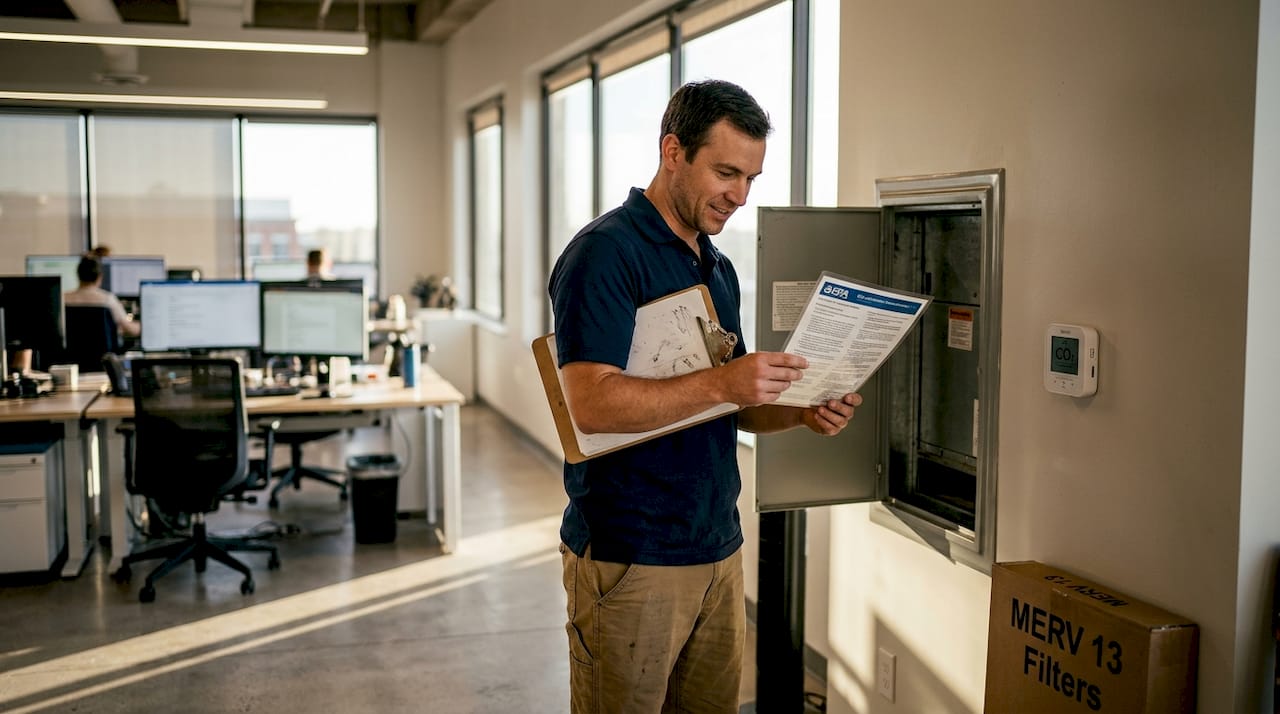
Filters rated MERV 13 (Minimum Efficiency Reporting Value) capture at least 85% of particles in the 1 to 3 micron range. That includes most PM2.5 and many biological particles. Upgrading from a standard MERV 8 filter to MERV 13 is one of the highest-impact, lowest-cost changes most offices can make.
Pro Tip: Install a CO2 sensor in your most densely occupied conference room. If readings regularly exceed 1,000 ppm during meetings, your ventilation system is not keeping up, and that is your first compliance signal to act on.
For a step-by-step IAQ improvement plan and a closer look at filtration efficiency explained, both resources will help you translate these benchmarks into real decisions.
Practical steps to comply and improve air quality
Having covered what the numbers mean, it is time to translate those into the exact steps office decision makers can implement.
Compliance does not happen from reading a guide. It happens from a scheduled, documented process. Here is a practical sequence that covers both USA and European requirements:
- Audit your HVAC system. Start with a professional inspection. ASHRAE Table 8-1 maintenance recommends annual HVAC inspections and testing, adjusting, and balancing (TAB) every three years. If you cannot document your last inspection, schedule one now.
- Upgrade filtration. Replace filters rated below MERV 13 with MERV 13 or higher equivalents. Verify your HVAC system can handle the increased resistance before upgrading.
- Deploy CO2 and PM2.5 monitors. Place sensors in high-occupancy zones. Real-time data lets you respond before problems become complaints or health incidents.
- Implement demand-controlled ventilation (DCV). DCV systems use CO2 sensors to automatically adjust fresh air intake based on actual occupancy. This keeps CO2 below 1,000 ppm while reducing energy costs during low-occupancy periods.
- Document everything. Inspection records, filter change logs, and sensor data form your compliance paper trail. In the event of an OSHA inspection or a European regulatory review, documentation is your first line of defense.
- Train your facilities team. The best systems fail without people who understand why they matter. Brief quarterly reviews of air quality data keep your team aligned.
“Demand-controlled ventilation can reduce HVAC energy use by 20% to 30% while simultaneously improving compliance. It is one of the few investments that pays for itself in both health and operating costs.”
Pro Tip: Set automated alerts on your CO2 monitors so your facilities team gets a notification when any zone exceeds 900 ppm. Acting at 900 ppm gives you a buffer before you hit the 1,000 ppm compliance threshold.
For a comprehensive air quality guide and a look at the full air optimization process, both resources support the implementation steps above.
Going beyond compliance: Creating a truly healthy workplace
Compliance is just the start. Let’s explore how to make your office stand out as a leader in workplace health.
Meeting the minimum is not the same as creating a workplace where people thrive. Organizations that go beyond the checklist consistently report lower absenteeism, higher employee satisfaction scores, and better retention. The investment is modest compared to the return.
The EPA recommends integrated strategies that combine source control, enhanced filtration, upgraded monitoring, and continuous improvement. In practice, that means:
- Switch to green cleaning products. Many standard cleaning chemicals release VOCs that linger for hours. Certified low-VOC alternatives cost roughly the same and eliminate a significant pollution source.
- Control humidity actively. Relative humidity between 30% and 60% inhibits mold growth and dust mite populations while keeping occupants comfortable. Both too dry and too humid conditions degrade air quality.
- Engage occupants. Post air quality data on a shared dashboard. When employees can see CO2 levels in real time, they naturally adjust behaviors like opening windows or reducing occupancy in crowded rooms.
- Audit furniture and materials. New furniture, carpets, and paints off-gas VOCs for weeks. Schedule major renovations during low-occupancy periods and increase ventilation rates for 72 hours after installation.
- Consider third-party certification. Programs like WELL Building Standard, RESET Air, and LEED provide independent verification that your air quality meets rigorous benchmarks. Certification signals commitment to clients, recruits, and regulators.
Pro Tip: Even without full certification, downloading the WELL or RESET Air assessment criteria is free and gives you a world-class benchmark to measure your current performance against.
For actionable 8 IAQ tips you can implement this week and a practical air quality checklist to track your progress, both resources make the beyond-compliance journey straightforward.
Our perspective: Why most offices get air quality wrong (and how to get it right)
Stepping back, it is worth asking why air quality compliance remains such a pain point for so many well-meaning organizations.
The honest answer is that voluntary standards create a false sense of optionality. When nothing is technically mandatory, it is easy to deprioritize. In the USA, the voluntary-first approach means inconsistency between voluntary and mandatory standards is the norm, not the exception. In Europe, the push for harmonization is real, but national variation still gives organizations room to do the minimum and call it done.
The offices that get air quality right do not treat it as a compliance exercise. They treat it as an operational investment. They measure continuously, not just during inspections. They upgrade proactively, not reactively. And they communicate results to their teams, which creates accountability and trust.
The uncomfortable truth is that most air quality failures are not technical. They are organizational. The sensor is there. The filter is there. But nobody checked the data last quarter, and nobody replaced the filter on schedule. Building a culture where air quality is tracked like a financial metric is what separates leaders from laggards.
Improve your office air quality with advanced solutions
If you have worked through this guide, you already know more about office air quality than most facilities managers. The next step is putting the right equipment in place to back up your strategy.
A high-performance air purifier with HEPA and activated carbon filtration adds a critical layer of protection that HVAC systems alone cannot provide, especially for VOCs and ultrafine particles. Our air purifier selection guide walks you through choosing the right unit for your office size and specific pollutant concerns. If you want to see how leading models compare for workplace use, the best air purifiers 2026 roundup gives you a clear, evidence-based starting point. Your team’s health is worth the investment.
Frequently asked questions
Are air quality regulations for offices legally enforceable in the USA?
Most office air quality regulations in the USA are voluntary, but OSHA’s General Duty Clause requires employers to eliminate recognized hazards, which includes poor air quality when it poses a known risk.
What air quality parameters should offices monitor for compliance?
Prioritize CO2 (target below 1,000 ppm), PM2.5, ventilation rate in CFM per person, relative humidity, and temperature. ASHRAE 62.1 benchmarks cover all of these and are widely used as the practical compliance standard in the USA.
How often should HVAC systems be inspected in offices?
Annual HVAC inspections are the standard, with full testing, adjusting, and balancing performed every three years per ASHRAE Table 8-1 best practices.
Is there a universal EU office air quality standard?
No single EU standard covers all offices, but Directive 2024/2881 and EPBD together require each member state to set its own indoor air quality and ventilation rules, which your local regulator enforces.
Recommended
- Office Wellness via Air Quality: Healthier Workplaces – Coway Water Purifier
- Step-by-Step Guide to Indoor Air Quality Improvement – Coway Water Purifier
- Indoor Air Optimization Process for Healthier Homes – Coway Water Purifier
- Airborne Pollutants Guide: Proven Ways to Boost Home Air Quality – Coway Water Purifier
- Air Quality and Carpets: Complete Guide for Homes – Yarra Valley Carpet Cleaning
