
Uncategorized
Understand filtration efficiency ratings for healthier homes
Apr
TL;DR:
- Filtration ratings are system-specific and involve trade-offs between particle removal and system performance.
- Matching your filtration system to your specific contaminants ensures safer water and air quality.
- Certifications like NSF 53 and 58 offer more reliable protection than ratings alone for health-critical concerns.
Most families assume that the smallest micron number or the highest MERV rating automatically means the best protection. That assumption leads to clogged filters, stressed HVAC systems, and water that still contains chemicals a fine-mesh filter was never designed to catch. Filtration efficiency ratings for both air and water are actually a system of trade-offs, and understanding how they work together is what keeps your household genuinely safer. This article breaks down micron ratings, MERV scores, and NSF certifications in plain terms, so you can make choices that match your real health goals.
Table of Contents
- What are filtration efficiency ratings?
- Decoding micron, MERV, and NSF: How the main ratings work
- How to choose the right filter for your health goals
- Trade-offs, common mistakes, and myths about efficiency ratings
- Our take: Why filter certifications and smart choices matter more than chasing ratings
- Take the next step to a cleaner, safer home
- Frequently asked questions
Key Takeaways
| Point | Details |
|---|---|
| Understand all ratings | Knowing the differences between micron, MERV, and NSF ratings helps you choose the right filters for every home use. |
| Certification matters | NSF-certified water filters and recommended MERV levels deliver safer, proven contaminant reduction. |
| Balance efficiency and flow | The highest rating isn’t always best—balance filtration power with water flow, air system compatibility, and filter lifespan. |
| Use multi-stage systems | Layering coarse and fine filters provides cleaner results and longer-lasting performance for both air and water. |
What are filtration efficiency ratings?
Filtration efficiency ratings tell you how well a filter removes particles from water or air. They are not one-size-fits-all numbers. Each rating system was built for a specific type of filter, a specific set of contaminants, and a specific testing method. Mixing them up is one of the most common mistakes health-conscious households make.
For water filters, the main measurement is the micron rating. A micron (micrometer) is one-millionth of a meter. To put that in perspective, a human hair is about 70 microns wide. Filters rated at 1 micron or below can capture bacteria, cysts like Cryptosporidium, and fine sediment. But there is a critical distinction you need to know: nominal vs. absolute ratings for water filters are not the same thing. A nominal rating means the filter catches roughly 50 to 85 percent of particles at the stated size. An absolute rating means it captures at least 99 percent. If you are filtering for health protection, absolute ratings are far more reliable.
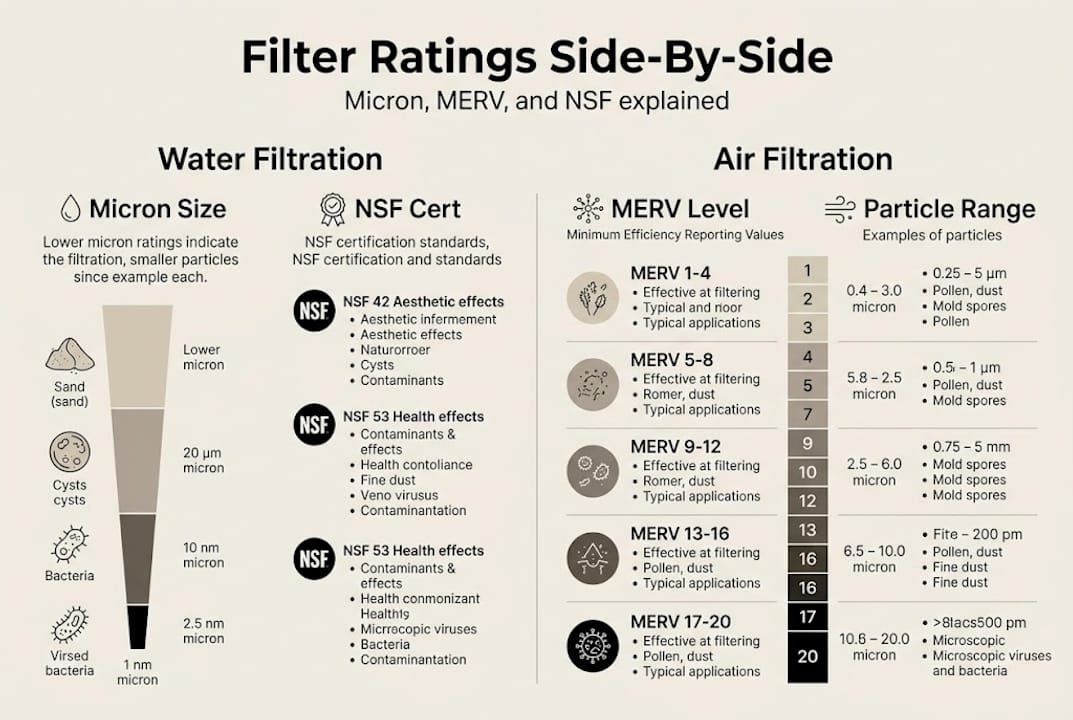
For air quality, the standard is MERV, which stands for Minimum Efficiency Reporting Value. MERV ratings (ASHRAE 52.2) run from 1 to 20 and measure how well a filter captures particles between 0.3 and 10 microns across multiple size ranges, tested with lab aerosols under controlled conditions. A MERV 1 filter catches large dust and lint. A MERV 16 filter approaches the performance of hospital-grade filtration.
Here is a quick overview of what different ratings generally target:
| Rating type | Scale | Targets |
|---|---|---|
| Micron (nominal) | 0.1 to 100+ µm | Sediment, rust, larger particles |
| Micron (absolute) | 0.1 to 5 µm | Cysts, bacteria, fine particulates |
| MERV | 1 to 20 | Pollen, dust, mold, smoke, viruses |
| NSF certification | Pass/fail | Chemical, biological, PFAS reduction |
A few important points to keep in mind:
- Smaller microns catch finer particles but clog faster and reduce water flow
- Higher MERV ratings filter more but can restrict airflow in residential HVAC systems
- No single rating covers every type of contaminant in your home
- Certified filtration standards go beyond ratings to verify real-world performance
“Filtration ratings are a starting point, not a finish line. What matters most is matching the right rating to the right contaminant in your specific home.”
Decoding micron, MERV, and NSF: How the main ratings work
Now that you understand the basics, let’s look at how these three systems compare side by side and what each one actually means for your daily life.
Micron ratings for water tell you the physical size of particles a filter can block. If your concern is Cryptosporidium or Giardia cysts (both common in municipal water), you need a filter with an absolute micron rating of 1 µm or lower. NSF 53 certification requires an absolute 1-micron rating for cyst reduction, achieving at least 99.95% removal. The EPA specifically recommends NSF-certified filters for PFAS (per- and polyfluoroalkyl substances), a class of chemicals linked to serious health risks.

MERV ratings for air measure capture efficiency across three particle size ranges. MERV 13 filters achieve at least 50% efficiency for particles between 0.3 and 1 micron, at least 85% for particles between 1 and 3 microns, and at least 90% for particles between 3 and 10 microns. That makes MERV 13 a strong choice for households with allergy or asthma concerns.
Here is a practical comparison table:
| Concern | Best rating type | Recommended level | What it removes |
|---|---|---|---|
| Cysts in water | Micron (absolute) | 1 µm absolute | Cryptosporidium, Giardia |
| PFAS in water | NSF 58 or NSF 53 | Certified pass | PFAS chemicals |
| Pollen and dust | MERV | MERV 8 to 11 | Pollen, mold spores, dust mites |
| Smoke and fine particles | MERV | MERV 13+ | Smoke, bacteria, fine PM2.5 |
| Sediment and rust | Micron (nominal) | 5 to 20 µm | Rust, sand, sediment |
Here is how to apply this in real life:
- Identify your primary concern first (cysts, PFAS, pollen, smoke)
- Match the concern to the correct rating system
- Look for certified products, not just labeled ratings
- Consider multi-stage filtration for households with multiple concerns
- Verify claims against benefits of certified water filters before purchasing
One statistic worth noting: a MERV 13 filter captures particles as small as 0.3 microns at 50% efficiency, which includes many airborne virus carriers. For families with respiratory conditions, that difference is meaningful.
How to choose the right filter for your health goals
Understanding the ratings is only half the story. Here is how you can use them to make the best filtration choices for your home’s unique needs.
Start by identifying your household’s specific contaminants of concern. This is not guesswork. Get your water tested through a certified lab or your local utility’s annual water quality report. For air, consider your region’s air quality index and whether anyone in your household has allergies or asthma.
Factors to evaluate before choosing a filter:
- Water contaminants: Sediment, chlorine, lead, cysts, PFAS, nitrates
- Air concerns: Pollen season, pet dander, indoor smoke, mold spores
- Household health needs: Asthma, immunocompromised family members, infants
- System compatibility: Your HVAC’s maximum MERV tolerance, your water pressure and flow rate
- Maintenance schedule: How often you can realistically replace filters
For advanced filtration at home, a staged approach almost always outperforms a single high-rated filter. A coarse pre-filter handles sediment and larger particles first. A finer stage then handles bacteria, cysts, or chemicals without getting overwhelmed. This protects the fine filter, extends its life, and keeps water flow strong. You can learn more about how the role of filtration stages affects both performance and cost over time.
For MERV 8 to 13 ratings, most residential HVAC systems strike the best balance between air quality improvement and system stress. Going above MERV 13 in a standard home system can restrict airflow enough to reduce efficiency and increase energy bills.
If chemical reduction is a priority, look into nano filtration benefits for water systems. Nano filtration operates at 0.001 to 0.01 micron range and removes dissolved salts, heavy metals, and many organic compounds that standard micron filters miss entirely.
Pro Tip: Do not rely only on micron ratings when shopping for water filters. Always look for NSF 53 or NSF 58 certification if chemical reduction (especially PFAS) is a concern. A filter can have a great micron rating and still let harmful chemicals pass through.
Trade-offs, common mistakes, and myths about efficiency ratings
Even with a solid understanding of filter ratings, it is easy to make avoidable mistakes. Let’s break down the trade-offs and clear up the most stubborn myths.
The biggest myth is that higher always means better. Smaller microns and higher MERV ratings come with real trade-offs: faster clogging, reduced water flow, higher HVAC resistance, and increased energy use. A MERV 16 filter in a standard residential system can restrict airflow so severely that it damages the blower motor over time.
For water quality, higher efficiency ratings can also affect overall system performance when filters clog prematurely due to mismatched staging.
Common mistakes households make:
- Choosing the smallest micron available without checking if it matches the actual contaminant
- Skipping NSF certification and trusting manufacturer claims alone
- Ignoring HVAC compatibility when upgrading to a higher MERV filter
- Replacing all filters at once instead of staggering replacements to monitor performance
Another frequent error is treating air and water filtration as separate problems. In reality, they interact. Dust and mold in your HVAC system can enter your water heater and storage areas. A whole-home approach, using energy-efficient filtration systems designed to work together, reduces both contamination risk and operating costs.
“No single rating covers all concerns. A filter rated for particles may do nothing for dissolved chemicals, and a filter rated for chemicals may miss biological contaminants entirely.”
Pro Tip: For the best filter lifespan and lower maintenance costs, always stagger your filter stages from coarse to fine. A 20-micron sediment pre-filter protecting a 1-micron absolute filter will last two to three times longer than using the fine filter alone.
Our take: Why filter certifications and smart choices matter more than chasing ratings
After years of watching consumers navigate the filtration market, one pattern stands out. Families who obsess over getting the highest MERV or the smallest micron number often end up spending more money, replacing filters more frequently, and sometimes creating new problems like reduced water pressure or HVAC strain. The number on the label is not the whole story.
What actually protects your family is a combination of certified performance and smart system design. A filter with advanced filtration technology that is certified to remove your specific contaminants, staged correctly for your system, and maintained on schedule will outperform an uncertified ultra-fine filter every single time.
The most effective approach is to test first, research second, and select based on your household’s actual needs, not on which number sounds most impressive. Certifications like NSF 53 and NSF 58 exist precisely because ratings alone cannot tell the full story. Trust the certification, understand the rating, and build a system that fits your home.
Take the next step to a cleaner, safer home
Ready to make a smart, informed choice for your family’s well-being? Understanding ratings is the foundation, but choosing the right certified system is what actually delivers results.
Explore our detailed guide on the water purification process to see how certified multi-stage systems work in practice. If indoor air is your priority, our air purifier selection guide walks you through matching MERV performance to your household’s needs. For a compact, high-performance option, the countertop ice water purifier combines certified filtration with everyday convenience, making it a practical upgrade for any health-focused kitchen.
Frequently asked questions
What is the difference between a nominal and absolute micron rating?
A nominal micron rating captures roughly 50 to 85 percent of particles at the stated size, while an absolute rating captures at least 99 percent. For health-critical applications like cyst removal, always choose absolute.
How does a MERV rating affect indoor air quality and HVAC performance?
Higher MERV ratings remove finer particles for cleaner air, but MERV 13 and above can increase airflow resistance and strain residential HVAC systems not designed for that level of filtration.
Why is NSF certification important for home water filters?
NSF certification verifies that a filter actually removes specific contaminants under real conditions. The EPA recommends NSF 53 and 58 certified filters specifically for PFAS reduction, which micron ratings alone cannot guarantee.
Does using multiple filters improve efficiency?
Yes. Multi-stage filtering catches particles in sequence from coarse to fine, which protects the finer stages from premature clogging and significantly extends the overall system lifespan.
Recommended
- How filtration supports sustainable, healthy homes in 2026 – Coway Water Purifier
- What Is Energy Efficient Filtration? Cleaner Air and Water – Coway Water Purifier
- Certified Filtration: Safeguarding Your Home Health – Coway Water Purifier
- Role of filters in health: Improve your home quality – Coway Water Purifier
- How water quality affects heating system efficiency – Skan Plumbing & Heating
