
Uncategorized
Why certified filters? 99% vs. 61% for your family’s water
Apr
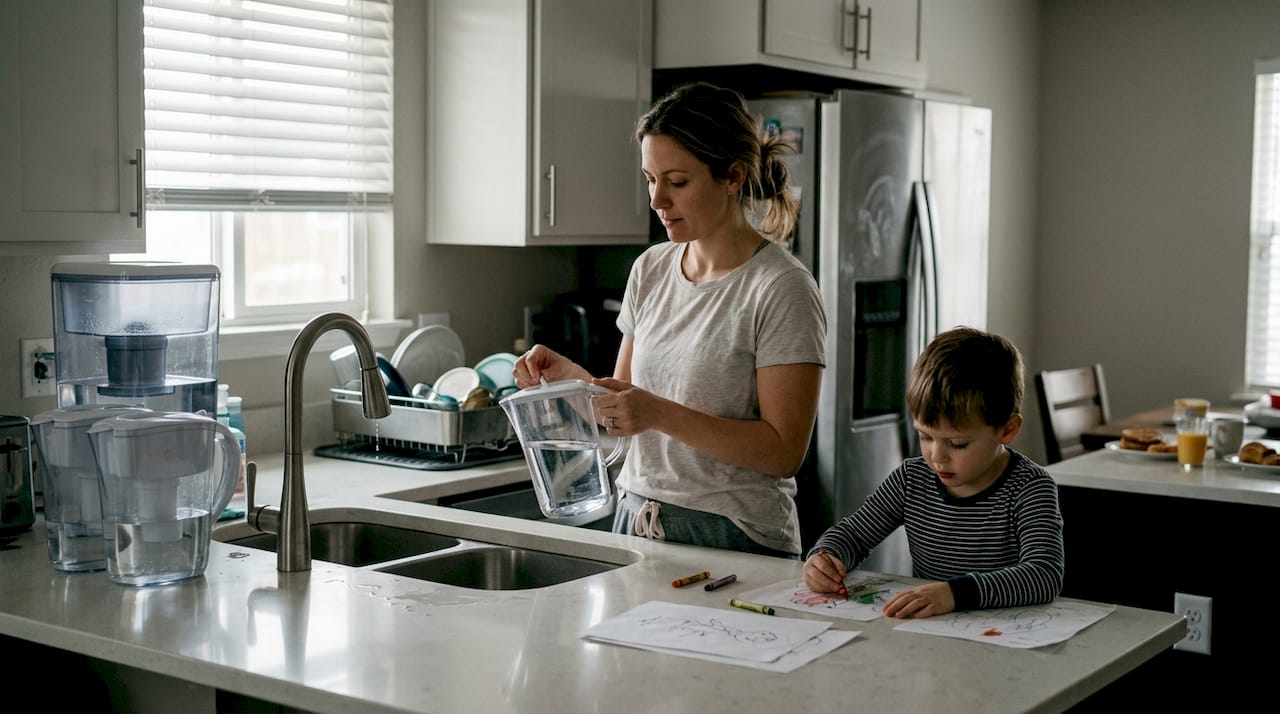
Most homeowners assume that if a water filter is on the shelf, it works. That assumption is costing families their health. Studies show that 99% of certified filters meet safe lead levels, while only 61% of uncertified models do. That gap is not a minor technicality. It represents real exposure to lead, PFAS, bacteria, and other contaminants hiding in your tap water. This guide breaks down exactly what filter certification means, why the data so strongly favors certified models, and how you can make a confident, informed choice to protect everyone in your home.
Table of Contents
- What does filter certification really mean?
- Certified versus uncertified filters: What does the data show?
- Contaminant reduction you can trust: Why the details matter
- How to confidently choose a certified filter for your home
- Why shortcuts on water filter certification put your family at risk
- Ready to upgrade your water safety?
- Frequently asked questions
Key Takeaways
| Point | Details |
|---|---|
| Certification is proof | Only certified filters guarantee verified contaminant removal backed by third-party testing. |
| Safer water for families | Certified filters consistently protect against lead, PFAS, bacteria, and viruses that can compromise health. |
| Not all filters are equal | Uncertified filters can fail crucial safety tests and even introduce new health risks. |
| Easy to verify certification | Look for NSF/ANSI labels and cross-check them online to ensure genuine compliance. |
What does filter certification really mean?
When a water filter carries a certification mark, it means an independent, accredited organization has tested that specific product against a defined set of safety standards. The two most important standards in the United States are NSF/ANSI 53 and NSF/ANSI 58. NSF stands for the National Sanitation Foundation, and ANSI is the American National Standards Institute. Together, they set the benchmarks that water filters must meet to earn a certification label.
Certification is not a one-time rubber stamp. It requires manufacturers to submit their products for third-party lab testing, document their filtration claims, and prove consistent performance across the full lifespan of the filter. This is fundamentally different from a brand simply printing “tested” or “laboratory approved” on a box. Those phrases carry no legal or scientific weight without a verifiable certification number.
Here is what NSF/ANSI 53 specifically covers:
- Lead reduction: NSF/ANSI 53 requires greater than 99% lead reduction and proven cyst removal, benchmarks that most certified filters consistently meet.
- Cyst removal: Cryptosporidium and Giardia, two parasites found in municipal and well water, must be reduced to safe levels.
- VOC reduction: Volatile organic compounds from industrial runoff are also addressed under this standard.
- Mechanical integrity: The filter housing and materials must not leach harmful substances into your water.
NSF/ANSI 58 covers reverse osmosis systems and adds requirements for PFAS and nitrate reduction. The EPA directly recommends these standards to consumers shopping for home filtration.
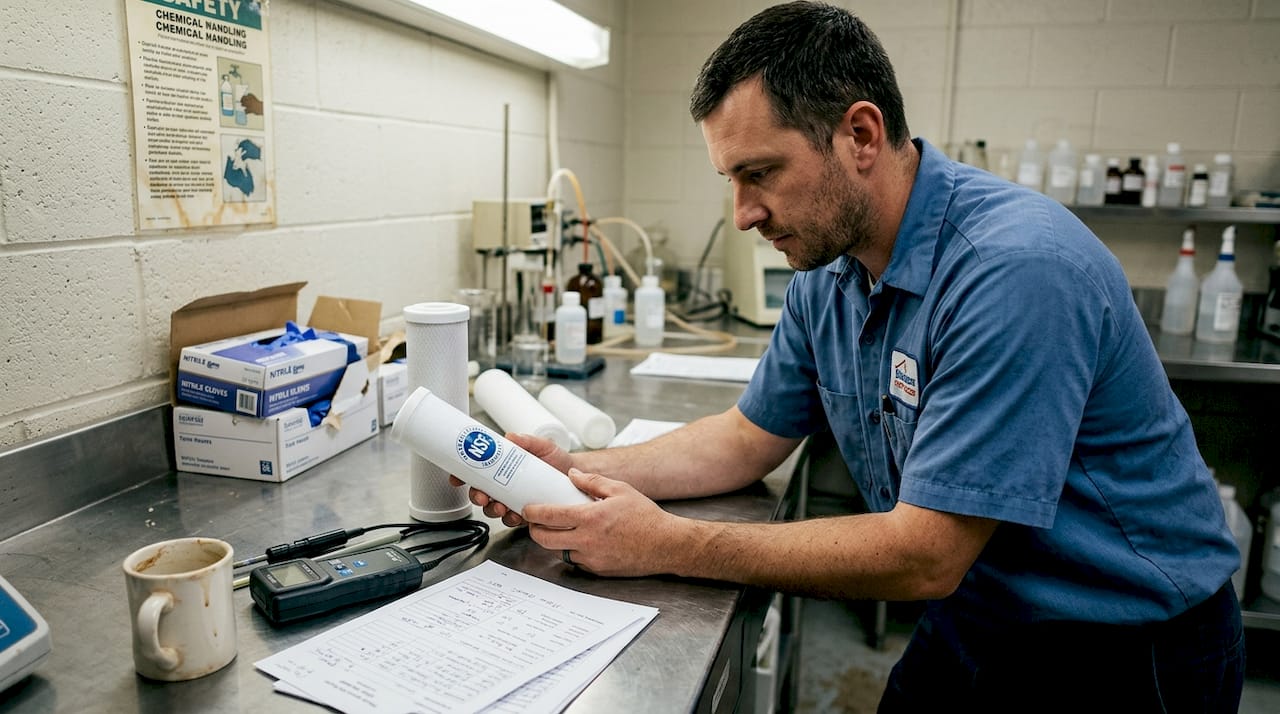
Pro Tip: When shopping for a filter, search the NSF product database at nsf.org and enter the exact model number. If it does not appear, the certification claim is unverified.
Understanding certified filtration standards helps you cut through marketing noise quickly. Brands that invest in third-party certification are making a public, verifiable commitment to your safety. Those that do not are asking you to take their word for it. For your family’s health, that is simply not good enough. Learning more about certified filtration home health gives you a stronger foundation before you ever walk into a store.
Certified versus uncertified filters: What does the data show?
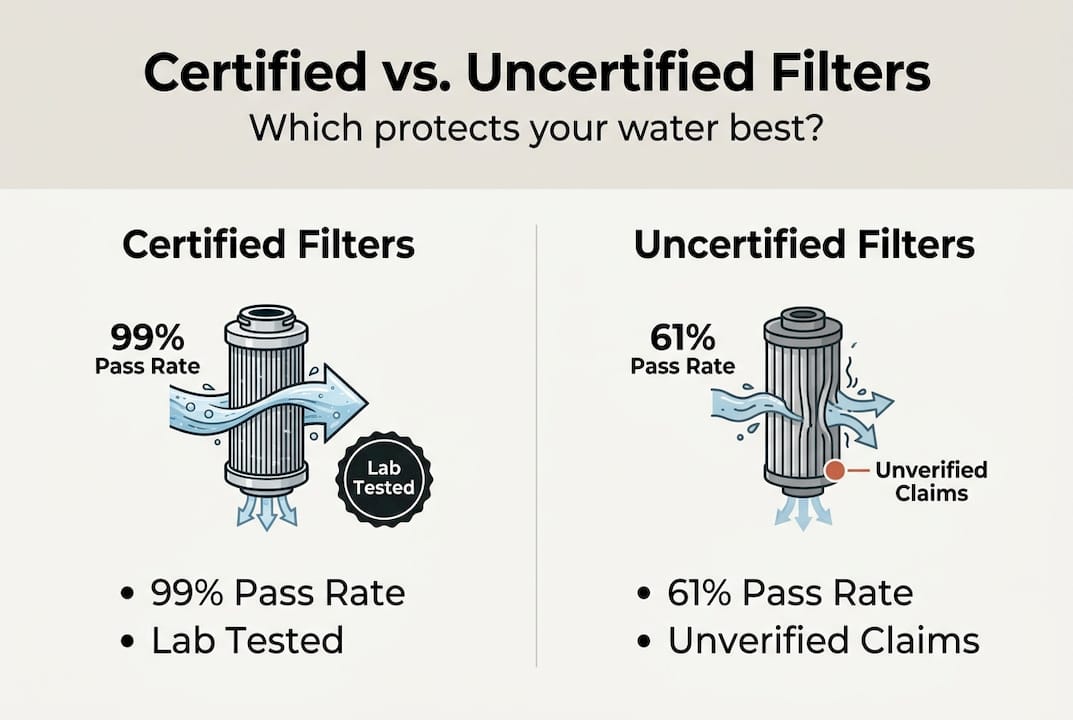
The numbers tell a clear story. Only 61% of uncertified filters meet safe lead levels, compared to 99% of certified ones. That 38-point gap is not a rounding error. It means that if you randomly pick an uncertified filter off the shelf, you have nearly a 4-in-10 chance it will not adequately protect your family from lead.
The Berkey filter case is one of the most instructive real-world examples. Berkey was a popular brand that marketed its products as capable of removing bacteria, viruses, and heavy metals. Independent testing revealed a different picture. Uncertified filters like Berkey leached aluminum at 1.44 ppm, which exceeds the EPA’s recommended limit, and failed lifecycle microbiological claims. The EPA eventually issued stop-sale actions against certain Berkey products.
Here is a direct comparison of what the data shows:
| Performance metric | Certified filters | Uncertified filters |
|---|---|---|
| Lead reduction to safe levels | 99% | 61% |
| Verified contaminant claims | Yes, documented | Often unverifiable |
| Lifecycle testing completed | Required | Rarely conducted |
| Material safety (no leaching) | Tested and confirmed | Not guaranteed |
| EPA recommended | Yes | No |
“Uncertified filters can make bold claims on their packaging, but without third-party testing across the filter’s full lifecycle, those claims are just words. Certified filters are held to a standard that protects you at day one and at month twelve.”
This is not just about lead. Uncertified filters frequently claim viral and bacterial protection without the lab evidence to back it up. Understanding why water filters matter for your household starts with recognizing that not every product on the market delivers what it promises. If you want to go deeper on filtration technology, advanced water filtration resources can help you understand which mechanisms are actually proven.
Contaminant reduction you can trust: Why the details matter
Knowing that certified filters outperform uncertified ones is important. Knowing exactly which contaminants they address is what helps you make the right choice for your specific home.
Here are the five most critical threats in home tap water:
- Lead: Enters water through aging pipes and fixtures. Even low-level exposure causes developmental damage in children.
- PFAS: Synthetic “forever chemicals” linked to cancer, thyroid disruption, and immune suppression. EPA recommends certified filters with NSF/ANSI 53 or 58 certification specifically for PFAS reduction.
- Bacteria: E. coli and other pathogens can enter water through infrastructure failures or well contamination.
- Cysts: Cryptosporidium and Giardia are resistant to chlorine and require physical filtration to remove.
- Viruses: Norovirus and hepatitis A can survive in water and require specific filtration or UV treatment.
Here is how filtration technologies compare for these threats:
| Contaminant | Carbon block filter | Ultrafiltration (UF) | Reverse osmosis (RO) |
|---|---|---|---|
| Lead | High (certified) | Moderate | Very high |
| PFAS | High (certified) | Low | Very high |
| Bacteria | Moderate | High | Very high |
| Cysts | High (certified) | High | Very high |
| Viruses | Low | Not reliably removed | Very high |
This table reveals something important. UF purifiers, which are marketed as advanced filtration, do not reliably remove viruses. NF and RO filters are the proven options for full microbiological protection. If viral protection matters to your household, you need to verify that your filter’s certification specifically covers it.
Pro Tip: Do not assume a higher price tag means better protection. Always match the filter’s certified contaminant list to your actual water quality concerns. Request a water quality report from your utility provider first.
Exploring a waterborne contaminants guide can help you identify which threats are most relevant to your zip code. And if you want to understand the broader connection between clean water and daily wellness, water quality and wellness resources make that link concrete.
How to confidently choose a certified filter for your home
Shopping for a water filter does not have to be overwhelming. A few clear steps will protect you from misleading claims and help you find a product that genuinely performs.
- Start with your water quality report. Your local utility is required to publish an annual water quality report. Identify your top contaminants before you shop.
- Look for the NSF/ANSI mark on the product itself. The certification mark should appear on the filter unit or packaging, not just in a footnote.
- Verify the specific certification number. Go to nsf.org and search the model. Confirm that the certification covers the contaminants you care about.
- Read the certified spec sheet, not the marketing copy. Packaging may say “removes 99 contaminants” while the certified spec sheet lists only a handful. The spec sheet is the legal document.
- Be skeptical of “tested to NSF standards” language. This phrase means the product was tested using NSF methods but did not necessarily pass or earn certification. It is a common tactic to imply credibility without earning it.
Certification labels like NSF/ANSI 53/58 are verifiable through third-party listings, and the EPA directly recommends these standards for consumers making home water safety decisions.
Pro Tip: If a brand cannot provide a certification document when you ask, walk away. Legitimate certified brands keep this documentation readily available because it is their strongest proof of quality.
Reviewing the water filtration benefits of certified systems reinforces why this verification step is worth the extra five minutes. And if you want to understand how pre-filtration stages add another layer of protection, pre-filters for water safety explains how multi-stage systems work together.
Why shortcuts on water filter certification put your family at risk
Here is the uncomfortable truth most filter brands do not want you to think about. Uncertified filters are not just slightly less effective. They can actively make your water worse. The Berkey case proved that a filter marketed as a premium health product was leaching aluminum into drinking water at levels above EPA limits. Families buying that filter believed they were protecting their health. They were not.
The appeal of uncertified filters is usually price or a compelling story. A sleek design, a charismatic founder, or a viral social media post can make a product feel trustworthy. But trust in water safety must be earned through lab results, not marketing.
We have seen this pattern repeatedly. A brand makes bold claims, builds a loyal customer base, and then independent testing reveals the product fails where it matters most. By then, families have been drinking that water for months or years.
Demand documentation. Ask for the certification number. Check the NSF database. These are not unreasonable requests. They are the minimum standard for anything you put in your family’s body. For deeper reading on what filtration and health insights actually look like in practice, the evidence is clear and consistent. Certified always outperforms uncertified when it counts most.
Ready to upgrade your water safety?
You now have the knowledge to make a genuinely informed decision. The next step is finding a filtration system that meets the standards you have just learned to demand.
Coway’s water purifiers are built to exceed minimum certification requirements, combining advanced filtration technology with UV sanitization for full-spectrum protection. Whether you are exploring the Countertop Ice Water Purifier for everyday convenience or want to understand the full water purification process behind each system, Coway makes it easy to verify exactly what you are getting. Browse certified home filtration standards to see how Coway’s lineup measures up, and take the first step toward water your family can trust every single day.
Frequently asked questions
Which contaminants are most important to filter from tap water?
Lead, PFAS, bacteria, cysts, and viruses are the top priorities for home water safety. Certified filters are validated specifically for lead, cyst, and PFAS removal, making them the only reliable choice for these threats.
How can I check if a filter is truly certified?
Look for NSF/ANSI 53 or 58 marks on the product and verify the model number in the NSF product database at nsf.org. Certification labels are verifiable through official third-party listings, so there is no guesswork involved.
Are all certified filters effective against all contaminants?
No. Each certified filter is tested for a specific list of contaminants, and that list varies by model and technology. Always review the certified contaminant reduction claims for the exact model you are considering before purchasing.
Can uncertified filters be trusted for home use?
The EPA does not recommend uncertified filters for home use, and real-world testing supports that position. Uncertified filters have failed EPA safety benchmarks and in some cases have leached harmful substances like aluminum directly into drinking water.
Recommended
- Certified Filtration: Safeguarding Your Home Health – Coway Water Purifier
- Certified Filtration Standards: Safeguarding Home Wellness – Coway Water Purifier
- Why Regular Filter Replacement Matters for Families – Coway Water Purifier
- Water Quality Checklist 2026: 30% More Confident Choices – Coway Water Purifier
