
Uncategorized
Why water quality matters for family health and wellness

Mar
Most families assume their tap water is safe because it’s regulated, yet thousands of US households unknowingly consume water with harmful contaminants like lead, PFAS, and nitrates. Children and pregnant women face heightened risks from these substances, which can cause developmental delays, hormone disruption, and serious illness. Understanding water quality and choosing the right filtration technology protects your family’s health and enhances home wellness. This guide explains which contaminants threaten your water supply, how advanced filtration systems work, and practical steps to safeguard your household.
Table of Contents
- Understanding Water Contaminants And Health Impacts
- How Advanced Filtration Protects Your Family’s Health
- Balancing Water Safety: Municipal Standards And Filtration Needs
- Practical Steps To Improve And Maintain Your Home Water Quality
- Enhance Your Home Wellness With Coway’s Advanced Water Purifiers
- Frequently Asked Questions
Key takeaways
| Point | Details |
|---|---|
| Hidden contaminants | Water often contains lead, PFAS, nitrates, and pathogens that pose health risks to families. |
| Vulnerable groups | Children and pregnant women face increased danger from poor water quality. |
| Filtration solutions | Reverse osmosis and activated carbon filters remove most harmful substances effectively. |
| Municipal standards | Over 90% of US water meets EPA standards, but testing and filtration add safety layers. |
| Proactive protection | Annual water testing and proper filter maintenance improve wellness and home safety. |
Understanding water contaminants and health impacts
Your household water may harbor invisible threats that affect your family’s wellbeing. Drinking water quality exposes families to contaminants like lead, chlorine byproducts, PFAS, nitrates, heavy metals, and pathogens, causing serious health issues. Lead leaches from aging pipes and fixtures, damaging children’s developing brains and nervous systems. PFAS chemicals persist in water for decades, disrupting hormones and increasing cancer risks.

Nitrates from agricultural runoff contaminate wells and municipal supplies, posing particular danger to infants by interfering with oxygen transport in blood. Chlorine byproducts form when disinfectants react with organic matter, potentially causing bladder cancer with long-term exposure. Heavy metals like arsenic and mercury accumulate in body tissues, harming organs over time. Pathogens such as E. coli and Giardia trigger gastrointestinal illness, especially dangerous for young children.
Children and pregnant women face amplified vulnerability to water contaminants because their bodies are still developing. Research shows E. coli contamination worsens child undernutrition and stunting in affected communities. Even low-level arsenic exposure below 10μg/L significantly increases risk for preterm birth and low birth weight. These outcomes underscore why understanding and addressing water quality matters for family health.
Your home’s water source determines which contaminants you’re most likely to encounter. Municipal systems face different challenges than private wells, but both require vigilance. Older homes with lead pipes or fixtures present immediate risks, while rural properties may battle agricultural runoff. Urban areas often contend with industrial pollutants and aging infrastructure.
“Water contamination during pregnancy can affect fetal development, leading to complications that impact both mother and child for years.”
Recognizing these risks empowers you to take protective action. Testing reveals what’s actually in your water, not just what should be there according to regulations. The safe drinking water guide offers detailed information on identifying and addressing specific contaminants. Understanding drinking water health effects helps you make informed decisions about filtration and family protection.
How advanced filtration protects your family’s health
Modern filtration technologies offer powerful defenses against water contaminants, each using different mechanisms to remove specific threats. Understanding how these systems work helps you choose the right protection for your household’s needs. Reverse osmosis stands out as the most comprehensive option for families concerned about multiple contaminants.
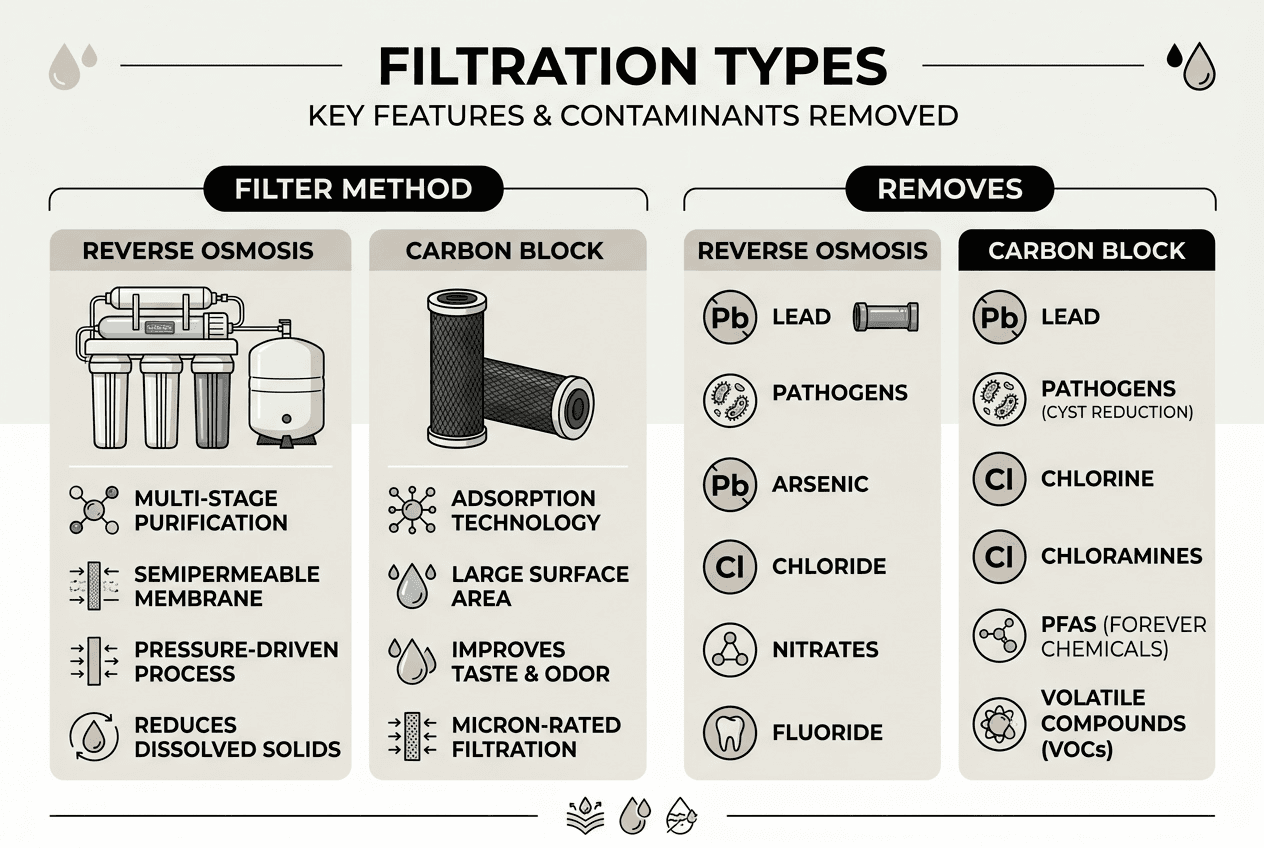
Reverse osmosis membranes remove 99% of dissolved solids, heavy metals, PFAS, and nitrates but waste water and remove beneficial minerals. The system forces water through semi-permeable membranes with pores so tiny that only water molecules pass through. Contaminants get flushed away as wastewater, leaving purified water for your family. This technology excels at removing lead, arsenic, fluoride, and emerging contaminants like PFAS that other methods miss.
Granular activated carbon filters work differently, using adsorption to trap organic chemicals and chlorine byproducts. Carbon’s porous structure provides massive surface area where contaminants stick as water flows through. These filters effectively remove chlorine taste and odor, pesticides, and some industrial chemicals. However, their PFAS removal varies by carbon type and contact time, making them less reliable for these persistent chemicals than reverse osmosis.
Nanofiltration and ultrafiltration target particles and pathogens through physical barriers. Nanofiltration membranes have slightly larger pores than RO, blocking bacteria, viruses, and larger molecules while allowing some minerals through. Ultrafiltration removes suspended solids, bacteria, and protozoa but lets dissolved chemicals pass. These technologies suit specific contamination scenarios but offer narrower protection than RO.
Pro Tip: Match your filtration technology to your water test results rather than choosing based on price alone, ensuring you actually remove the contaminants present in your supply.
Each filtration method involves tradeoffs you should consider:
- Reverse osmosis provides broadest protection but wastes 3 to 5 gallons for every gallon purified
- Activated carbon filters cost less and preserve minerals but require frequent replacement
- Nanofiltration balances mineral retention with contaminant removal for moderate contamination
- Ultrafiltration excels at pathogen removal but leaves dissolved chemicals untouched
| Filtration Type | Contaminants Removed | Efficiency | Considerations |
| — | — | — |
| Reverse Osmosis | Lead, PFAS, nitrates, heavy metals, dissolved solids | 95 to 99% | Wastes water, removes minerals, higher cost |
| Activated Carbon | Chlorine, pesticides, organic chemicals, taste/odor | 70 to 90% | Variable PFAS removal, frequent replacement needed |
| Nanofiltration | Bacteria, viruses, some dissolved solids | 85 to 95% | Retains some minerals, moderate cost |
| Ultrafiltration | Bacteria, protozoa, suspended particles | 90 to 99% | Does not remove dissolved chemicals |
The advanced water filtration guide explores these technologies in greater depth, helping you evaluate options for your home. Understanding certified filtration standards ensures the system you choose actually delivers promised performance. Certification from NSF International or similar bodies verifies that filters remove specific contaminants as claimed.
Combination systems offer comprehensive protection by pairing multiple technologies. A reverse osmosis unit with activated carbon pre-filters and UV sterilization addresses chemical contaminants, improves taste, and eliminates pathogens in one integrated solution. These multi-stage systems provide the most complete family protection, though they cost more upfront and require regular maintenance.
Balancing water safety: municipal standards and filtration needs
Municipal water treatment in the United States follows strict EPA regulations designed to protect public health. Over 90% of US municipal water systems comply with EPA standards and are considered safe by most experts. Treatment plants use multiple barriers including filtration, disinfection, and monitoring to remove contaminants before water reaches your tap. This regulated approach has virtually eliminated waterborne disease outbreaks in developed areas.
Yet compliance with standards doesn’t guarantee perfect water quality for every household. Regulations set maximum contaminant levels based on feasibility and cost, not just health impacts. Some harmful substances remain legal at low concentrations. Infrastructure age matters too, as water can pick up lead or other contaminants from pipes between the treatment plant and your faucet. Understanding these nuances helps you decide whether additional filtration makes sense.
Your local Consumer Confidence Report reveals exactly what’s in your municipal water supply. Water utilities must publish these annual reports showing test results for regulated contaminants. Review your report to identify any substances detected near regulatory limits or violations of standards. Even legal levels of certain contaminants may concern families with young children or pregnant members.
Chlorination benefits outweigh risks, but specific contaminants like lead or PFAS may require home filtration according to water quality experts. Chlorine prevents dangerous microbial outbreaks that once killed thousands, making disinfection essential for public health. The byproducts formed during chlorination pose theoretical long-term cancer risks, but these pale compared to immediate threats from untreated water. Balancing these factors helps you make rational decisions about filtration.
Home filtration becomes important when your water contains specific contaminants:
- Detected lead levels above 5 parts per billion, especially in homes with young children
- Any measurable PFAS concentration, as these chemicals accumulate in the body
- Nitrate levels approaching 10 mg/L, particularly for households with infants
- Frequent boil water advisories indicating compromised treatment or distribution
- Unpleasant taste, odor, or appearance suggesting contamination
Pro Tip: Test your household water annually using a certified laboratory rather than relying solely on municipal reports, as contamination can occur in your home’s plumbing after water leaves the treatment plant.
Private well owners face different challenges since wells aren’t regulated like municipal systems. You’re responsible for testing and treating your own water supply. Wells are vulnerable to agricultural runoff, septic system contamination, and naturally occurring substances like arsenic or radon. Annual testing for bacteria, nitrates, and other common well contaminants protects your family from hidden risks.
The filtration disease prevention guide explains how proper filtration reduces illness risk for vulnerable family members. Even when municipal water meets all standards, additional filtration provides extra security for households with immune-compromised individuals, infants, or pregnant women. These groups benefit from removing even trace contaminants that pose minimal risk to healthy adults.
Practical steps to improve and maintain your home water quality
Taking control of your home water quality starts with testing to identify what contaminants you actually face. This data-driven approach ensures you invest in filtration that addresses real risks rather than imagined ones. Follow these steps to systematically improve and maintain your family’s water safety.
- Test your water quality annually using certified labs or home test kits that screen for lead, bacteria, nitrates, and other common contaminants.
- Review your local Consumer Confidence Report to understand municipal water quality and identify substances detected in your area.
- Choose filtration technology aligned to detected risks, matching system capabilities to the specific contaminants present in your supply.
- Install your filtration system per manufacturer guidelines, ensuring proper connections and initial flushing to remove manufacturing residues.
- Perform regular maintenance by replacing filters and sanitizing units as recommended, typically every 6 to 12 months depending on usage.
- Monitor water taste and clarity as informal quality cues that may signal when filters need replacement or systems require servicing.
Testing reveals which contaminants threaten your household. Certified laboratory analysis provides the most accurate results, identifying dozens of substances at very low concentrations. Home test kits cost less and offer quick screening for common problems like lead, bacteria, or pH imbalances. Either approach beats guessing about your water quality.
Selecting appropriate filtration depends on your test results and family situation. The table below matches common contaminants to effective filtration methods:
| Contaminant Detected | Recommended Filtration | Why It Works |
|---|---|---|
| Lead, heavy metals | Reverse osmosis or certified lead filters | Removes dissolved metals through membrane filtration |
| PFAS chemicals | Reverse osmosis or specialized carbon | Traps persistent chemicals other methods miss |
| Bacteria, pathogens | UV sterilization or ultrafiltration | Kills or physically removes microorganisms |
| Chlorine, taste/odor | Activated carbon | Adsorbs chlorine and organic compounds |
| Nitrates | Reverse osmosis or ion exchange | Removes dissolved nitrate ions |
Installation quality affects system performance and longevity. Follow manufacturer instructions carefully, paying attention to water pressure requirements and drain connections. Improper installation can cause leaks, reduce filtration efficiency, or damage your home. When in doubt, hire a professional installer to ensure everything works correctly from day one.
Maintenance keeps your filtration system protecting your family effectively. Effective filtration and maintenance directly reduce exposure to harmful contaminants and improve family wellness. Replace filters on schedule, as exhausted media stops removing contaminants and may release trapped substances back into your water. Sanitize system components during filter changes to prevent bacterial growth in housings and lines.
Pro Tip: Consider combination systems pairing reverse osmosis with UV sterilization for broad protection against both chemical contaminants and pathogens, especially if you have well water or immune-compromised family members.
The home water filtration checklist walks you through evaluation and selection step by step. Understanding water filtration setup steps prevents installation mistakes that compromise performance. Learning about the importance of water filters reinforces why consistent maintenance matters for ongoing family protection.
Tracking filter life and replacement dates prevents lapses in protection. Many systems include indicators that alert you when filters need changing. Set calendar reminders as backup, especially for systems without automatic alerts. Keep replacement filters on hand so you can swap them immediately when needed rather than waiting for shipping.
Water quality can change over time due to infrastructure repairs, source water shifts, or new contamination. Retest annually or whenever you notice changes in taste, odor, or appearance. This ongoing vigilance catches emerging problems before they affect your family’s health. Treat water quality as an ongoing responsibility rather than a one-time fix.
Enhance your home wellness with Coway’s advanced water purifiers
Having learned why water quality matters and how to improve it, discover how Coway helps safeguard your family’s wellness every day. Coway offers state-of-the-art water purifiers combining reverse osmosis, UV sterilization, and activated carbon in integrated systems designed for family health. Our technology removes contaminants while preserving the convenience and taste your household expects from drinking water.
Explore our water purification process guide to learn how multi-stage filtration delivers superior protection. Our UV sanitization technology enhances home water safety by eliminating pathogens that other methods might miss. The countertop ice water purifier provides convenient, effective filtration for modern families who value both health and ease of use. Coway systems include professional installation and ongoing maintenance support, ensuring your investment protects your family for years to come.
Frequently asked questions
What are the common water contaminants affecting households?
Common contaminants include lead from aging pipes, PFAS chemicals from industrial sources, nitrates from agricultural runoff, chlorine byproducts from disinfection, heavy metals like arsenic, and pathogens such as E. coli or Giardia. These substances enter water through infrastructure, environmental pollution, and natural geological sources. The water filtration guide explains how different filtration technologies target specific contaminants based on their chemical and physical properties.
Is municipal tap water safe to drink without filtration?
Over 90% of US municipal water systems meet EPA standards and are generally safe for most people. However, filtration is recommended if your Consumer Confidence Report shows concerning contaminant levels or if your household includes vulnerable individuals like infants, pregnant women, or immune-compromised members. Water can also pick up contaminants from home plumbing after leaving the treatment plant.
How often should I test and maintain my home water filter?
Test your water quality annually using certified laboratory analysis or after any changes in your water source or local infrastructure. Replace filters according to manufacturer recommendations, typically every 6 to 12 months depending on water usage and quality. Regular maintenance prevents contamination buildup and preserves filter efficiency, ensuring continuous protection for your family.
Which filtration system works best for families with young children?
Reverse osmosis systems provide the most comprehensive protection for families with young children because they remove 99% of dissolved contaminants including lead, PFAS, nitrates, and heavy metals. Pairing RO with UV sterilization adds pathogen protection, creating a multi-barrier system. Choose systems certified by NSF International to verify they actually remove the contaminants that pose greatest risk to developing children.
Can water filters remove all contaminants completely?
No single filter removes every possible contaminant completely, though reverse osmosis comes closest by eliminating 95 to 99% of most substances. Different technologies target different contaminant categories, which is why combination systems offer superior protection. Regular testing helps you verify your filtration system effectively addresses the specific contaminants present in your water supply.
How do I know when my water filter needs replacement?
Many modern systems include indicator lights or digital displays showing filter life remaining. You should also replace filters on the manufacturer’s recommended schedule regardless of indicators, as exhausted media stops removing contaminants effectively. Changes in water taste, odor, flow rate, or clarity signal that filters may need immediate replacement even before scheduled maintenance.
Recommended
- Understanding the Importance of Water Quality at Home – Coway Water Purifier
- 7 Health Benefits of Purified Water for Your Family – Coway Water Purifier
- Filtration’s Role in Family Health: 15% Fewer GI Illnesses – Coway Water Purifier
- Complete Guide to Why Water Filters Are Important – Coway Water Purifier
- Demystifying Structured Water and Its Benefits – Omnia Radiation Balancer
