
Uncategorized
Filtered vs bottled water: Which is healthier for you?
May
TL;DR:
- Most bottled water is sourced from municipal tap water and often receives minimal treatment despite higher prices. Filtering home tap water with certified systems offers better regulation, contaminant targeting, and zero microplastic risk. Bottled water is only necessary during emergencies like natural disasters or boil alerts when tap filtration may be insufficient.
You’ve probably grabbed a bottle of water at the grocery store assuming it came from some pristine mountain spring, far removed from the same tap you use at home. The reality is far less glamorous. Over 25% of bottled water is simply repackaged municipal tap water, often with minimal additional treatment, yet sold at prices hundreds or even thousands of times higher than what comes out of your faucet. For anyone serious about making informed hydration decisions, the differences between filtered and bottled water go far deeper than branding and packaging.
Table of Contents
- Where does your water come from? Sources and treatment
- Regulation, safety, and transparency: Who is protecting your water?
- Health impacts: What are you really drinking?
- Cost and environmental impact: True price of your water choice
- When is bottled water the better (or necessary) choice?
- Our take: Why most people overestimate bottled water (and what actually matters)
- Invest in your hydration: Explore advanced filtration solutions
- Frequently asked questions
Key Takeaways
| Point | Details |
|---|---|
| Filtered water is customizable | Home filters can target specific contaminants found in your local water supply using certified technologies. |
| Bottled is pricier and less regulated | Bottled water typically costs thousands of times more per gallon and faces less frequent safety testing. |
| Filtered tap avoids microplastics | Filtered tap water avoids the microplastics and chemicals often present in bottled water. |
| Bottled best for emergencies | Bottled water is important in disasters or boil advisories but not ideal for daily use. |
| Sustainable choice matters | Choosing filtration helps reduce your environmental footprint by cutting plastic waste and saving money. |
Where does your water come from? Sources and treatment
Most people picture bottled water originating from remote glaciers or underground springs untouched by human activity. Some brands do source from springs, but a significant portion of the bottled water market pulls directly from municipal supplies. That means you could be paying premium prices for water that started its journey in the same city reservoir as your tap water.
Bottled water sourced from municipal tap typically goes through basic filtration and purification steps before bottling, but these processes are often not disclosed in detail to consumers. The lack of transparency makes it genuinely difficult to know what you’re getting.
Home filtration works differently because it targets the specific problems present in your local water supply. When you run your water through a quality home system, you’re addressing the actual contaminants that show up in your community’s water report. Activated carbon and reverse osmosis systems each tackle different issues. Activated carbon removes chlorine, taste and odor problems, volatile organic compounds, and some heavy metals. Reverse osmosis goes further, removing 90 to 99% of total dissolved solids, PFAS, lead, arsenic, nitrates, fluoride, and even bacteria.
Understanding waterborne contaminants in your local area is the first step toward choosing the right filtration approach for your household.
Here’s a quick comparison of how the two water types stack up at the source:
| Feature | Filtered tap water | Bottled water |
|---|---|---|
| Primary source | Municipal tap water | Municipal tap or spring |
| Treatment method | Activated carbon, RO, UV | Basic filtration, ozonation |
| Regulatory body | EPA | FDA |
| Consumer transparency | High (public water reports) | Low (rarely disclosed) |
| Customization | Yes, filter to local needs | No |
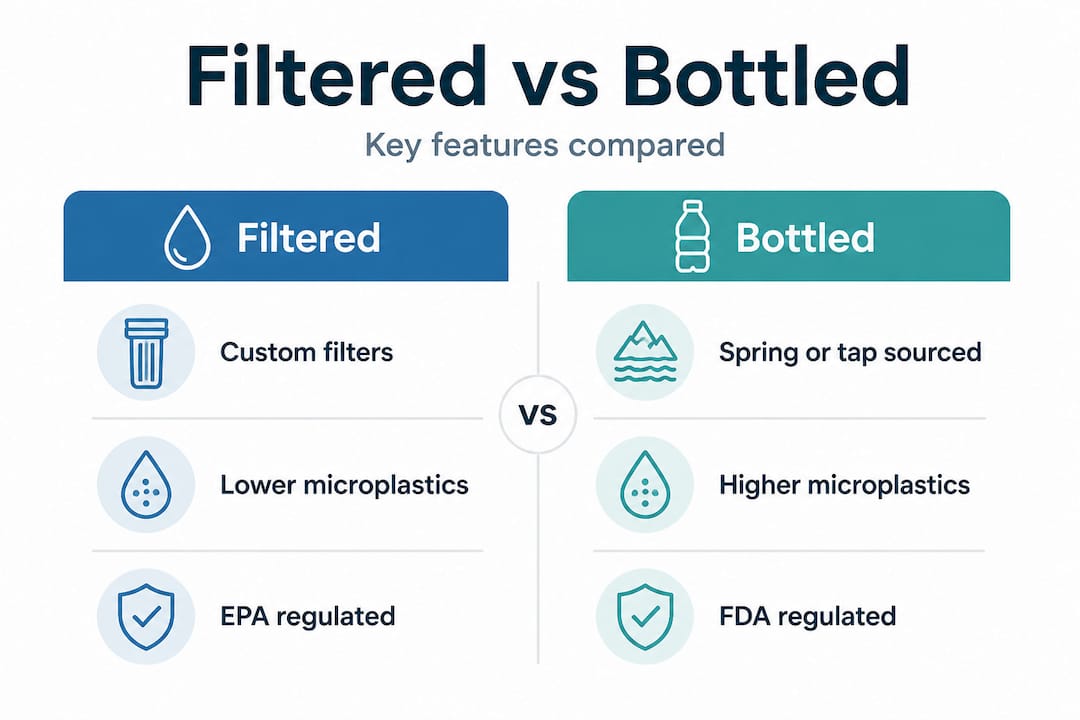
The regulatory gap is significant. The EPA oversees tap water and requires utilities to meet strict contaminant limits, while the FDA applies food safety standards to bottled water. These standards are not equivalent in scope or enforcement frequency. Refer to the advanced filtration guide to understand which technology suits your specific situation best.
Key considerations when thinking about source and treatment:
- Spring water labeling does not guarantee purity or absence of contaminants
- Municipal tap water is tested far more frequently than bottled water
- Home filters can be matched to your specific local contaminant profile
- Bottled water treatment processes are rarely disclosed publicly
Regulation, safety, and transparency: Who is protecting your water?
After understanding how water is sourced and filtered, it’s vital to look at how quality and safety are enforced. The answer here is surprisingly one-sided.
Tap water is regulated by the EPA with frequent testing and required public disclosure, while bottled water falls under FDA oversight with far less frequent testing and no mandatory public disclosure of results. That’s a meaningful difference when you’re deciding what to drink every single day.
Your local water utility must publish an annual Consumer Confidence Report, also called a water quality report. This document lists every contaminant tested, the levels found, and the legal limits for each. You can request it or find it online. Bottled water companies are not required to provide anything comparable to consumers. Many brands simply don’t, and most consumers never think to ask.
Did you know? Your municipality tests tap water hundreds of times per month. Bottled water brands may test their product far less frequently, and results stay private.
Independent lab tests have found disinfection byproducts and PFAS in various bottled water products, including trace drugs, bacteria, and industrial chemicals. These findings aren’t universal, but they challenge the assumption that bottled automatically means cleaner.
Pro Tip: Pull up your city’s annual water quality report before investing in a filtration system. It tells you exactly which contaminants to filter for, so you’re not guessing or spending money on features you don’t need.
Understanding why water quality matters in a household context helps you connect these regulatory gaps to real outcomes for your family’s health, not just abstract policy differences.
The practical bottom line on regulation comes down to this: when you use filtered tap water, you benefit from one of the most rigorously monitored water systems in the country, then add a second layer of targeted protection through your home filter. Bottled water gives you a single layer of protection that’s rarely verified and even less frequently disclosed.
Health impacts: What are you really drinking?
Beyond regulation and standards, the real health effects of your everyday water choice deserve careful attention.
The biggest surprise for most people is microplastics. Bottled water contains up to 240,000 microplastic particles per liter, plus potential chemical leaching from PET plastic bottles, especially when those bottles are exposed to heat, light, or stored for long periods. Filtered tap water avoids this entirely because it never touches a plastic bottle.
Research increasingly links microplastic exposure to inflammation, hormonal disruption, and other health concerns. While the full picture is still developing, the precautionary argument for avoiding plastic packaging makes practical sense for health-conscious households.
Filtered tap water is generally superior to bottled when you consider the full picture. It offers customizable contaminant removal tailored to your local water supply, lower long-term cost, zero microplastics, no plastic waste, and operates under stronger regulatory oversight.
Health advantages of choosing filtered water:
- Targeted contaminant removal: You can choose filters that specifically address lead, chlorine, PFAS, or other concerns identified in your local report
- No microplastics: Water never contacts plastic packaging under heat or pressure
- No leaching risk: Quality home systems use food-grade materials designed for long-term water contact
- Consistent quality: You control the filtration standard, not a distant manufacturer
Understanding how filtration prevents disease goes beyond just removing bad tastes. Properly certified filters can remove biological and chemical threats that create real health risks over time.
Pro Tip: Look for filters certified to NSF standards 42 and 53 at minimum. NSF 42 covers aesthetic improvements like chlorine and taste, while NSF 53 covers health-related contaminants like lead and cysts. If PFAS is a concern in your area, look for NSF 58 certification for reverse osmosis systems.
One often overlooked factor: why water filters matter becomes especially clear when you look at health outcomes in communities with known contamination issues, where bottled water dependence creates both financial strain and environmental harm simultaneously.
Cost and environmental impact: True price of your water choice
Now that health is addressed, let’s examine the financial and environmental consequences of each choice. The numbers here are stark.
Bottled water costs between $1 and $4 per gallon, making it up to 2,000 times more expensive than tap water. A quality home filtration system typically pays for itself within 6 to 12 months, with annual maintenance costs ranging from just $50 to $200 depending on the system and your usage volume. For a family of four drinking the recommended daily water intake, the savings over a single year can easily exceed several hundred dollars. Over five years, you’re looking at thousands of dollars saved.
“The financial math of bottled water only makes sense if you place no value on environmental cost, your own time, and long-term spending.”
The environmental toll of bottled water is equally difficult to justify. Bottled water production uses 2,000 times more energy than treating and delivering tap water, and fewer than 30% of plastic bottles are actually recycled. The rest end up in landfills, waterways, or as the microplastics we just discussed ending up back in drinking water.
Environmental and cost comparison at a glance:
- Filtered tap water: Pennies per gallon, minimal packaging waste, low energy footprint
- Bottled water: $1 to $4 per gallon, massive plastic waste, high energy production cost
- Filter maintenance: $50 to $200 per year for most systems
- Plastic bottle production: Creates emissions, consumes oil-based materials, and strains recycling infrastructure
Exploring filtration technology comparisons can help you identify the most cost-effective system for your household’s specific needs, whether that’s a countertop unit, an under-sink reverse osmosis system, or a whole-house solution.
The environmental case for filtered water isn’t just about personal virtue. It’s about recognizing that billions of plastic bottles produced each year have cumulative consequences that reach far beyond your kitchen counter.
When is bottled water the better (or necessary) choice?
Even with filtered water’s advantages, there are situations where bottled water is the safest solution. It’s important to be honest about these exceptions rather than pretending filtered water is always the answer.
The CDC recommends bottled water during disasters and boil water notices because home filtration systems may not function properly when infrastructure is compromised. Reverse osmosis and carbon filters are designed to work with already-treated municipal water, not with water that has experienced sewage overflow, flooding, or chemical spills. In those scenarios, sealed commercial bottled water from a reliable brand is genuinely the safer choice.
Here are the situations where bottled water makes practical or safety sense:
- Active boil water advisories issued by your local utility, where tap water is considered unsafe to drink even after filtering
- Natural disasters or infrastructure failures such as flooding, pipe breaks, or system contamination events
- International travel to destinations where tap water quality is unreliable or unknown
- Temporary situations before a home filtration system is installed or during filter replacement
- Remote locations without access to municipal water where a trusted local source isn’t available
For everyday situations at home, however, a properly maintained home filtration system is far more reliable than reaching for plastic bottles. The role of pre-filters in extending the life and effectiveness of your primary filtration stage also matters here. A well-maintained multi-stage system handles the vast majority of scenarios where people currently turn to bottled water out of habit.
The key distinction is between genuine necessity and ingrained convenience. Most daily bottled water consumption falls firmly in the convenience category.
Our take: Why most people overestimate bottled water (and what actually matters)
Here’s something the bottled water industry doesn’t advertise: the perception of purity is doing a lot of heavy lifting. Glossy labels featuring mountain ranges and glaciers create a powerful psychological association with cleanliness and health. But perception and chemistry are two very different things.
Most people who rely on bottled water for daily hydration are not making a safer choice. They’re making a more expensive, less transparent, and environmentally costly choice based on marketing rather than data. That’s a direct and sometimes uncomfortable truth.
The smarter approach starts with your own water report. Check your local water quality first, identify any contaminants that appear above comfort levels, then select a filter certified to address those specific issues. NSF certifications 42, 53, and 58 are your reference points. This approach is customized, evidence-based, and dramatically more cost-effective than defaulting to bottles.
What actually matters for daily hydration is not whether your water comes in a branded bottle. It’s whether your filtration system is properly maintained, certified for the contaminants in your area, and consistently used. A well-maintained home filter gives you filters and health outcomes that bottled water simply cannot match on a routine basis.
The sustainable, health-conscious hydration choice isn’t complicated once you strip away the marketing. It’s filtered, it’s local, and it’s maintained. Everything else is convenience and branding.
Invest in your hydration: Explore advanced filtration solutions
Making the switch from bottled water to a quality home filtration system is one of the most impactful health and sustainability decisions you can make for your household. Understanding the water purification process from source to glass helps you choose the right system with confidence.
Coway offers a full range of advanced home water purification systems designed to address real contaminant concerns with certified technology. Whether you’re looking at top under-sink purifiers for whole-household coverage or the convenience of a countertop ice water purifier that fits any kitchen setup, every system is built around science-backed filtration. Free delivery, professional installation, and ongoing maintenance support make getting started straightforward. Clean, safe water at home shouldn’t require a compromise.
Frequently asked questions
Does bottled water always come from natural springs?
No, over 25% of bottled water comes directly from municipal tap sources and typically receives only basic treatment before being packaged and sold.
Can filtered tap water be as safe as bottled water?
Filtered tap water is generally superior to bottled because it benefits from stricter EPA regulation, frequent public testing, and the ability to target specific local contaminants using certified filter technology.
Does bottled water contain microplastics?
Yes, testing has found up to 240,000 microplastic particles per liter in bottled water, while filtered tap water avoids microplastic exposure entirely since it never contacts plastic packaging under pressure or heat.
Are there situations where bottled water is recommended?
Yes, bottled water is the safer choice during active boil water notices, natural disasters, and international travel to destinations where tap water infrastructure is unreliable or unknown.
Recommended
- Complete Guide to Why Water Filters Are Important – Coway Water Purifier
- Difference Between Tap and Filtered Water Explained – Coway Water Purifier
- Benefits of Pure Water for Health – Why Purity Matters – Coway Water Purifier
- Understanding waterborne contaminants for healthier water – Coway Water Purifier
