
Uncategorized
Mineral Filters Explained: Benefits, How They Work

May
TL;DR:
- Mineral filters are designed to add beneficial minerals or adjust water pH, not remove contaminants.
- They work best after heavy purification stages like reverse osmosis to restore mineral content.
- Proper testing and system design are essential to ensure mineral filters address specific water quality issues effectively.
Water filters are not all built the same, and assuming they are is one of the most common mistakes homeowners make. A mineral filter does something very specific: it either adds beneficial minerals back into your water or adjusts your water’s chemistry to improve pH, taste, or corrosion resistance. Understanding that distinction is the practical starting point for choosing the right filter instead of spending money on technology that doesn’t match your actual water problem.
Table of Contents
- What is a mineral filter? Core functions and types
- How mineral filters transform water: The mechanisms explained
- Mineral filters vs. other filtration methods: Key differences and when to use each
- How to choose and maintain a mineral filter at home
- Why the ‘one-size-fits-all’ filter myth misleads homeowners
- Explore advanced water purification solutions for your home
- Frequently asked questions
Key Takeaways
| Point | Details |
|---|---|
| Mineral filters add key minerals | They restore or balance minerals like calcium and magnesium for better taste and wellness. |
| Not all filters are equal | Mineral filters work differently from carbon, RO, or UV systems and solve specific water issues. |
| Identify your water needs first | Test your water to determine if you truly need remineralization or other filtration. |
| Proper filter maintenance matters | Regular maintenance keeps your mineral filter working well and prevents taste or quality issues. |
| Right fit, right sequence | Mineral filters are most effective when paired with the correct main filter for your unique water profile. |
What is a mineral filter? Core functions and types
A mineral filter is a water treatment component designed specifically to manage the mineral content of your water. Unlike carbon filters that trap chlorine and organic compounds, or reverse osmosis (RO) membranes that strip nearly everything out, mineral filters work by either introducing healthy minerals or adjusting chemical balance. They are rarely a standalone solution. Most of the time, they work as one stage inside a multi-step purification system.
Understanding mineralization in purifiers helps clarify why this stage exists at all. When water passes through an RO membrane, it loses not just contaminants but also beneficial minerals like calcium and magnesium. Without remineralization, that ultra-pure water can taste flat and lifeless. A mineral filter restores what was lost.
The three primary types of mineral filters:
- Calcite neutralizers: These use calcium carbonate media to raise the pH of acidic water. Acidic water (below pH 7) corrodes copper pipes and leaches metals into your drinking water. Calcite dissolves slowly into the water, neutralizing acidity and reducing corrosion risk.
- Post-RO remineralizers: Placed after an RO unit, these add calcium, magnesium, and sometimes potassium back into the water to improve taste and restore a natural mineral profile.
- Specialty mineral blends: Some filters use combinations of calcite, magnesium oxide, or other compounds to target specific water chemistry goals. These are popular in high-end purification systems that aim to replicate the mineral content of natural spring water.
Here is a quick look at how the main mineral filter types compare:
| Filter type | Primary function | Best used when |
|---|---|---|
| Calcite neutralizer | Raises pH, reduces corrosion | Source water is acidic (below pH 7) |
| Post-RO remineralizer | Restores calcium and magnesium | After reverse osmosis removes minerals |
| Specialty mineral blend | Targets specific mineral profiles | Custom water wellness goals |
| Magnesium oxide media | Rapid pH correction | Severely low pH water |
The practical benefit of each type depends entirely on what problem you are solving. pH and corrosion control call for calcite neutralizers, while post-RO taste and mineral restoration call for remineralizers. Conflating the two leads to wasted purchases and water that still doesn’t taste or perform the way you want.
How mineral filters transform water: The mechanisms explained
With the basics established, it is crucial to understand exactly what these filters are doing to your water at a process level. The mechanism matters because it directly explains what you will and won’t get from adding a mineral filter to your home setup.
Here is how a typical post-RO remineralization process works:
- Water enters the mineral filter stage after RO. At this point, the water is essentially demineralized. It may have a pH as low as 5.5 to 6.5, which is slightly acidic and capable of leaching metal ions from pipes and fixtures.
- Water contacts the mineral media. The media, usually a blend of food-grade calcite and magnesium oxide, dissolves slowly as water passes through. The rate of dissolution depends on the water’s contact time, flow rate, and existing chemistry.
- Calcium and magnesium ions enter the water. These are the two most beneficial minerals for both taste and health. Calcium gives water a familiar, crisp taste, while magnesium adds a subtle smoothness.
- pH rises to a more neutral range. As minerals dissolve, the pH climbs toward the 7.0 to 8.0 range, which is ideal for drinking water. This also makes the water far less corrosive in your plumbing.
- Water exits ready for final polishing. A carbon post-filter often follows the mineral stage to catch any taste issues introduced during remineralization.
The impact on your wellness is more than cosmetic. Research consistently links magnesium and calcium intake from water to better cardiovascular health and bone density maintenance, particularly in populations where dietary sources are limited.
For calcite neutralizers working on acidic source water, the mechanism is similar but the goal is different. The water isn’t demineralized first. Instead, naturally acidic well water or municipal water with a low pH passes through calcite media, which buffers the acidity and raises pH before the water ever reaches your tap.
Common pitfalls to avoid:
- Using too fast a flow rate through a mineral filter reduces contact time and under-mineralizes the water.
- Overfilling or incorrectly sizing the filter housing can lead to channeling, where water bypasses the media entirely.
- Neglecting to replace mineral media on schedule allows the filter to become depleted, causing pH to drop and taste to suffer.
- Pairing a remineralizer with very hard source water (skipping RO first) can push mineral levels far too high, creating scaling problems in appliances and an unpleasant taste.
Pro Tip: Test your water before and after installing a mineral filter using an inexpensive TDS (total dissolved solids) meter and pH strips. This gives you a clear baseline and confirms the filter is doing its job. If pH doesn’t shift within the expected range after installation, contact time may need to be increased or media replaced.
Mineral filters vs. other filtration methods: Key differences and when to use each
Now, let us see how mineral filters stack up against other filtration options and why you might choose one approach over another.
“The practical benefit of a mineral filter depends on what problem you’re solving: pH and corrosion control for calcite neutralizers, post-RO remineralization for taste and mineral balance, or separate technologies altogether for hardness and TDS reduction.”
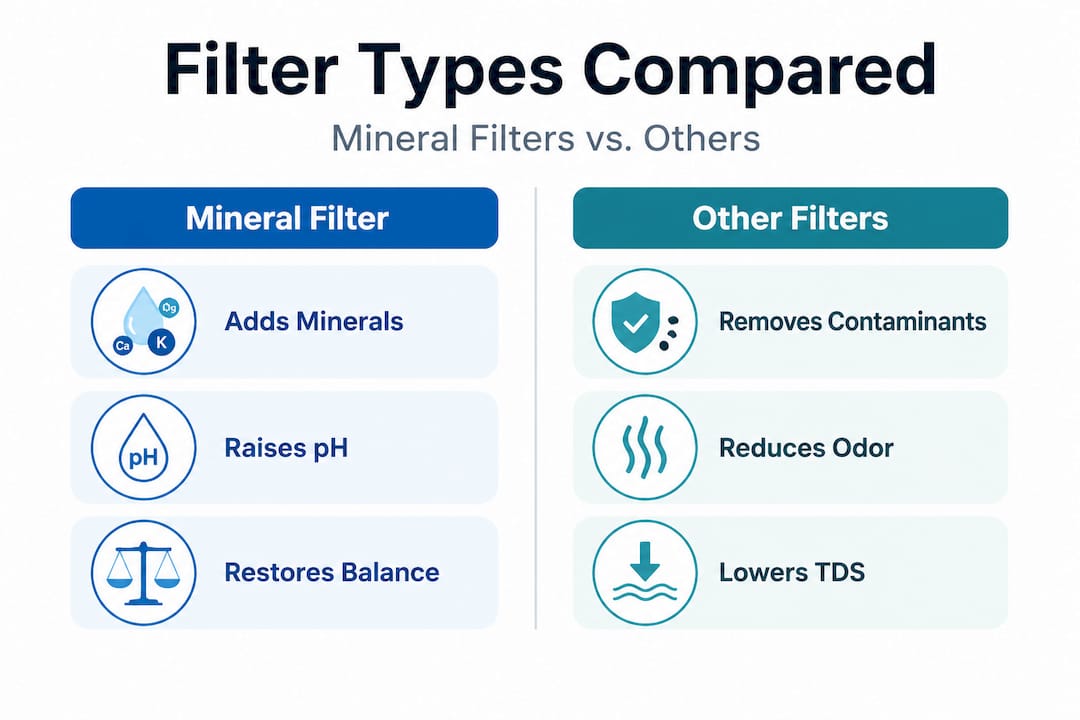
This is the core truth most filter marketing glosses over. Here is how mineral filters compare to the most common alternatives:
| Filter type | Removes contaminants | Adjusts pH | Adds minerals | Best for |
|---|---|---|---|---|
| Carbon filter | Yes (chlorine, VOCs) | No | No | Taste and odor improvement |
| Reverse osmosis | Yes (heavy metals, TDS) | Slightly lowers pH | No | Broad contaminant removal |
| UV filter | Yes (bacteria, viruses) | No | No | Microbial safety |
| Mineral filter | No | Yes | Yes | Post-RO restoration, pH balance |
| Water softener | Partially | No | No | Hard water scaling prevention |
Understanding waterborne contaminants is the key first step before deciding where a mineral filter fits your system. If your water has high bacterial counts or elevated heavy metals, you need RO and UV first. A mineral filter alone won’t protect your family in that situation.
When does a homeowner actually need a mineral filter?
- You have an RO system that produces flat-tasting, acidic water.
- Your well water has a consistently low pH (below 6.8) that corrodes your pipes.
- You want to restore a natural mineral profile to your drinking water for taste and wellness.
- Your current purification method strips out all minerals and you want them back.
The difference between tap and filtered water often comes down to mineral content. Tap water in many areas naturally contains calcium and magnesium. Heavily filtered or RO-treated water loses those minerals, which is exactly why adding a remineralizer as a final stage makes practical sense in those systems.

Filter sequence matters. Mineral filters should almost always come after heavy contaminant removal stages. Placing a remineralizer before RO wastes the minerals you just added, since the RO membrane will strip them right back out. The correct order is typically: sediment filter, carbon pre-filter, RO membrane, mineral filter, and carbon post-filter.
How to choose and maintain a mineral filter at home
Armed with this comparison, it is time to get practical: how can you select and get the most from a mineral filter at home?
Step-by-step guide to choosing the right mineral filter:
- Test your water first. Order a basic home water test kit or send a sample to a certified lab. You need to know your current pH, TDS (total dissolved solids), and hardness before selecting any filter. This data tells you whether you need pH correction, remineralization, or neither.
- Identify where the mineral filter fits in your system. If you already have an RO system, you need a post-RO remineralizer. If you have acidic well water with no RO, a calcite neutralizer is the right call.
- Check flow rate compatibility. Mineral filter cartridges are rated for specific flow rates, usually measured in gallons per minute. A mismatch between your household demand and filter capacity leads to under-treatment or wasted media.
- Choose food-grade certified media. Look for NSF/ANSI Standard 42 or 61 certified mineral media. These certifications confirm the media won’t introduce harmful substances into your water.
- Select housing that allows easy cartridge replacement. Mineral media needs periodic replacement, typically every six to twelve months. Choose a housing design you can service without calling a plumber.
The filter’s impact on your wellness is only as good as the maintenance you put into it. A depleted mineral cartridge doesn’t just stop working. It can actually allow pH to drift back down, undoing the benefits and potentially re-exposing your plumbing to corrosive water.
Simple maintenance routine:
- Check pH and TDS levels monthly using a basic meter.
- Inspect the filter housing every three months for sediment buildup or discoloration.
- Replace mineral media according to the manufacturer’s schedule, typically every six to twelve months, or sooner if pH starts dropping.
- Flush the system after each cartridge replacement to clear any fine particles.
Understanding why water filters matter goes beyond contaminant removal. Consistent maintenance is what keeps every stage of your system performing accurately. A mineral filter that isn’t monitored eventually becomes a liability rather than an asset.
Pro Tip: Keep a simple logbook (a note on your phone works fine) tracking your monthly pH readings. If you notice a trend where pH is dropping over several consecutive weeks, that is your early warning that the mineral media is nearly exhausted. Don’t wait until the taste changes. Replacing media proactively costs far less than reactive plumbing repairs from acidic water damage.
Why the ‘one-size-fits-all’ filter myth misleads homeowners
Stepping back from the practical details, here is what most guides miss about mineral filters: the marketing around them often implies they are universally beneficial, and that framing is actively misleading for homeowners who need real solutions.
Mineral filters are genuinely excellent tools when they match a specific water problem. Post-RO remineralizers restore taste and mineral balance beautifully. Calcite neutralizers solve corrosion problems that would otherwise cost thousands in pipe repairs. In those contexts, these filters deliver real, measurable value.
But the moment a homeowner assumes a mineral filter also handles bacteria, heavy metals, or pesticides, they are in dangerous territory. Those problems require entirely different technologies. UV light handles microbial threats. RO membranes handle heavy metals and dissolved solids. A mineral filter that matches your water profile is powerful. One that doesn’t match your actual water problem is just an expensive placebo.
We see this play out in a very predictable way. A homeowner installs a remineralizer because they read it adds calcium and magnesium, which sounds healthy. Their real problem, however, is elevated arsenic from a nearby industrial site. The remineralizer adds minerals beautifully while doing absolutely nothing about the arsenic. Their water tastes better. They feel reassured. The actual risk continues unchecked.
The smarter approach is to treat water quality and health as a diagnostic process, not a shopping exercise. Test first. Identify the actual problems. Then build a filtration sequence around those results, placing each filter type where it solves a confirmed issue. A mineral filter earns its place in that sequence when your water profile genuinely calls for it. Not before.
Confidence in your home water system comes from understanding what each stage does and why it’s there, not from having the most filter stages or the most impressive marketing claims.
Explore advanced water purification solutions for your home
For those ready to improve their home water quality, here is where to learn more or find modern solutions. Understanding the water purification process from start to finish helps you see exactly where mineral filtration fits in a complete system. You can also explore examples of filtration technologies to compare how each stage addresses specific water concerns before committing to a system.
At Coway, our water purification systems are engineered around multi-stage filtration that includes mineral balance as part of a complete health-focused approach to water quality. Whether you are exploring a countertop water purifier for a straightforward upgrade or looking at a full under-sink solution with UV sanitization and remineralization built in, our lineup is designed so each filter stage earns its place in the sequence. The goal is water that is clean, safe, balanced, and genuinely good for your household.
Frequently asked questions
Does a mineral filter remove contaminants?
Mineral filters are mainly designed to add or balance minerals, not to remove all contaminants. As purewateratlas.com notes, contaminant removal is best handled by other technologies like RO or UV, with mineral filters serving as a complementary stage.
What minerals are usually added by a mineral filter?
Calcium and magnesium are the most commonly added minerals, improving taste and raising pH. Some specialty blends also add trace amounts of potassium to more closely replicate natural spring water mineral profiles.
Do I need a mineral filter if my water already tastes good?
If your water already tastes balanced and your pH is in the neutral range, a mineral filter may not add meaningful value. Focus on what problem you’re solving first rather than adding filter stages by default.
Where does a mineral filter fit in a multi-stage filtration system?
Mineral filters almost always belong after reverse osmosis or demineralizing stages, where they restore the mineral content and pH that the RO process removes. Placing them before RO wastes the minerals entirely.
Can mineral filters help with hard water problems?
Most mineral filters are not designed to soften hard water and won’t reduce calcium or magnesium levels that cause scaling. Hard water problems generally require softening technology like ion exchange, which is a separate and distinct process from remineralization.
Recommended
- Mineralization in Water Filters: Impact on Home Wellness – Coway Water Purifier
- Sediment Filtration Explained: Clearer Water for Your Home – Coway Water Purifier
- What is mineralization in purifiers? A 2026 guide – Coway Water Purifier
- What is Water Filtration? Understanding Its Importance – Coway Water Purifier
