
Uncategorized
Energy-efficient purifiers: healthier homes, lower costs
May
TL;DR:
- Choosing energy-efficient purifiers saves families hundreds of dollars annually on electricity bills and reduces environmental impact. Continuous operation of these models improves health outcomes by ensuring consistent air and water purification while maintaining low noise levels. Prioritizing certified, appropriately sized units with high CADR-to-wattage ratios maximizes both cost savings and household well-being.
Most families spend hundreds of dollars on air and water purifiers without ever checking the wattage on the label. That oversight adds up fast. A single inefficient air purifier running 24 hours a day can quietly add $50 to $100 or more to your annual electricity bill, depending on your local rates. Choose an energy-efficient model instead, and you get the same clean air or water for a fraction of that cost. This guide breaks down exactly how much you save, what health benefits come with consistent operation, and how to pick the right purifier without falling for common marketing traps.
Table of Contents
- How energy-efficient purifiers save money and resources
- Key health benefits for your family and home
- Common myths and mistakes about purifier efficiency
- Choosing the right energy-efficient purifier for your needs
- Why energy efficiency is the future of home purification
- Explore top-rated energy-efficient purifiers for your home
- Frequently asked questions
Key Takeaways
| Point | Details |
|---|---|
| Major energy savings | Energy-efficient purifiers cut electricity use and utility bills by up to 40%. |
| No compromise on protection | Certified efficient models provide the same cleaning performance as standard purifiers. |
| Healthier continuous operation | Savings make it practical to run purifiers all day for cleaner air and water. |
| Smarter selection required | Choosing the right size and certification maximizes health and cost benefits. |
How energy-efficient purifiers save money and resources
After recognizing the importance of energy efficiency, let’s look at the actual numbers behind the savings.
The difference between an efficient and a standard purifier often comes down to watts. A typical standard air purifier running at medium speed might draw 55 watts. An energy-efficient model doing the same job at the same speed might draw only 35 watts. That gap of 20 watts seems small, but multiply it by 8,760 hours in a year and you get a significant difference in kilowatt-hours consumed and money spent.
At a national average rate of $0.14 per kilowatt-hour, here’s what that difference looks like annually:
| Model type | Wattage (medium speed) | Annual kWh | Annual cost |
|---|---|---|---|
| Standard purifier | 55W | 481.8 kWh | $67.45 |
| Efficient purifier | 35W | 306.6 kWh | $42.92 |
| Savings per year | 175.2 kWh | $24.53 |
Run two purifiers in your home, one in the bedroom and one in the living room, and you’re looking at nearly $50 in savings every year. Scale that to water purifiers, which also vary widely in pump efficiency and standby power draw, and total annual purifier energy savings across your household can reach $72 or more.
Key advantages of choosing energy-efficient models:
- Lower monthly electricity bills without sacrificing performance
- Reduced carbon footprint: using 175 fewer kWh per year is equivalent to skipping roughly 120 miles of driving
- Ability to run purifiers continuously without worrying about cost
- Longer motor life due to reduced heat generation at lower power loads
- Quieter operation at lower wattage settings
It’s also worth noting that Energy Star certified purifiers use 40% less electricity than standard models while delivering comparable air cleaning performance as measured by CADR (Clean Air Delivery Rate). CADR is the industry standard for measuring how fast a purifier removes pollutants. A higher CADR at lower watts is the sweet spot every smart shopper should target.
Pro Tip: Divide a purifier’s CADR by its wattage to get its efficiency score. A score above 2.0 is good; above 3.0 is excellent. This simple calculation cuts through marketing noise instantly.
The environmental benefit is real too. When millions of households switch to efficient purifiers, the cumulative reduction in electricity demand measurably reduces strain on the power grid and lowers greenhouse gas emissions nationally. For health-conscious families, that broader impact aligns with the same values that motivated the purifier purchase in the first place.
Key health benefits for your family and home
Now that you’ve seen the economic and environmental benefits, let’s focus on how these savings translate into real health gains for your family.
The biggest health advantage of an energy-efficient purifier is simple: you can actually afford to run it all the time. Most families with standard, power-hungry models quietly turn their purifiers off at night or during the day to manage electricity costs. That means hours of unfiltered air or unprocessed water, which is exactly when allergens, pollutants, and pathogens go unchecked.
“Continuous filtration matters more than peak filtration. A purifier that runs 24/7 at moderate efficiency protects your family far better than a powerful one that gets switched off to save money.”
With an efficient model, round-the-clock operation is economically painless. That consistency is where the real health gains come from.
Health benefits your family experiences with continuous, efficient operation:
- Reduced airborne allergens like pollen, pet dander, and dust mites
- Lower concentrations of VOCs (volatile organic compounds) from cleaning products and furniture off-gassing
- Cleaner drinking water with fewer contaminants, chlorine byproducts, and heavy metals
- Fewer respiratory irritants, which directly benefits family members with asthma or seasonal allergies
- Quieter sleep environments because efficient purifiers on low settings generate less noise
There’s also a wellness dimension that extends beyond physical health. Making health-focused purifier choices for your home creates a measurably better living environment. Studies on advantages of home wellness consistently show that cleaner indoor environments reduce stress, support better sleep, and improve cognitive function over time.
Many families also report that efficient purifiers change how they think about home comfort. Because the purifier runs quietly and costs little, they stop noticing it and start benefiting from it passively. That invisible, consistent protection is a completely different experience compared to a bulky machine you switch on occasionally and off frequently.
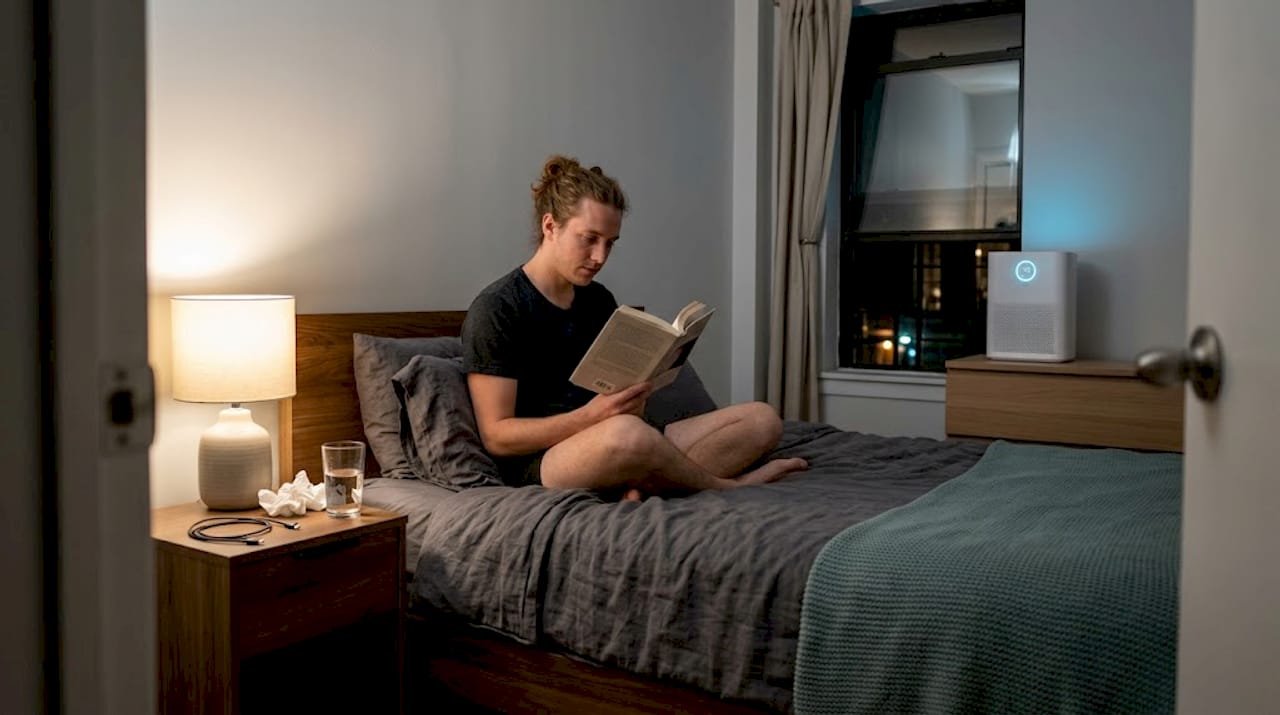
Pro Tip: Place your purifier in the room where your family spends the most time sleeping or relaxing. Running it on a low, energy-efficient setting overnight protects the hours when your body is most actively recovering. Check out these air purifier selection tips to match the right model to each room.
Long-term, consistent use is where the measurable improvements in well-being show up. One month of continuous air purification reduces baseline indoor pollutant levels dramatically compared to occasional use. Over a full year, that sustained difference adds up to fewer sick days, reduced allergy medication costs, and better overall respiratory health for every person in your household.
Common myths and mistakes about purifier efficiency
Understanding the health benefits is vital, but many families still make choices that undercut both savings and effectiveness. Let’s correct the most damaging myths.
The top myths about purifier efficiency, corrected:
-
“Higher wattage means better purification.” False. Performance is measured by CADR, not watts. A 35-watt purifier with a high CADR cleans air just as effectively as a 70-watt model with the same CADR. Wattage only tells you how much electricity is being consumed.
-
“I should buy the exact-size purifier for my room.” Not always. An oversized purifier running on its lowest setting often uses less energy, makes less noise, and maintains excellent air quality compared to a perfectly-sized unit running at high speed to keep up with demand.
-
“High CADR automatically means efficient.” Wrong. A purifier can have a very high CADR but terrible energy efficiency if it achieves that performance by simply running a powerful, high-draw motor. Always check the wattage alongside the CADR rating.
-
“Turning it off saves money.” In the short term, yes. But restarting a purifier to clean a room that has accumulated hours of pollutants requires it to run at higher settings for longer, using more energy overall than consistent low-speed operation would have consumed.
Here’s a direct comparison that illustrates the right and wrong approach:
| Scenario | Unit size | Speed setting | Noise level | Energy use | Effectiveness |
|---|---|---|---|---|---|
| Right-sized at max | Correct size | High | Loud | High | Good short-term |
| Oversized on low | Larger unit | Low | Quiet | Lower | Better long-term |
| Small unit at max | Too small | Max | Very loud | High | Poor, insufficient coverage |
As the research confirms, oversized units on low speed save more energy and produce less noise than exact-size models running at high speed. This counter-intuitive insight surprises most shoppers, but it’s backed by real-world testing data.
For cost-saving purification tips that go deeper, including how to set timers and use auto-modes intelligently, it’s worth reviewing your purifier’s smart features. Many modern efficient models include auto-sensing modes that reduce power draw when air quality is already good, which adds another layer of savings.
Pro Tip: When comparing purifiers, look for the annual energy cost listed in the product specs rather than just the wattage. This number accounts for typical usage patterns and gives you a real-world cost comparison. For a deeper look at what these ratings actually mean, the guide on understanding purifier efficiency is an excellent starting point.
Choosing the right energy-efficient purifier for your needs
Armed with essential facts, you can now make a smart choice for your next air or water purifier. Here’s how to do it step by step.
Step 1: Look for Energy Star certification first.
This is your baseline filter for efficiency. Energy Star certified purifiers deliver comparable air cleaning performance as measured by CADR while using far less energy. Without this certification, you’re largely relying on marketing claims.
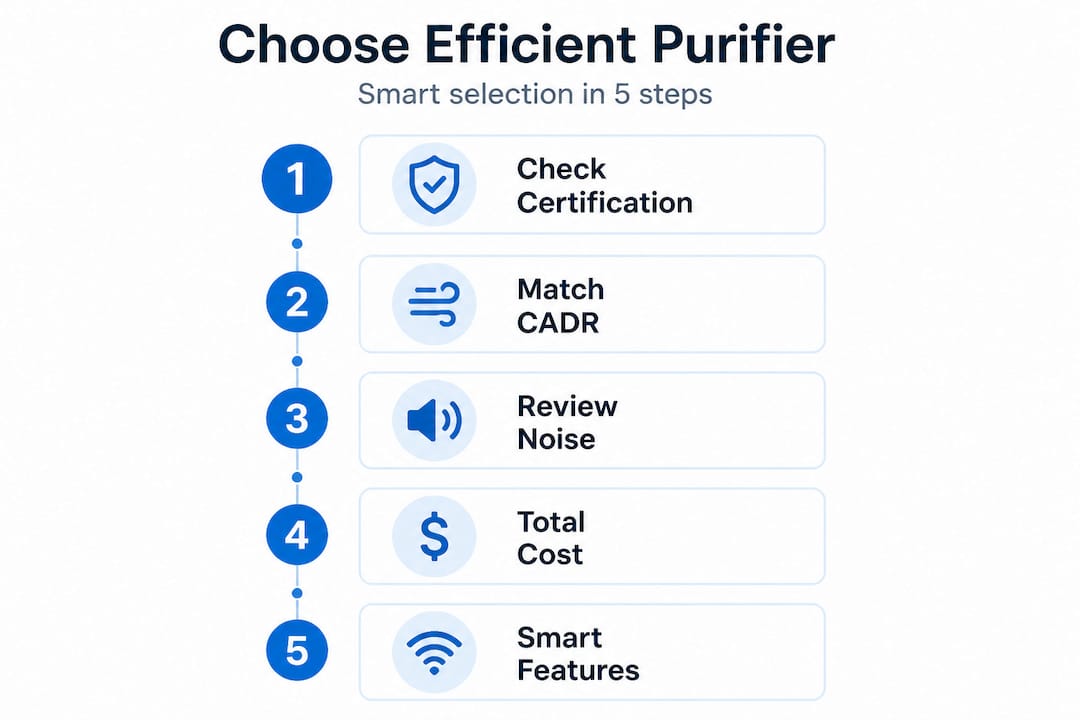
Step 2: Match CADR to your room size, not your aspirations.
The general rule is 2/3 of CADR for a room’s square footage. A 300 square-foot bedroom needs a purifier with at least 200 CADR. Going significantly above that number means you can run the unit on a lower, quieter, more efficient setting and still clean the air effectively.
Step 3: Check the noise rating alongside efficiency.
Efficient purifiers on low settings typically operate at 25 to 35 decibels, which is close to a whisper. If the product specs don’t list a decibel rating for the low setting, that’s a red flag. Quiet operation at low power is a hallmark of well-engineered efficient models.
Step 4: Calculate total ownership cost, not just sticker price.
A purifier that costs $100 less upfront but draws 30 more watts continuously will cost you an extra $36 per year in electricity alone. Over five years, that’s $180 extra on top of the higher filter replacement costs that often come with lower-tier models. For guidance on how to select an air purifier based on total cost of ownership, the math is almost always in favor of the efficient model.
Step 5: Consider smart features that automate efficiency.
Auto-mode sensors that detect particulate matter and adjust fan speed accordingly are a major efficiency booster. When air quality is good, the purifier drops to its lowest setting automatically. When pollutants spike, it ramps up. This dynamic operation can cut energy use by an additional 20 to 30 percent compared to running a fixed medium setting all day. Resources on optimizing home comfort highlight how smart home devices, including purifiers, create better living conditions with less user management.
Understanding the right air purifier for your home comes down to matching performance specs to your actual living situation, not choosing based on brand aesthetics or the most impressive-sounding feature list.
Why energy efficiency is the future of home purification
Most buying guides treat energy efficiency as a secondary consideration, something listed near the bottom after filtration technology, design, and smart features. That ordering is backwards, and it’s costing families real money and real health.
Here’s the uncomfortable truth: a purifier that runs inefficiently often runs less. Families notice the electricity bill, feel the discomfort, and start switching the unit off. The very appliance purchased to protect their health becomes something they use inconsistently, defeating its entire purpose. Efficiency isn’t just a nice-to-have budget feature. It’s the mechanism that makes consistent protection possible.
The industry has historically rewarded the spec sheet arms race. Bigger motors, higher CADR numbers, more filter stages. All of it valid, but none of it means anything if the operating cost discourages continuous use. Future-ready homeowners are beginning to think like investors: what is the five-year cost of this device, and does it actually stay on?
We’ve also seen the conversation shift among health-conscious families who’ve been using purifiers for several years. The early adopters who bought high-powered, inefficient models in 2019 and 2020 are now the loudest advocates for efficient replacements. They learned through experience what the data already shows.
The next generation of air purifier selection choices will be shaped by families who understand that a purifier’s true value is measured in months and years of uninterrupted operation, not peak performance during a single test. Brands and guides that ignore this shift are setting families up for higher costs and less reliable protection over the long run.
Explore top-rated energy-efficient purifiers for your home
You’ve seen the math, corrected the myths, and now have a clear framework for choosing smarter. The next step is finding models that actually deliver on these standards.
At Coway, every product recommendation starts with the same question: will this device actually stay on? That means prioritizing efficiency, quiet operation, and verified filtration performance together. Whether you’re exploring understanding water purification for the first time or comparing the best air purifiers for 2026 for a specific room, the goal is always the same: clean air and water that your family benefits from every single day, without an electricity bill that makes you second-guess leaving it on. For those considering water purification specifically, our roundup of top UV water purifier options highlights the most efficient and effective choices available right now.
Frequently asked questions
How much money can I save with an energy-efficient purifier?
You can save roughly $24 to $72 per year per device, based on the 40% electricity reduction delivered by Energy Star certified models compared to standard purifiers at $0.14 per kilowatt-hour.
Does energy efficiency affect air or water purification quality?
No. Certified energy-efficient purifiers must deliver the same cleaning performance as conventional models, with comparable CADR ratings verified through standardized testing before certification is granted.
Is it better to get a bigger purifier and run it on low?
Yes, in most cases. Oversized units on low speed use less energy and generate significantly less noise than a correctly-sized unit running at maximum fan speed to keep up with room demand.
How do I know if a purifier is energy-efficient?
Look for Energy Star certification on the product label, then verify by comparing wattage to CADR. Certified models also include annual energy cost estimates in their official product specs, which gives you the clearest real-world comparison.
Recommended
- Energy-Efficient Purification: Cleaner Air and Water at Home – Coway Water Purifier
- Cost-saving air purification tips for healthier homes 2026 – Coway Water Purifier
- How Purifiers Save Energy and Lower Costs – Coway Water Purifier
- How Purifiers Save Cost for Homes and Businesses – Coway Water Purifier
- Levoit Core 300S air purifier: Guide to cleaner indoor air — Blog | ClimatePro UAE
