
Uncategorized
How UV-C technology protects your home’s water and air
May
TL;DR:
- UV-C light effectively inactivates over 99.99% of germs in water and air.
- Proper installation, maintenance, and pre-filtration are essential for UV-C system effectiveness.
- UV-C is safe if enclosed and used with support filters but does not remove chemical contaminants.
UV-C light can inactivate over 99.99% of germs in home water purification systems, yet most families still aren’t sure what UV-C actually does, whether it’s safe to use indoors, and when it’s enough protection on its own. The technology has moved from hospitals and municipal treatment plants into kitchen counters and bedroom air purifiers, but the confusion hasn’t gone away. This guide cuts through the noise and explains exactly how UV-C works for water and air in your home, what its real limits are, and how to make it work hardest for your family.
Table of Contents
- What is UV-C technology?
- How UV-C purifies water and air in the home
- Types of UV-C systems: Lamps vs. LEDs and far-UVC
- Critical limitations and how to maximize UV-C effectiveness
- The real-world truth: Why UV-C is powerful but not a standalone fix
- Get safer water and air at home with proven UV-C solutions
- Frequently asked questions
Key Takeaways
| Point | Details |
|---|---|
| UV-C destroys germs | UV-C light inactivates bacteria, viruses, and protozoa instantly through DNA damage. |
| Not a filter substitute | UV-C does not remove particles or chemicals, so pre-filtration is essential for safe water. |
| Annual maintenance needed | Replacing the UV lamp or LED yearly is crucial for reliable performance. |
| Air and water solutions differ | Water and air UV-C systems operate differently and have unique safety needs. |
| Best with multi-barrier systems | Combining UV-C with certified filters provides comprehensive protection for your home. |
What is UV-C technology?
Ultraviolet light is invisible to the human eye, but not all ultraviolet light is the same. Scientists divide the UV spectrum into three bands based on wavelength. UV-A (315 to 400 nanometers, or nm) is the band responsible for suntans and, with long exposure, skin damage. UV-B (280 to 315 nm) is the band behind sunburns and vitamin D production. UV-C (200 to 280 nm) is the shortest and most energetic band, and it’s almost entirely absorbed by Earth’s atmosphere before it reaches the ground.
That last fact is important. Because UV-C doesn’t occur naturally at ground level, living organisms, including bacteria, viruses, and protozoa, never evolved a meaningful defense against it. When UV-C light hits a microorganism, the energy attacks its genetic material directly.
Here’s what that means in practical terms:
- UV-C photons are absorbed by the DNA and RNA inside microorganisms
- The absorbed energy breaks apart the molecular bonds in those strands
- The damaged microbe can no longer replicate or cause infection
- The process happens in seconds, with no chemicals involved
The most effective wavelength for this process is 254 nm. At that specific point on the spectrum, DNA absorption peaks, meaning microbes absorb the maximum amount of destructive energy per unit of light. Traditional mercury-vapor UV-C lamps naturally emit right at that wavelength, which is one reason they’ve dominated the disinfection industry for decades.
You can learn more about the UV sterilization basics that make this process relevant to everyday home use, including which types of microbes are most vulnerable and why water clarity plays a central role in effectiveness.
How UV-C purifies water and air in the home
Understanding the spectrum is step one. Step two is seeing how UV-C systems translate that science into safer water flowing from your faucet and cleaner air circulating through your living room.
Water purification: the UV chamber process
Water-based UV-C systems work by exposing flowing water to a UV lamp inside a sealed chamber. Here’s the sequence:
- Water enters a pre-filter stage that removes sediment, chlorine, and other particles that could block UV light from reaching microbes
- Pre-filtered water enters a narrow, transparent chamber lined with a UV-C lamp
- As water flows past the lamp, every organism in the water receives a calculated dose of UV-C energy
- Water exits the chamber cleared of active biological threats, with no chemical residue added
The dose is measured in millijoules per square centimeter (mJ/cm²). NSF/ANSI 55 Class A UV-C at 40 mJ/cm² achieves greater than 99.99% inactivation of bacteria, viruses, and protozoa, including Giardia and Cryptosporidium, two parasites that are resistant to standard chlorine treatment. This standard matters because it’s the benchmark certified products must meet before reaching your home.
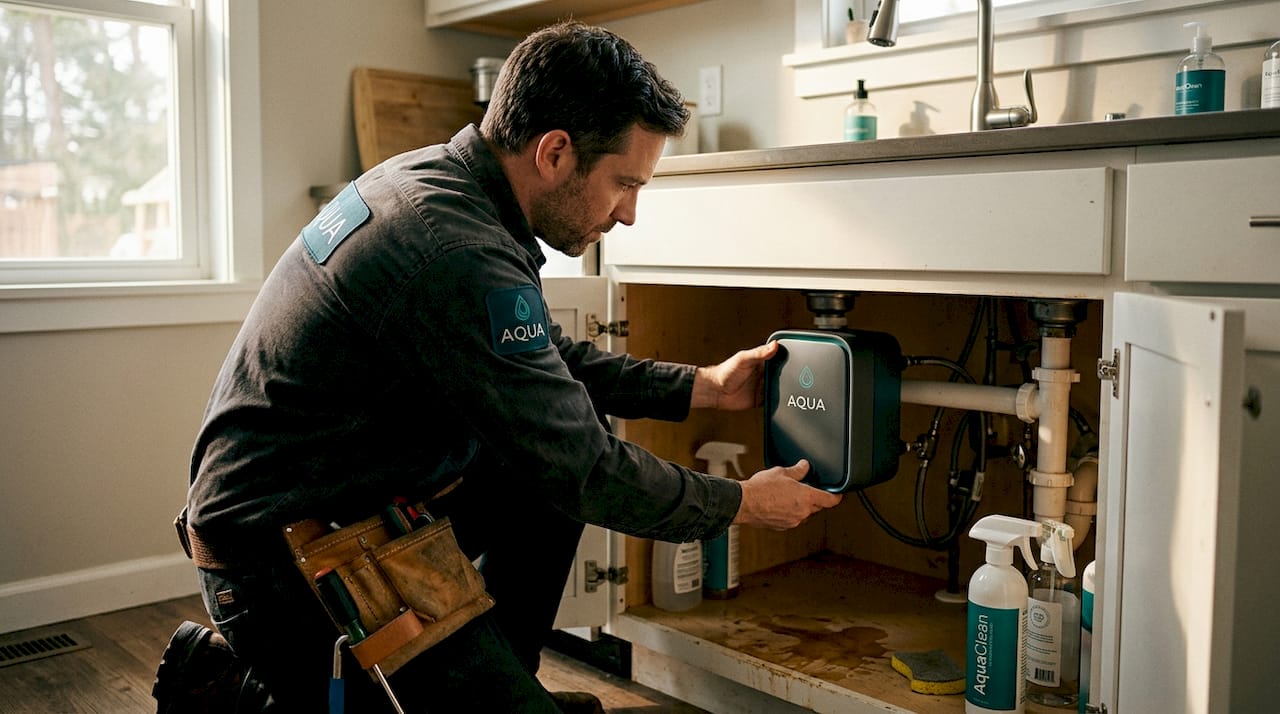
Common home water UV-C setups include point-of-entry units (which treat all water entering the house), under-sink units (which treat drinking and cooking water specifically), and countertop systems that sit right at the faucet.
Air purification: UV-C in motion
Air purifiers work differently because air, unlike water, is always moving and not contained in a single chamber. UV-C air systems either mount inside ductwork (in-duct units) to treat air as your HVAC system circulates it, or they sit as portable units in individual rooms where a fan draws air across a UV lamp or LED array.
Testing shows that 275 nm UVC-LED with filter achieves up to 99.8% germ reduction in just 10 to 20 minutes of operation. That number applies when the system is properly sized for the room and paired with a mechanical filter.
Side-by-side comparison
| Feature | Water UV-C | Air UV-C |
|---|---|---|
| Primary targets | Bacteria, viruses, protozoa | Bacteria, viruses, mold spores |
| UV dose standard | 40 mJ/cm² (NSF/ANSI 55) | Varies by flow rate and room size |
| Time to effectiveness | Seconds per liter | 10 to 20 minutes per room cycle |
| Must-have support system | Pre-filtration | HEPA or mechanical filter |
| Chemical residue | None | None |
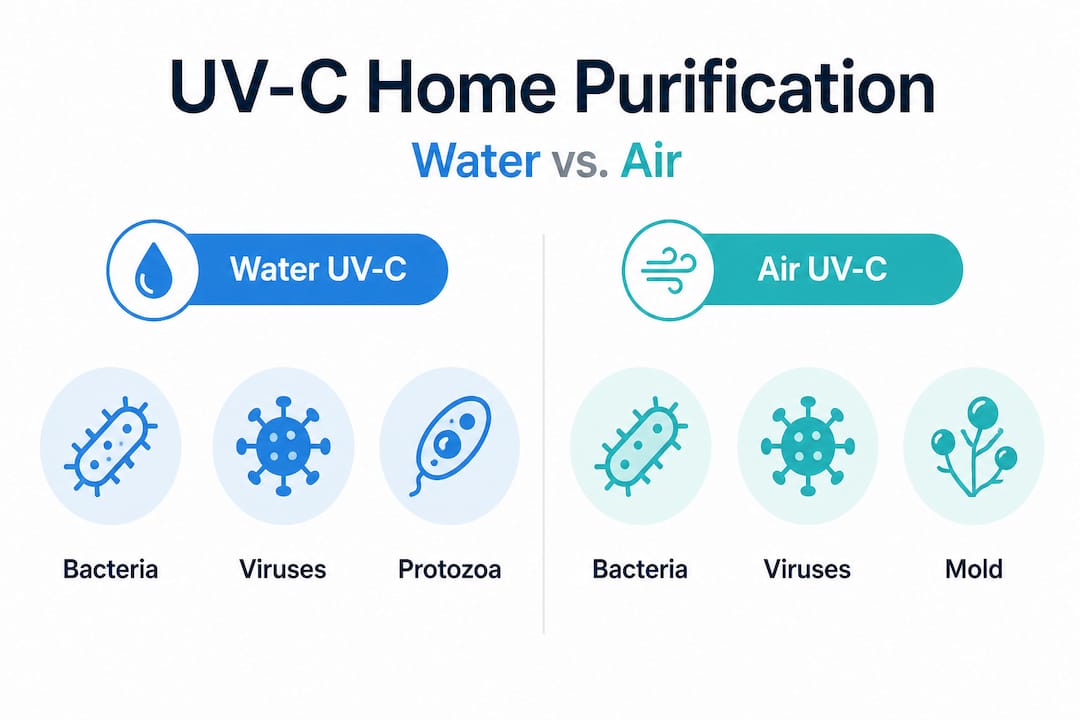
Pro Tip: If you’re buying an air purifier with UV-C, always check that it pairs the UV lamp with a physical filter. UV-C alone won’t trap dust, pet dander, or pollen, and a filter alone won’t inactivate live viruses.
For a deeper look at both applications, see UV water purification steps and learn more about the UV in air purification process and how modern systems integrate both technologies.
Types of UV-C systems: Lamps vs. LEDs and far-UVC
The hardware behind UV-C has changed significantly in recent years. Homeowners now have three main categories to choose from, each with distinct trade-offs.
Traditional mercury UV-C lamps (254 nm)
These are the workhorses of water disinfection. They emit light right at 254 nm, the peak absorption wavelength for DNA, making them extremely effective at inactivating a broad range of microorganisms. They’re well-tested, affordable, and widely certified.
The main drawback is safety during operation. Mercury UV-C lamps at 254 nm are highly effective but should not be used with people or pets present in the room. For water systems, this isn’t a concern because the lamp is fully enclosed inside the purifier. For air systems, however, exposure risk becomes a real consideration.
UV-C LEDs (mercury-free)
LED-based UV-C systems don’t contain mercury, which makes them more environmentally friendly and eliminates disposal concerns. They can be engineered to emit at specific wavelengths, last longer between replacements, and are easier to build into compact designs.
The trade-off is intensity. Current UV-C LEDs don’t yet match the raw output of mercury lamps at equivalent cost, which means some units need longer exposure times or higher-quality engineering to hit the same disinfection benchmarks. That gap is closing fast as the technology matures.
Far-UVC (222 nm): the emerging option
Far-UVC systems emit at 222 nm, a wavelength that research suggests can’t penetrate human skin cells or eye tissue deeply enough to cause damage. This makes far-UVC potentially safe to use in occupied rooms. That’s a significant practical advantage for air disinfection.
The catch is ozone. Far-UVC is promising but ozone risk requires good ventilation, and at this stage the technology is still accumulating long-term safety data. Some recent modeling also suggests that upper-room 254 nm UV-C may outperform far-UVC for air quality in occupied spaces, meaning the “winner” in air disinfection hasn’t been settled yet.
Quick comparison of UV-C hardware options
| System type | Wavelength | Mercury-free | Occupied room safe | Ozone risk | Relative cost |
|---|---|---|---|---|---|
| Mercury lamp | 254 nm | No | No | Low | Low |
| UV-C LED | 260 to 280 nm | Yes | No (enclosed use) | Very low | Medium |
| Far-UVC | 222 nm | Yes | Potentially yes | Moderate | High |
“254 nm systems are highly proven but require enclosure away from occupants. Far-UVC and LED options offer flexibility but need certification review and good ventilation to ensure safety.”
Pro Tip: Before purchasing any UV-C air unit, look for third-party certifications like UL or NSF, and check the product’s ozone emission rating. Ozone can irritate airways, especially in children and people with asthma.
Learn how UV-C for home water fits into a broader treatment strategy by reviewing UV-C for home water and understanding how different system designs serve different household needs.
Critical limitations and how to maximize UV-C effectiveness
UV-C is genuinely impressive, but it’s not a complete solution on its own. Here’s where many homeowners run into trouble.
UV-C does not remove particles
This is the most common misunderstanding. UV-C destroys living microorganisms by damaging their genetic material, but it has zero effect on sediment, heavy metals, chlorine byproducts, pesticides, or dissolved minerals. If your water contains lead or arsenic, UV-C won’t touch those contaminants. UV-C has no residual effect, so pairing with mechanical filtration is essential for complete safety.
Water clarity directly affects performance
UV-C light is blocked by anything that clouds the water. Turbidity, meaning the cloudiness caused by particles suspended in water, reduces how far UV-C energy can travel through the chamber. A unit rated for 99.99% inactivation in clear water may perform at a fraction of that level if the water entering the chamber is murky. This is why pre-filtration is not optional. It’s the foundation on which UV-C performance rests.
There is no residual protection
Chlorine, the most common chemical disinfectant in municipal water, stays active in treated water as it travels through pipes, killing any microbes it encounters after treatment. UV-C provides no such ongoing protection. Once treated water leaves the UV chamber, it can be recontaminated if pipes, storage tanks, or fixtures are not clean. This is a real consideration in older homes with aging plumbing.
Key habits that protect your investment in UV-C technology:
- Replace UV-C lamps or LEDs annually, even if the light still appears to be working
- Clean pre-filters on the schedule recommended by the manufacturer
- Have your water tested yearly to confirm your system is performing at rated levels
- For air units, replace HEPA or mechanical filters according to the manufacturer’s timeline
- Keep air purifiers away from walls and furniture to allow proper airflow around the unit
Understanding why pre-filters matter is critical before setting up any UV-C water system, and reading about the advantages of UV filtration can help you weigh UV-C against other purification options for your specific water quality situation.
Pro Tip: UV-C lamp output degrades gradually over time, often without any visible sign that the lamp is weakening. An aging lamp may look fine but deliver only 60% of the dose it once did. Annual replacement keeps your family protected at the level you paid for.
The real-world truth: Why UV-C is powerful but not a standalone fix
We’ve worked closely with homeowners who install a UV-C water purifier and immediately feel safer, which is understandable because the technology is genuinely powerful. But over time, we’ve noticed a pattern that worries us: people treat UV-C as a finish line rather than one layer of a complete system.
UV-C’s strength is its immediacy. No waiting, no chemical taste, no residual compounds. It disables live pathogens the instant they pass through the light, and UV-C must be maintained and validated to stay at that level of performance. That maintenance step is where most households fall short. Bulb changes get delayed, pre-filters get forgotten, and suddenly the system that was certified to inactivate 99.99% of microbes is operating at a fraction of that capacity.
For air, the picture is similar. Newer far-UVC and LED systems make it possible to run UV-C disinfection in occupied rooms, which is genuinely exciting for families dealing with seasonal illness or immunocompromised members. But UV-C in air doesn’t replace ventilation. A room with poor airflow and a UV-C unit is still a room with stale, potentially contaminated air recirculating. The UV-C needs fresh air cycling through it regularly to do its job well.
The honest take on UV-C, after following the science closely, is that it belongs in every serious home purification setup, but always in a supporting role alongside mechanical filtration, proper ventilation, and a consistent maintenance schedule. Families who use UV-C as one layer in a broader system get results that last. Families who treat it as the whole solution often find out the hard way that they have a gap.
For a complete picture of how UV-C fits into a safe home strategy, read more on UV sanitization and safety and understand which configurations work best for your household’s specific needs.
Get safer water and air at home with proven UV-C solutions
Knowing the science is the first step. Acting on it is what actually protects your family’s health every day. If you’ve been weighing whether UV-C is right for your home, the evidence points clearly toward yes, provided the system is certified, properly installed, and maintained.
At Coway, every water and air purifier we offer is built around validated filtration technology, including UV sanitization, pre-filtration stages, and service plans that take the guesswork out of maintenance. To understand how how our purifiers work from intake to output, or to explore what makes a great choice in best home air purifiers for families in 2026, our product pages walk you through every feature in plain language. If you want the fastest path to cleaner water and air at home, start with our full range of UV solutions for your home, backed by free delivery, professional installation, and scheduled maintenance.
Frequently asked questions
Is UV-C safe to use around children and pets?
Properly enclosed UV-C units are completely safe around children and pets because the light never escapes the sealed chamber. 222 nm far-UVC is safer for occupied spaces, but standard 254 nm units must remain fully enclosed and should never shine directly on people or animals.
Can UV-C purifiers remove all contaminants from water?
No. UV-C inactivates biological threats like bacteria, viruses, and protozoa, but it cannot filter out sediment, heavy metals, or chemical contaminants. Pre-filtration is required for high effectiveness, and pairing UV-C with a multi-stage filter gives you the most complete protection.
How often do I need to replace the UV-C lamp or LED?
Most home UV-C systems need annual replacement to stay at their rated performance level. Annual lamp replacement is considered critical for consistent germ kill, even when the lamp still appears to be working normally.
Does UV-C treat both bacteria and viruses?
Yes. NSF/ANSI 55 Class A UV-C at 40 mJ/cm² achieves greater than 99.99% inactivation of bacteria, viruses, and protozoa in water, including tough parasites like Giardia and Cryptosporidium that resist standard chlorine treatment.
Recommended
- UV Sanitization: Boosting Home Water and Air Safety – Coway Water Purifier
- Top 5 Advantages of UV Filtration for Safe Home Water – Coway Water Purifier
- Understanding the Role of UV in Water Purification – Coway Water Purifier
- Complete Guide to the Role of UV in Air Purification – Coway Water Purifier
