
Uncategorized
How purifiers help prevent pandemics and protect your home
Mar
Most families assume that running an air purifier or water filter is enough to keep viruses out of their home. That assumption is understandable, but it’s only half the story. Air purifiers alone do not prevent transmission, and many studies lack real-world human outcome data. What purifiers can do is remarkable when they’re used as part of a smarter, layered home defense strategy. This article breaks down the science, the limits, and the practical steps your family can take right now.
Table of Contents
- How airborne and waterborne pathogens spread at home
- The science behind home air purifiers and virus reduction
- Water purifiers and risk management during pandemics
- Safety, limitations, and real-world results
- Layered defense: Integrating purifiers into home pandemic prevention
- Explore advanced air and water purifier solutions for your home
- Frequently asked questions
Key Takeaways
| Point | Details |
|---|---|
| Purifiers reduce but don’t eliminate risk | HEPA and certain water purifiers lower pathogen counts but aren’t a standalone fix. |
| HEPA and RO/NF are most effective | Only HEPA for air and RO/NF for water reliably remove virus-sized particles. |
| Proper use and maintenance matter | Effectiveness drops sharply if units are sized poorly or filters aren’t regularly changed. |
| Avoid ozone and ionizer purifiers | Some air cleaners release harmful byproducts, so choose wisely for family safety. |
| Layered approach is best | Combine purifiers with ventilation, hygiene, and care for maximum home protection. |
How airborne and waterborne pathogens spread at home
Understanding how viruses and bacteria actually enter your home changes everything about how you defend against them. There are two main pathways: the air you breathe and the water you drink.
Airborne threats travel as respiratory droplets and aerosols released when someone talks, coughs, or breathes. Aerosols are the sneaky ones. They’re tiny enough to hang in the air for hours, especially in rooms with poor ventilation. Activities like cooking with steam, showering in a closed bathroom, or simply gathering in a small room all increase aerosol concentration. Most people underestimate how much viral spread happens indoors through the air they share.
Airborne viral transmission is far more common indoors than most families realize. A single infected person in a poorly ventilated room can expose everyone present within minutes, not hours.
Waterborne threats work differently. Bacteria, protozoa, and some viruses can survive in tap water, especially during infrastructure disruptions that sometimes accompany public health emergencies. The good news is that purifiers can interrupt both of these transmission chains.
- Airborne threats: HEPA filters capture particles down to 0.3 microns, trapping virus-carrying aerosols before you inhale them.
- Waterborne threats: Chlorination, UV, and RO effectively inactivate coronaviruses and other pathogens in drinking water.
- High-risk zones: Bedrooms, living rooms, and kitchens are the highest-priority spaces for air purification.
- Water risk windows: Boil advisories and infrastructure stress during outbreaks make household water purifiers especially valuable.
For a deeper look at choosing the right unit for your space, the air purifier selection tips on our site walk you through the key decisions. You can also explore our UV air purification guide for a closer look at how UV technology fits into your home defense.
The science behind home air purifiers and virus reduction
With the basics of risk understood, you need to know what today’s purifiers can really do for the air you breathe. Three main technologies dominate the market: HEPA filtration, UVC-LED, and ionization. Each works differently, and the differences matter.
HEPA filters physically trap particles using a dense fiber mesh. They don’t kill viruses, but they capture them so effectively that the air coming out is dramatically cleaner. Portable HEPA air cleaners supplement ventilation and reduce potential for airborne COVID-19 transmission when combined with distancing and masks.
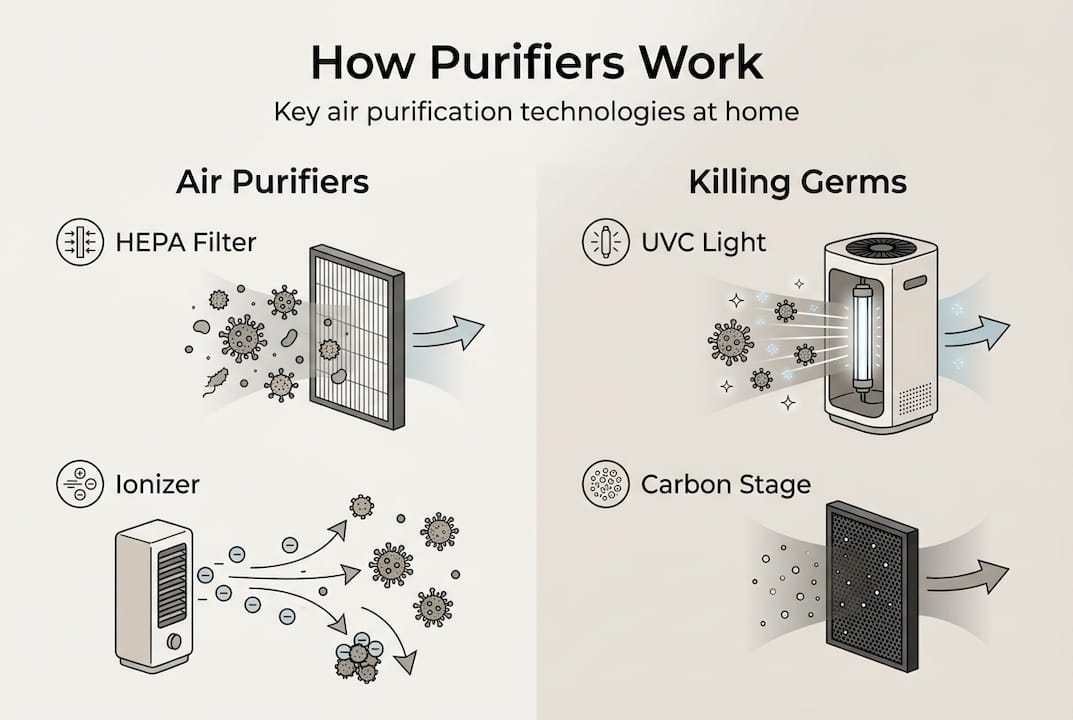
UVC-LED technology uses ultraviolet light to destroy the genetic material of viruses and bacteria, rendering them unable to replicate. UVC-LED air cleaners reduce airborne coronaviruses and influenza by 94 to 99.8% in 10 to 20 minutes, with even better results when paired with HEPA filtration.
Ionizers release charged particles that cause airborne contaminants to clump together and fall out of the air. They can be effective, but some produce ozone as a byproduct, which is a concern we’ll address shortly.
Here’s how the three technologies compare at a glance:
| Technology | Viral removal efficiency | Speed | Ozone risk |
|---|---|---|---|
| HEPA filter | High (captures 99.97% of 0.3-micron particles) | Continuous | None |
| UVC-LED | Very high (94-99.8% reduction) | 10-20 minutes | None |
| Ionizer | Moderate | Fast | Possible |
| HEPA + UVC-LED combined | Highest | 4-log reduction in 36 seconds | None |
Stat to know: High-performing air purifiers are rated by CADR (Clean Air Delivery Rate), which measures how fast they clean a room. A unit with a strong CADR can remove 90% of fine particles in under two minutes in an average bedroom.
Pro Tip: Running your air purifier on a continuous low speed in high-use rooms is more effective than blasting it on high for short bursts. Consistent airflow keeps particle counts low throughout the day.
For a full breakdown of which unit fits your home, check out our guide on the best air purifier types. If you’re watching your budget, our cost-saving tips for air purifiers show you how to get maximum protection without overspending.
Water purifiers and risk management during pandemics
With air safety covered, families often worry next about what comes out of their faucets, especially during a public health scare. Not all water purifiers are created equal, and the differences in what they remove are significant.
Here’s a quick breakdown of the main household water purification technologies:
| Technology | What it removes | Virus removal |
|---|---|---|
| Reverse Osmosis (RO) | Bacteria, viruses, heavy metals, chemicals | 100% of MS2 phage and enteric bacteria |
| Nanofiltration (NF) | Bacteria, viruses, some minerals | 100% of viruses |
| Ultrafiltration (UF) | Bacteria, protozoa | Poor virus removal |
| UV treatment | Inactivates bacteria and viruses | Effective against coronaviruses |
| Carbon filter | Chemicals, chlorine, odor | Does not remove viruses |
The key takeaway: only RO and NF systems reliably eliminate viruses from drinking water. UF is excellent for bacteria and protozoa but falls short on viruses. UV treatment is a strong add-on because it inactivates coronaviruses and other pathogens without adding chemicals.
Maintenance is where most families drop the ball. A neglected filter can become a breeding ground for the very microbes you’re trying to eliminate. Follow these steps to keep your system safe:
- Replace filters on schedule. Check your manufacturer’s recommended interval and set a calendar reminder.
- Sanitize the storage tank every six months if your system includes one.
- Flush the system after any period of non-use longer than two weeks.
- Test your water annually or after any local water advisory.
- Inspect UV lamps every 12 months and replace them even if they still appear to glow, since UV output degrades before the light goes out.
Pro Tip: Skipping filter changes is not just inefficient, it’s risky. Post-activated carbon stages that go too long without replacement can harbor microbial growth, turning your purifier into a contamination source instead of a solution.
For everything you need to stay on top of upkeep, our water purifier maintenance essentials guide covers the full schedule. You can also read our tips on maintaining water purifier efficiency for natural, low-cost approaches.
Safety, limitations, and real-world results
Knowing what works in theory isn’t enough. True safety means understanding real-world results and how to avoid unintentional risks that come with purifier use.
Let’s be direct: purifiers are one layer of protection, not a magic shield. Air purifiers alone show no direct evidence of reducing actual infections in real-world settings. Lab results are promising, but human outcome trials are scarce.
While lab data shows virus reduction, real-world infection trials are scarce. The hype around purifiers often exceeds their proven prevention power. Use them wisely, not exclusively.
Here are the most important safety caveats every family should know:
- Ozone risk: Ozone-generating ionizers may produce harmful byproducts in occupied spaces. Stick with HEPA units that explicitly state zero ozone output.
- Wrong room size: A purifier rated for 200 square feet placed in a 500-square-foot open living area will underperform significantly. Always match CADR to your room size.
- Placement errors: Tucking a purifier in a corner or behind furniture blocks airflow and cuts effectiveness dramatically.
- Secondary water contamination: Post-activated carbon stages in water purifiers that go too long without replacement can harbor microbial growth.
- Overconfidence: Families who rely solely on purifiers may skip ventilation, hygiene, or other proven steps, which actually increases their overall risk.
Pro Tip: When shopping for an air purifier, look for the phrase “no ozone” or “ozone-free” in the product specifications. If it’s not listed, ask before you buy.
For a broader look at how indoor air quality solutions fit into a healthy home, it’s worth reviewing what property experts recommend alongside purifier use. Our own maintenance schedule tips and importance of purifier maintenance resources make it easy to stay on track.
Layered defense: Integrating purifiers into home pandemic prevention
With realistic expectations and a clear view of purifier roles, it’s time to put action in the hands of homeowners and families. The concept is simple: no single tool stops a pandemic at your front door. But combining the right tools creates a defense that’s far stronger than any one piece.
The layered defense model works like this: portable HEPA air purifiers with high CADR ratings (targeting 4 to 6 air changes per hour) in high-use rooms reduce aerosol risks when combined with ventilation, hygiene, and masks when someone in the home is sick. Water purifiers with RO or UV technology handle the waterborne side. Together, they cover the two main indoor transmission pathways.
Here’s how to integrate everything step by step:
- Choose the right purifier. Match your air purifier’s CADR to your room size. Choose RO or UV for drinking water.
- Place units strategically. Put air purifiers in bedrooms and living areas where your family spends the most time. Keep them away from walls and corners.
- Run air purifiers continuously on low speed in occupied rooms rather than only during peak hours.
- Follow a strict maintenance schedule. Replace filters, sanitize tanks, and inspect UV lamps on time, every time.
- Layer in other habits. Open windows when weather allows, wash hands frequently, and wear a mask if someone in the home is symptomatic.
Do’s and don’ts for your home defense strategy:
- Do combine purifiers with good ventilation and hygiene habits.
- Do size your air purifier to the actual room, not the largest room in the house.
- Do follow the must-know water purifier care steps to prevent secondary contamination.
- Don’t rely on purifiers alone as your only line of defense.
- Don’t use ozone-generating ionizers in rooms where children or elderly family members sleep.
- Don’t skip filter replacements, even if the unit appears to be working fine.
For a complete framework, the healthy home checklist from home health experts pairs well with everything covered here.
Explore advanced air and water purifier solutions for your home
If this article has made one thing clear, it’s that the right purifier, properly maintained and paired with smart habits, makes a real difference for your family’s health. Coway’s range of air and water purifiers is built on the same science we’ve covered here: HEPA filtration, UVC-LED technology, and RO water systems designed for real families in real homes.
Start with our air purifier selection guide to find the right unit for every room in your home. If water safety is your priority, our complete water purification guide explains every technology in plain language. And if you want to understand how UV fits into both air and water protection, our UV sanitization for home safety resource is the place to start. Coway combines scientific rigor with practical home solutions so your family doesn’t have to choose between safety and convenience.
Frequently asked questions
Do air purifiers fully prevent virus infections at home?
No. Air purifiers reduce airborne virus particles, but no direct evidence links them to reduced real-world infections. They work best as one part of a broader strategy that includes ventilation and hygiene.
Is a HEPA filter necessary for virus protection?
Yes. Only HEPA-grade filters reliably capture particles down to 0.3 microns, which is the size range that includes virus-carrying aerosols. For pandemic defense indoors, HEPA is the standard to meet.
What water purifier technology removes viruses?
Reverse osmosis and nanofiltration achieve 100% virus removal from drinking water. UV treatment also inactivates viruses effectively and is often used alongside RO for added protection.
Are ozone or ionizer air purifiers safe for families?
Most are not recommended for occupied spaces. Ozone-generating units produce harmful byproducts that can irritate lungs, especially in children and older adults. Choose certified ozone-free HEPA models instead.
Recommended
- Understanding How Air Purifiers Work for Healthier Homes – Coway Water Purifier
- 7 Key Benefits of Air Purifiers for Urban Homeowners – Coway Water Purifier
- How Purifiers Save Cost for Homes and Businesses – Coway Water Purifier
- How Purifiers Save Cost for Homes and Businesses – Coway Water Purifier
- Common indoor air pollutants: what homeowners should know – HVAC Service and Repair | Louisville, KY | Project Heating & Cooling
