
Uncategorized
Why Businesses Need Air Purification: 2026 Guide
May
TL;DR:
- Many businesses mistakenly believe ventilation alone ensures air quality, but supplemental purification is essential for standards compliance. Proper placement, maintenance, and technology selection of air purifiers significantly improve indoor air quality, reducing sick days, enhancing performance, and increasing customer satisfaction. Implementing a layered IAQ strategy tailored to specific sectors ensures healthier environments and long-term operational benefits.
Most business owners assume that keeping windows open or running the HVAC system handles their air quality obligations. That assumption is costing them more than they realize. Why businesses need air purification goes well beyond a wellness trend. Indoor air quality (IAQ) directly shapes how many sick days employees take, how clearly your team thinks, and whether your customers feel comfortable enough to return. With ASHRAE Standard 241 raising the bar on clean air delivery requirements in 2026, the gap between “ventilated” and “clean” has never been wider.
Table of Contents
- Key takeaways
- Why businesses need air purification beyond basic ventilation
- Why HVAC systems fall short on their own
- How air purification systems deliver measurable results
- Practical steps for implementing air purification at your business
- How air purification benefits differ across business sectors
- My honest take after years of watching businesses get this wrong
- Clean air solutions from Cowayswaterpurifier
- FAQ
Key takeaways
| Point | Details |
|---|---|
| Ventilation is not enough | HVAC systems alone cannot meet current IAQ standards without supplemental air cleaning. |
| IAQ affects performance | CO2 above 1000 ppm can reduce cognitive performance by up to 15% in occupied spaces. |
| Technology type matters | HEPA, UV, and activated carbon each target different pollutants and must match your environment. |
| Placement drives results | A purifier in the wrong location can reduce its effectiveness regardless of filter rating. |
| Maintenance is non-negotiable | Filter degradation and deferred upkeep undermine compliance and real-world air quality gains. |
Why businesses need air purification beyond basic ventilation
The EPA reports that Americans spend roughly 90% of their time indoors, and commercial spaces rank among the most densely occupied environments on the planet. That statistic alone reframes the stakes. When your employees are breathing recirculated air for eight or more hours a day, the quality of that air is not a minor amenity. It is a working condition.
Here is what businesses consistently overlook: indoor air can carry concentrations of pollutants two to five times higher than outdoor air. That includes particulate matter, volatile organic compounds (VOCs) from cleaning products and furnishings, biological contaminants, and carbon dioxide from occupant respiration. None of these are fully addressed by opening a vent.
Poor air quality produces a chain of consequences that hits the bottom line directly:
- Increased sick days. Respiratory irritants and biological aerosols elevate the risk of illness, particularly in open offices and shared commercial spaces.
- Reduced concentration. CO2 above 1000 ppm reduces cognitive performance by up to 15%, a measurable hit to output in knowledge-work settings.
- Lower customer satisfaction. Unpleasant odors, stuffiness, or visible dust immediately signal neglect, regardless of how clean the space looks.
- Higher turnover signals. Employees who report chronic fatigue or headaches at work often cite “sick building syndrome” symptoms that trace back to IAQ failures.
Customer expectations have also shifted. Post-pandemic, a meaningful share of consumers and clients now actively notice air quality cues, particularly in healthcare waiting rooms, restaurants, and retail environments. The businesses that invest in workplace air quality are not just checking a compliance box. They are building a tangible brand signal.
Why HVAC systems fall short on their own
Understanding the limits of standard ventilation is not an attack on HVAC. It is a practical engineering reality. ASHRAE Standard 62.1, the long-standing ventilation benchmark, was designed to control CO2 and general stuffiness by diluting indoor air with outdoor air. It was never designed to neutralize fine particulates, VOCs, or infectious aerosols at the occupant level.
ASHRAE Standard 241, introduced to address infection risk, requires four to six times higher clean air delivery than Standard 62.1. Meeting that target by increasing outdoor air intake alone is expensive, energy-intensive, and often physically impossible in sealed commercial buildings. You would need to overhaul ductwork, add mechanical capacity, and still fight the problem of uneven air distribution.
Experts are clear that layered IAQ strategies combining source control, filtration, and active air cleaning consistently outperform ventilation-only approaches. The concept of equivalent clean air changes per hour (eACH) captures this well. A portable HEPA air cleaner with a sufficient clean air delivery rate (CADR) can contribute additional eACH values on top of what the HVAC system provides. Target benchmarks of 3 eACH minimum and 5 to 6 preferred for densely occupied spaces are now standard planning parameters.
Pro Tip: Before purchasing any purifier, calculate your room’s CADR requirement based on floor area and ceiling height. A unit rated for 300 square feet will not perform adequately in a 600-square-foot conference room, even if the filter is top-rated.
The comparison below shows what each approach can and cannot deliver:
| Approach | Strengths | Limitations |
|---|---|---|
| HVAC ventilation | Controls CO2 and temperature | Misses fine particles, VOCs, and biological aerosols near source |
| HVAC with upgraded filters (MERV 13+) | Captures airborne particles centrally | Uneven coverage, no help for pollutants generated between returns |
| Supplemental air purifiers | Targeted, zone-level clean air delivery | Requires correct sizing, placement, and maintenance to work |
| Layered strategy (all three) | Meets ASHRAE 241 and protects all occupants | Highest upfront planning; best long-term results |
How air purification systems deliver measurable results
Not all air purifiers are equal, and the technology type matters as much as the brand name. Businesses generally encounter four categories:
- HEPA filtration captures 99.97% of particles at 0.3 microns, including dust, pollen, mold spores, and many bacteria-carrying aerosols. This is the workhorse for most commercial applications.
- Activated carbon filters adsorb VOCs, odors, and gases that HEPA misses entirely. Restaurants, salons, and manufacturing floors benefit most from this layer.
- UV-C germicidal irradiation inactivates biological contaminants including viruses and bacteria. It works best when combined with filtration rather than as a standalone solution.
- Ionization can charge particles for easier capture but carries mixed evidence for occupied spaces and should be selected carefully.
Real-world performance, however, depends heavily on placement and room dynamics. A two-week office study from the EDIAQI project found purifier-associated reductions of 19 to 37% for heavy polycyclic aromatic hydrocarbons (PAHs), but results varied significantly by unit location and nearby source activities. Simply placing a unit in a corner because it is convenient can erase much of that benefit.
Field studies consistently show that manufacturer performance claims made in controlled lab conditions often overestimate what happens in real offices with irregular occupancy, open doors, and varied pollutant sources. That is not a reason to avoid purifiers. It is a reason to plan their deployment deliberately.
Pro Tip: Position purifiers within the breathing zone of the highest-occupancy areas, not against walls far from where people actually sit. A unit placed two to three feet from a workstation cluster delivers meaningfully better results than one tucked behind a filing cabinet.
Practical steps for implementing air purification at your business
Getting from awareness to action requires a structured approach. Here is how to do it right:
- Conduct a baseline IAQ assessment. Measure CO2, PM2.5, and VOC levels during peak occupancy using low-cost sensors or a professional audit. You cannot set targets you have not measured.
- Define your clean air goals. Align targets with ASHRAE 62.1 for general comfort and ASHRAE 241 if infection risk control is a priority. Document these goals before selecting equipment.
- Select purifiers matched to your spaces. Use CADR and eACH calculations to size units correctly. A useful indoor air quality improvement guide can help you map room-by-room requirements before you buy.
- Install and position units strategically. Place units near occupant zones and primary pollutant sources, not in unoccupied corners.
- Establish a maintenance schedule. ASHRAE-aligned checklists recommend monthly HVAC filter inspections and replacement based on differential pressure readings, not just calendar time.
- Verify performance over time. ASHRAE 241 compliance requires documented, measured clean air delivery on an ongoing basis, not just at installation.
Beyond this checklist, the ongoing IAQ management layer matters. Integrate your purifiers with your ventilation schedule, eliminate or reduce indoor pollutant sources where possible (choose low-VOC cleaning products and furnishings), and use your monitoring data to trigger maintenance rather than waiting for complaints.
Pro Tip: Set up a simple monthly reminder to check filter status indicators on every unit. Filter efficiency degrades with loading, and facilities that defer maintenance often face higher costs and compliance gaps precisely when they can least afford it.
How air purification benefits differ across business sectors
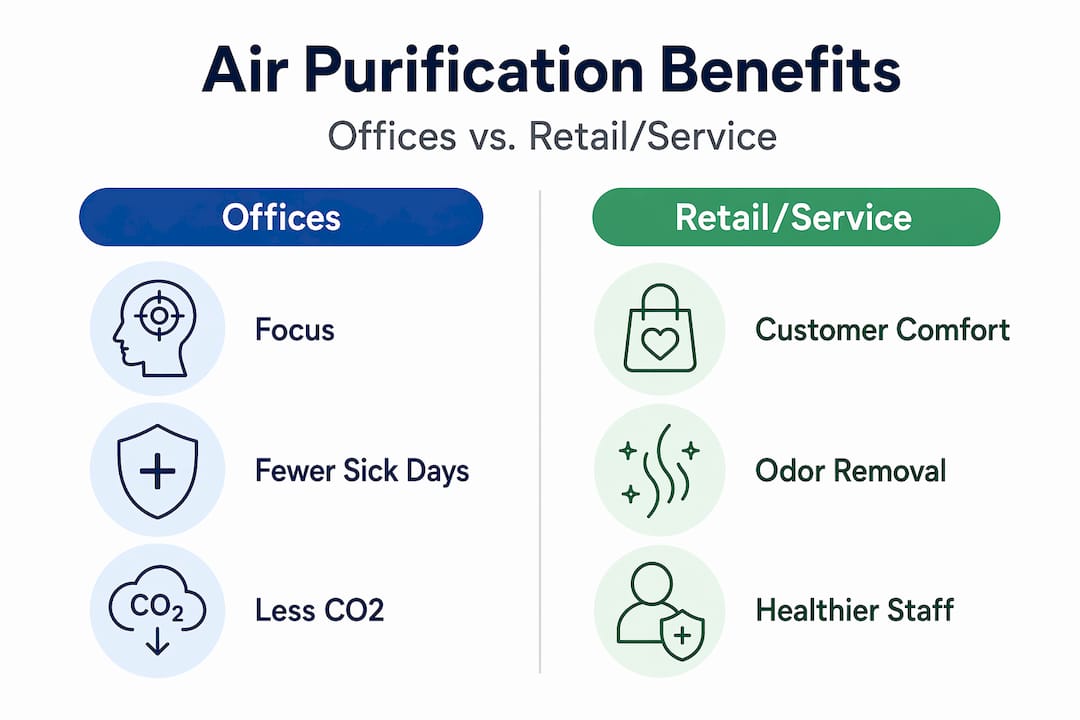
The importance of air purification is not uniform. Different industries face different pollutant profiles, occupancy densities, and regulatory pressures. Here is how the calculus changes by sector:
| Sector | Primary Pollutant Concern | Purifier Priority |
|---|---|---|
| Office | CO2, VOCs, biological aerosols | HEPA plus activated carbon for general coverage |
| Healthcare | Biological contaminants, particulates | HEPA plus UV-C; strict compliance with infection control standards |
| Retail | Odors, dust, customer comfort | Activated carbon plus HEPA; quiet operation matters |
| Food service | Cooking aerosols, odors, grease particles | High-CADR activated carbon units with grease filters |
| Manufacturing | Industrial dust, chemical fumes | Industrial-grade HEPA with VOC control; source capture first |
Offices benefit primarily from indoor air quality improvements that address the slow cognitive drain of elevated CO2 and VOC accumulation throughout the workday. Healthcare facilities face the most stringent requirements and often integrate stacking approaches from combined IAQ strategies that layer filtration, ventilation, and source control simultaneously.

Retail and food service businesses often underestimate the customer experience dimension. Odors and stale air register at an unconscious level before a customer consciously notices anything wrong. Clean, neutral air in a restaurant or boutique directly affects how long customers stay and whether they return.
My honest take after years of watching businesses get this wrong
I’ve seen companies spend thousands on premium air purifiers and then wonder why the air still smells stale six months later. Every single time, the issue traces back to one of three things: bad placement, deferred filter maintenance, or no source control at all.
What I’ve learned from reviewing real deployment data is that the businesses that get IAQ right treat it like a system, not a product purchase. They buy the purifier and then they follow through. They keep the maintenance log. They measure before and after. They swap out cleaning products that off-gas VOCs while the new purifier sits next to a cabinet full of chemical aerosols.
The counterintuitive part? A well-maintained midrange unit almost always outperforms a neglected premium one. I’d take a properly placed, regularly serviced purifier rated for the actual room size over a flagship device stuck in a corner and ignored every time.
My recommendation for any business evaluating this: start with measurement, size correctly, place deliberately, and build maintenance into your operations calendar before you spend a dollar on hardware. The benefits of clean air in workplaces are real and documented. But they only materialize when the strategy behind the equipment is as serious as the equipment itself.
— Soldierboy
Clean air solutions from Cowayswaterpurifier
If you are ready to move from evaluation to action, Cowayswaterpurifier offers a range of Coway air purifiers engineered for both home and commercial environments, with multi-stage filtration that combines HEPA, activated carbon, and UV sanitization in a single unit. The Coway air purifier catalog covers units suited to offices, retail spaces, and healthcare-adjacent environments, with free delivery, professional installation, and ongoing maintenance support included.
Before you select a model, the air purifier selection guide at Cowayswaterpurifier walks you through CADR requirements, room sizing, and technology matching for your specific space. For businesses that already have units deployed, the maintenance workflow guide gives you a practical schedule to sustain performance and stay ahead of compliance documentation requirements.
FAQ
Why do businesses need air purification if they already have HVAC?
HVAC systems control temperature and dilute CO2 but cannot eliminate fine particles, VOCs, or biological aerosols at the occupant level. Supplemental air purification fills those gaps and helps meet ASHRAE 241 clean air delivery targets.
What is the most important factor in air purifier performance?
Placement matters more than most businesses expect. A two-week office study showed that units positioned near occupant zones and pollutant sources significantly outperformed those placed for convenience.
How often should businesses replace air purifier filters?
Replacement frequency depends on usage, occupancy, and pollutant load rather than a fixed calendar schedule. Monthly inspections with replacement triggered by differential pressure readings are the ASHRAE-recommended approach.
Can air purification improve employee productivity?
Yes. CO2 levels above 1000 ppm reduce cognitive performance measurably, and reducing airborne irritants lowers sick day frequency. Both outcomes directly affect output and labor costs.
Which businesses benefit most from air purification?
Healthcare, food service, and high-density offices see the largest measurable gains, but any commercial space with regular occupancy benefits from cleaner air in terms of health outcomes, customer satisfaction, and regulatory compliance.
Recommended
- How Air Purifiers Protect Workplace Health and Safety – Coway Water Purifier
- Air purification trends 2026: 7.2% market growth insights – Coway Water Purifier
- Role of Air Purifiers in U.S. Business Wellness – Coway Water Purifier
- 8 Key Commercial Air Purifier Benefits You Should Know – Coway Water Purifier
