
Uncategorized
Filtration in Regulatory Compliance: 2026 Guide

Jun
TL;DR:
- Filtration in regulatory compliance involves systematically removing contaminants from processes to meet health and safety standards. It is essential for product release in pharmaceuticals, food, and healthcare, with strict requirements for validation, documentation, and material compliance. Adhering to guidelines like EU Annex 1 and FDA standards requires ongoing risk assessments, structured contamination control, and detailed traceability to ensure audit readiness and manufacturing integrity.
Filtration in regulatory compliance is defined as the systematic removal of contaminants from process streams, utilities, and products to meet legally mandated health and safety standards. Across pharmaceuticals, food and beverage, and healthcare, the role of filtration in regulatory compliance determines whether a product reaches market or fails inspection. Regulatory bodies including the FDA, the European Medicines Agency, and agencies enforcing FSMA set specific expectations around filter selection, validation, and documentation. Companies like Cytiva, Donaldson, and CRB have built entire compliance frameworks around filtration as a primary control measure, not an afterthought.
What are the key regulatory requirements governing filtration systems?
Filtration systems regulation differs significantly between the United States and the European Union, and compliance officers must understand both frameworks to operate globally.
EU Annex 1 requires pre-use post-sterilization integrity testing, known as PUPSIT, as a regulatory expectation for sterile manufacturing. The reasoning is direct: sterilization processes can mask filter defects, and a filter that passes post-use testing may have allowed contamination during the entire production run. Cost alone does not justify skipping PUPSIT under EU guidance.
FDA supports risk-based assessments around PUPSIT but mandates only post-use integrity testing. This creates a compliance gap for companies selling into both markets. You need a documented risk assessment that satisfies both regulators, not two separate documents that contradict each other.
For food processors, FSMA introduced Hazard Analysis and Risk-Based Preventive Controls (HARPC), which updated the older HACCP model. Filtration is a core control measure at critical control points (CCPs) within these plans. Donaldson identifies specific micron rating requirements tied to each CCP, meaning a filter that works for compressed air may be entirely wrong for direct product contact.
Key regulatory expectations across industries include:
- PUPSIT documentation: Written acceptance criteria and deviation protocols before production begins, not after a failure occurs.
- Material compliance: Filtration elements in food-contact applications are classified as food contact materials under EU Regulation (EC) 852/2004 and must be food grade, non-leaching, and validated through cleaning and sterilization cycles.
- Filter validation records: Evidence that filters perform under worst-case process conditions, not just standard operating parameters.
- Certificates of conformance: Traceability documentation linking each filter lot to its validation data and regulatory submission.
“Regulatory acceptance requires contamination-control strategies embedding filtration validation into a coherent contamination control narrative beyond isolated compliance documents.” — GMP Journal
Atlas Copco notes that CIP (clean-in-place) and SIP (sterilize-in-place) robustness testing is non-negotiable for food-grade filtration. A filter that degrades after 50 cleaning cycles in a facility running 200 cycles per year is a compliance liability, not a cost saving.
How does filtration integrate into contamination control strategies?
Filtration sits at the center of contamination control because most hazards enter through utilities, not through raw materials. Compressed air, process water, and nitrogen gas all carry microbial and particulate contamination that filtration must intercept before product contact.
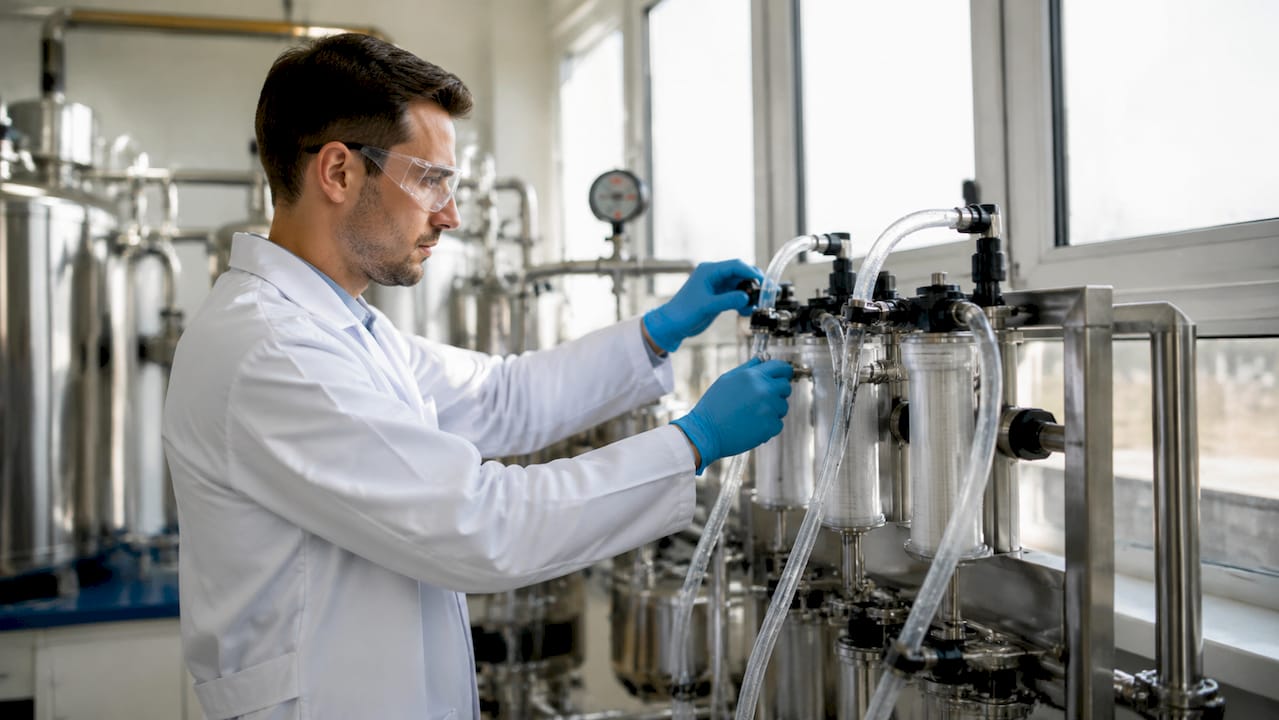
Filtration sits at the center of food safety controls because many contamination hazards enter through utilities, making its efficiency and placement critical. This means your contamination control strategy (CCS) must map every utility stream and assign a filtration specification to each one.
The integration process follows a logical sequence:
- Hazard identification: Map all contamination entry points across the process, including water, air, and direct product contact surfaces.
- CCP assignment: Designate filtration as a control measure at each CCP, with defined micron ratings and efficiency targets tied to the specific hazard.
- Technology matching: Select filtration technology based on the contamination type. Membrane filters handle microbial control. Depth filters manage particulate loads. Activated carbon addresses chemical contaminants.
- Sterile filtration placement: In pharmaceutical and healthcare environments, sterilizing-grade 0.2-micron membrane filters are placed immediately upstream of fill points to provide the final microbial barrier.
- Monitoring and verification: Define the frequency and method for integrity testing at each CCP, and document every result.
Donaldson’s guidance on food and beverage filtration makes clear that matching the filtration efficiency to the contamination hazard is a science-based decision, not a procurement preference. A 5-micron filter at a CCP designed to control bacterial contamination is a compliance failure waiting to happen.
In pharmaceutical cleanrooms, the CCS must address both airborne and liquid-borne contamination. Cleanroom filtration qualifications include leakage and integrity testing and airflow visualization studies, commonly called smoke studies, to confirm unidirectional airflow and filter coverage. AZoM outlines pressure difference measurement as a critical ongoing monitoring tool, not a one-time qualification exercise.
Pro Tip: Map your filtration points directly onto your process flow diagram before writing your CCS. Regulators expect to see filtration placement justified by hazard analysis, not selected by engineering convenience.
The role of water filtration in healthcare settings extends this logic further. Hospital water systems must control Legionella, Pseudomonas, and other opportunistic pathogens. Point-of-use filters rated at 0.2 microns provide the final barrier in immunocompromised patient areas. These filters require documented change-out schedules tied to validated service life data, not manufacturer recommendations alone.
What filtration technologies and testing protocols drive compliance?
The practical methods behind filtration in compliance fall into two categories: the technology itself and the testing that proves it works.
| Filtration Technology | Primary Application | Key Compliance Requirement |
|---|---|---|
| Sterilizing-grade membrane (0.2 micron) | Pharmaceutical liquid filtration | Pre- and post-use integrity testing per GMP |
| HEPA/ULPA air filtration | Cleanroom air handling | Leakage testing and airflow visualization per Annex 1 |
| Depth filtration | Bioburden reduction, clarification | Validation under worst-case process conditions |
| Activated carbon filtration | Chemical contaminant removal | Extractables and leachables testing for food contact |
| Point-of-use membrane filters | Healthcare water systems | Documented change-out schedules with service life validation |
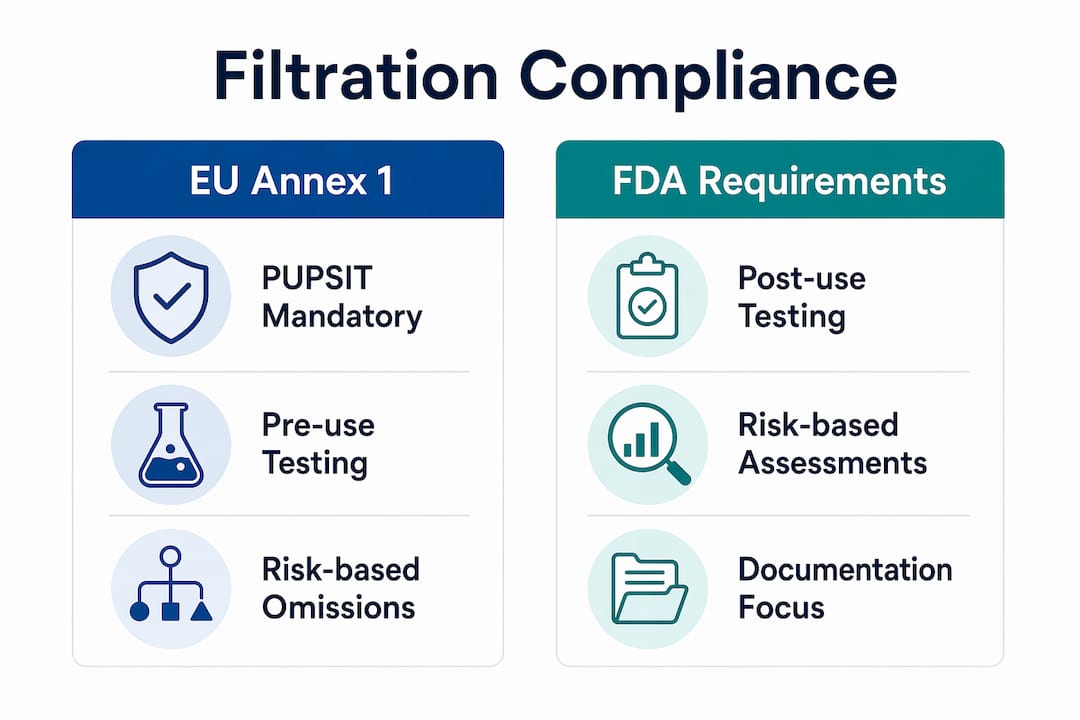
Sterilizing-grade membrane filtration requires pre- and post-use integrity testing as a GMP sterility assurance practice. Cytiva specifies that documented evidence of integrity testing before and after filtration is a regulatory expectation, not optional best practice. The pre-use test confirms the filter was not damaged during installation or sterilization. The post-use test confirms it maintained integrity throughout the production run.
Filter integrity testing verifies that sterilizing-grade filters perform to manufacturer claims and detect setup issues. This is the compliance mechanism that catches problems before product release, not during a recall.
Filter validation under worst-case conditions is the standard that separates compliant operations from those that pass audits on paper. Worst-case validation means testing at maximum flow rate, maximum temperature, maximum process time, and minimum filter area. If your validation was conducted at comfortable mid-range conditions, it will not hold up under regulatory scrutiny.
Pro Tip: Run your filter validation protocol past your regulatory affairs team before execution. Discovering a gap in your worst-case parameters after the study is complete costs far more than a pre-study review.
Maintaining thorough documentation and certificates of conformance for sterilizing-grade filters is the foundation of audit readiness. International Filter Products emphasizes traceability across regulatory jurisdictions, meaning your documentation system must link each filter lot number to its validation data, integrity test results, and regulatory submission history. A gap in that chain is a finding in an FDA inspection.
For filtration standards in industry that extend into water purification for regulated environments, the same principles apply: certified materials, documented performance, and traceable records.
What challenges do companies face in maintaining filtration compliance?
Compliance through filtration is not a one-time project. It is an ongoing operational discipline with several recurring pressure points.
PUPSIT implementation costs and complexity are the most cited challenge in sterile manufacturing. PUPSIT is considered a line-in-the-sand control in sterile production, with companies required to plan deviation handling based on risk assessment before production begins. CRB is direct on this point: a science-based justification is required to omit PUPSIT, and financial burden does not qualify. Companies that have not built PUPSIT into their facility design face significant retrofitting costs.
The most common compliance gaps in filtration programs include:
- Inadequate risk justification: Exemption requests that cite cost or operational disruption without supporting microbial risk data.
- Material compliance failures: Using filtration components that have not been validated for food contact or that degrade under CIP/SIP conditions, violating material safety and cleaning compatibility requirements.
- Fragmented documentation: Integrity test records stored separately from validation data, making audit preparation a manual reconciliation exercise.
- Procurement disconnects: Engineering specifying a filter for performance without confirming regulatory status, resulting in non-compliant components entering the supply chain.
- Outdated contamination control narratives: CCS documents that list filtration as a control measure without connecting it to specific hazard analyses or CCPs.
Global operations require rigorous documentation of conformance and filtration validation to maintain traceability and audit readiness across regulatory jurisdictions. Companies operating in both FDA and EMA jurisdictions need a unified documentation architecture, not separate filing systems that create version control problems during inspections.
The solution to most of these challenges is structural. Build filtration compliance into your quality management system as a defined process with owners, schedules, and escalation paths. Treat filter change-out, integrity testing, and documentation review as recurring quality events, not maintenance tasks.
For food and beverage operations, filtration in food service compliance requires the same discipline: documented CCPs, validated filter specifications, and scheduled verification activities tied to your HACCP or HARPC plan.
Key takeaways
Filtration compliance is not a documentation exercise. It is a science-based operational system that requires validated technology, structured testing, and traceable records to satisfy FDA, EU Annex 1, and FSMA requirements simultaneously.
| Point | Details |
|---|---|
| PUPSIT is mandatory in the EU | Risk-based justification is required to omit it; cost alone does not qualify under Annex 1. |
| Filtration belongs at every CCP | Assign specific micron ratings and efficiency targets to each critical control point in your HACCP or HARPC plan. |
| Pre- and post-use testing is non-negotiable | Sterilizing-grade membrane filters require documented integrity testing before and after every production run. |
| Material compliance extends beyond micron size | Food-contact filtration elements must be food grade, non-leaching, and validated through CIP/SIP cycles. |
| Documentation is your audit defense | Certificates of conformance, integrity test records, and validation data must be linked by lot number and instantly retrievable. |
Why proactive filtration validation is your strongest compliance asset
I have reviewed compliance programs across pharmaceutical, food, and healthcare operations, and the pattern is consistent. Companies that treat filtration validation as a one-time qualification exercise face the most painful audit findings. The ones that build it into their quality calendar as a recurring event rarely get surprised.
The regulatory direction is clear. EU Annex 1’s PUPSIT requirement is not a temporary measure. It reflects a fundamental shift toward catching defects before product release rather than investigating them after. The FDA’s risk-based approach is converging with that logic, even if the mandate language differs. If you are operating under both frameworks, design your program to the stricter standard and document your rationale.
What I find most underappreciated is the contamination control narrative requirement. Regulators do not want to see filtration listed as a bullet point in a CCS document. They want to see it connected to a specific hazard, a specific process stage, a specific filter specification, and a specific testing protocol. That chain of logic is what separates a defensible program from a compliant-looking one.
The operational challenge is real. PUPSIT adds time and complexity to manufacturing. Material validation for food-contact filters requires coordination between quality, engineering, and procurement. Documentation systems that link lot numbers to validation data require investment. None of that is easy. But the cost of a recall, a consent decree, or a market withdrawal makes every one of those investments look trivial.
My recommendation: treat your filtration compliance program as a living system. Review your filter specifications against your current process conditions annually. Confirm that your contamination control narrative reflects your actual filtration placement. And never let documentation fall behind operations.
— Soldierboy
How Cowayswaterpurifier supports filtration compliance in water purification
Regulated industries need water purification systems that meet the same standards they apply to their own processes. Cowayswaterpurifier designs filtration systems with certified materials, documented performance data, and advanced multi-stage filtration technology built to support health and safety requirements.
Whether you need a countertop unit for a controlled environment or an under-sink system for a regulated facility, Cowayswaterpurifier’s product line addresses microbial, chemical, and particulate contamination through validated filtration stages. The water purification process behind each system is documented and traceable, giving compliance officers the technical foundation they need for regulatory submissions. Explore the full range of Coway water care products to find the right filtration solution for your compliance requirements.
FAQ
What is the role of filtration in regulatory compliance?
Filtration in regulatory compliance is the systematic removal of microbial, particulate, and chemical contaminants from process streams to meet legally mandated health and safety standards set by bodies like the FDA, EMA, and FSMA. It functions as a primary control measure at critical control points across pharmaceutical, food and beverage, and healthcare industries.
What is PUPSIT and why does it matter for compliance?
PUPSIT stands for pre-use post-sterilization integrity testing, required by EU Annex 1 to detect filter defects that sterilization may mask before a production run begins. Omitting it requires a documented, science-based risk justification because cost alone is not an acceptable reason under current EU guidance.
How does FSMA affect filtration requirements for food processors?
FSMA requires food processors to identify filtration as a control measure at critical control points within their HARPC or HACCP plans, with specific micron ratings tied to each identified contamination hazard. Donaldson’s guidance confirms that filter efficiency and placement must be justified by hazard analysis, not selected by default.
What documentation is required for sterilizing-grade filters?
Compliance requires certificates of conformance, pre- and post-use integrity test records, and filter validation data all linked by lot number and retrievable for regulatory inspections. International Filter Products identifies traceability across jurisdictions as the foundation of audit-ready filtration documentation.
How do filtration standards differ between the FDA and EU annex 1?
The FDA mandates post-use integrity testing and supports risk-based approaches to PUPSIT, while EU Annex 1 requires PUPSIT as a default expectation with documented justification needed for any exemption. Companies operating in both markets need a unified compliance program designed to the stricter EU standard.
Recommended
- Water quality trends for businesses 2025: compliance guide – Coway Water Purifier
- Filtration in hospitality: safety, quality, and guest satisfaction – Coway Water Purifier
- 2025 Water Filtration Trends: Complete Guide – Coway Water Purifier
- Role of Filtration in Food Service – Impact on Safety and Quality – Coway Water Purifier
