
Uncategorized
The Role of UV in Microbial Control for Water and Air
Jun
TL;DR:
- UV-C light inactivates microorganisms by damaging their DNA, RNA, and cell membranes, preventing replication and causing cell death. Factors such as wavelength, water quality, flow dynamics, and lamp maintenance influence the system’s effectiveness, with optimized design based on worst-case conditions ensuring reliable disinfection. Combining UV with filtration or secondary disinfectants is essential because UV provides no residual protection against recontamination.
Ultraviolet light is defined as a physical disinfectant that inactivates microorganisms by damaging their DNA, RNA, and cellular structures, preventing replication without adding chemicals to water or air. The role of UV in microbial control centers on the UV-C spectrum, specifically wavelengths between 200 and 280 nanometers, which carry enough photon energy to break molecular bonds inside microbial cells. Validated research from 2026 confirms that UV-C combined with hydrogen peroxide achieves 99.24% removal of Total Coliform bacteria, illustrating how UV performs as both a standalone and integrated disinfection technology. Water treatment engineers, air quality professionals, and home users all rely on this mechanism, though the system design choices that determine real-world performance are far more nuanced than lamp selection alone.
How does UV light inactivate microorganisms?
UV-C light disrupts microbial life through two distinct pathways, and understanding both changes how you design and evaluate any disinfection system. The primary mechanism is photochemical damage to nucleic acids. When UV photons at 254 nm strike thymine bases in DNA, they trigger the formation of pyrimidine dimers, covalent bonds between adjacent bases that block the replication machinery of bacteria, viruses, and fungi. A cell that cannot replicate its genetic material cannot cause infection, even if it remains physically intact.
The second mechanism is less widely discussed but equally significant. UV-C causes multi-target damage including peptide bond cleavage in membrane proteins and oxidation of phospholipids, particularly at 222 nm. This means UV-C does not simply punch one hole in a microbe’s defenses. It attacks the cell membrane, enzymatic proteins, and genetic material simultaneously, which explains why UV-resistant mutations are rare compared to chemical disinfectants that target a single pathway.
Wavelength selection matters more than most system buyers realize. Key performance benchmarks by wavelength:
- 253.7 nm: The classic low-pressure mercury lamp output, highly effective for DNA thymine dimer formation and the most widely validated wavelength in regulatory frameworks
- 267 nm and 275 nm: UV-C viral inactivation peaks at these wavelengths, with a dose-response log beta of 3.38 (95% CI 2.95 to 3.82), making them optimal for virus-targeted applications
- 222 nm: An emerging safe wavelength that does not penetrate the outer dead-cell layer of human skin or eyes, expanding applications in occupied spaces
Gram-positive bacteria such as Staphylococcus aureus have thicker peptidoglycan cell walls that provide modest additional resistance compared to Gram-negative bacteria like E. coli, but neither class escapes UV-C damage at adequate doses. The practical implication is that dose, not wavelength alone, determines whether your system achieves the log reductions required by regulation or application.
Pro Tip: When evaluating UV systems for virus control, prioritize systems validated at 267 nm or 275 nm rather than defaulting to legacy 253.7 nm specifications. The difference in viral log reduction at equivalent doses is measurable and matters in healthcare and food processing environments.
What factors influence the efficacy of UV microbial control systems?
UV disinfection performance is not a fixed property of a lamp. It is the product of at least six interacting variables, and optimizing any one of them without addressing the others produces a system that looks good on paper but underperforms in the field.
-
UV Transmittance (UVT). UVT measures how much UV light passes through a given sample of water or air at the target wavelength. Its effect on delivered dose is exponential, not linear. A drop from 95% UVT to 85% UVT can reduce effective dose by 30% or more depending on reactor geometry. Designing for worst-case UVT rather than average water quality is the single most important design decision for regulatory compliance.
-
Flow dynamics and hydraulic design. Short-circuiting occurs when a fraction of the flow passes through the reactor faster than the design residence time, receiving a sub-lethal dose. Computational fluid dynamics modeling and biodosimetry validation are the standard tools for confirming uniform dose distribution across the full flow range.
-
Total Suspended Solids (TSS). Particles in water physically shield microorganisms from UV photons. Upstream pretreatment to reduce TSS below 2 to 5 mg/L is required for advanced disinfection systems to function as designed. Skipping this step is one of the most common causes of field failures in municipal and industrial UV installations.
-
Lamp aging and quartz sleeve fouling. Low-pressure mercury lamps lose roughly 15 to 20% of their UV output over their rated service life. Quartz sleeves accumulate mineral scale, biofilm, and iron deposits that absorb UV before it reaches the water. Neither problem is visible to the naked eye, which is why sensor calibration schedules are non-negotiable.
-
Delivered dose versus lamp wattage. Lamp wattage tells you the electrical input. Delivered dose, expressed in mJ/cm², tells you the actual germicidal energy received by the target organism. These numbers diverge significantly as lamps age, sleeves foul, and flow rates vary. Sensor networks that track delivered dose in real time are the only reliable performance indicator.
-
Organism-specific resistance. UV disinfection does not inactivate certain protozoa such as Giardia and Cryptosporidium at standard doses, and it is not recommended for water exceeding 1,000 total coliforms or 100 fecal coliforms per 100 mL. This means UV is a barrier, not a complete treatment solution on its own.
Pro Tip: Set your UV system’s alarm threshold at 80% of the minimum required dose, not at zero output. This gives you a maintenance window before the system falls out of compliance, rather than discovering the problem during an audit.
How does UV microbial control compare in water versus air systems?
Both water and air UV systems use UV-C wavelengths and rely on the same genetic and cellular damage mechanisms. The differences lie in the physical properties of the medium being treated, and those differences drive entirely different engineering decisions.
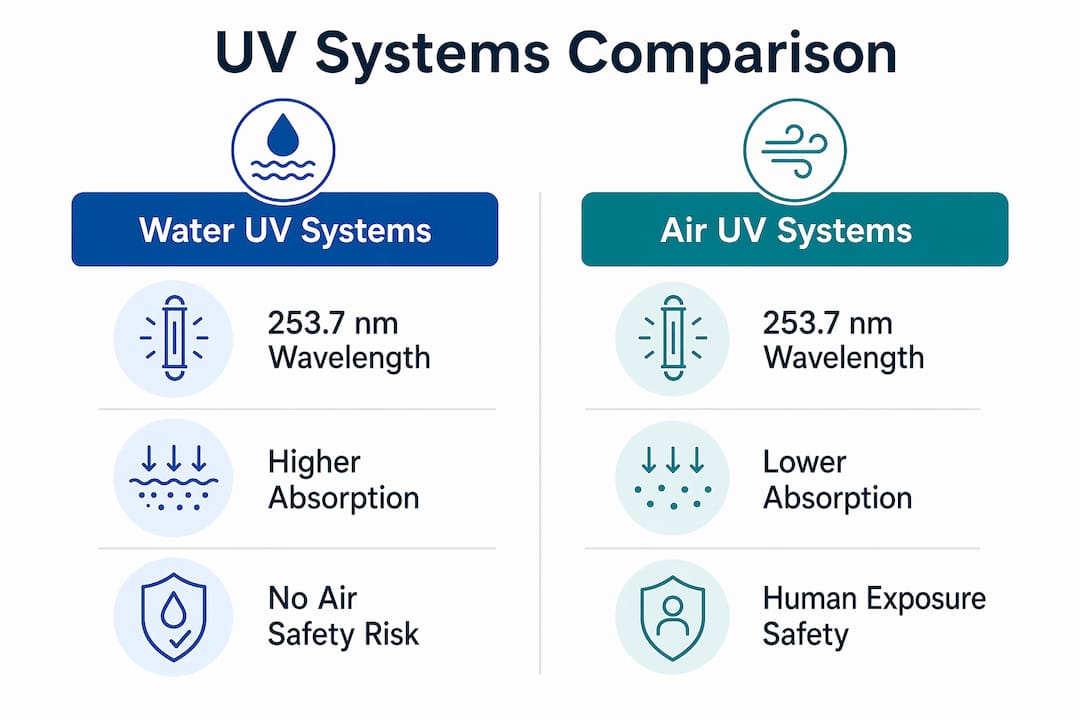
| Factor | Water UV systems | Air UV systems |
|---|---|---|
| Primary wavelength | 253.7 nm, 265 nm | 253.7 nm, 222 nm |
| Flow dynamics | Controlled flow rate in sealed reactor | Variable air velocity in HVAC ducts or room units |
| Penetration challenge | UVT reduction by dissolved organics and TSS | Shadowing by dust, particulates, and duct geometry |
| Residual protection | None. Requires secondary disinfectant downstream | None. Requires HEPA or filtration for particle removal |
| Typical applications | Municipal treatment, home purifiers, food processing | HVAC sterilization, hospital upper-room UV, home air purifiers |
| Human exposure risk | Contained system, no direct exposure | Open-room systems require 222 nm or shielded fixtures |
| Regulatory framework | EPA and NSF/ANSI validated dose tables | ASHRAE and ACGIH exposure limits for occupied spaces |
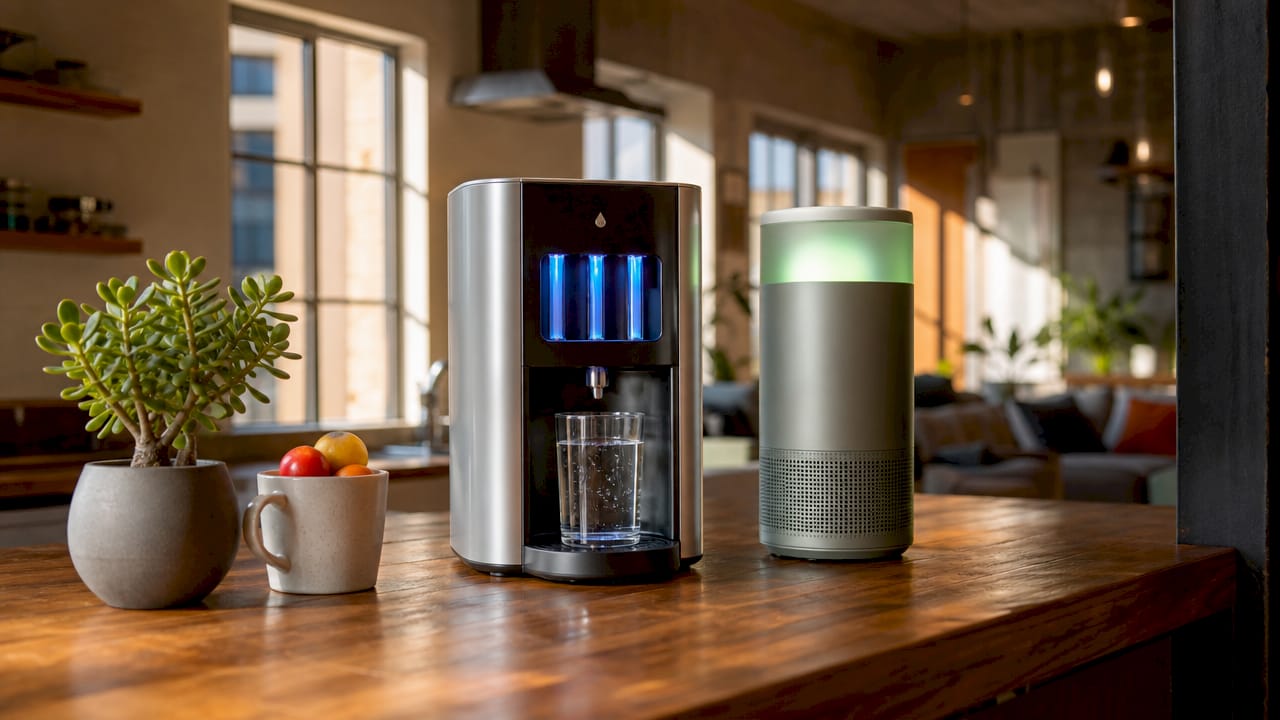
The role of UV in air purification introduces a safety variable absent in water systems. When UV-C fixtures operate in occupied rooms, wavelengths above 222 nm pose a risk to skin and eyes. Upper-room germicidal UV installations use louvers to direct UV-C above the breathing zone, while 222 nm far-UV systems can operate at full room level with current evidence supporting their safety profile. Water systems, by contrast, are fully enclosed, and human exposure is not a design concern during normal operation.
Both media share one critical limitation. UV provides no residual disinfectant effect, meaning recontamination downstream of the UV reactor is possible in water distribution systems and in air that recirculates through untreated zones. Integrated system design, pairing UV with chlorination in water or HEPA filtration in air, is the professional standard for this reason.
What are best practices for UV microbial control system performance?
Selecting and maintaining a UV system correctly determines whether you achieve the log reductions you paid for. These practices apply across home, healthcare, and industrial settings, scaled to the application.
- Match UV dose to the target organism. Cryptosporidium requires 10 mJ/cm² for a 3-log reduction. E. coli achieves the same reduction at 6 mJ/cm². Sizing a system to the most resistant relevant pathogen in your water or air source is the baseline requirement, not an optional upgrade.
- Commission with biodosimetry. Biodosimetry uses a surrogate microorganism, typically Bacillus subtilis spores, to validate that the reactor delivers the design dose under real operating conditions. Manufacturer dose tables are calculated under ideal conditions and do not account for your specific hydraulics or water quality.
- Establish a lamp replacement schedule based on hours, not appearance. Most low-pressure mercury lamps are rated for 9,000 to 12,000 hours. Replace them at the rated interval regardless of whether they still emit visible light. UV output declines well before visible emission stops.
- Clean quartz sleeves on a fixed schedule. In hard water areas, quarterly cleaning with a dilute acid solution prevents scale buildup that can reduce UV transmission through the sleeve by 30% or more within a single season.
- Combine UV with upstream filtration. For UV treatment for water safety in residential systems, a sediment pre-filter rated at 5 microns removes the particle load that would otherwise shield pathogens from UV exposure.
- Install online UV intensity sensors with data logging. Sensor drift is a documented failure mode. Calibrate sensors against a reference standard at least annually, and configure alarms to trigger at dose thresholds rather than simple lamp-on or lamp-off states.
Pro Tip: For home water purifiers, check whether the manufacturer’s UV dose specification is measured at end-of-lamp-life, not at initial installation. A system rated at 40 mJ/cm² at startup may deliver only 28 mJ/cm² when the lamp needs replacement. The end-of-life dose is the number that matters.
Key takeaways
UV microbial control works because UV-C photons damage DNA, membrane proteins, and lipids simultaneously, making resistance difficult for microorganisms to develop and making UV effective across bacteria, viruses, and fungi when dose is correctly delivered.
| Point | Details |
|---|---|
| UV-C wavelength determines target | 267 nm and 275 nm optimize viral inactivation; 222 nm expands safe use in occupied spaces. |
| Delivered dose is the real metric | Lamp wattage does not equal germicidal performance; hydraulics, UVT, and fouling all reduce actual dose. |
| TSS pretreatment is non-negotiable | Reducing suspended solids below 2 to 5 mg/L before UV exposure prevents particle shielding of pathogens. |
| UV has no residual effect | Pair UV with filtration or secondary disinfectants to prevent recontamination downstream. |
| Worst-case design prevents failure | Size UV systems for minimum UVT conditions, not average water quality, to maintain regulatory compliance. |
Why UV system design is harder than it looks
I have reviewed enough UV system installations to say with confidence that the most common failure mode is not a bad lamp or a wrong wavelength. It is a system designed for average conditions that encounters reality. Water quality in municipal supplies fluctuates. Seasonal runoff events drop UVT by 15 points in 48 hours. An HVAC system that performs well in summer recirculates air at different velocities in winter. None of these scenarios appear in the manufacturer’s performance table.
The 222 nm wavelength development genuinely excites me because it removes the human exposure constraint that has limited UV-C deployment in hospitals, transit systems, and schools. But I have also watched facilities install 222 nm fixtures without addressing ventilation patterns, which means the air receiving the highest dose is not the air people are breathing. Technology does not substitute for system thinking.
The multi-target damage mechanism, covering DNA, membrane proteins, and phospholipids simultaneously, is the most underappreciated aspect of UV light in sanitation. It explains why UV-resistant strains are rare in practice, but it does not mean UV is infallible. Protozoa with protective cyst walls, high-TSS water, and shadowed air zones all represent real limits. The professionals who get the best results treat UV as one layer in a defense-in-depth strategy, not as a standalone solution.
My advice: validate with biodosimetry, design for worst-case UVT, and never trust a sensor that has not been calibrated in the past 12 months. The technology works. The question is always whether the installation does.
— Soldierboy
UV purification solutions from Cowayswaterpurifier
Cowayswaterpurifier offers UV-C water purifiers and air purifiers engineered to deliver validated germicidal doses under real household operating conditions, not just laboratory benchmarks. Each system integrates UV-C technology with multi-stage filtration to address the particle shielding and recontamination limitations that standalone UV cannot solve. If you are evaluating options for your home or facility, the water purification process guide on the Cowayswaterpurifier site breaks down how UV fits within a complete treatment sequence. For indoor air quality, the 2026 air purifier selection guide covers UV-C air purifier models with performance data relevant to home and small-office environments.
FAQ
What wavelength of UV light is most effective for microbial control?
UV-C at 267 nm and 275 nm produces the highest viral inactivation rates, while 253.7 nm remains the standard for bacterial and broad-spectrum disinfection. Emerging 222 nm sources offer effective microbial control with a safer profile for use in occupied spaces.
Does UV light kill all types of microorganisms?
UV-C inactivates most bacteria, viruses, and fungi at validated doses, but it does not reliably inactivate protozoa such as Giardia and Cryptosporidium without filtration as a complementary step. Water exceeding 1,000 total coliforms per 100 mL also exceeds the effective range of UV alone.
How often should UV lamps be replaced in a water purifier?
Most low-pressure mercury UV lamps require replacement every 9,000 to 12,000 operating hours, typically once per year in residential systems. Replace based on hours logged, not on whether the lamp still emits visible light, since UV output declines before visible emission stops.
Why does UV disinfection need to be combined with filtration?
UV provides no residual disinfectant effect, meaning water or air can be recontaminated after it passes the UV reactor. Pairing UV with sediment filtration upstream and a secondary disinfectant or HEPA filter downstream creates a complete barrier against both initial contamination and recontamination.
What is the difference between UV dose and lamp wattage?
Lamp wattage measures electrical input to the lamp. UV dose, expressed in mJ/cm², measures the actual germicidal energy delivered to the target organism, accounting for UVT, flow rate, lamp aging, sleeve fouling, and reactor geometry. Delivered dose is the only metric that predicts microbial inactivation performance.
Recommended
- UV Sanitization: Boosting Home Water and Air Safety – Coway Water Purifier
- What Is UV Sterilization? Complete Guide for 2024 – Coway Water Purifier
- Advantages of UV Sanitization for Healthier Homes – Coway Water Purifier
- Complete Guide to the Role of UV in Air Purification – Coway Water Purifier
