
Uncategorized
Filtration in hospitality: safety, quality, and guest satisfaction

May
TL;DR:
- Many hospitality managers overlook the critical role of water and air filtration as strategic safety and quality tools. Properly implemented, filtration systems control contaminants that impact guest taste, equipment longevity, and health safety, preventing costly repairs and health incidents. Selecting certified technologies, maintaining schedules based on actual performance, and addressing invisible risks like biofilms and Legionella are essential for operational excellence.
Water and air filtration touch nearly every corner of a hospitality operation, yet most managers treat it as a background utility rather than a strategic asset. The coffee your guests order, the ice in their cocktails, the air circulating through your dining room, the reliability of your most expensive kitchen equipment: all of it depends on filtration working correctly. Operators who underestimate this connection routinely face higher equipment repair costs, guest complaints about off-tasting beverages, and, in the worst cases, serious health incidents tied to contaminated water systems. This guide breaks down exactly what filtration does, which technologies matter most, and how to build a program that protects your guests, your team, and your business.
Table of Contents
- How filtration shapes guest experience and operational safety
- Key filtration technologies and their impacts in hospitality
- Certifications, standards, and compliance: ensuring health protection
- Monitoring, maintenance, and practical implementation for hospitality teams
- What most hospitality operators miss about filtration strategy
- Explore advanced filtration solutions for hospitality success
- Frequently asked questions
Key Takeaways
| Point | Details |
|---|---|
| Filtration impacts quality | Proper filtration directly improves beverage taste, clarity, and guest satisfaction. |
| Health and compliance | Certified filtration systems are essential for regulatory compliance and health risk mitigation. |
| Maintenance drives effectiveness | Measurement-based filter changes prevent system overloads and ensure ongoing safety. |
| Technology matters | Choosing the right filtration system requires matching risk context, certification, and operational needs. |
| Practical staff monitoring | Staff training and automated monitoring help avoid overlooked failures and costly mistakes. |
How filtration shapes guest experience and operational safety
Now that we’ve framed the stakes, let’s look at the specific ways filtration delivers quality and safety in hospitality environments.
Water quality is one of the most underappreciated drivers of guest satisfaction. When chlorine, sediment, or dissolved minerals pass through your water lines unchecked, the effects show up everywhere: in the flat taste of your house coffee, in cloudy ice cubes that make cocktails look amateur, and in the limescale buildup quietly shortening the life of your espresso machines and ice makers. As Omnipure frames it, filtration controls water quality for taste-critical beverages and protects downstream equipment from damage that accumulates invisibly over months.
The specific contaminants that matter most in a hospitality context include:
- Chlorine and chloramines: Added by municipalities for disinfection, these chemicals create bitter off-notes in coffee, tea, and fountain beverages.
- Sediment and particulates: Clog valves, damage seals, and degrade filter membranes in coffee machines and ice makers.
- Scale-forming minerals (calcium, magnesium): Deposit as limescale inside heating elements and narrow water passages, reducing efficiency and eventually causing mechanical failure.
- Biofilm precursors: Organic matter that provides the foundation for microbial growth inside water lines and machine reservoirs.
Properly implemented filtration in food service addresses all of these simultaneously. A multi-stage system that combines sediment pre-filtration with activated carbon and, where needed, a reverse osmosis membrane can deliver consistently clean water to every point of use in your kitchen or bar.
“Maintaining clean water is not just about taste. It’s about protecting your guests from invisible contaminants and protecting your equipment from premature failure.” The two goals are inseparable in a well-run operation.
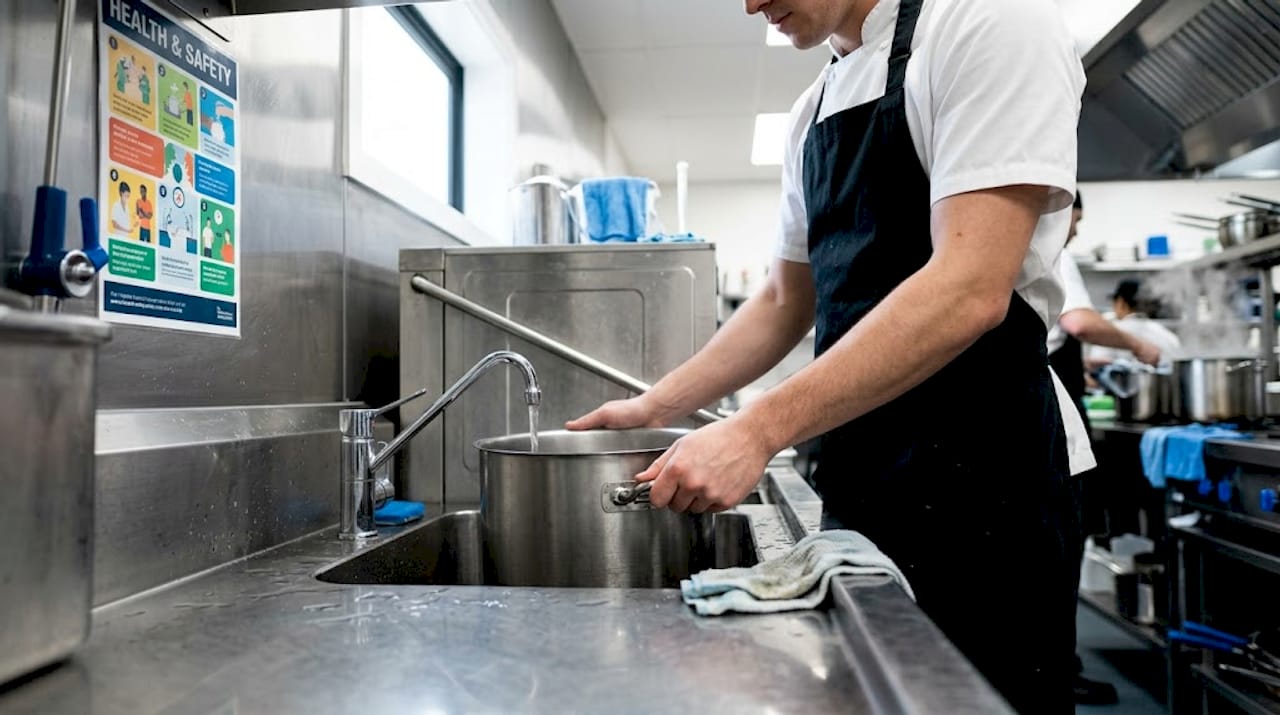
Beyond the kitchen, water purity importance extends to food preparation, dishwashing, and even hand-washing stations. Restaurant-oriented water filtration guidance confirms that filtration in commercial kitchens directly supports health and safety objectives by reducing the contaminant load that reaches food, surfaces, and equipment.
Pro Tip: Schedule quarterly inspections of all water-using equipment specifically looking for limescale deposits. The presence of visible scale is a reliable sign your filtration system is underperforming or overdue for filter replacement.
Key filtration technologies and their impacts in hospitality
Understanding the roles of filtration, it’s essential to know which technologies fit specific hospitality needs.
Not every filtration method is appropriate for every application. Matching the right technology to the right point of use is what separates an effective filtration strategy from one that just looks good on paper. Here’s how the major technologies stack up:
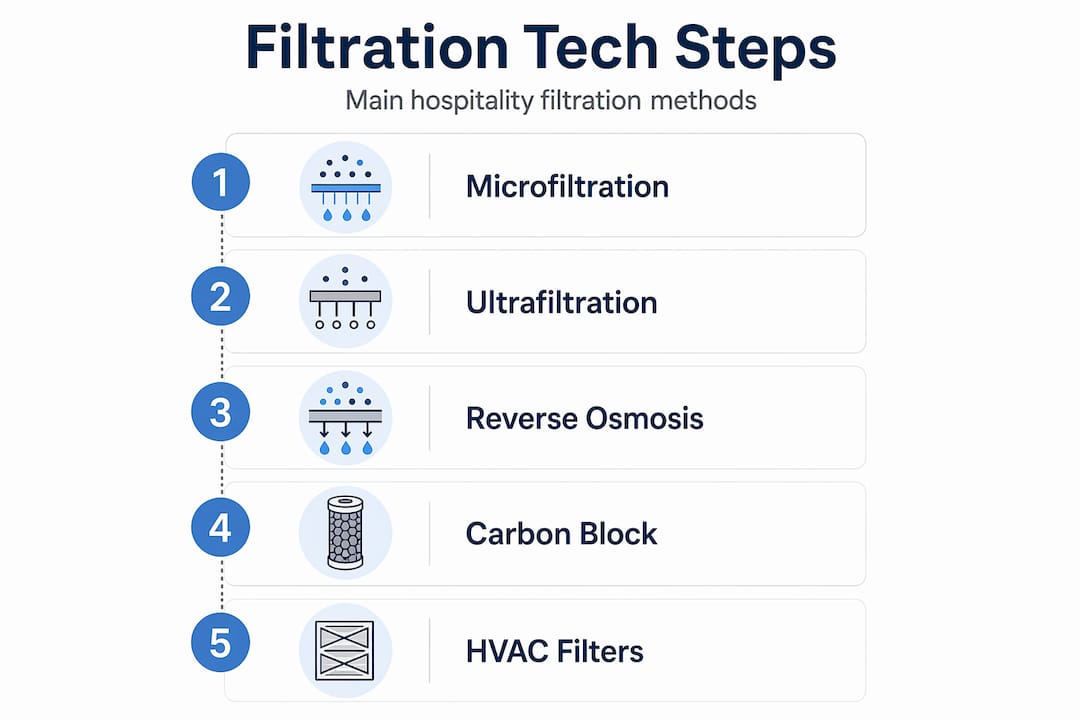
1. Membrane filtration (microfiltration and ultrafiltration)
These systems use semi-permeable membranes with precise pore sizes to physically block bacteria, protozoa, and particulates. They are excellent for point-of-use applications where pathogen removal is the priority. However, membrane integrity and pore characteristics are essential for reliable pathogen removal. A membrane with even minor damage bypasses its own safety claim entirely, which is why integrity testing is not optional.
2. Reverse osmosis (RO)
RO systems force water through an extremely tight semi-permeable membrane, removing dissolved salts, heavy metals, nitrates, and most organic contaminants. They deliver the highest purity level available in commercial filtration. The trade-off is that RO requires pre-filtration to protect the membrane from sediment and chlorine damage, and they produce a concentrate (reject water) stream that must be managed. For applications like premium beverage programs or purified water benefits in fine dining, RO is often the best investment.
3. High-flow carbon block filtration
Designed for large-volume applications like full-service restaurants or hotel banquet kitchens, high-flow systems deliver filtered water at the rates needed without creating pressure drop problems. They excel at chlorine, taste, and odor removal but don’t match RO for dissolved solids reduction.
4. HVAC air filtration
Often overlooked entirely, HVAC filtration directly affects indoor air quality (IAQ) for both guests and staff. Higher-rated filters (MERV 11 to 13 range) capture fine particulates, allergens, and some pathogens, but they also create more resistance in the air handling system. Hotel HVAC filtration effectiveness must be balanced against pressure drop and system strain to avoid overloading equipment that was not designed for high-resistance filters.
| Technology | Best application | Pathogen removal | Maintenance frequency |
|---|---|---|---|
| Membrane filtration | Point-of-use, pathogen control | High | Monthly to quarterly |
| Reverse osmosis | Beverage programs, high-purity needs | Very high | Quarterly, plus pre-filter changes |
| High-flow carbon block | Large-volume kitchens, bars | Moderate | Per manufacturer/flow rate |
| HVAC MERV 11-13 filters | Dining rooms, lobbies, guest rooms | Moderate | Seasonal or usage-based |
Steps for selecting the right filtration technology:
- Map every point of water and air use in your property.
- Identify the specific risk at each point (taste, pathogen, scale, particulate).
- Match the technology to the risk, not to the lowest price point.
- Confirm the selected product carries certified filtration standards from a recognized body.
- Build maintenance intervals into your facility management schedule before installation, not after.
Pro Tip: Consult your local water utility’s annual water quality report before finalizing filtration specifications. It tells you exactly which contaminants are present at elevated levels in your supply, which directs your technology choice precisely. Explore filtration technologies examples to see how different systems compare in real-world applications.
Certifications, standards, and compliance: ensuring health protection
Choosing technology is only the first step; meeting health standards requires rigorous certification and compliance.
A filter without third-party certification is essentially a marketing claim with no accountability. NSF/ANSI 42 certification confirms a filter reduces aesthetic contaminants like chlorine and taste compounds. NSF/ANSI 53 is the one that matters for health protection: it certifies reduction of specific health-related contaminants including lead, cysts, and VOCs (volatile organic compounds). For managers operating properties with older plumbing, both certifications are minimum requirements, not optional upgrades.
Legionella compliance in hospitality represents one of the most serious risks in large hotel and resort water systems. Legionella bacteria thrive in stagnant warm water, often in cooling towers, hot tubs, and complex pipe networks. Point-of-use certified filters can reduce exposure at faucets and showers, but the CDC is clear: [certified filters](https://www.cdc.gov/control-legionella/php/guidance/building-water-system.html#:~:text=Legionella and Legionnaires%27 disease) must be installed and maintained per manufacturer instructions and replaced before they expire to remain effective.
Key contaminant risk areas by venue type:
- Hotels with multiple guest floors: Legionella in hot water systems, lead from aging pipes in older buildings.
- Full-service restaurants: Chlorine interference with beverage quality, sediment damage to espresso and ice equipment.
- Resorts with recreational water features: Pathogen risk in recirculating systems, biofilm formation in low-flow zones.
- Catering operations: Scale buildup in portable equipment, cross-contamination risks from non-filtered portable water sources.
Ice machine water systems are a frequently cited compliance concern. The Joint Commission’s ice-machine guidance identifies ice machines as a potential infection-control risk, particularly in healthcare-adjacent hospitality settings. The principle extends broadly: any equipment that produces ice for human consumption requires documented maintenance, filter replacement logs, and periodic microbiological testing.
A compliance-ready filtration program includes the following:
- Written filter replacement schedules tied to both time and usage metrics
- Documentation of certified filter models installed at each point of use
- Regular water quality testing at key points (inlet, post-filter, equipment output)
- A certified filtration standards guide referenced during procurement decisions
- Staff training on recognizing and escalating filtration issues
Important: Compliance is not a one-time event. Regulatory inspections in hospitality environments increasingly include water quality documentation as a standard audit item. Having your records organized and current before an inspection is far less stressful than scrambling to assemble them during one.
Monitoring, maintenance, and practical implementation for hospitality teams
With compliance in place, application comes down to hands-on monitoring and smart maintenance strategies.
The most common mistake hospitality managers make with filtration is treating it like a calendar event rather than a measurement-driven process. Filtration maintenance in hotels is most effective when driven by occupancy levels, seasonal load changes, and actual performance data, not simply by marking a date on a facilities calendar six months in advance.
Practical implementation steps:
- Install pressure differential gauges on your primary water filtration systems. A significant pressure drop across a filter housing indicates it’s loading up with particulates and needs replacement sooner than scheduled.
- Track occupancy-adjusted usage. A filter in a 400-room hotel running at 95% occupancy in peak season exhausts its capacity far faster than the same filter running at 40% in the off-season. Adjust replacement intervals to reflect actual throughput, not just elapsed time.
- Conduct integrity testing for membrane systems. Integrity testing is critical for detecting breaches and pathogens that bypass a damaged membrane undetected. Even a small fiber breach compromises the entire safety claim of the system.
- Create a fouling log. Record every filter replacement with the date, the pressure differential at replacement, and any unusual observations (discoloration, odor, accelerated loading). This builds a historical record that helps predict future maintenance needs with real accuracy.
- Cross-train staff at multiple skill levels. Front-line staff in kitchens and housekeeping are your first line of detection. Train them to recognize warning signs like unusual water taste, reduced flow rates, or equipment alarms related to water quality.
Understanding filtration stages helps your team communicate more clearly about where problems originate. A pressure drop at the sediment pre-filter tells you a different story than a pressure drop at the final carbon block. The ability to localize the issue saves time and avoids unnecessary full-system replacements.
Key warning signs your team should be trained to report immediately:
- Noticeable change in water or ice taste at any service station
- Visible particles or cloudiness in filtered water outputs
- Reduced flow rate at any point-of-use faucet or equipment inlet
- Unusual odors from water-using equipment
- Equipment error codes related to water pressure or quality
Pro Tip: Set up a shared maintenance log accessible to both your facilities team and your food and beverage manager. When both departments can see the same data, issues get escalated faster and rarely fall through the organizational gap between the two teams. Review why water filters are important as a team training resource to align everyone on the stakes.
What most hospitality operators miss about filtration strategy
Most managers focus on filtration problems they can see and taste. If the coffee is good and the ice is clear, the assumption is that filtration is working. This is exactly backwards from how effective risk management works.
The real dangers in hospitality water systems are invisible. Biofilm forms inside pipes where flow rates are low, not at the faucet where you can observe the output. Legionella colonizes in the middle sections of complex pipe networks, not at the endpoints your guests touch directly. Lead leaches from solder joints in older buildings, undetectable without a test but present in every glass served from those lines. Operational health protection requires aligning filtration to actual risk, with certified claims and documented maintenance, not to what’s visible at the service counter.
The second major gap we see consistently is certification confusion. A filter labeled “removes 99% of contaminants” without an NSF/ANSI certification number is a marketing statement, not a performance guarantee. Hospitality managers must demand certified products and verify the specific contaminant claims against their actual water quality data.
The third overlooked dimension is sizing. An undersized filter for your actual water volume doesn’t fail loudly. It simply degrades gradually, passing more contaminants as it loads up, until you’re effectively operating without filtration while believing you have full protection in place. Proper sizing based on peak daily throughput is as important as the technology itself.
Understanding filtration and health role as a genuine business risk, rather than a compliance checkbox, is what separates operators who protect their guests from those who get lucky until they don’t.
Explore advanced filtration solutions for hospitality success
For those ready to turn knowledge into action, Coway can help with expert guidance and proven filtration solutions built for demanding environments.
Coway’s certified water purification systems are designed with hospitality-grade performance in mind, combining multi-stage filtration, UV sanitization, and reliable construction that holds up under continuous commercial use. Whether you’re looking to understand the full water purification process guide, upgrade your service line with a countertop ice water purifier, or benchmark your setup against food service filtration expertise, Coway provides the resources and products to match your operational needs with filtration that actually performs.
Every hospitality property has a unique risk profile. Coway’s product range and educational content help you match the right certified solution to your specific water quality challenges, so your guests stay safe, your equipment lasts longer, and your team operates with confidence.
Frequently asked questions
What types of filtration are most important for hospitality settings?
Membrane, reverse osmosis, and certified HVAC filters are the most critical for ensuring guest safety, beverage quality, and compliance, with membrane pathogen removal being especially important for point-of-use safety in high-traffic venues.
How does filtration help manage health risks like Legionella?
Certified point-of-use filters combined with timely replacement and documented maintenance are key steps in [Legionella risk reduction](https://www.cdc.gov/control-legionella/php/guidance/building-water-system.html#:~:text=Legionella and Legionnaires%27 disease), particularly in large hotel water systems with complex pipe networks.
What’s better: scheduled filter changes or measurement-based maintenance?
Measurement-driven maintenance using pressure differential readings and occupancy-adjusted usage tracking is far more reliable than fixed calendar schedules, which can both over-replace and under-replace filters depending on actual load.
How often should filters for ice machines be replaced?
Follow manufacturer instructions and replace filters before their rated capacity expires; ice-machine maintenance documentation is an active infection-control and compliance requirement, not just a best practice.
Why is filter certification important for hospitality?
Certification from a recognized body like NSF/ANSI confirms that a filter’s performance claims are independently verified, protecting your guests from waterborne risks and your business from [compliance gaps tied to Legionella](https://www.cdc.gov/control-legionella/php/guidance/building-water-system.html#:~:text=Legionella and Legionnaires%27 disease) and other serious contaminants.
Recommended
- Role of Filtration in Food Service – Impact on Safety and Quality – Coway Water Purifier
- Certified Filtration: Safeguarding Your Home Health – Coway Water Purifier
- Certified Filtration Standards: Safeguarding Home Wellness – Coway Water Purifier
- Role of Filtration in Health – Why It Matters – Coway Water Purifier
