
Uncategorized
Why Water Purity Matters for Food Businesses

Jan
Finding the right water purification solution is a challenge every restaurant and cafe owner faces. When you rely on water for cooking, brewing, and cleaning, water purity goes far beyond just taste—it protects your customers and safeguards your business against legal risks under American health regulations. With contaminants like lead, arsenic, and PFAS showing up in United States water supplies, understanding how water quality standards affect your operations is key to building trust and compliance. This guide helps you make informed decisions about water treatment technology that matches both your safety needs and customer expectations.
Table of Contents
- Defining Water Purity In Food Service
- Key Water Contaminants And Their Effects
- Legal Standards For Water Quality In The U.S.
- Impact On Taste, Safety, And Customer Trust
- Risks Of Non-Compliance And Poor Water Quality
- Choosing Reliable Purification Solutions
Key Takeaways
| Point | Details |
|---|---|
| Water Purity Definition | In food service, water purity emphasizes safety from harmful microorganisms and maintaining safe mineral levels, rather than strict chemical definitions. |
| Contamination Risks | Heavy metals, chemical compounds, and microbes pose significant risks to food safety and equipment integrity, necessitating regular water testing. |
| Compliance Importance | Adhering to legal standards set by the EPA and local health departments is crucial to avoid fines and operational shutdowns. |
| Purification Solutions | Choosing the right water purification technology tailored to specific contaminants is essential for maintaining quality and compliance in food service. |
Defining Water Purity in Food Service
Water purity means different things depending on who you ask. In a chemistry lab, it refers to water containing only hydrogen and oxygen molecules. But that theoretical definition doesn’t apply to real food service operations. The FDA recognizes that pure water contains minerals and ions that affect how we classify and use water in food preparation. For your restaurant, café, or commercial kitchen, purity focuses on two practical concerns: keeping harmful microorganisms out and maintaining the right balance of safe minerals and chemicals that won’t damage your food, equipment, or customer health.
Think about it this way. The water flowing into your kitchen isn’t pure in the laboratory sense, and it never will be. What matters is that it meets safety standards for food service. This means your water should be free from dangerous bacteria, viruses, and parasites that cause foodborne illness. It also means chemical contaminants stay below acceptable levels. The FDA and local health departments set these limits. When water passes those standards, it’s classified as safe for food service. But here’s where it gets practical: water that’s safe for general consumption might not be ideal for specialty coffee brewing, soup stocks, or ice production. Different food applications sometimes need slightly different water profiles to ensure both safety and quality.
The distinction between “pure” and “healthy” water matters for your business operations. Healthy water, as food industry experts use the term, maintains proper pH levels and contaminant profiles that support both food safety and flavor integrity. If your water is too acidic, it corrodes equipment and affects taste. If it’s too alkaline, it builds up mineral deposits in pipes and machines. Chemical contaminants beyond safety thresholds can create off-flavors that customers notice immediately. Microbiological safety is non-negotiable, but balancing these other factors determines whether your water actually supports your business goals. Understanding water purification standards and their health impact helps you make informed decisions about which water treatment approach fits your specific operation.
Pro tip: Request a water quality report from your local water utility to identify what contaminants already exist in your supply, then consult with a water treatment specialist about targeted purification solutions rather than assuming generic filtration will handle all your food service needs.
Key Water Contaminants and Their Effects
Water contamination isn’t always visible, but its effects on your food business are very real. The contaminants showing up in water supplies across the United States fall into several categories, each posing different risks to your operation. Heavy metals like lead and arsenic seep into groundwater from natural deposits and industrial sources. Chemical compounds such as PFAS (per- and polyfluoroalkyl substances), nitrates, and disinfection byproducts come from manufacturing, agriculture, and water treatment processes themselves. Microbial contaminants including bacteria, viruses, and parasites thrive when water quality drops. The challenge for food businesses is that common water contaminants include arsenic, lead, and PFAS, which can introduce serious health risks if not properly removed before water touches your food preparation areas.
Let’s talk about what happens when these contaminants make it into your kitchen. Lead contamination is particularly dangerous because it builds up in the body over time. If your water pipes contain lead solder or fittings (common in older buildings), hot water pulls lead out at higher concentrations. Your staff drinks it, customers consume it in soup or coffee, and ice machines concentrate it as water freezes. Arsenic and uranium create long-term health problems, including cancer risks with extended exposure. PFAS compounds resist breakdown and accumulate in human tissue. Nitrates from agricultural runoff become especially problematic in areas downwind from farms. Disinfection byproducts form when chlorine reacts with organic matter in water. That chlorine smell you notice? That’s often not chlorine itself but these byproducts, and they’ve been linked to reproductive issues and neurological effects. Beyond human health, these contaminants corrode equipment, stain food products, and damage your reputation when customers notice odd tastes or odors.
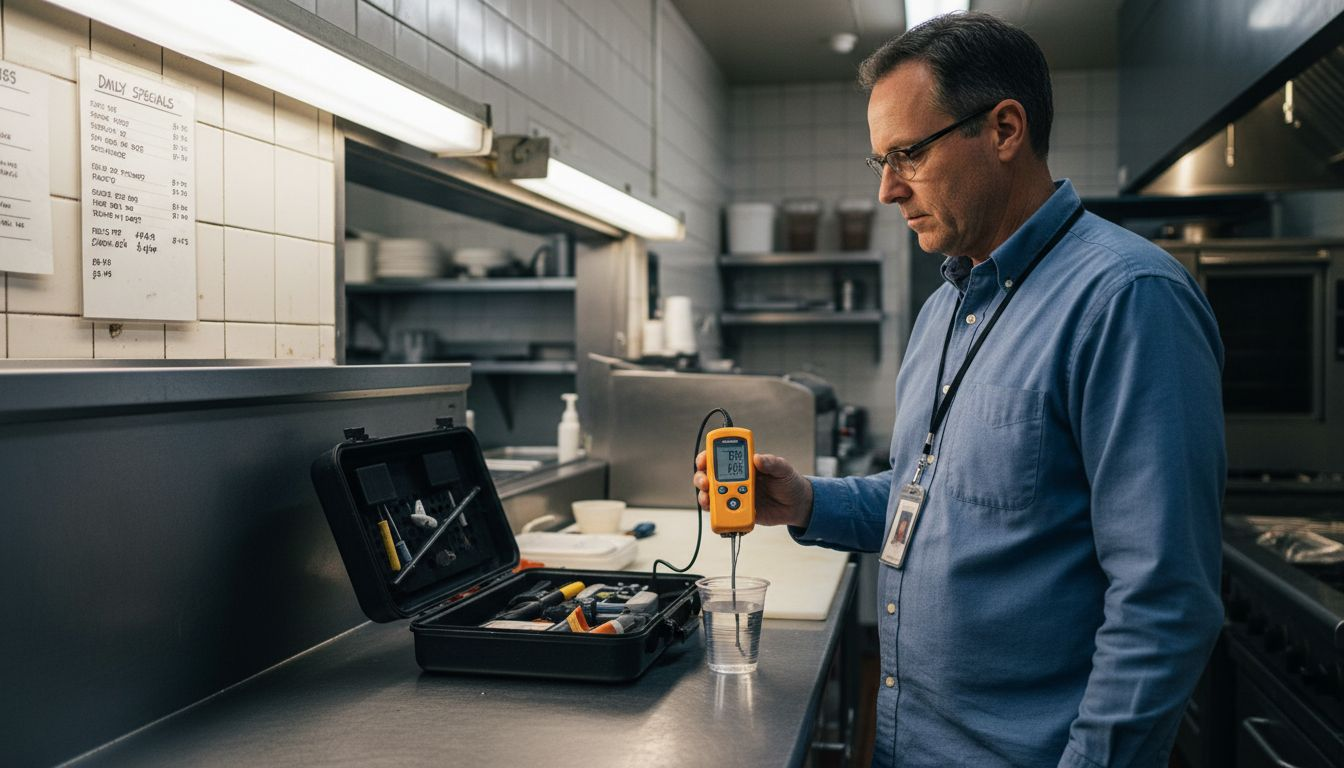
Here’s how major water contaminants differ in their effects and sources:
| Contaminant Type | Typical Source | Main Risk in Food Service |
|---|---|---|
| Heavy Metals | Old pipes, groundwater | Chronic health effects, taste |
| PFAS Chemicals | Industrial runoff | Long-term toxicity, bioaccumulation |
| Nitrates | Agriculture, runoff | Infant illness, equipment stains |
| Microbes | Sewage, failing systems | Acute illness, shutdown risk |
| Disinfection Byproducts | Water treatment | Off-flavors, potential long-term health risks |
The real problem is that standard municipal water treatment doesn’t always remove all contaminants to safe levels, particularly emerging ones like PFAS. Different regions face different contamination profiles. Coastal areas deal with saltwater intrusion. Rural areas struggle with agricultural runoff. Industrial regions see manufacturing chemicals. Your specific water supply might contain a unique combination of contaminants based on geology, local industry, and upstream water use. This is why one filtration system doesn’t fit every food business. Understanding water testing methods for safety verification helps you identify exactly what you’re dealing with. You need baseline data before you can select appropriate treatment technology. Once you know your contaminant profile, you can choose targeted solutions rather than generic filtration that might miss your specific problems.
Pro tip: Get your water tested by a certified lab for both common contaminants (lead, arsenic, bacteria) and emerging ones (PFAS, nitrates) specific to your region, then match your filtration system to those results rather than guessing what needs to be removed.
Legal Standards for Water Quality in the U.S.
Your water supply isn’t just a business convenience. It’s subject to strict federal regulations that carry real consequences if you don’t comply. The backbone of American water safety is the Clean Water Act, passed in 1972 and updated multiple times since. This federal law sets the framework for controlling what ends up in the water your business uses. The U.S. Environmental Protection Agency (EPA) administers these standards, but here’s the important part: water quality standards are jointly regulated by EPA and states, meaning your state often has stricter requirements than federal minimums. If you operate in California, New York, or other states with aggressive environmental policies, you’re dealing with regulations that go beyond baseline EPA standards. Your state health department and local water utility enforce these rules in your specific area. Ignorance isn’t an excuse. Health inspectors check water systems during routine food service audits, and violations can shut down your operation.
The EPA maintains specific limits for contaminants that can legally appear in drinking water and water used in food preparation. These limits, called Maximum Contaminant Levels (MCLs), exist for over 90 different substances. Lead must stay below 15 parts per billion. Arsenic cannot exceed 10 parts per billion. Nitrates have a 10 parts per million limit. Beyond these established standards, the EPA also monitors emerging contaminants like PFAS, which don’t yet have formal MCLs but are under active review for regulation. The challenge for food businesses is that pollution control standards regulate point source discharges to maintain water quality, but many contaminants slip through because they enter water through diffuse sources like agricultural runoff or atmospheric deposition. Your municipal water treatment plant does its best to meet EPA standards before water reaches your taps, but municipal treatment isn’t always comprehensive. That’s why many food businesses need additional treatment beyond what the city provides.
What does compliance actually mean for your business? Your local health department enforces EPA and state standards through periodic water testing requirements. Most states require food service businesses to conduct water quality testing at least annually, though some require quarterly testing depending on your operation size and local risk factors. You must maintain test results and make them available to health inspectors. If tests show contamination above legal limits, you’re required to notify the health department and take corrective action. Failure to comply can result in fines ranging from hundreds to thousands of dollars, temporary closure orders, or loss of your food service license. Beyond the legal obligation, your liability extends to customers. If someone gets sick from contaminated water in your establishment, they can pursue legal action against you personally and your business. This creates a strong incentive to go beyond minimum compliance and actually ensure your water is safe. Many successful food businesses treat their water system like they treat their HVAC or refrigeration units: proactive maintenance rather than reactive crisis management.
State and Local Variations
Federal standards set the floor, not the ceiling. Several states have implemented stricter drinking water standards than EPA requires. Massachusetts has lower lead action levels. New Jersey regulates additional contaminants. California limits PFAS to levels significantly lower than federal guidance. This means your compliance obligations depend on your specific location. A coffee shop in Vermont faces different water regulations than an identical shop in Arizona. Your local water utility can tell you which additional standards apply in your area. Many regional water quality reports are available online, showing exactly which contaminants your municipal supply contains and at what levels.
Pro tip: Contact your state environmental agency and local health department to request their specific water quality testing requirements for food service businesses, then have your water tested by a certified lab that checks for both federally regulated contaminants and any state-specific standards that apply to your region.
Impact on Taste, Safety, and Customer Trust
Water quality hits your bottom line in ways you might not immediately notice. The most obvious impact happens when customers taste something off in their coffee, tea, or soup. Chlorine tastes like a swimming pool. High mineral content creates a metallic or bitter aftertaste. Sulfur compounds smell like rotten eggs. These aren’t just minor annoyances. A customer who notices bad taste in their first visit becomes a customer who doesn’t return. More importantly, contaminated water directly threatens food safety. Water quality affects food safety through microbial contamination and chemical toxins, which can cause foodborne illnesses that damage your reputation and expose your business to liability. A single outbreak linked to your establishment can generate negative reviews across social media, local news coverage, and health department records that follow your business for years.
Consider what happens behind the scenes. Your espresso machine uses water to extract flavor from coffee grounds. If that water contains chlorine or mineral buildup, it affects extraction and produces bitter shots that baristas can’t compensate for through technique. Your ice machine deposits mineral scale on its interior surfaces, reducing efficiency and requiring expensive maintenance. Your soup stock absorbs off flavors from contaminated water, making batches inconsistent. Your vegetable washing station delivers water that leaves residue on produce. These operational problems compound over time. Equipment breaks down faster. Your food quality becomes unpredictable. Staff morale drops when they’re constantly fighting against water problems. Customers notice all of it.
The trust component matters even more than you might realize. Customers increasingly care about water quality. They’ve read headlines about lead in municipal supplies, PFAS in drinking water, and industrial contamination. When they visit your restaurant or cafe, they’re not just buying the food. They’re buying the implicit guarantee that you’ve taken care with every ingredient, including water. If a customer learns that you haven’t addressed water quality and someone gets sick, that breach of trust extends beyond the immediate health incident. People assume you’ve been careless with other food safety measures too. Online reviews cascade. Local social media groups share warnings. Your Google rating plummets. Recovery takes months or years, if it happens at all. The opposite is also true. Food businesses that visibly prioritize water quality build customer loyalty. Transparency about water testing, filtration systems, and quality standards positions you as a business that cares. Some establishments even highlight their water quality in marketing. Customers remember being served great tasting beverages and trust that they’re in a safe environment.
The financial case becomes clear when you add it up. Bad water compromises product quality, which reduces repeat customers and increases waste. Contaminated water creates health liability risk and potential legal costs. Equipment damage from mineral buildup or corrosion requires expensive repairs. Staff turnover increases when they’re frustrated by operational problems. Your reputation damage translates directly into lost revenue. Conversely, clean water improves product consistency, reduces equipment maintenance, supports staff productivity, and builds customer trust that drives repeat business. This isn’t a cost. It’s an investment that pays returns through reduced waste, lower maintenance, better employee retention, and stronger customer relationships.
Pro tip: If you’re considering water treatment investment, calculate your current costs: equipment repairs, product waste from bad batches, staff overtime on maintenance, and estimated customer loss from negative experiences, then compare that total against water purification system costs to see the actual return on investment.
Risks of Non-Compliance and Poor Water Quality
Non-compliance isn’t some abstract regulatory concern. It’s a direct threat to your business survival. When your water doesn’t meet standards, you’re creating multiple layers of risk simultaneously. The immediate danger is foodborne illness. Poor water quality creates microbial contamination and food safety hazards that can trigger outbreaks affecting your customers. A single outbreak links back to your establishment. Health departments launch investigations. Your facility gets quarantined. Customers get sick and file reports. Lawyers get involved. Medical bills accumulate. Class action lawsuits aren’t uncommon. The financial damage extends far beyond the immediate incident. You’re facing emergency facility closures, mandatory water system replacement, staff retraining programs, and potential criminal charges if negligence is established. One contamination event can bankrupt a small food business.
The regulatory consequences mount quickly once violations are documented. Health inspectors test water during routine inspections and unannounced follow-ups. If your water fails testing, they issue violations and citations. Depending on severity, you might receive warnings, fines, or immediate closure orders. Multiple violations trigger escalating penalties. Repeat violations within a certain timeframe lead to license suspension or revocation. Your business can’t operate without a food service license. Losing it doesn’t just close you temporarily. It affects your ability to get future licenses, damages your credit rating, and makes it nearly impossible to sell the business later. Banks and investors know that facilities with water quality violations represent high risk. Insurance companies may refuse coverage or charge premiums so high that operations become economically impossible. What starts as one failed water test cascades into systemic business problems.
Brand damage from water quality failures extends into spaces you can’t directly control. Customers research food safety violations online. Poor water quality risks significantly damage food establishment reputation and operational viability. Local news outlets love negative health stories. One outbreak gets picked up by regional media. That story stays on Google search results for years, poisoning your online reputation. Prospective customers see “water contamination” when they search your business name. Your Google reviews fill with warnings. Trip Advisor ratings plummet. Yelp marks you with food safety warnings. Social media groups for your city discuss what happened. Parents specifically warn other parents to avoid your establishment. Recovery takes years, and many businesses never fully recover. Some close permanently because the reputational damage is simply too severe.
Operational and Equipment Damage
Beyond safety and compliance, poor water quality destroys your operational infrastructure. Mineral-heavy water causes scale buildup in espresso machines, coffee brewers, steamers, and dishwashers. This buildup reduces equipment efficiency, increases energy consumption, and accelerates component failure. Replacement parts are expensive. Technician calls add up. Downtime during repairs means lost sales. Acidic water corrodes copper pipes, stainless steel equipment surfaces, and valve components. You’ll discover pinhole leaks at inconvenient times. Bacteria and microbial growth in water systems create biofilm that clogs aerators, screens, and filtration components. Staff wastes time on maintenance that could be spent on customer service. Over time, the cumulative cost of equipment damage from poor water quality often exceeds the initial investment in proper water treatment systems.
The Compliance Testing Trap
Many food businesses assume that passing one water quality test means ongoing safety. That’s not how it works. Contamination can develop between tests. Seasonal variations affect water quality. Equipment degradation introduces new contaminants. You must maintain ongoing testing documentation and demonstrate consistent compliance, not just occasional passing tests. Audits by health departments, insurance companies, or certification bodies require proof of regular testing protocols. Spotty testing records raise red flags. Consistent documentation of good water quality becomes your protection.
Pro tip: Establish a documented water testing schedule that exceeds minimum regulatory requirements (quarterly instead of annually), keep organized records of all test results and corrective actions, and share your testing documentation proactively with health inspectors and insurance carriers to demonstrate your commitment to water quality compliance.
Choosing Reliable Purification Solutions
Not all water filtration systems are created equal. When you’re selecting a purification solution for your food business, you’re making a decision that affects health, compliance, and operations for years to come. Start by understanding what you’re actually filtering out. Your water test results tell you exactly which contaminants need removal. Lead requires different treatment than nitrates. Bacteria demands different technology than PFAS. A system that removes one contaminant perfectly might be completely useless against another. This is why matching your system to your specific contaminant profile matters more than buying the most expensive or most popular option. Certified filtration systems and disinfection technologies remove microbial and chemical contaminants according to rigorous safety standards. NSF certification means the equipment has been tested and verified to perform as claimed. When you’re evaluating purification equipment, certification from NSF International, the Water Quality Association, or similar organizations should be non-negotiable. Uncertified systems might cost less upfront, but they carry liability risk and won’t satisfy health inspectors.
Your choices essentially break down into several categories. Activated carbon filtration removes chlorine, odors, and some organic compounds but doesn’t eliminate bacteria or viruses. Reverse osmosis systems produce highly purified water by forcing water through a membrane, removing nearly everything including beneficial minerals. UV disinfection kills microorganisms but doesn’t remove chemical contaminants. Ion exchange systems remove minerals that cause hardness and some metals. Membrane filtration including microfiltration and ultrafiltration removes bacteria and some viruses. Most commercial food service operations use combination systems that layer multiple technologies. For example, sediment filtration removes larger particles first, then activated carbon removes chlorine and odors, then a membrane or UV stage handles microbiological contaminants. Sustainable water purification technologies like membrane filtration offer cost-effective contaminant removal with scalability for different business sizes. The layered approach costs more initially but provides comprehensive protection and reduces maintenance on individual components.
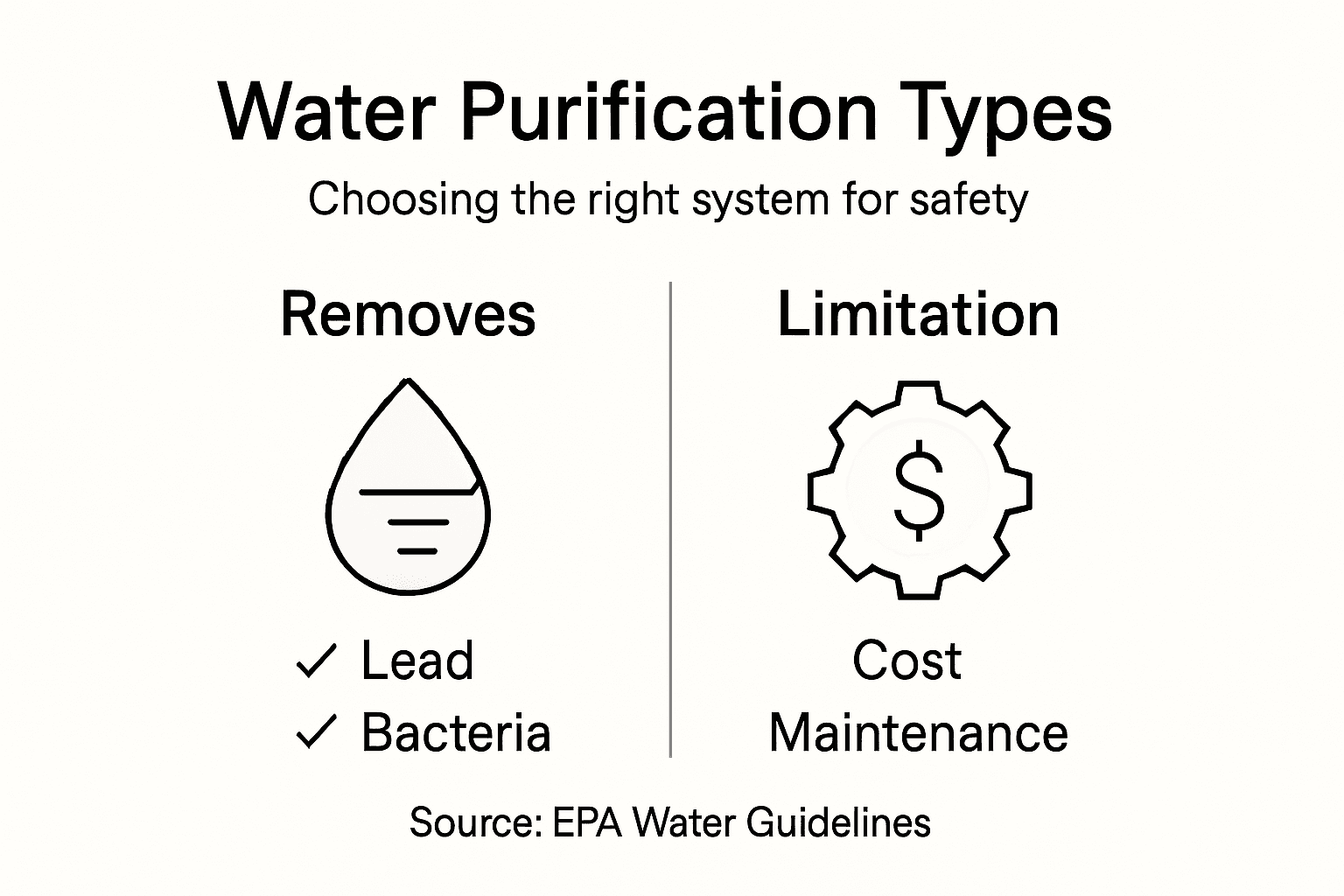
Below is a quick comparison of popular purification technologies for food service operations:
| Technology | Removes | Key Limitation |
|---|---|---|
| Activated Carbon | Chlorine, odors, organics | Fails against microbes and some metals |
| Reverse Osmosis | Most contaminants, minerals | Strips beneficial minerals |
| UV Disinfection | Microbes | No chemical removal |
| Ion Exchange | Hardness, some metals | Does not remove organics or microbes |
| Membrane Filtration | Bacteria, some viruses | Lower flow rates, higher cost |
Beyond the technology itself, consider system logistics. Where will the purification equipment sit? Under-sink systems work for small cafes with limited water needs. Countertop models provide flexibility but take up valuable counter space. Larger restaurants need whole building systems or point-of-use stations for different applications. Installation requires plumbing modifications that might need professional help. Maintenance demands regular filter changes according to manufacturer specifications. Most systems require filter changes every 6 to 12 months depending on water quality and usage volume. Budget for ongoing maintenance costs, not just the equipment purchase. Calculate your water usage to ensure the system can keep up with demand. An espresso machine pulling 20 gallons daily needs different capacity than a restaurant using 500 gallons. Oversized systems waste money and space. Undersized systems create bottlenecks that frustrate staff and compromise water availability during peak service periods.
Key Selection Criteria
- NSF or WQA certification for the specific contaminants in your water
- Adequate flow rate to handle your peak water demand without creating service delays
- Local technical support for installation, maintenance, and emergency repairs
- Transparent reporting on water quality before and after filtration
- Replacement filter availability and reasonable costs for ongoing maintenance
- Warranty coverage that protects your investment against equipment failure
- Service agreements that include regular maintenance and response time guarantees
Don’t choose based on price alone. The cheapest system often becomes the most expensive when you factor in maintenance problems, frequent filter replacements, poor service support, and potential compliance failures. A system that costs 40 percent more but lasts three times longer and requires less maintenance delivers better value. Request references from other food businesses using the same equipment. Ask about their experience with customer service, reliability, and whether the system actually delivered the water quality improvements they expected.
Pro tip: Before purchasing any purification system, request a free water quality analysis and specific product recommendations from the vendor, then independently verify their recommendations against your water test results to confirm the system will actually address your contaminants rather than treating problems you don’t have.
Ensure Safe and Pure Water for Your Food Business Today
Maintaining the highest water purity is critical for protecting your customers and your brand from the risks associated with contaminants like lead, PFAS, and microbial pathogens. This article highlighted the complex challenges food businesses face when trying to meet strict legal standards and deliver consistent flavor while safeguarding health and equipment integrity. With the right water purification solution designed to address your unique water quality profile, you can eliminate those worries and build lasting customer trust.
Explore the advanced water filtration systems available at Coway Water Purifier that combine proven technologies such as UV disinfection and multi-stage filtration. Whether you need a compact under-sink unit or a large-capacity system, Coway offers options that help you comply with regulatory requirements and enhance your food and beverage quality. Learn more about innovations in water safety and health at our Uncategorized Archives – Coway Water Purifier to make an informed choice.
Don’t wait for costly compliance failures or customer complaints to take action. Visit Coway Water Purifier now to find the perfect purifier tailored to your food business needs and start ensuring water quality that supports your success and reputation.
Frequently Asked Questions
What is water purity, and why is it important for food businesses?
Water purity refers to the quality of water concerning the presence of harmful microorganisms and safe mineral balances. For food businesses, maintaining water purity is crucial to ensure food safety, flavor integrity, and equipment longevity, ultimately protecting customer health and business reputation.
What are common contaminants found in water that can affect food safety?
Common contaminants include heavy metals like lead and arsenic, chemical compounds such as PFAS and nitrates, and microbial contaminants like bacteria and viruses. These contaminants can pose serious health risks and affect the quality of the food and beverages served.
How can I ensure my food business complies with water quality regulations?
You can ensure compliance by regularly testing your water supply for contaminants, following local health department guidelines, and maintaining documentation of your water quality tests. Additionally, employing appropriate water purification systems tailored to your specific contaminant profile is essential.
What types of water purification systems are suitable for food service operations?
Suitable water purification systems include activated carbon filters, reverse osmosis systems, UV disinfection, ion exchange systems, and membrane filtration. A combination of these technologies is often recommended to address various contaminants effectively.
Recommended
- Why Pure Water Boosts Health and Vitality – Coway Water Purifier
- Benefits of Pure Water for Health – Why Purity Matters – Coway Water Purifier
- Purification Industry Standards Explained: Impact on Health – Coway Water Purifier
- The Essential Guide to Purified Water for Offices – Coway Water Purifier
- Understanding Personal Hygiene in Food Service – Probe IT
