
Uncategorized
Top 5 Advantages of UV Filtration for Safe Home Water
Apr
TL;DR:
- UV filtration instantly destroys pathogens without chemicals or residue.
- It offers chemical-free purification, preserving water taste and mineral content.
- Certified UV systems are low-maintenance, energy-efficient, and environmentally friendly.
Every time you fill a glass from the tap, invisible threats like E. coli, norovirus, and giardia may be present, even in treated municipal water. Chlorine does a reasonable job, but it leaves behind a chemical taste and can irritate sensitive users. UV filtration offers something different: rapid, chemical-free destruction of pathogens with no byproducts and almost no upkeep. If you have been searching for a safer, simpler way to protect your family’s drinking water, this guide walks through the five most compelling advantages of UV purification, so you can decide whether it is the right upgrade for your home.
Table of Contents
- Destroys bacteria and viruses instantly
- Chemical-free purification with no taste or odor changes
- Low maintenance and cost-effective operation
- Environmentally friendly and energy efficient
- Certified protection and peace of mind
- What most homeowners overlook about UV filtration
- Discover UV and modern water filtration for your family
- Frequently asked questions
Key Takeaways
| Point | Details |
|---|---|
| Destroys germs instantly | UV filtration neutralizes waterborne bacteria and viruses as water passes through the system. |
| No added chemicals | UV keeps your water pure without altering taste or introducing unwanted substances. |
| Low-maintenance option | Annual UV lamp change is typically all that’s needed for safe, effective operation. |
| Eco-friendly choice | Reduces reliance on disposable filters and plastic bottles while saving energy. |
| Certified home safety | NSF-certified UV systems provide peace of mind with proven pathogen removal. |
Destroys bacteria and viruses instantly
Now that you know why UV filtration deserves attention, let us break down its real-world pathogen-fighting abilities.
When water passes through a UV purification chamber, germicidal ultraviolet light at 254 nanometers penetrates microbial cell walls and scrambles the DNA inside. That process renders bacteria, viruses, and protozoa completely unable to reproduce. No reproduction means no infection. The reaction happens in seconds, so by the time water exits the chamber, it is already safe to drink.
One of the biggest reasons homeowners choose UV is that the process adds absolutely nothing to your water. No chlorine, no bromine, no residue. Families who are sensitive to chemical disinfectants often notice the difference immediately: water tastes clean, not treated. Understanding the role of UV in water purification helps explain why that purity is not just pleasant but scientifically reliable.
Pathogens UV inactivates in home water systems:
- E. coli and other coliform bacteria
- Norovirus and rotavirus
- Giardia lamblia and Cryptosporidium
- Salmonella and Legionella species
- Hepatitis A virus
For context on performance standards, the EPA standards for UV water treatment confirm that UV is effective for virus inactivation at specific doses, and NSF/ANSI 55 certification applies to residential units. That means any certified UV system you bring home has already been tested to meet strict performance benchmarks.
“A UV system that meets NSF/ANSI 55 Class A certification delivers the consistent germicidal dose required to protect households from microbiologically unsafe water, without introducing new risks.”
Getting familiar with UV sanitization home safety standards shows why those benchmarks matter far more than brand marketing alone. For a detailed look at how the process works from start to finish, the UV purification step-by-step breakdown is a worthwhile read.
Chemical-free purification with no taste or odor changes
Beyond eliminating germs, UV offers another big perk: it purifies without altering your water’s natural qualities.
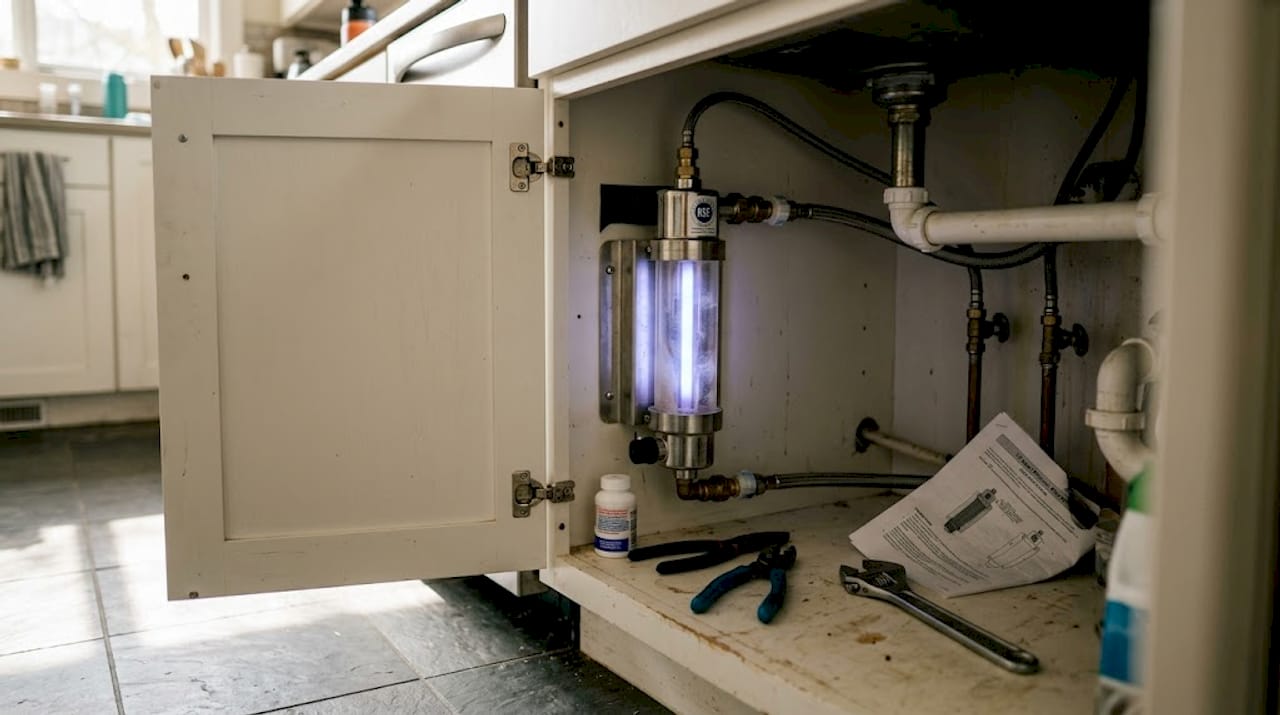
Chemical disinfection has always been a trade-off. Chlorine works, but it reacts with organic matter in water to form disinfection byproducts, some of which are under ongoing health scrutiny. UV sidesteps that issue entirely. No chemicals enter your water at any stage, which means your water’s original mineral profile, taste, and smell stay exactly as nature intended.
This matters most for specific households and uses. The CDC’s UV system recommendations note that UV is especially well-suited for private well owners wanting a chemical-free purification solution. That guidance applies equally well to any homeowner who wants pure water without compromise.
Situations where chemical-free water matters most:
- Allergy and sensitivity sufferers who react to chlorine or chloramine residues in tap water
- Cooking and beverages where you want flavors undisturbed by disinfectant aftertaste
- Pets and aquariums where even trace chemicals can affect health and water chemistry
- Infants and formula preparation where water purity is especially critical
- Skincare routines where filtered water is used topically on sensitive or eczema-prone skin
Learning more about UV sterilization basics confirms that the process is non-reactive by design. The light does its work and leaves nothing behind. Your water comes out cleaner but completely unchanged in flavor or mineral content.
Pro Tip: If your household includes formula-fed infants or family members with chemical sensitivities, UV purification is one of the safest upgrades you can make. Pair it with a sediment pre-filter to handle any particles before the UV stage.
Low maintenance and cost-effective operation
If you love the idea of hassle-free safety, UV makes daily water management simple and affordable.
One of the most underrated advantages of UV is how little attention it demands once installed. There are no chemical tanks to refill, no heavy filter cartridges to swap out every few months, and no complicated maintenance routines. The system runs automatically whenever water flows through, and the only regular task is an annual UV lamp replacement.
NSF certified residential UV systems are engineered for consistent performance and easy maintenance, which means you are not relying on guesswork to know when your system needs attention. Many modern models include indicator lights or digital alerts that tell you exactly when the lamp needs changing.
What UV system maintenance actually looks like:
- Annual UV lamp replacement: typically costs $20 to $60 per bulb depending on model
- Quartz sleeve cleaning: once or twice per year, takes under ten minutes
- No chemical refills: zero recurring chemical purchase costs
- Automatic operation: system runs on its own, no daily monitoring needed
- Energy cost: most residential units use between 10 and 40 watts, comparable to a basic LED desk lamp
When you compare that to bottled water costs for a family of four, which can easily run $500 or more per year, or to chemical dosing systems that require regular replenishment and safety precautions, UV wins on simplicity and long-term value. Exploring must-have filtration technologies shows how UV fits into a broader home wellness strategy without adding complexity.
Pro Tip: Choose a UV model that includes a lamp life indicator or audible alert. Some lamps lose germicidal effectiveness before they physically burn out, and a good alert system removes all guesswork from your maintenance schedule.
Environmentally friendly and energy efficient
Alongside personal health, UV supports your eco-friendly values and helps reduce your family’s footprint.
Bottled water has a hidden cost most households ignore. A typical family of four consuming the recommended daily water intake from plastic bottles generates roughly 1,500 plastic bottles per year. Most of those bottles end up in landfills or oceans. UV filtration eliminates that waste stream entirely because your source is the tap, and your purification is light.
As noted in environmental water safety research, UV filters don’t introduce pollutants or disposable filter cartridges into the environment. That is a real distinction from many multi-stage systems that require regular cartridge disposal.
| Method | Annual energy use | Plastic waste | Chemical use | Filter waste |
|---|---|---|---|---|
| UV filtration | 10 to 40 watts | None | None | Minimal (lamp only) |
| Bottled water | Shipping energy | 1,000+ bottles | None | Packaging |
| Boiling water | High (stove/kettle) | None | None | None |
| Chemical dosing | Negligible | Moderate packaging | Yes | Some |
The energy profile is genuinely impressive. Running a UV system continuously for a year costs roughly the same in electricity as leaving a single LED bulb on. That low energy draw, combined with zero plastic output, makes UV filtration one of the most environmentally responsible choices for home water safety. Looking at examples of filtration technologies puts UV’s environmental footprint in sharp context against the alternatives.
Certified protection and peace of mind
Ultimately, trust in your filtration system comes down to proof. Certifications and standards give homeowners powerful protection.
Not all UV systems are created equal. Budget models sold without any certification may use underpowered lamps, poor-quality quartz sleeves, or inconsistent chamber designs that let water bypass the UV exposure zone. The result is a system that looks functional but delivers unpredictable protection.
NSF/ANSI 55 Class A certifies residential UV systems for microbiologically unsafe water, which is major peace of mind for homeowners. Class A systems must deliver a minimum UV dose of 40 mJ/cm², enough to inactivate the full range of common waterborne pathogens. Class B is rated for already-treated water and delivers a lower dose.
| Feature | NSF/ANSI 55 certified UV | Uncertified UV | Basic filter jug |
|---|---|---|---|
| Virus inactivation | Confirmed | Unverified | No |
| Bacterial elimination | Confirmed | Inconsistent | Partial |
| Build quality testing | Yes | No | Limited |
| Performance guarantee | Yes | No | No |
| Safe for untreated water | Class A: Yes | Unknown | No |
“Choosing a UV system without third-party certification is like wearing a helmet that has never been crash-tested. It might work, but you have no way to know until it matters.”
This is why we always recommend checking certified filtration standards before purchasing. The certification process is not bureaucratic paperwork. It is independent laboratory verification that your system works when your family’s health is on the line.
What most homeowners overlook about UV filtration
Most homeowners treat UV purification as an optional add-on, a nice upgrade layered on top of their existing filter. That framing underestimates what certified UV actually delivers.
The real insight is this: a quality, NSF-certified UV system paired with a sediment pre-filter handles the most dangerous water threats, bacteria, viruses, and protozoa, more reliably than many complex multi-stage systems that cost significantly more. The simplicity is the strength, not a limitation.
Chemical-based disinfection always involves trade-offs: residue, taste, potential byproducts. UV has none of those. For families who want UV for water and air safety without constant maintenance headaches, modern certified UV is not just a reasonable option. It is the most straightforward path to dependable, chemical-free protection at home.
Pro Tip: When evaluating any UV system, skip models without visible certification markings. The NSF/ANSI 55 Class A badge is your clearest signal that the system has been independently validated for real-world pathogen removal.
Discover UV and modern water filtration for your family
Now that you understand the core advantages, the next step is finding the system that fits your household’s size, budget, and water quality needs.
Our water purification guide walks through everything from flow rates to installation, so you can compare options with confidence. If you are ready to evaluate specific models, the top UV water purifiers comparison breaks down certified choices side by side. For households that want clean, cold water on demand, the countertop ice water purifier is a popular certified option worth exploring. Every Coway system ships with free delivery and professional installation, so upgrading your home’s water safety has never been simpler.
Frequently asked questions
Does UV filtration remove all contaminants from tap water?
UV kills bacteria and viruses but does not remove chemical pollutants, heavy metals, or sediment. A multi-stage system that combines UV with carbon filtration and a sediment pre-filter provides broader protection. Per UV filtration limitations, UV is not a physical filter for chemicals or particles.
How do you maintain a UV water filtration system at home?
Maintenance means an annual UV lamp replacement and periodic cleaning of the quartz sleeve to prevent mineral buildup. Residential UV units are designed for minimal upkeep, and most modern models alert you when the lamp is due for a change.
Is UV water purification safe for children and pets?
Yes. UV-treated water is completely safe for all household members because no chemicals are added and nothing is altered in the water’s composition. The CDC highlights UV as ideal for chemical-free purification, making it a trusted choice for infants, children, and pets.
What certifications should I look for on a UV filtration system?
Look for NSF/ANSI 55 Class A certification, which confirms the system delivers the minimum UV dose required to inactivate disease-causing organisms. NSF/ANSI 55 certifies systems specifically tested for microbiologically unsafe water conditions.
Recommended
- 7 Key Examples of Filtration Methods for Safer Home Water – Coway Water Purifier
- UV Sanitization: Boosting Home Water and Air Safety – Coway Water Purifier
- 7 Advantages of Under-Sink Purifiers for Your Home – Coway Water Purifier
- 7 Essential Water Purification Facts 2025 for Healthy Homes – Coway Water Purifier
