
Uncategorized
Office Water Safety Checklist 2026: 70% Fewer Risks
Mar
Office managers face tough choices selecting water safety solutions. Poor office water safety can raise employee sick days by up to 15%. Choosing the right purification system is complex due to regulations and technology options. This guide offers a clear checklist for selection and maintenance to reduce contamination risks.
Table of Contents
- Understanding Selection Criteria For Office Water Safety
- Top Water Purification Technologies For Office Use
- Step-By-Step Office Water Safety Checklist
- Cost Considerations And Budget Planning For Water Safety
- Summary Comparison Of Water Safety Solutions For Offices
- Situational Recommendations For Choosing Office Water Safety Solutions
- Explore Advanced Office Water Safety Solutions With Coway
- Office Water Safety Checklist FAQ
Key Takeaways
| Point | Details |
|---|---|
| Selection Factors | Effective choice depends on contaminant removal rates, cost, maintenance schedules, and regulatory compliance requirements. |
| Combination Systems | Combination purification systems remove 10-15% more contaminants than single-technology units. |
| Monitoring Impact | Regular water dispenser monitoring cuts contamination events by 70% in workplace settings. |
| Budget Planning | Total ownership costs include upfront equipment, maintenance contracts, and water waste from reverse osmosis systems. |
| Technology Matching | Office size, contamination profile, and budget constraints determine optimal purification technology selection. |
Understanding Selection Criteria for Office Water Safety
Office water safety isn’t just about installing any filter. You need to understand EPA water testing frequency and monitoring standards that govern workplace environments. OSHA compliance requirements add another layer to your decision matrix.
Contaminant reduction effectiveness matters most. Microbial pathogens like bacteria and viruses pose immediate health risks. Chemical contaminants such as lead, chlorine byproducts, and pesticides create long-term exposure concerns. Your chosen system must address both categories effectively.
Balancing technology choice with practical constraints requires careful analysis. Consider these critical factors:
- Initial equipment costs versus long-term maintenance expenses
- Water waste rates that impact utility bills and sustainability goals
- Installation complexity and space requirements in your office layout
- Filter replacement frequency and technician availability
- Energy consumption for powered systems like UV or RO units
Common misconceptions can derail your selection process. Activated carbon filters excel at removing chlorine, bad tastes, and odors but do not eliminate microbes. Many office managers assume one filter type solves all problems. This thinking leaves gaps in your protection strategy.
Pro Tip: Request third-party lab certification reports for any purification system you’re considering. NSF International certifications verify specific contaminant removal claims rather than relying on marketing materials alone.
The office water purification guide shows how proper system selection integrates with broader workplace safety programs. Your water quality directly affects employee health, productivity, and satisfaction levels.
Top Water Purification Technologies for Office Use
Four main technologies dominate office water safety solutions. Each brings distinct advantages and limitations to your workplace.
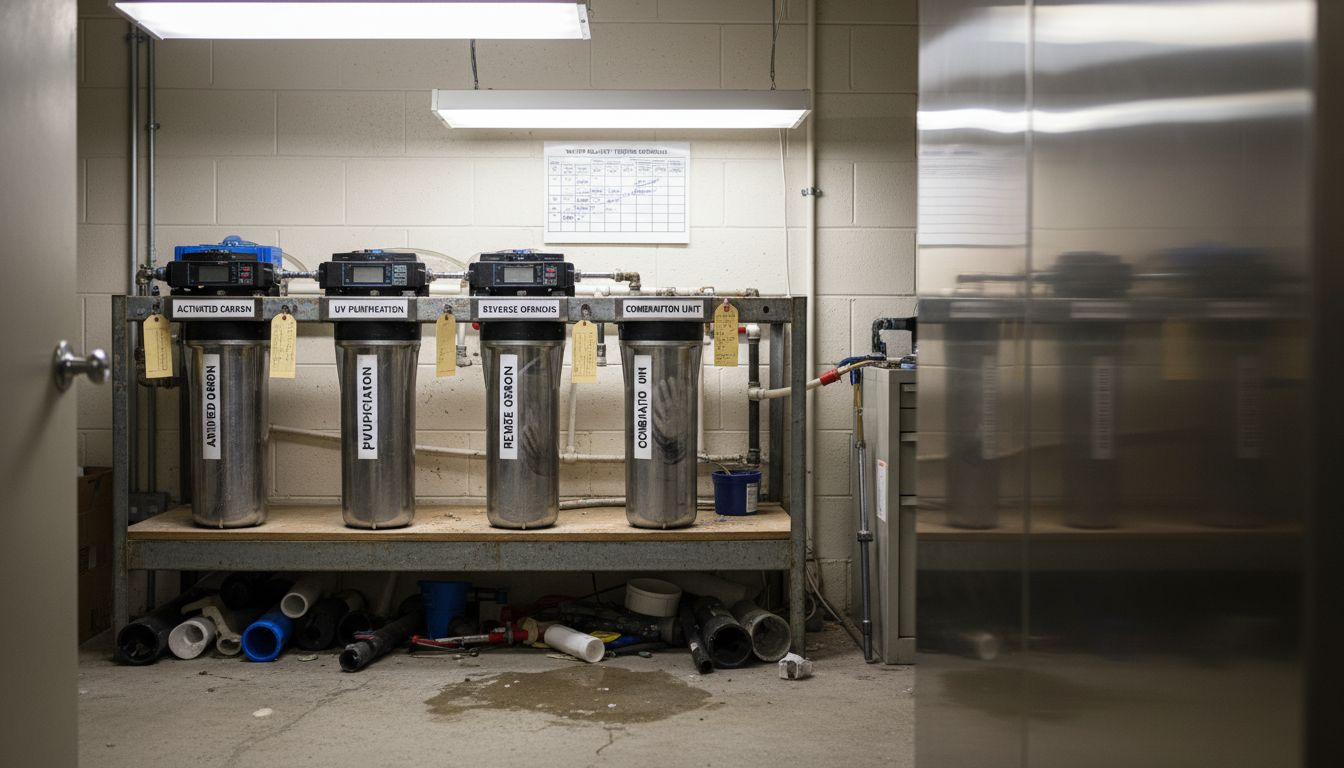
Activated carbon filtration offers the most affordable entry point. These filters effectively remove chlorine, volatile organic compounds, and taste problems. Water flows through porous carbon media that traps chemical contaminants through adsorption. However, carbon filters cannot remove bacteria, viruses, or dissolved minerals. You’ll need replacement cartridges every 3 to 6 months depending on water volume.
UV purification kills bacteria and viruses using ultraviolet light without adding chemicals. The system exposes water to UV-C radiation that destroys microbial DNA. This method works chemically free and leaves no taste or odor changes. UV units require electricity to operate and only address biological contaminants. Physical particles can shield microbes from UV exposure, requiring pre-filtration.
Reverse osmosis removes dissolved solids through a semipermeable membrane. RO systems eliminate heavy metals, fluoride, nitrates, and other ionic contaminants that other methods miss. The technology produces exceptionally pure water but wastes 3 to 5 gallons for every gallon of purified water. Maintenance costs run higher due to multiple filter stages and membrane replacement needs.
Combination systems outperform single technology filtration by 10-15% in contaminant removal. These units integrate multiple purification methods in sequence. A typical combination uses sediment pre-filtration, carbon adsorption, and UV disinfection. Some advanced models add RO membranes for comprehensive protection.
| Technology | Removes Microbes | Removes Chemicals | Water Waste | Maintenance Level |
|---|---|---|---|---|
| Activated Carbon | No | High | None | Low |
| UV Purification | High | No | None | Low |
| Reverse Osmosis | Medium | High | High | High |
| Combination Systems | High | High | Low to Medium | Medium |
The top UV water purifiers comparison reveals performance variations even within single technology categories. Flow rate capacity, lamp life, and chamber design significantly impact effectiveness.
Pro Tip: Match your technology choice to your source water test results. If municipal water already removes microbes through chlorination, carbon filtration may suffice. Well water or areas with compromised infrastructure need UV or combination systems.
Modern water purifier features now include real-time monitoring, filter life indicators, and automatic shutoff mechanisms. These advances simplify maintenance tracking and reduce human error in safety protocols.
Step-by-Step Office Water Safety Checklist
Implementing effective water safety requires systematic execution. Follow this proven sequence to establish comprehensive protection.
-
Assess Source Water Quality: Obtain a detailed water test before selecting any equipment. Municipal water reports provide baseline data but may not reflect conditions at your building. Independent lab testing reveals contaminants specific to your location including lead from pipes, bacteria from storage tanks, or chemicals from local sources.
-
Choose Filtration Method: Match purification technology to identified contaminants. High bacterial counts demand UV or combination systems. Chemical contamination requires activated carbon or RO depending on specific compounds. Hard water with dissolved minerals benefits from RO membrane filtration.
-
Implement Regular Testing: EPA recommends testing every 3 months minimum for workplace water systems. Create a testing calendar with specific parameters to check each cycle. Document all results to track trends and catch problems early.
-
Follow Maintenance Protocols: Strict adherence to manufacturer maintenance schedules prevents system failures. Replace filters before expiration dates, not after problems appear. Clean dispensers and contact surfaces weekly to prevent biofilm growth. UV lamps lose effectiveness over time even when still glowing.
-
Train Employees: Your staff needs clear guidance on water safety procedures. Post instructions for reporting taste, odor, or appearance changes. Establish emergency protocols if contamination is suspected. Designate responsible parties for routine checks and maintenance coordination.
Your office water quality testing importance extends beyond compliance. Regular monitoring identifies emerging problems before they cause illness or violate regulations.
Pro Tip: Create a maintenance log visible near each water station. Simple checkboxes for daily visual inspection, weekly cleaning, and filter replacement dates keep everyone accountable. Digital tracking apps can send automatic reminders to responsible staff members.
The water purification maintenance schedule should integrate with your broader facility management calendar. Coordinate filter changes with other building system maintenance to improve efficiency.
Regular microbial monitoring benefits include early detection of system failures, verification of purification effectiveness, and documentation for regulatory inspections. These tests provide peace of mind that your investment delivers promised protection.
Cost Considerations and Budget Planning for Water Safety
Budgeting for water purification requires understanding both obvious and hidden costs. Initial purchase prices represent only one component of total ownership expenses.
Activated carbon systems offer the lowest entry cost at $200 to $800 for office-grade units. These affordable options suit tight budgets but require frequent filter replacement. Annual filter costs range from $150 to $400 depending on water volume.
UV purification systems cost $400 to $1,500 upfront. Bulb replacement every 12 months adds $100 to $200 annually. Electricity consumption remains minimal at roughly $20 per year for continuous operation.
Reverse osmosis installations run $800 to $3,000 for commercial models. Multiple filter stages mean higher maintenance costs of $300 to $600 annually. Water waste from RO increases utility bills substantially in high-usage offices.
Combination systems balance performance and cost at $1,000 to $2,500 initially. Maintenance expenses average $250 to $500 per year. These units deliver comprehensive protection without extreme water waste.
Consider these factors when planning your budget:
- Installation costs vary from simple countertop placement to complex plumbing modifications
- Service contracts for professional maintenance add $200 to $500 annually but ensure proper care
- Replacement parts availability affects long-term ownership costs and system downtime
- Energy costs for powered systems accumulate over years of continuous operation
| Cost Category | Activated Carbon | UV System | Reverse Osmosis | Combination |
|---|---|---|---|---|
| Initial Equipment | $200-$800 | $400-$1,500 | $800-$3,000 | $1,000-$2,500 |
| Annual Maintenance | $150-$400 | $100-$200 | $300-$600 | $250-$500 |
| Water Waste Cost | $0 | $0 | $200-$400 | $50-$150 |
| 5-Year Total | $950-$2,800 | $900-$2,500 | $2,300-$6,000 | $2,250-$5,000 |
Return on investment includes factors beyond equipment costs. Reduced sick days from improved water safety translate to productivity gains. Avoiding regulatory violations prevents fines and legal expenses. Employee satisfaction improves when workplace amenities demonstrate health commitment.
Pro Tip: Request total cost of ownership projections from vendors covering 5 years of operation. This reveals which seemingly affordable options become expensive through maintenance and consumables.
Summary Comparison of Water Safety Solutions for Offices
This comprehensive comparison table consolidates key performance metrics to guide your final decision. Review how each technology balances effectiveness against resource requirements.
| Technology | Microbial Removal | Chemical Removal | Dissolved Solids | Water Waste | Maintenance Frequency | Best For |
|---|---|---|---|---|---|---|
| Activated Carbon | 0% | 85-95% | 0% | 0% | Every 3-6 months | Chlorine, taste, odor issues |
| UV Purification | 99.9% | 0% | 0% | 0% | Annual bulb change | Municipal water with microbe concerns |
| Reverse Osmosis | 95-98% | 90-95% | 95-99% | 75% | Every 6-12 months | Complete purification needs |
| Carbon + UV Combo | 99.9% | 85-95% | 0% | 0% | Every 6 months | Balanced microbial and chemical protection |
| RO + UV Combo | 99.9% | 90-95% | 95-99% | 60% | Every 6-12 months | Comprehensive maximum protection |
Contaminant removal percentages reflect laboratory testing under optimal conditions. Real-world performance depends on source water quality, system maintenance, and proper installation. Flow rate capacity also affects removal efficiency during peak usage periods.
Water waste percentages show how much input water becomes drain discharge. High waste rates impact sustainability goals and utility costs. Areas with water scarcity or high municipal rates should weigh this factor heavily.
Maintenance frequency indicates typical service intervals for filter changes and component replacement. Actual schedules vary based on water volume processed and source water contamination levels. Some offices require more frequent service than manufacturers suggest.
Situational Recommendations for Choosing Office Water Safety Solutions
Your specific circumstances determine the ideal water purification approach. These scenarios help match technology to your office profile.
Small offices with 10 to 25 employees benefit from activated carbon or UV combination systems. Lower water volume makes maintenance manageable while delivering effective protection. Budget constraints in small operations favor systems with minimal ongoing costs. Purified water recommendations for offices suggest starting with UV plus carbon unless testing reveals heavy metal concerns.
Large high-usage offices should invest in combination RO and UV systems for comprehensive purification. Processing 50 to 200 gallons daily requires robust equipment with high flow capacity. Multiple water stations may need individual units or a central system with distribution lines. The higher upfront cost pays off through reduced health risks and regulatory compliance confidence.
Sustainability-focused offices might avoid RO to reduce water waste while using UV and carbon filtration. This approach maintains effective purification for most contaminants without excessive resource consumption. Green building certifications often reward water conservation efforts. Balance environmental goals against purification needs based on your source water quality.
Offices with tight budgets should combine basic filtration with frequent monitoring. A quality activated carbon system plus quarterly water testing costs less than advanced purification technology. This strategy works when municipal water provides reliable baseline safety. Testing alerts you to changes requiring technology upgrades.
Specific contamination profiles demand targeted solutions:
- High bacterial counts in well water require UV as minimum protection
- Lead contamination from old pipes needs RO or specialized lead-removal filters
- Agricultural areas with pesticide concerns benefit from carbon and RO combinations
- Hard water causing scale buildup requires RO or water softening integration
Pro Tip: Pilot test your chosen system for 90 days before committing to multiple units. This trial period reveals practical issues like maintenance burden, user acceptance, and actual performance in your specific conditions.
Explore Advanced Office Water Safety Solutions with Coway
Coway delivers advanced purification technologies designed specifically for demanding office environments. Our systems integrate multiple filtration stages to address both microbial and chemical contaminants comprehensively.
Our top UV water purifiers feature powerful germicidal lamps combined with multi-stage filtration for superior protection. Installation flexibility allows countertop water purifiers for visible placement or under sink water purifiers for space-conscious offices. Each model includes maintenance reminders and filter life indicators to simplify ongoing care. Free delivery, professional installation, and comprehensive service support ensure your water safety system performs reliably for years.
Office Water Safety Checklist FAQ
How often should offices test their water for safety?
Test office water every 3 months minimum to comply with EPA workplace guidelines. High-risk environments like healthcare offices or buildings with old plumbing should test monthly. Regular testing frequency catches problems before they affect employee health.
Which purification technology is best against viruses and bacteria?
UV purification delivers 99.9% elimination of bacteria and viruses without chemicals. Combination systems pairing UV with filtration provide comprehensive microbial protection plus chemical contaminant removal. RO systems also remove most microbes but primarily target dissolved solids.
What maintenance routines ensure continuous water safety?
Replace filters according to manufacturer schedules, typically every 3 to 12 months depending on technology. Clean dispenser surfaces weekly with approved sanitizers to prevent biofilm growth. Change UV bulbs annually even if still illuminated since germicidal effectiveness declines over time.
How do offices meet EPA and OSHA water safety regulations?
Implement regular water testing at EPA-recommended intervals and maintain documentation. Install certified purification systems appropriate for identified contaminants. Train staff on water safety protocols and emergency procedures. Keep maintenance logs current to demonstrate compliance during inspections.
Are activated carbon filters sufficient for safe drinking water?
Activated carbon filters effectively remove chlorine, taste, odor, and many chemical contaminants but do not eliminate bacteria or viruses. They work well for treated municipal water already disinfected at the source. Offices with well water or compromised municipal systems need additional UV or RO purification for complete safety.
Recommended
- Office Water Pollution: Risks and Solutions for Managers – Coway Water Purifier
- 7 Essential Steps for a Safe Drinking Water Checklist – Coway Water Purifier
- Why Test Water Quality in Offices Today – Coway Water Purifier
- Complete Office Water Purification Guide for Healthier Spaces – Coway Water Purifier
