
Uncategorized
Certified Filtration Standards: Safeguarding Home Wellness
Feb
Choosing a water filter for your American home can feel confusing when words like “certified” are everywhere but not always clear. You want protection that goes beyond the label—certified filtration standards deliver third-party proof that your system does exactly what it claims. Understanding how certifications like NSF and ANSI target specific contaminants will help you avoid common misconceptions and make choices that actually improve your household’s water safety and wellness.
Table of Contents
- Defining Certified Filtration Standards And Misconceptions
- Major Certifications For Water And Air Filters
- How Certified Standards Guarantee Performance
- Legal Requirements And Regulatory Compliance In The Us
- Risks Of Uncertified Systems For Homeowners
Key Takeaways
| Point | Details |
|---|---|
| Certified Filtration Standards | NSF/ANSI certifications are essential for ensuring that water filters effectively remove specific contaminants as claimed. |
| Misconceptions About Certification | Many believe that certification guarantees total protection, but each standard focuses on different contaminants. |
| Importance of Verification | Certification involves rigorous, independent testing, ensuring that filters meet performance claims and material safety standards. |
| Health Risks of Uncertified Filters | Using uncertified filters poses serious health risks as they lack verified claims and may not effectively remove harmful contaminants. |
Defining certified filtration standards and misconceptions
Certified filtration standards exist to protect you. They’re third-party verifications that your water filter actually removes what it claims to remove. Without these standards, manufacturers could make any promise they want.
What certified filtration standards actually do:
NSF/ANSI 42, 53, and 401 standards are the leading certifications for drinking water filters in American homes. Each one targets different contaminants and health concerns. They ensure minimum requirements for reducing specific issues—whether that’s aesthetic problems like taste and odor, serious health contaminants, or emerging compounds.
The key word here is specific. This is where misconceptions start.
Most people believe one certification means total protection. That’s not accurate. A filter certified under NSF/ANSI 42 handles cosmetic issues. One certified under NSF/ANSI 53 tackles health-related contaminants. NSF/ANSI 401 addresses emerging substances like pharmaceuticals and pesticides.
Common misconceptions about certified filtration
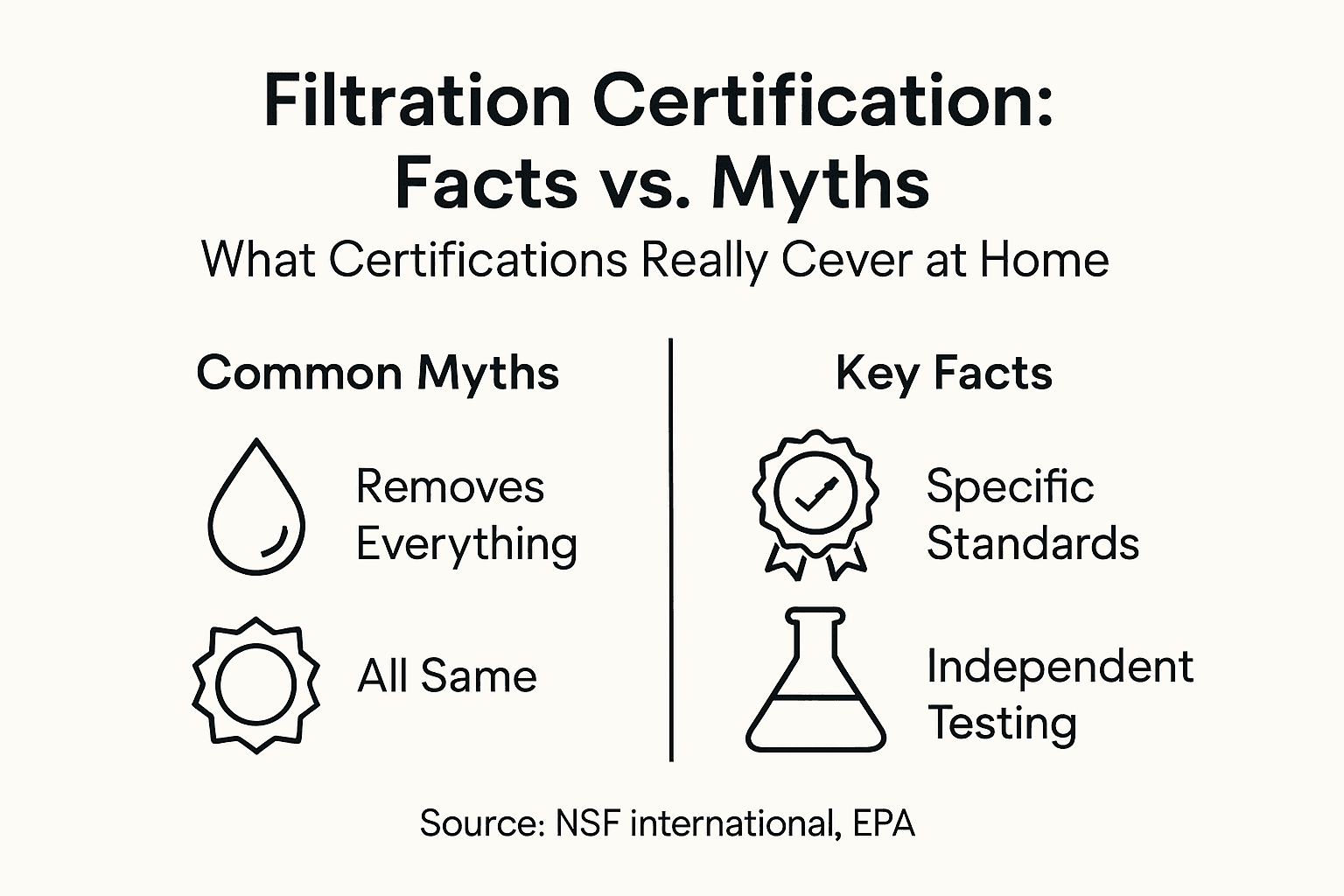
The biggest myth: “Certified means it removes everything harmful.” It doesn’t. It means the filter removes specific contaminants listed in its certification.
Another false belief: “All certifications are the same.” They’re not. Different certifications cover varying contaminants, so a filter certified for one may not address all issues. One system might excel at chlorine removal but miss heavy metals.
People also assume certification is optional. It’s not if you want verified protection. Without it, you’re trusting marketing claims instead of scientific testing.
Here’s what matters most:
- NSF/ANSI 42: Reduces chlorine taste, odor, sediment
- NSF/ANSI 53: Removes health hazards like lead, mercury, cryptosporidium
- NSF/ANSI 401: Targets pharmaceuticals, pesticides, endocrine disruptors
Your water quality challenges are specific to your location. Some regions have heavy lead contamination. Others struggle with agricultural runoff. You need the right certification for your actual water issues.
Certification also means independent laboratory testing. NSF International and ANSI don’t just take the manufacturer’s word. They test filters in controlled conditions to verify performance claims.
Certified standards provide third-party proof that a filter removes the contaminants it claims to address—not all contaminants, but specific ones.
When comparing systems, check which specific certifications each one holds. Then cross-reference that against your water report. Your local utility provides free water quality testing results annually. Match the certification to your actual contaminant concerns.
Pro tip: Request your water utility’s annual water quality report to identify your specific contaminants, then select a filter certified to address those exact issues rather than assuming one certification covers everything.
Major certifications for water and air filters
Certification systems vary significantly between water and air filtration. Each type of filter follows different standards because they address different contamination challenges. Understanding which certification applies to your system matters for evaluating its effectiveness.
Water filter certifications
NSF/ANSI standards dominate water filtration certification in American homes. These certifications validate that filters actually remove the contaminants they claim to remove and that materials are safe for drinking water.
The three primary NSF/ANSI certifications you’ll encounter are:
- NSF/ANSI 42: Aesthetic contaminant reduction (chlorine taste, sediment, odor)
- NSF/ANSI 53: Health-related contaminant reduction (lead, mercury, cryptosporidium, volatile organic compounds)
- NSF/ANSI 401: Emerging compound reduction (pharmaceuticals, pesticides, personal care products)
Water filters don’t just need one certification. A comprehensive system might carry multiple certifications to address different water quality issues. When shopping, check the product label for all applicable certifications.
Here’s a quick guide to major water and air filter certifications and their primary focus:
| Certification Standard | Applies To | Main Focus | Typical Home Benefit |
|---|---|---|---|
| NSF/ANSI 42 | Water | Taste, odor, particles | Improved taste and clarity |
| NSF/ANSI 53 | Water | Health contaminants | Heavy metal and pathogen removal |
| NSF/ANSI 401 | Water | Emerging compounds | Pharmaceutical and pesticide reduction |
| ISO 16890 | Air | Particle filtration | Accurate particle removal rating |
| ASHRAE | Air | HVAC system performance | Better air circulation and quality |
| HEPA | Air | Particle efficiency | High removal of fine particles |
Air filter certifications
Air filtration uses different standards because airborne particles behave differently than dissolved water contaminants. ISO and ASHRAE standards provide the primary frameworks for air filter classification and performance.
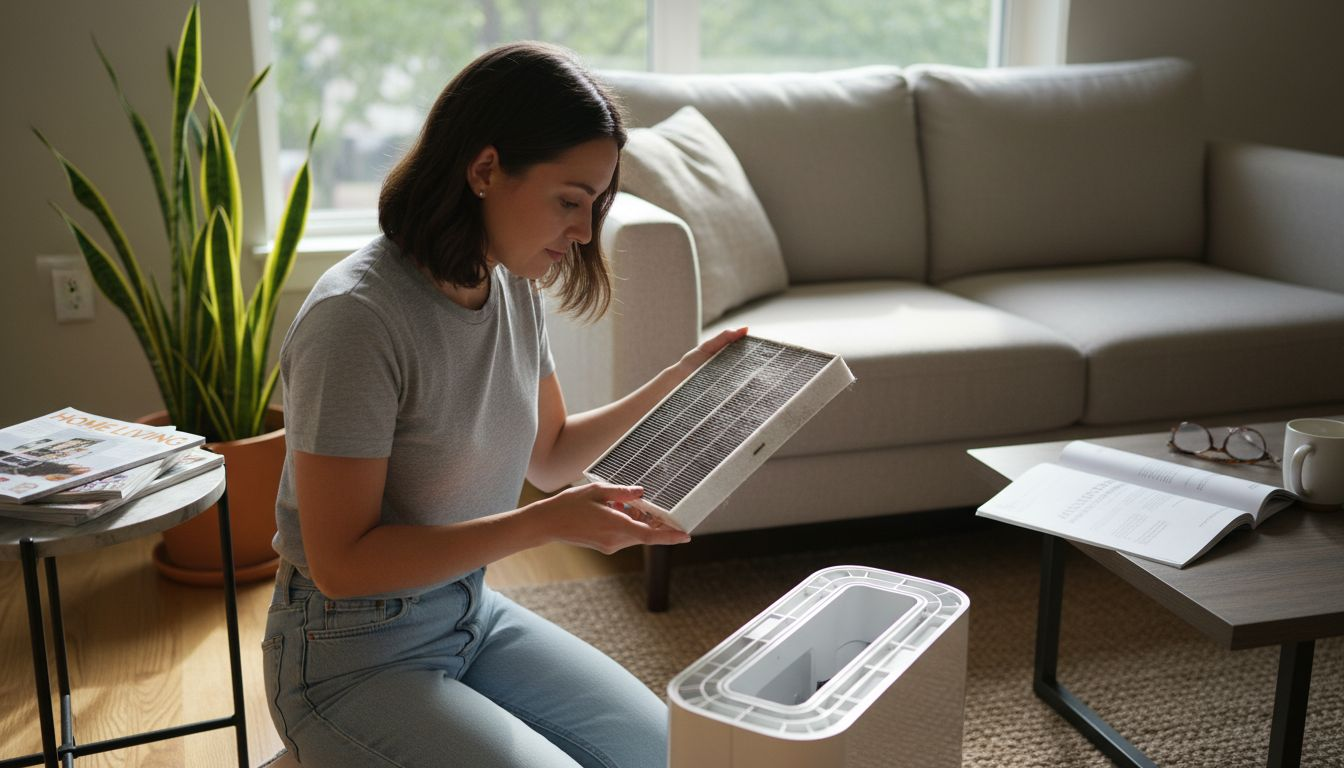
ISO 16890 classifies air filters by particulate removal efficiency across different particle sizes. This standard replaced older efficiency ratings and provides more accurate real-world performance data.
ASHRAE standards focus on filtration and HVAC system performance criteria. These guidelines help residential systems maintain air quality while operating efficiently. ASHRAE considers factors like filter lifespan, airflow resistance, and particle capture rates.
HEPA certification represents the highest consumer-level air filtration standard. HEPA filters remove 99.97% of particles 0.3 micrometers or larger. But HEPA alone doesn’t guarantee air quality—the entire system design matters.
Why different standards exist
Water and air contamination require different testing approaches. Water tests measure dissolved chemicals and biological organisms. Air tests measure particle sizes and capture efficiency under specific airflow conditions.
Understanding filtration standards helps you avoid buying systems that sound impressive but don’t match your actual needs. A HEPA-certified air filter won’t remove gases. An NSF/ANSI 42 water filter won’t eliminate heavy metals.
Certification standards are tool-specific. Water certifications don’t apply to air filters, and air certifications don’t apply to water systems.
Look for certifications matching your specific contamination concerns. If your area has hard water issues, NSF/ANSI 42 helps. If lead contamination is documented, you need NSF/ANSI 53. For air quality, check if ISO 16890 ratings match the particle sizes affecting your home.
Manufacturers pay independent labs to test their products against these standards. This costs money, which is why certified systems typically cost more than uncertified ones. You’re paying for verified performance, not just marketing claims.
Pro tip: Cross-reference your water utility report or indoor air quality test results with a system’s specific certifications before purchasing, ensuring the certification addresses your documented contamination issues.
How certified standards guarantee performance
Certified standards guarantee performance through rigorous, independent testing. A manufacturer can’t just claim their filter works—third-party laboratories verify every claim under controlled conditions before certification is granted.
The testing process behind certification
Certification isn’t a rubber stamp. Third-party verifications involve rigorous testing under controlled conditions to ensure products meet or exceed claims for removing contaminants. Labs don’t test one unit—they test multiple samples to confirm consistency.
Here’s what testing includes:
- Material safety assessment: Confirming that filter materials don’t leach harmful substances into your water or air
- Structural integrity evaluation: Ensuring filters won’t break down or fail prematurely under normal use
- Contaminant removal efficacy: Measuring exactly how much of each targeted contaminant the filter removes
- Performance consistency: Verifying that multiple units perform the same way
Manufacturers submit their products to independent labs like NSF International. These labs have no financial stake in whether the product passes or fails. They follow standardized protocols that haven’t changed, ensuring fair comparison across brands and models.
Specific performance guarantees you can trust
Performance guarantees from certified standards include precise contaminant removal rates backed by laboratory data. NSF 53 certification, for example, requires over 99% removal of lead and pathogens.
This isn’t approximate. It’s verified. The lab doesn’t accept “approximately 99%”—they measure actual removal rates across multiple test cycles.
When you see a certified filter, you get specific information:
- Exact contaminants it removes
- Minimum removal percentage for each contaminant
- Expected filter lifespan under normal conditions
- Flow rate and water quality impact
- Material safety confirmation
Uncertified filters might claim similar performance, but they lack this independent verification. You’re trusting marketing language instead of laboratory data.
Why this matters for your home
Certification guarantees aren’t just numbers. They translate to real protection. If you buy an NSF 53 certified filter for lead reduction and your water test shows lead contamination, you know that system will remove over 99% of it.
Without certification, you’re gambling. The filter might work. It might not. You won’t know until your next water test shows whether contamination levels actually dropped.
Certified performance guarantees are backed by independent laboratory testing, not manufacturer claims.
Manufacturers understand this value. The cost of certification testing means certified systems cost more upfront. You’re paying for proof, and that proof protects your family’s health.
Real-world performance confirms laboratory results. Homeowners using certified filters consistently report improved water clarity, taste, and odor reduction. This isn’t coincidence—it’s the result of filters that actually meet their claims.
Pro tip: Request the specific NSF/ANSI certification number and test results from the manufacturer before purchasing, then verify that certification addresses your documented water or air quality issues.
Legal requirements and regulatory compliance in the US
The regulatory landscape for water filtration in the United States might surprise you. The federal government sets strict standards for public water supplies, but residential filtration devices operate under different rules.
Federal regulations and the Safe Drinking Water Act
The Safe Drinking Water Act governs public water systems through the Environmental Protection Agency (EPA). This law sets maximum contaminant levels for tap water delivered to your home. Your local utility must test for these contaminants and report results annually.
But here’s the critical distinction: Federal regulations focus on source water quality, not on requiring residential filters to meet specific standards. The EPA doesn’t mandate that you use any filtration device at all.
This means:
- Public water systems must meet EPA standards
- Residential filters are not federally mandated
- Manufacturers are not required to certify their products
- Compliance with certification standards remains voluntary
Voluntary certification as the real standard
Since federal law doesn’t require residential water filters to meet specific standards, the industry relies on voluntary certification programs. NSF/ANSI certifications provide de facto benchmarks that manufacturers adopt to assure consumers of quality and safety.
Filtration devices do not have regulatory requirements but rely on voluntary certification programs like NSF and ANSI to assure consumers of quality and safety. This system works because certification has become the market expectation. Consumers trust certified products more, so manufacturers pursue certification to remain competitive.
When a filter carries NSF/ANSI certification, it means the manufacturer chose to exceed federal minimums and submit to independent testing.
State-level variations matter
Some states impose additional standards beyond federal requirements. California, for example, has stricter contaminant limits than the EPA for certain substances. If you live in a state with additional regulations, your water supplier must meet those standards.
Your local water utility report specifies which contaminants exceed federal limits in your area. This report becomes your guide for choosing appropriate filtration.
State regulations focus on source water quality, not on requiring you to purchase filters. However, if your water tests show contamination above federal limits, you might consider filtration regardless of whether it’s mandated.
What this means for your purchasing decisions
No law forces you to buy a certified filter. You could purchase an uncertified system with no regulatory consequence. But uncertified filters offer no verified protection.
Federal law doesn’t require residential filters to be certified, but certification remains your best assurance of actual performance.
Manufacturers understand this gap. Those pursuing NSF/ANSI certification are essentially saying: “Our system performs better than the minimum federal standard, and we’ve proved it through independent testing.”
Uncertified filters might work fine. They might not. You have no way to verify because no testing occurred.
Your responsibility is matching filter capabilities to your documented water quality. If your water report shows lead, choose a filter certified for lead removal. If bacteria concerns exist, verify certification for pathogen removal.
Pro tip: Obtain your local water utility’s annual water quality report from their website or by calling their customer service, then match your filter’s specific certifications to the contaminants documented in your report.
Risks of uncertified systems for homeowners
Uncertified filtration systems expose your family to serious health risks. Without third-party verification, you have no proof that a filter actually removes the contaminants it claims to address. You’re essentially gambling with your household’s water quality.
Performance claims without verification
Uncertified filtration systems pose significant health risks because contaminant removal claims lack third-party verification. A manufacturer can state their filter removes 99% of lead. Without certification, that claim goes untested. No independent lab verified it. No standards were applied.
This creates a dangerous gap between what’s promised and what’s delivered. You install the system believing it protects you, but it might not. You won’t know until you conduct another water test months or years later.
Consumers naturally trust certified products more because certification represents proof. Uncertified filters offer only marketing language.
Material safety concerns
Uncertified products may contain materials that leach harmful chemicals or fail to provide adequate filtration. Filters contain multiple materials—plastics, resins, activated carbon, membranes. Each material must be tested to ensure it doesn’t leach toxins into your water.
Certified systems undergo rigorous material safety assessment. Laboratories test filters under various conditions to verify materials remain stable and don’t contaminate water. Uncertified systems skip this testing entirely.
You might actually be adding contaminants to your water instead of removing them.
The following table highlights potential risks when using uncertified filtration systems compared to certified systems:
| Risk Type | Uncertified Filters | Certified Filters |
|---|---|---|
| Health Risk | Unknown contaminant removal | Verified contaminant reduction |
| Material Safety | May leach harmful chemicals | Independently tested materials |
| Reliability | No performance guarantee | Consistent laboratory-proven results |
| Consumer Confidence | Based on marketing claims | Backed by third-party certification |
| Cost Effectiveness | May waste money on ineffective filters | Higher upfront cost but tested value |
Real consequences for your household
The risks break down into three categories:
- Health exposure: Contaminants like lead, pathogens, or chemicals reach your family through drinking water, cooking, and bathing
- False confidence: You believe you’re protected when you’re actually vulnerable
- Wasted money: You pay for a system that doesn’t work as promised
Lead exposure provides a concrete example. If your water contains lead and you install an uncertified filter claiming to remove it, your family continues ingesting lead. Children exposed to lead develop learning disabilities and behavioral problems. The effects are permanent.
Pathogenic bacteria present another serious concern. Uncertified filters might not remove cryptosporidium or other disease-causing organisms. A family member contracts illness without knowing the filtration failed.
Why manufacturers avoid certification
Certification costs money. Independent testing isn’t cheap. NSF certification for a water filter typically costs $1,500 to $3,000. This investment only makes sense if the product actually performs well.
Manufacturers of uncertified systems often skip certification because their filters wouldn’t pass testing. They know the product won’t meet standards, so they avoid the cost and the failure. Instead, they market aggressively to consumers who don’t know better.
Uncertified filters lack independent verification of both performance and material safety, exposing households to unknown contaminant risks.
Some uncertified systems work fine by accident. But you have no way to know which ones do and which ones don’t. Certification removes the guessing game.
What you should do instead
Choose certified systems matching your documented water quality issues. Request the certification number from manufacturers. Verify that certification on the NSF website. If a manufacturer won’t provide certification details, that’s your signal to look elsewhere.
Your family’s health depends on actual protection, not marketing promises. Certification guarantees that protection exists.
Pro tip: Before purchasing any filtration system, ask the manufacturer for the specific NSF/ANSI certification number, then verify that certification exists on NSF International’s product directory to confirm legitimacy.
Protect Your Home with Verified Filtration Solutions
Understanding certified filtration standards is essential for safeguarding your family from unseen contaminants like lead, pathogens, and emerging chemicals. The challenge lies in choosing a system that meets specific NSF/ANSI certifications aligned with your local water quality issues. Without this, you risk relying on unverified claims and leaving your loved ones vulnerable.
At Coway, we provide advanced water purifiers and air purifiers designed to meet rigorous safety and performance standards. Featuring state-of-the-art filtration technologies, including UV sanitization and multi-stage filters certified to reduce contaminants effectively, our systems give you trusted protection backed by science and independent testing.
Explore our Uncategorized Archives – Coway Water Purifier to find models tailored for your health needs. Don’t wait until risks become realities. Visit Coway Water Purifier today to discover proven solutions that protect what matters most.
Choose peace of mind now by selecting a purification system verified to meet your water and air quality challenges. Take control of your home wellness and Explore our wide range of filters to get started.
Frequently Asked Questions
What do certified filtration standards guarantee?
Certified filtration standards provide third-party verification that a water filter effectively removes specific contaminants as claimed. These certifications assure consumers about the filter’s performance and material safety.
How can I determine which certification my water filter has?
You can typically find the certification details on the product label or the manufacturer’s website. Look for certifications like NSF/ANSI 42, 53, or 401, which indicate what contaminants the filter is certified to reduce.
What is the difference between NSF/ANSI 42, 53, and 401 certifications?
NSF/ANSI 42 focuses on aesthetic improvements such as taste and odor reduction. NSF/ANSI 53 addresses health-related contaminants like lead and bacteria, while NSF/ANSI 401 targets emerging compounds, including pharmaceuticals and pesticides.
Why is certification important for home water filters?
Certification is important because it provides assurance that filters have undergone rigorous testing for effectiveness and safety. Uncertified filters may not reliably remove harmful contaminants, leaving your household at risk.
Recommended
- Certified Filtration: Safeguarding Your Home Health – Coway Water Purifier
- Advanced Filtration Technology: Cleaner Home Wellness – Coway Water Purifier
- 7 Must-Have Filtration Technologies for Home Wellness – Coway Water Purifier
- Advanced Water Filtration Guide for Healthier Homes – Coway Water Purifier
