
Uncategorized
Understanding TDS in Water: A Homeowner’s Guide
Jun
TL;DR:
- Total dissolved solids (TDS) measure the combined concentration of all dissolved inorganic and organic substances in water but do not specify their individual types or safety. It is mainly used as an aesthetic indicator, with readings influenced by measurement methods and not directly linked to health risks. Effective water management should combine TDS monitoring with targeted testing for specific contaminants, utilizing reverse osmosis for significant TDS reduction.
Total dissolved solids (TDS) is defined as the combined concentration of all dissolved inorganic and organic substances in water, measured in milligrams per liter (mg/L) or parts per million (ppm), where the two units are numerically equivalent. Understanding TDS in water gives you a fast snapshot of what your tap or filtered water contains, but it does not tell you which specific substances are present or whether the water is safe to drink. The WHO and EPA both reference TDS as a secondary water quality parameter, meaning it signals taste and aesthetic concerns rather than direct health risk. Portable TDS meters, reverse osmosis systems, and laboratory gravimetric testing are the three main tools used to measure and manage dissolved solids at home and in professional settings.
How is TDS in water measured and why do readings vary?
TDS measurement falls into two categories: field estimation and laboratory analysis. Knowing the difference matters because the method you use directly affects how much you can trust the number on your screen.
Conductivity-based portable meters
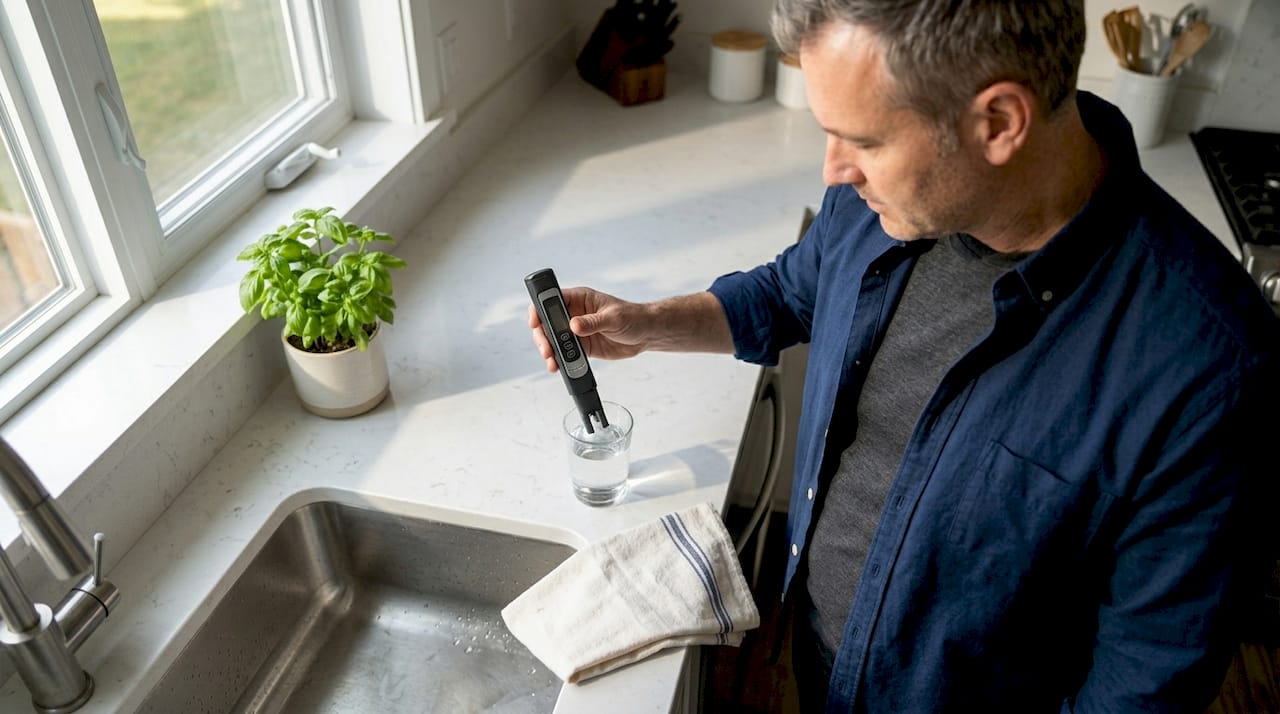
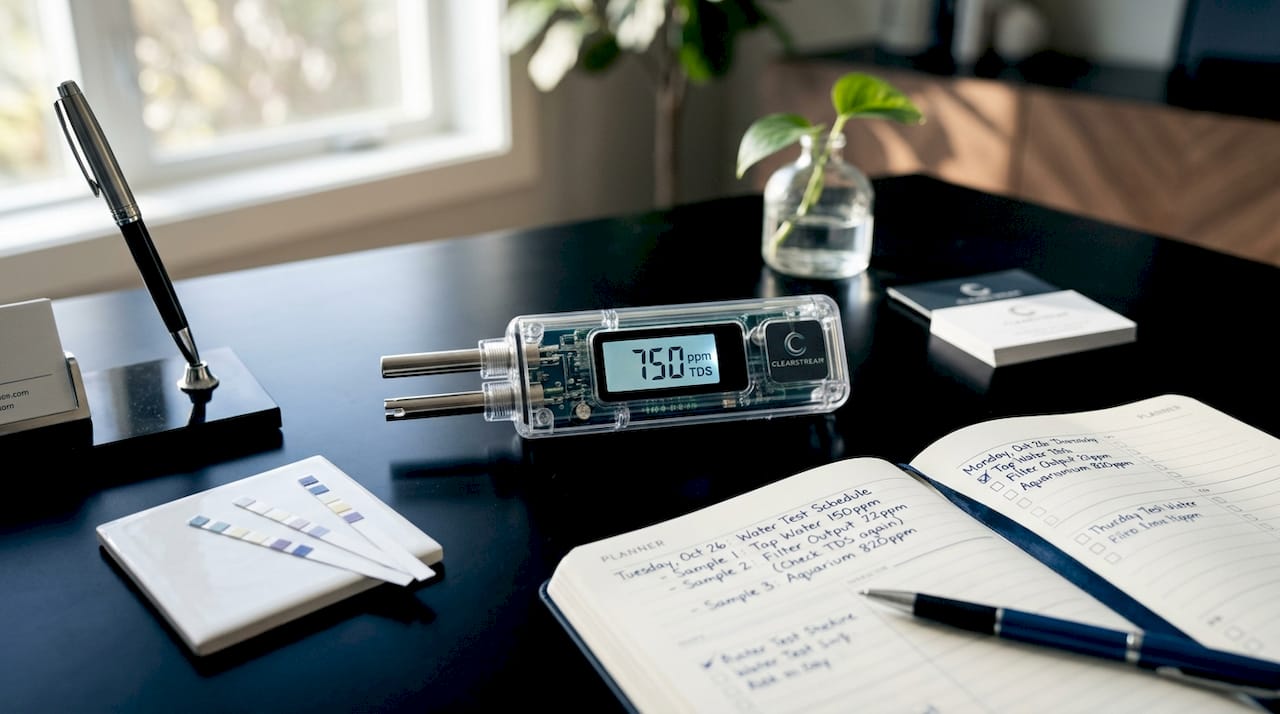
Portable TDS meters are the most common tool for home testing. They do not measure dissolved solids directly. Instead, they measure electrical conductivity, which reflects how well the water conducts a charge, and then apply a conversion factor to estimate TDS. Those conversion factors range from 0.50 to 0.70 depending on the ionic composition of the water and the meter’s internal settings. This is why two different meters can show readings that differ by 20% or more on the same glass of water. Neither reading is necessarily wrong. They are just using different assumptions about what is dissolved.
Laboratory gravimetric analysis
The gold standard for TDS measurement is the gravimetric method performed in a certified lab. A technician filters a known water volume, evaporates it at 180°C, and weighs the residue. This produces a direct, accurate TDS value with no conversion factor involved. Gravimetric results are the benchmark that portable meter readings should be compared against when precision matters, such as before and after installing a filtration system.
Here is a step-by-step approach for reliable home TDS testing:
- Use the same meter every time. Switching between devices introduces variability that has nothing to do with your water.
- Test at a consistent water temperature. Conductivity rises with temperature, so a warmer sample reads higher even if the dissolved solids have not changed.
- Record the meter model, conversion factor setting, and temperature alongside every reading.
- Rinse the probe between tests to avoid cross-contamination from previous samples.
- Calibrate the meter monthly using a reference solution if you are tracking changes over time.
Pro Tip: When monitoring water quality changes over time, record meter settings and temperature with every reading. A jump in TDS could reflect a change in water composition or simply a warmer sample on a hot day.
What do TDS levels tell you about drinking water quality?
TDS levels give you a rough map of water palatability and mineral content, but the map has real limits. TDS alone cannot confirm microbiological safety or the absence of specific contaminants. Two water samples with identical TDS readings can contain completely different dissolved substances. One might be rich in beneficial calcium and magnesium. The other might carry elevated nitrates or heavy metals. The number looks the same; the risk profile does not.
TDS ranges and what they mean for taste
The EPA secondary standard for TDS in drinking water is 500 mg/L, a non-enforceable guideline focused on aesthetics rather than health. Water below that threshold is generally acceptable in taste. Water above it may taste bitter, salty, or metallic and can cause scale buildup in pipes and appliances.
| TDS Range (mg/L) | Typical Perception | Common Sources |
|---|---|---|
| 0 to 50 | Flat or bland taste | Distilled or RO-treated water |
| 50 to 300 | Clean, pleasant taste | Quality municipal or filtered water |
| 300 to 500 | Slightly mineralized | Groundwater, some tap sources |
| 500 to 1,000 | Noticeable mineral or salty taste | Hard groundwater, some well water |
| Above 1,000 | Unpleasant, potential scaling | Brackish or heavily mineralized sources |
The EPA and WHO treat TDS as a secondary aesthetic parameter for good reason. A reading of 250 mg/L from a well in an agricultural area could include nitrate runoff that a TDS meter will never flag. This is why comprehensive water safety testing should go beyond a single TDS number whenever you have reason to suspect contamination.
When to go beyond TDS and order targeted testing:
- Your water source is a private well near farmland or industrial sites
- You notice sudden changes in taste, odor, or color
- A household member has a compromised immune system
- Your TDS reading spikes unexpectedly after heavy rainfall
- You live in an older home with lead or copper plumbing
How does TDS differ from hardness, conductivity, and salinity?
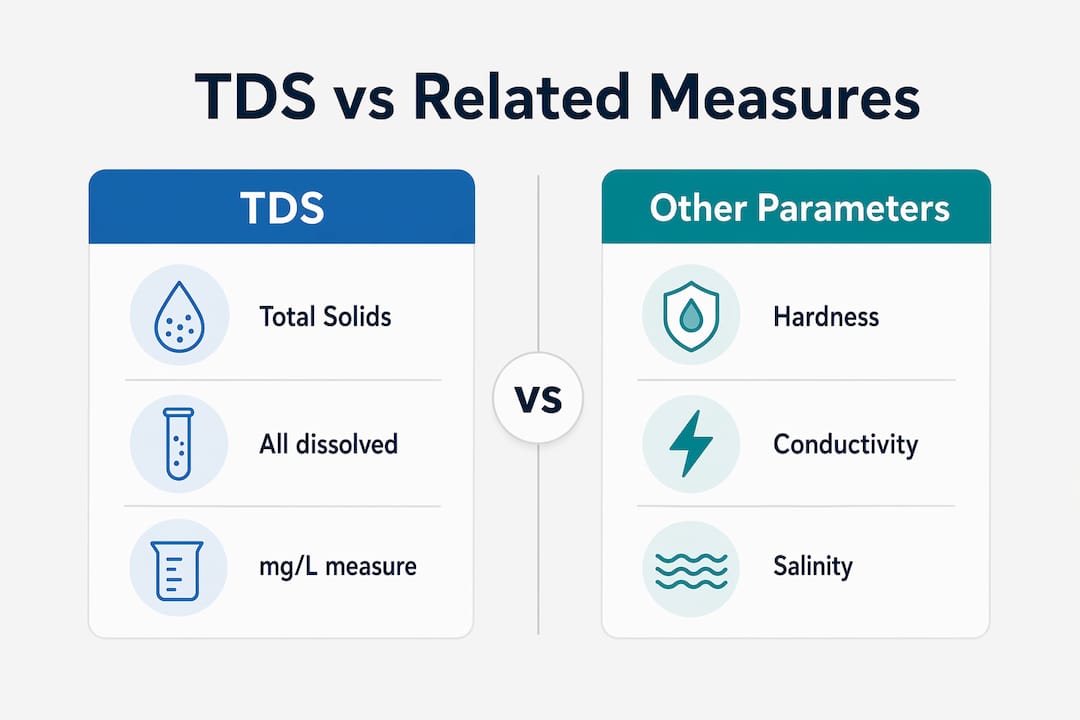
These four terms appear together constantly in water quality reports, and confusing them leads to poor decisions about treatment. Each measures something distinct.
Water hardness specifically measures calcium and magnesium ion concentration, expressed in mg/L as calcium carbonate (CaCO3). Hard water contributes to TDS, but TDS includes dozens of other dissolved substances that hardness testing ignores entirely. You can have hard water with moderate TDS or soft water with high TDS if sodium or other ions dominate.
Conductivity measures how efficiently water transports an electrical charge. It is the raw signal that TDS meters convert into a dissolved solids estimate. Conductivity is reported in microsiemens per centimeter (µS/cm) and is a distinct physical parameter, not a synonym for TDS.
Salinity refers specifically to dissolved salt content, primarily sodium chloride. It is a subset of TDS and is most relevant for coastal or brackish water sources.
| Parameter | What it measures | Unit | Health relevance |
|---|---|---|---|
| TDS | All dissolved solids combined | mg/L or ppm | Indirect, aesthetic |
| Hardness | Calcium and magnesium ions | mg/L as CaCO3 | Scale, pipe wear |
| Conductivity | Ionic charge transport | µS/cm | Used to estimate TDS |
| Salinity | Dissolved salts | ppt or mg/L | Relevant for brackish sources |
Pro Tip: If your water report shows high hardness but acceptable TDS, a water softener addresses scale but does not reduce total dissolved solids. For TDS reduction, you need a different treatment approach entirely.
How to interpret TDS results and manage water quality at home
A TDS reading is a starting point, not a verdict. Here is how to use it well.
High TDS often correlates with hard or mineralized water, increasing scale and corrosion risk in appliances, but it does not directly indicate health risk without identifying the specific dissolved substances involved. A reading above 500 mg/L warrants investigation, not panic. Your first step is to identify your water source and its history. Municipal water that consistently reads 350 mg/L is very different from well water that suddenly jumps from 200 to 600 mg/L after a storm.
For treatment, reverse osmosis removes 90 to 99% of TDS and is the most effective residential option. Distillation achieves similar or higher removal rates. Water softeners, by contrast, exchange calcium and magnesium for sodium. They reduce hardness and may slightly lower TDS, but they do not deliver meaningful TDS reduction and can actually raise sodium levels in the treated water. If you are considering a hydrogen-rich reverse osmosis purifier, these systems combine TDS reduction with additional filtration stages for a more thorough treatment outcome.
Practical steps for managing TDS at home:
- Test your water at the same time of day and season to build a reliable baseline
- Use a step-by-step testing guide to combine TDS testing with targeted contaminant checks
- If TDS exceeds 500 mg/L, consider reverse osmosis as your primary treatment
- After installing any filtration system, retest TDS to verify performance
- Schedule professional water testing annually if you rely on a private well
Common misconceptions about TDS that lead homeowners astray
Misreading TDS data is one of the most common mistakes homeowners make when evaluating their water. These are the five misconceptions that cause the most trouble.
-
TDS equals water safety. TDS is a broad screening tool, not a safety certificate. A low TDS reading does not rule out bacteria, viruses, pesticides, or heavy metals. The WHO’s risk-based approach to drinking water safety explicitly requires contaminant-specific testing beyond TDS.
-
All TDS meters give the same reading. They do not. Conversion factors built into different meter models vary, and without matching methodology, comparing readings across devices is unreliable. Experts caution that portable meter readings should never be equated directly with lab values without accounting for conversion factors.
-
Low TDS always means better-tasting water. Water with TDS below 50 mg/L, such as distilled or heavily filtered water, often tastes flat and unappealing. Most people prefer water in the 50 to 300 mg/L range, where mineral content adds character without overwhelming the palate.
-
TDS and turbidity are the same thing. Turbidity measures suspended particles that make water appear cloudy. TDS measures dissolved substances that are invisible to the naked eye. A glass of water can be crystal clear and have high TDS, or visibly cloudy and have low TDS.
-
A water softener will fix high TDS. Water softeners address hardness by replacing calcium and magnesium with sodium. They do not remove the full spectrum of dissolved solids and are not a substitute for reverse osmosis when TDS reduction is the goal.
Key takeaways
TDS is a useful first-pass screening tool for water quality, but safe drinking water requires contaminant-specific testing that goes well beyond a single number.
| Point | Details |
|---|---|
| TDS is a screening tool, not a safety test | Two samples with the same TDS can contain completely different dissolved substances and risk profiles. |
| Meter readings vary by design | Conversion factors from 0.50 to 0.70 mean different meters produce different readings for identical water. |
| EPA sets 500 mg/L as the aesthetic limit | Above this threshold, taste and scaling concerns increase, but health risk depends on what is dissolved. |
| Reverse osmosis is the most effective home treatment | RO systems remove 90 to 99% of TDS; water softeners do not deliver comparable TDS reduction. |
| Always combine TDS with targeted testing | Microbiological and chemical safety requires lab testing that TDS meters cannot replace. |
Why TDS numbers alone never tell the whole story
I have talked with enough homeowners who bought a TDS meter, saw a reading of 400 mg/L, and immediately assumed their water was dangerous. That reaction is understandable, but it is also exactly the kind of mistake that leads people to spend money on treatment they do not need or, worse, skip testing they actually do.
What I have found after years of working with water quality data is that TDS is genuinely useful as a trend indicator. If your baseline is 180 mg/L and it climbs to 480 mg/L over six months with no change in your water source, that shift deserves attention. But a static reading of 350 mg/L from a well-managed municipal supply is not a red flag. Context is everything.
The other thing people consistently underestimate is the gap between a portable meter and a lab result. I have seen the same water sample produce readings of 210 mg/L on one meter and 290 mg/L on another. Neither meter was broken. They just used different conversion factors. If you are making a treatment decision based on a single meter reading, you are working with an estimate, not a measurement.
My honest recommendation: use TDS as your early warning system, not your final answer. Pair it with waterborne contaminant testing that covers bacteria, nitrates, and heavy metals at least once a year. Then use TDS monthly to watch for changes. That combination gives you real information to act on.
— Soldierboy
Get cleaner water at home with Cowayswaterpurifier
Understanding your TDS reading is the first step. Acting on it is where Cowayswaterpurifier comes in.
Cowayswaterpurifier offers countertop and under-sink purifiers designed to reduce TDS and remove a broad spectrum of contaminants through multi-stage filtration, including reverse osmosis and UV sanitization. If your TDS reading is above 500 mg/L or you simply want confidence in what you are drinking, the water purification process guide on the Cowayswaterpurifier site walks through exactly how each filtration stage works and what it removes. For compact home solutions, the countertop ice water purifier delivers filtered, chilled water without a complex installation. Better water quality does not require guesswork. It requires the right system.
FAQ
What is TDS in water?
TDS stands for total dissolved solids, the combined concentration of all dissolved inorganic and organic substances in water, reported in mg/L or ppm. It covers minerals, salts, metals, and trace organic compounds but does not identify which specific substances are present.
What TDS level is safe for drinking water?
The EPA secondary standard sets 500 mg/L as the upper aesthetic limit for drinking water. Water between 50 and 300 mg/L is generally considered excellent for taste, though safety depends on the specific contaminants present, not the TDS number alone.
Can a TDS meter tell me if my water is safe?
No. A TDS meter estimates the total concentration of dissolved solids but cannot detect bacteria, viruses, pesticides, or specific heavy metals. The WHO recommends comprehensive, contaminant-specific testing for a complete drinking water safety assessment.
What is the best way to reduce high TDS in drinking water?
Reverse osmosis is the most effective home treatment, removing 90 to 99% of TDS. Distillation achieves similar results. Water softeners reduce hardness but do not deliver significant TDS reduction and are not a substitute for RO filtration.
Why do two TDS meters show different readings for the same water?
Portable TDS meters convert conductivity to a TDS estimate using built-in conversion factors that range from 0.50 to 0.70. Different meters use different factors, producing different readings for identical water. For precise results, laboratory gravimetric analysis is the reliable standard.
Recommended
- How to test tap water safety: homeowner’s step-by-step guide – Coway Water Purifier
- Your step-by-step guide to household water safety – Coway Water Purifier
- Complete Water Filtration Process Guide for Homeowners – Coway Water Purifier
- The ultimate water safety checklist for healthy homes – Coway Water Purifier
