
Uncategorized
Water quality trends for businesses 2025: compliance guide

May
TL;DR:
- Water quality compliance for PFAS is urgent, with many systems exceeding EPA limits already.
- Regulations in the US and Europe are accelerating, requiring early monitoring, documentation, and updated operational strategies.
If you think water quality compliance is something you’ll deal with “later,” PFAS contamination is already here. About 8% of water systems exceeded the EPA’s 4 parts per trillion limit for PFOA, and nearly 9% exceeded it for PFOS during federal monitoring. For businesses that depend on municipal water, that’s not a future problem. The water quality trends for businesses 2025 show a regulatory landscape accelerating faster than most owners have planned for, and the gap between “we’re probably fine” and “we have defensible documentation” is exactly where enforcement risk lives.
Table of Contents
- Key regulatory developments shaping water quality trends for businesses in 2025
- PFAS and emerging contaminants: compliance challenges and operational impacts
- Operational water quality trends and risk management strategies
- Corporate water stewardship and building credibility through KPIs
- Why traditional water compliance approaches no longer suffice
- How Coway water purification solutions support your 2025 compliance and health goals
- Frequently asked questions
Key Takeaways
| Point | Details |
|---|---|
| Regulatory complexity | Businesses face evolving, multi-year PFAS and pollutant compliance deadlines in the US and EU in 2025. |
| PFAS prevalence | Significant percentages of water supplies exceed PFAS limits, making proactive supply chain monitoring essential. |
| Operational impacts | Water quality varies with operational changes; continuous monitoring ensures better control and compliance. |
| Measurable stewardship | Setting and reporting clear water-quality KPIs boosts corporate accountability and stakeholder trust. |
| Integrated approach | Combining compliance, operational controls, and strategic stewardship is crucial for sustainable water management. |
Key regulatory developments shaping water quality trends for businesses in 2025
The rules changed significantly in 2024 and 2025, and the compliance clock is running. Here’s what you need to know before the deadlines catch up with you.
EPA’s PFAS maximum contaminant levels
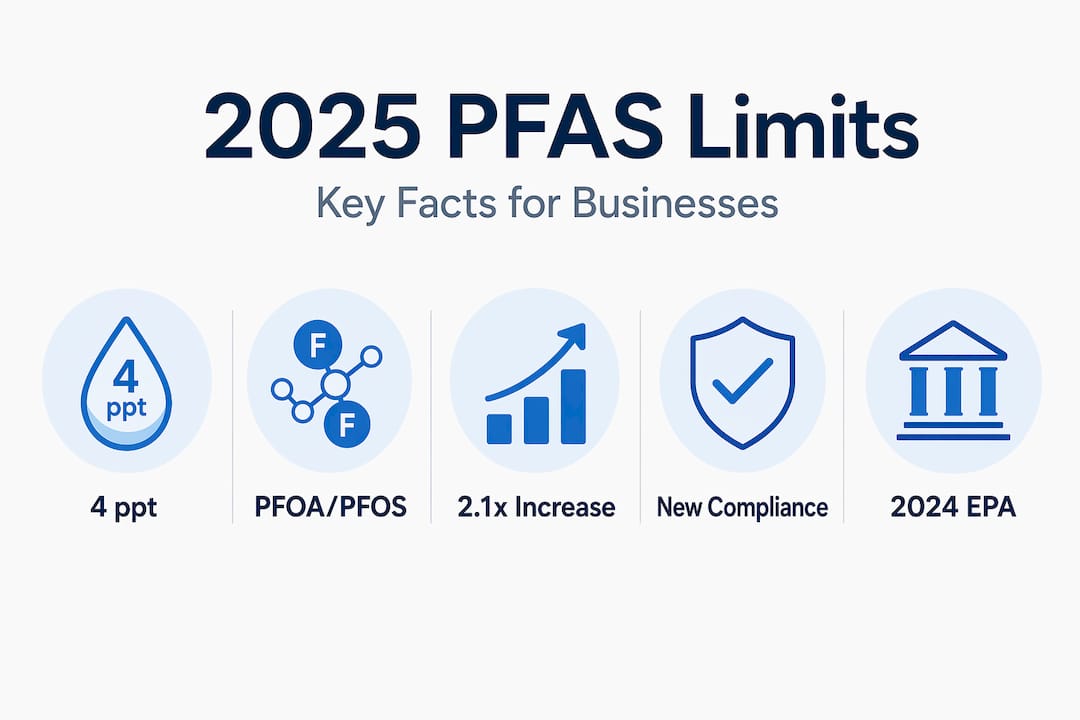
The EPA’s 2024 federal PFAS MCLs set PFOA and PFOS at 4 parts per trillion. This is the most significant update to the Safe Drinking Water Act in decades. Public water systems have compliance timelines extending to 2029 and 2031, but that timeline does not mean your business is off the hook. Monitoring and documentation obligations begin earlier, and businesses that wait until the deadline to build their compliance programs will be scrambling.
EU’s tightened water quality obligations
For businesses operating in or exporting to European markets, stricter EU water quality rules entered force in 2025 and 2026, including expanded coverage of emerging pollutants and new requirements for effect-based monitoring strategies. Effect-based monitoring looks at the biological impact of a water sample, not just its chemical composition. This matters because it catches combinations of contaminants that individual chemical tests can miss.
Compliance steps every business should take now
- Audit your current water source documentation and identify any gaps in monitoring records.
- Determine whether your municipal supplier has disclosed PFAS testing results under UCMR 5 monitoring.
- Review your Toxic Release Inventory obligations if you are a manufacturer with permitted discharges.
- Update stormwater management and spill-prevention plans to reflect current contaminant priorities.
- Build a documentation system that produces timestamped, location-linked records for every water quality test.
For a deeper understanding of where filtration technology is heading, the water purification trends in 2025 breakdown gives useful context on the treatment side of these regulatory shifts.
Key regulatory areas affecting businesses in 2025
- PFAS maximum contaminant levels under the Safe Drinking Water Act
- Toxic Release Inventory reporting for regulated industrial operations
- Updated discharge permit conditions for manufacturing sites
- Stormwater permit obligations for commercial properties
- EU effect-based monitoring requirements for international businesses
PFAS and emerging contaminants: compliance challenges and operational impacts
PFAS is not a single chemical. It is a family of more than 12,000 substances, and the EPA’s current MCLs cover only a handful of them. That gap creates real exposure for businesses that think checking PFOA and PFOS boxes means they are done.
Where PFAS risk actually sits in your operation
The compliance mistake most businesses make is treating PFAS as a wastewater problem. In reality, PFAS monitoring must start at procurement and documentation, meaning you need to know what your ingredient water, process water, and supply inputs contain before anything enters your facility. Food and beverage manufacturers, in particular, face liability from supplier inputs, not just their own treatment systems.

The following table shows PFAS exceedance rates detected during federal monitoring, which is useful for gauging the scale of the problem across different contaminants.
| PFAS compound | % of water systems exceeding 4 ppt |
|---|---|
| PFOA | ~8% |
| PFOS | ~9% |
| PFNA | Lower, but detected in multiple systems |
| PFHxS | Detected; regulatory status evolving |
| HFPO-DA (GenX) | Detected; MCL under evaluation |
What a complete PFAS compliance program includes
- Supplier verification: Request certificates of analysis from water and ingredient suppliers that include PFAS panel testing.
- Batch-level testing: For food, beverage, and personal care manufacturers, batch-level water testing creates the paper trail regulators expect.
- Facility treatment assessment: Identify whether your current filtration addresses PFAS. Granular activated carbon and reverse osmosis are the most established removal methods.
- Marketing review: Do not use “PFAS-free” claims on products unless you have third-party verified data. The FTC and state attorneys general are actively scrutinizing unsubstantiated environmental claims.
- Seasonal and regional trend monitoring: PFAS concentrations vary by season and geography. A single annual test does not capture that variability.
Pro Tip: Ask your municipal water supplier for their UCMR 5 results in writing. If they detected any PFAS above 4 ppt, you have an obligation to factor that into your facility’s water treatment and documentation strategy.
Understanding waterborne contamination risks provides a useful foundation for thinking about how contaminants travel from the source to your tap. And the 2025 water filtration trends guide maps out which treatment technologies are gaining traction for exactly these contaminants.
Operational water quality trends and risk management strategies
Here is something most compliance guides skip: water quality is not static. pH, turbidity, dissolved oxygen, and contaminant concentrations shift constantly based on upstream operational decisions, weather, and seasonal draw patterns. A single quarterly sample gives you a snapshot. It does not give you a trend.
Why continuous monitoring is now the standard
Operational changes like sustained bottom-water releases can significantly alter water quality parameters such as pH over time. This is not an abstract concern. Businesses downstream of reservoirs, agricultural operations, or industrial facilities can see measurable changes in water quality that affect both product quality and compliance status.
The shift in regulatory enforcement reflects this reality. Defensible documentation and up-to-date stormwater plans are critical as regulators increase confirmatory testing and enforcement visits. “We tested it last year” is no longer a sufficient answer.
Comparing monitoring approaches by operational impact
| Monitoring approach | Audit defensibility | Early warning capability | Cost tier |
|---|---|---|---|
| Annual grab sampling | Low | None | Low |
| Quarterly grab sampling | Moderate | Limited | Moderate |
| Continuous real-time sensors | High | Strong | Higher upfront |
| Automated timestamped logging | Very high | Strong | Scalable |
The table above is not an argument to spend the maximum. It is an argument to match your monitoring intensity to your actual risk profile. A small office building has different needs than a food processing plant drawing 50,000 gallons per day.
Risk management practices that actually reduce enforcement exposure
- Review and update your stormwater pollution prevention plan annually, not just when you get a notice.
- Log all water quality tests with timestamps, the name of the person conducting the test, and the instrument used.
- Build internal escalation procedures for when a parameter falls outside acceptable ranges.
- Schedule preventive maintenance on treatment equipment before it fails, not after a compliance event.
- Integrate water quality trend data into your operational decision-making process so that facility managers are not the last to know.
Pro Tip: Regulators conducting inspections look for documentation consistency. A well-maintained water system maintenance workflow is often what separates a warning letter from a fine. Separately, if you are assessing your current setup, office water quality testing is a practical starting point.
Corporate water stewardship and building credibility through KPIs
Compliance is the floor. Stewardship is what builds trust with customers, partners, and regulators over time. And right now, only 39% of companies reporting to CDP in 2025 disclosed quantitative water targets with defined timelines. That gap is both a credibility problem and a missed opportunity.
What effective water stewardship KPIs look like
Vague targets like “reduce water use” tell regulators and consumers very little. Credible KPIs follow a different structure:
- Set a quantitative baseline. Know your current water consumption, contaminant discharge levels, and treatment efficiency before setting any targets.
- Define a measurable target. Example: reduce PFAS-relevant contaminant load by 30% by December 2027 using verified third-party testing.
- Attach a timeline. KPIs without deadlines are intentions, not commitments.
- Normalize for business growth. Track water use per unit of production, not just absolute consumption, so growth does not automatically look like failure.
- Report publicly. CDP, GRI, and sector-specific sustainability reports are where stewardship claims get scrutinized and validated.
- Align with recognized frameworks. The CEO Water Mandate and Alliance for Water Stewardship standards provide credible benchmarks to reference.
Beyond internal performance, consumers expect companies to advocate for stronger water protection policies, not just manage their own usage. That is a meaningful shift. It means water stewardship is no longer purely operational. It is reputational.
Understanding the clean water benefits for wellness positions your business to communicate the human impact of your stewardship work, which resonates far more with consumers than regulatory language. For building the treatment foundation that makes those KPIs achievable, water purification best practices is worth reviewing alongside your KPI development process.
Why traditional water compliance approaches no longer suffice
Most businesses treat water compliance like a tax filing. Gather the data once a year, check the boxes, submit the form, and move on. That model worked when regulations were stable and contaminants were predictable. Neither of those conditions applies anymore.
The core problem with periodic sampling and checklist documentation is that it produces a still photograph of something that moves constantly. PFAS concentrations vary by season. pH responds to upstream operational changes within hours. A contaminant detected in a neighboring watershed today may be in your municipal supply within months. Snapshots cannot catch any of that.
Real compliance readiness in 2025 means supply-chain scrutiny before water enters your facility, real-time monitoring systems that flag anomalies before they become enforcement events, and verified record-keeping that holds up under audit without reconstruction. These are not aspirational practices. They are what regulators increasingly expect to see, as defensible documentation standards continue to tighten across both US and EU jurisdictions.
There is also a reputational dimension that business owners consistently underestimate. PFAS contamination stories generate significant media attention, and a business linked to PFAS exposure, even indirectly through a shared municipal system, faces consumer trust consequences that no compliance certificate can immediately repair. The companies that come through those moments intact are the ones that had already built visible, documented stewardship programs. They had the receipts. Advocacy for stronger water protection is increasingly part of what consumers expect from brands they trust.
The businesses that will lead on water quality in the next five years are not waiting for federal deadlines. They are integrating regulatory compliance, operational controls, and measurable stewardship into a single program that runs continuously, not annually.
How Coway water purification solutions support your 2025 compliance and health goals
Navigating the future trends in water quality requires more than awareness. It requires reliable treatment infrastructure that actually removes what the regulations are targeting.
Coway’s filtration systems are built around the contaminants that matter most in 2025 including PFAS, heavy metals, and microbial risks, using granular activated carbon, reverse osmosis, and UV sanitization. Whether you are reviewing the 2025 water filtration trends guide to understand what technologies are gaining traction, or looking for specifics on how each stage works with the water purification process explained guide, Coway offers solutions scaled for office environments, food service, and high-volume operations. The countertop ice water purifier is a practical starting point for businesses that need immediate, verified water quality without infrastructure overhaul. Every system comes with installation, maintenance, and ongoing support to help you build the kind of documentation record that holds up in regulatory reviews.
Frequently asked questions
What is the EPA’s current maximum contaminant level for PFAS in drinking water?
The EPA’s enforceable MCLs for PFAS are set at 4 parts per trillion for both PFOA and PFOS, established under the 2024 Safe Drinking Water Act rulemaking.
When do businesses need to comply with the EPA PFAS limits?
Public water systems have compliance timelines extending to 2029 and 2031 for PFOA and PFOS, but businesses should begin monitoring and documentation well before those deadlines to avoid enforcement gaps at the state level.
Why is continuous water quality monitoring more valuable than periodic sampling?
Streaming, timestamped data creates a defensible audit trail and enables early detection of operational impacts on water quality, which periodic grab samples cannot provide.
How can businesses build credible water stewardship programs?
Set quantitative water targets with timelines, report them publicly through frameworks like CDP or GRI, and advocate for stronger water protection policies as part of your brand position.
What operational changes can affect water quality parameters like pH?
Sustained bottom-water releases and similar upstream operational changes can measurably shift pH and other water quality parameters over time, which is why trend-aware, continuous monitoring programs outperform static annual testing.
Recommended
- Water Quality Checklist 2026: 30% More Confident Choices – Coway Water Purifier
- Understanding Water Purification Trends in 2025 – Coway Water Purifier
- 2025 Water Filtration Trends: Complete Guide – Coway Water Purifier
- Why Test Water Quality in Offices Today – Coway Water Purifier
