
Uncategorized
What is filter indicator technology for clean water?

May
TL;DR:
- Filter indicator technology monitors filter usage by tracking parameters like water flow and pressure to alert homeowners when replacement is needed. These systems use methods such as differential pressure, flow tracking, and sensor fusion to provide accurate and reliable maintenance alerts. Treating filter indicators as essential safety tools helps ensure optimal water quality and prolongs appliance lifespan.
Most homeowners assume a filter indicator is just a blinking light, the kind of feature you glance at, ignore, and deal with “later.” That assumption quietly costs people clean water, appliance longevity, and sometimes real money in repair bills. Filter indicator technology is actually the monitoring system built into your water purifier that tracks filter usage and tells you exactly when to act. This guide breaks down what filter indicator technology is, how it works across different detection methods, and why treating it seriously is one of the smartest things you can do for your family’s water safety.
Table of Contents
- Understanding filter indicator technology: What it is and how it works
- Key detection methods behind filter indicators: Differential pressure, flow, and sensor fusion
- Comparing filter indicator technologies: Timer-based, flow-based, pressure-based, and combined approaches
- Practical maintenance benefits and common misconceptions about filter indicator technology
- How advanced filter indicators enhance family health and home water system reliability
- Why treating filter indicator technology as optional risks your home water safety
- Explore advanced water filtration with Coway’s smart systems and indicator technology
- Frequently asked questions
Understanding filter indicator technology: What it is and how it works
Filter indicators are easy to dismiss as simple reminders, but the underlying technology is doing meaningful work every time water moves through your system. In household water treatment, filter indicator technology means built-in alerting that tells you when a filter should be replaced by tracking signals such as time elapsed and water flow volume. These are not sensors measuring whether your water tastes good. They are operational monitors tracking the physical conditions that predict when a filter can no longer do its job.
Most systems communicate through one of a few output methods: LED indicator lights that change color, digital displays showing filter life percentages, or audible alerts that escalate over time. You have likely seen a basic version of this on a dishwasher with a “Clean Filter” button that illuminates after a set number of cycles. Water purifiers take this further, using flow-based sensors that count gallons processed. Understanding filter change indicators explained in detail makes it clear that this is not decoration; it is a functional maintenance system.
Here is what most residential filter indicator systems monitor:
- Time elapsed since the last filter change or reset
- Total water volume processed through the filter
- Water pressure changes across the filter caused by gradual clogging
- Flow rate drops that indicate the filter is becoming restricted
- Cartridge identification signals in more advanced systems with RFID
One point that surprises many homeowners: filter indicators do not directly test whether your water is clean right now. They estimate filter exhaustion using operational signals. That distinction matters because a filter can appear to be working while silently degrading filtration performance below safe thresholds.

Key detection methods behind filter indicators: Differential pressure, flow, and sensor fusion
With the basics covered, it helps to understand how each detection method actually functions, because not all filter indicator systems are built equally.
Differential pressure monitoring is one of the most reliable approaches. Differential pressure monitoring detects filter clogging by measuring the pressure drop across the filter as resistance increases. Two pressure sensors sit on either side of the filter. As particles, sediment, and contaminants accumulate, the filter material restricts water flow, and the pressure difference between those two sensors grows. When that difference hits a preset threshold, the alert fires. This method responds to physical reality rather than estimates.
Volumetric flow tracking uses a sensor to count exactly how much water has passed through the filter. This is precise in systems with steady water pressure, because the reading directly reflects how hard the filter has worked. The limitation is that water pressure variations at the source can skew the count slightly, making the estimate less reliable in homes with fluctuating supply pressure.
Sensor fusion is where modern systems pull ahead significantly. Smart systems combine volumetric tracking, differential pressure, and water quality sensors to trigger filter replacement alerts. By pulling together flow data, pressure readings, and sometimes measurements like total dissolved solids (TDS) or total organic carbon (TOC), the system builds a complete picture of filter condition. This is the approach behind smart filtration systems that provide accurate alerts without wasting filters or missing actual degradation.
| Detection method | What it measures | Key advantage | Limitation |
|---|---|---|---|
| Time-based | Days or months elapsed | Simple, low cost | Ignores actual usage |
| Flow-based | Gallons or liters processed | Tracks real usage | Pressure variations affect accuracy |
| Differential pressure | Pressure drop across filter | Detects actual clogging | Requires careful sensor placement |
| Sensor fusion | Multiple inputs combined | Highest accuracy | More complex hardware |
Pro Tip: Sensor placement and calibration directly affect indicator accuracy. A poorly installed pressure sensor will generate false alarms or miss early clogging. If your system has been giving inconsistent alerts, ask your service technician to check sensor positioning before assuming the filter is the problem.
Comparing filter indicator technologies: Timer-based, flow-based, pressure-based, and combined approaches
Knowing what each approach measures is one thing. Understanding which one belongs in your home is another.
Timer-based indicators are the most common in entry-level systems. They simply count down from the last reset date. Time-based tracking assumes constant pressure and usage but can lead to premature or delayed alerts. A family of six running 30 gallons a day through their purifier will exhaust a filter far faster than a couple using 6 gallons. A timer does not know the difference. You could end up replacing a filter that still has weeks of life, or worse, running one well past its useful limit.
Flow-based systems fix the household-size problem by measuring actual consumption. They are accurate enough for most families, though homes with municipal pressure fluctuations or well pumps may see some variation in readings.
Differential pressure indicators respond to what is actually happening inside the filter, not a model of what should be happening. Differential pressure monitoring responds to actual physical clogging rather than estimated usage time. This makes them particularly valuable in areas with high sediment load in source water, where clogging can happen much faster than a timer or standard flow calculation would predict.
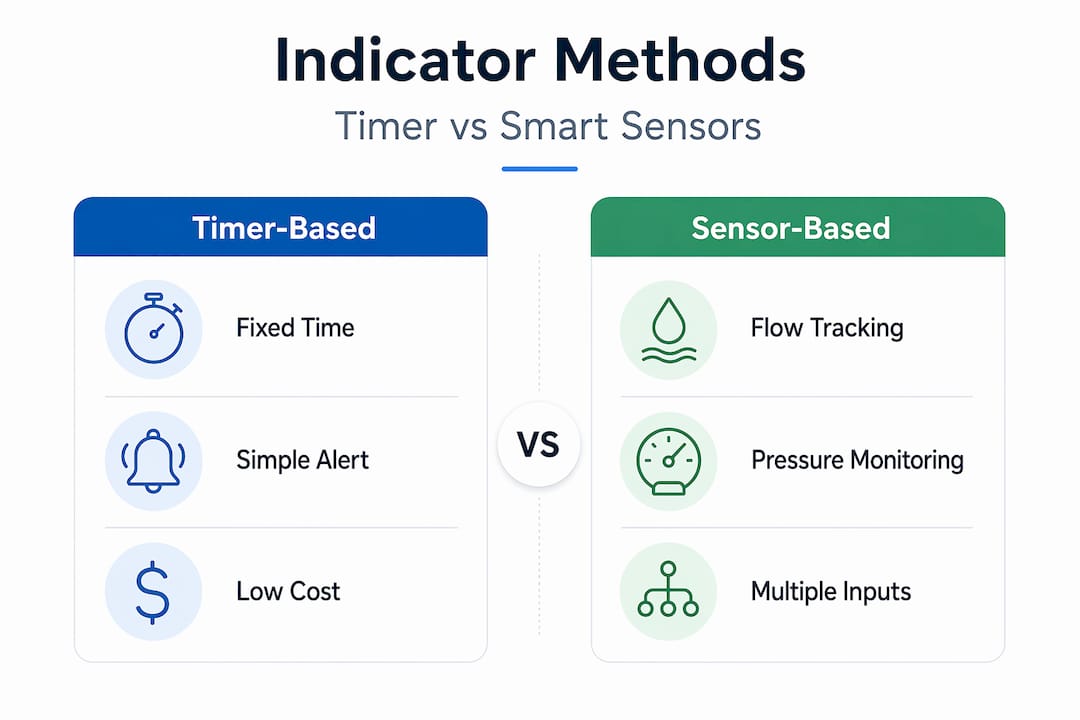
Combined sensor fusion systems provide the most reliable experience. They adapt to your actual water conditions and household patterns. For families with specific health concerns around water quality, or homes in areas with variable source water, combined systems justify their added cost quickly. The ability to review filter replacement triggers built into these systems helps you understand exactly why an alert fired.
Here is a quick breakdown of what suits different household needs:
- Light usage, consistent water quality: Timer-based indicators work reasonably well
- Variable household consumption: Flow-based sensors track reality more accurately
- High sediment or variable source water: Differential pressure monitoring adds critical protection
- Families prioritizing water safety and long system life: Sensor fusion systems offer the best overall reliability
Practical maintenance benefits and common misconceptions about filter indicator technology
Here is where homeowners most often get things wrong. The most common misconception is that a filter indicator measures water purity directly. It does not. It estimates filter exhaustion based on operational data. This distinction matters a lot in practice.
A filter can pass water that looks and tastes fine while the filtration media is saturated with contaminants it can no longer remove effectively. The indicator is there to alert you before that situation develops, not after. Many indicators prevent system operation once a filter is exhausted, protecting performance and appliance health. Some systems will reduce output flow, trigger a lockout, or sound repeated alarms because the engineers who designed them knew what an ignored alert can do to equipment and water quality alike.
The real-world benefits of acting on filter indicators consistently are significant:
- Maintained filtration performance. Filters at capacity allow contaminants to pass through, undermining the whole purpose of the system.
- Extended appliance lifespan. Clogged filters force pumps and pressure systems to work harder, accelerating mechanical wear.
- Reduced repair costs. Catching filter degradation early prevents damage that can cost far more than a replacement cartridge.
- Consistent water flow. A fresh filter provides steady pressure throughout your home’s filtration fixtures.
- Peace of mind. Knowing your indicator is functioning and responded to means your family’s water is as safe as the system can make it.
“A filter indicator is not a suggestion. It is a maintenance schedule built into your appliance by engineers who understand exactly how fast filter performance degrades. Ignoring it is the equivalent of driving well past your oil change light and hoping nothing breaks.”
Pro Tip: Every time you replace a filter, reset the indicator immediately and verify that it responds correctly. Some systems require a specific button hold sequence to register the reset. Skipping this step means your next alert cycle starts from the wrong baseline, making every future reading inaccurate. Review the importance of regular filter replacement to build a reliable maintenance habit.
How advanced filter indicators enhance family health and home water system reliability
The latest generation of filter indicator technology has moved well beyond a simple countdown timer. Two developments stand out as genuinely useful for families: RFID-based cartridge authentication and IoT sensor fusion.
Newer systems use RFID to authenticate filters, ensuring correct installation and preventing counterfeit use. This matters more than it sounds. A counterfeit or incompatible filter cartridge can fit physically into a housing while failing to filter contaminants properly. RFID authentication means the system checks whether the installed cartridge is a genuine, compatible filter before accepting it and starting the usage clock. If it fails verification, the indicator flags the problem immediately rather than letting an unsafe filter run silently.
IoT sensor fusion combines multiple sensor data locally for instant, reliable filter life alerts without cloud dependency. This local edge computing approach means alerts do not depend on an internet connection or remote server. The system processes flow, pressure, and water quality data on-device and issues alerts in real time. The practical benefit for families is that the information is always current and available, even during network outages.
| Advanced feature | How it protects your family | Practical benefit |
|---|---|---|
| RFID cartridge authentication | Verifies genuine filter installation | Prevents unsafe counterfeit filters |
| IoT sensor fusion | Combines multiple real-time data points | Most accurate replacement timing |
| Mobile app integration | Sends alerts to your phone | Easy monitoring without checking the unit |
| Edge computing processing | Works without cloud dependency | Reliable alerts regardless of internet connection |
These features collectively reduce the two biggest risks in home filtration maintenance: running filters too long and installing incompatible cartridges. Families with children, elderly members, or anyone with specific health concerns related to water quality benefit most from systems where the indicator technology leaves nothing to chance.
Why treating filter indicator technology as optional risks your home water safety
Here is the uncomfortable reality most articles avoid saying directly: the homeowners most likely to ignore filter indicator alerts are the same ones most likely to face equipment failures and degraded water quality. Not because they are careless, but because no one has framed filter indicators as the genuinely protective technology they are.
Filter indicator alerts are not the appliance asking for attention. They are the system telling you that a critical component is reaching the limit of its designed capacity. When you dismiss that alert, you are not just delaying maintenance. You are allowing the system to operate in a state its designers explicitly flagged as unsafe. Many indicators are designed to prevent system operation once filters are exhausted, protecting water quality and equipment. That design choice is telling. Engineers built lockout features specifically because they knew how often people would try to keep running an exhausted filter.
The smarter approach is to treat every filter alert the way you treat a low tire pressure warning: not as optional, but as time-sensitive information that protects something valuable. Verify that your indicator is functioning correctly during each filter change. Check the importance of regular filter replacement if you need a clear picture of what neglect actually costs over time.
Pro Tip: Schedule a quick monthly check of your filter indicator status. Set a phone reminder if needed. This 30-second habit catches sensor drift, missed resets, and filters that are consuming capacity faster than expected due to seasonal water quality changes.
Families who treat filter indicators as essential health tools, rather than optional reminders, consistently report better water quality outcomes and fewer appliance service calls. That is not a coincidence.
Explore advanced water filtration with Coway’s smart systems and indicator technology
If this article has made one thing clear, it is that the quality of your filter indicator technology directly affects the safety and reliability of your home water supply. Guesswork and ignored alerts are not a maintenance strategy.
Coway water purifiers are built with integrated filter indicator systems that take the guesswork out of maintenance entirely. From smart filtration systems by Coway that use sensor fusion for precise alerts, to RFID-verified cartridge authentication that confirms every filter change is genuine and correctly installed, Coway’s approach treats your family’s water safety as a non-negotiable. You can browse genuine Coway water filters designed for full compatibility with these indicator systems, and explore the complete water purification process guide to understand exactly how your system protects your household from source to glass.
Frequently asked questions
What exactly does filter indicator technology do in my water filtration system?
It tracks how much the filter has been used, usually by monitoring time, water flow, or pressure changes, and then alerts you when it’s time to clean or replace the filter. As filter indicator technology explains, these built-in systems track operational signals to keep your water safe and your system working at full capacity.
How does differential pressure monitoring improve filter change alerts?
It measures how much the filter physically resists water flow, and when clogging increases that resistance past a set threshold, the alert fires based on real conditions rather than an estimate. Differential pressure monitoring is more accurate than time-based tracking because it responds to what is actually happening inside your filter.
Why is it important not to ignore filter indicator alerts?
Ignoring alerts allows filters to operate past capacity, which reduces water quality and puts mechanical stress on your appliance. Some systems prevent operation entirely once a filter is exhausted, a design choice that reflects exactly how serious the consequences are.
What benefits do smart filter indicators with sensor fusion offer home users?
They combine flow, pressure, and water quality data locally to provide the most accurate replacement alerts available. IoT sensor fusion delivers these alerts in real time without cloud dependency, meaning your system stays reliable even when your internet connection does not.
How do RFID-based filter indicators help in home water filtration?
RFID sensors verify that the installed cartridge is genuine and correctly seated before the indicator cycle begins. Newer RFID systems prevent counterfeit or incompatible filters from running undetected, which keeps both your water quality and your indicator accuracy intact.
Recommended
- How to compare filtration technologies for safer home water – Coway Water Purifier
- Advanced Filtration Technology: Cleaner Home Wellness – Coway Water Purifier
- 7 Must-Have Filtration Technologies for Home Wellness – Coway Water Purifier
- Filter change indicators: clean water and air made simple – Coway Water Purifier
