
Uncategorized
Restaurant Hygiene Checklist for Operators: 2026 Guide
Jun
TL;DR:
- A restaurant hygiene checklist ensures compliance across critical areas like temperature control, employee hygiene, and pest prevention. Maintaining up-to-date, comprehensive documentation and a disciplined routine are essential for passing inspections and fostering a culture of safety. Regularly auditing and updating the checklist promotes ongoing quality, with clean water being a fundamental component supporting all sanitation efforts.
A restaurant hygiene checklist is the structured verification system that keeps your kitchen compliant, your customers safe, and your health inspection scores high. Without one, sanitation becomes reactive instead of systematic, and inspectors notice the difference immediately. Tools from PassMyKitchen, NCASS, and Toast POS confirm that operators who document hygiene practices consistently outperform those who rely on memory and habit. This guide breaks down every critical checklist category, from temperature control to pest prevention, so you can build a system that works every day, not just on inspection day.
1. What a restaurant hygiene checklist must cover
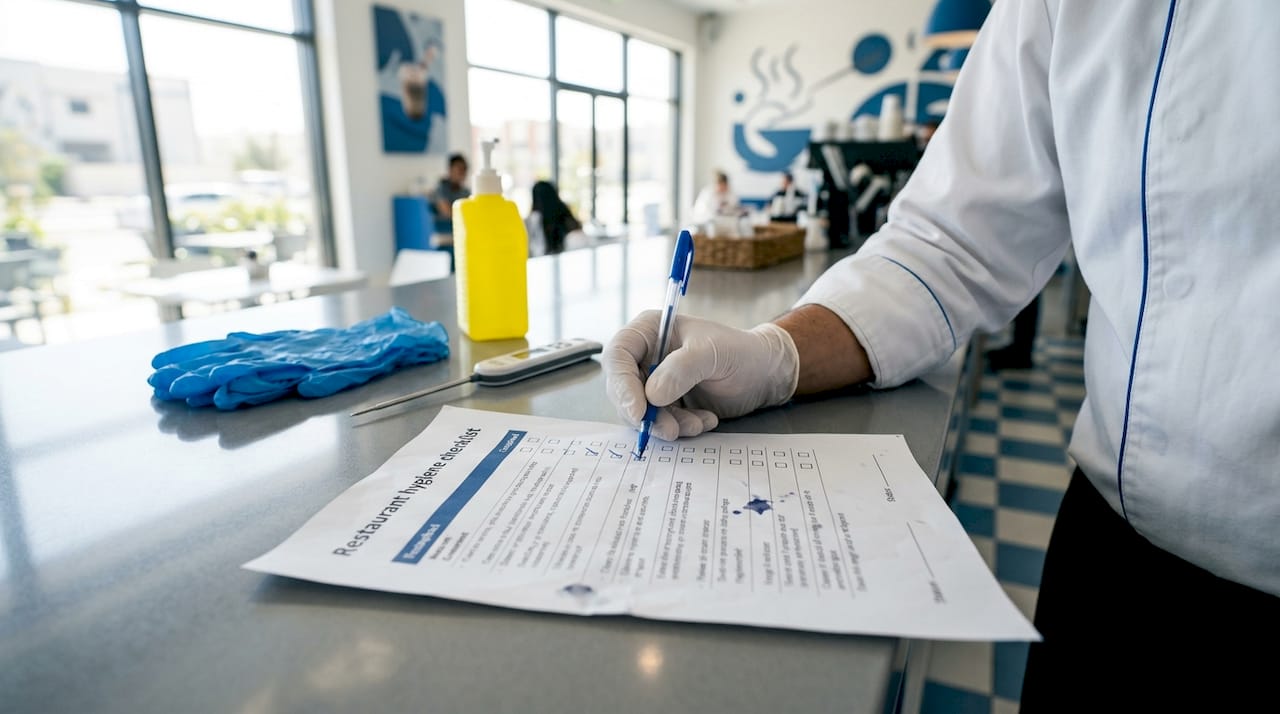
A well-structured checklist covers six core domains: food temperature and time control, employee hygiene, food handling and cross-contamination prevention, equipment condition, pest control, and documentation. Each domain maps directly to how health inspectors score your operation. Miss one area and you risk a critical violation that can trigger a re-inspection or temporary closure.
PassMyKitchen breaks these categories down explicitly because inspectors use the same framework when they walk through your door. The checklist is not a suggestion list. It is a mirror of the inspection scoring sheet. Operators who understand this alignment stop treating hygiene as a background task and start treating it as a daily operational standard.
2. Employee hygiene standards that inspectors verify
Handwashing is the single most scrutinized employee behavior during any food safety inspection. Proper technique requires wetting hands, applying soap, scrubbing for at least 20 seconds including under nails and between fingers, rinsing thoroughly, and drying with single-use paper towels. Inspectors check for this sequence at specific trigger points: before food prep, after handling raw meat, after using the restroom, and after handling money.
Your checklist should include a handwashing observation log, not just a reminder sign above the sink. Inspectors look for evidence that the technique is practiced, not just posted. Staff illness policies belong here too. Any employee with vomiting, diarrhea, jaundice, or a diagnosed foodborne illness must be excluded from food handling duties, and your checklist should document who reviewed these policies and when.
Pro Tip: Gloves do not replace handwashing. According to food safety guidance from Louis Pressbooks, both glove use and handwashing must be independently verified in your hygiene records. Inspectors check both.
3. Cross-contamination controls every operator needs
No bare-hand contact with ready-to-eat food is one of the most strictly enforced rules in any kitchen. Use gloves or utensils every time. A single violation in this category is often scored as critical, meaning it directly threatens public health and triggers mandatory corrective action on the spot.
Color-coded cutting boards and separate storage for raw proteins below ready-to-eat items are the two most practical controls you can implement today. Raw chicken goes on the bottom shelf, always. Produce and cooked foods go above. Your checklist should verify these storage positions daily, not assume staff remember the rule from their onboarding session.
Sanitizer concentrations matter just as much as physical separation. Chlorine-based sanitizers should hold between 50 and 100 parts per million. Quaternary ammonium compounds typically require 200 to 400 parts per million. Test strips belong in every prep station, and your checklist should include a concentration log for each sanitizing solution used during the shift.
4. How to organize your cleaning schedule for restaurants
Task frequency segmentation is the backbone of any effective cleaning schedule. Toast POS and industry operators consistently recommend dividing tasks into daily, weekly, and monthly categories, then assigning each task to a specific role and zone. When everyone knows what they own, nothing gets skipped.
Daily tasks cover the highest-contact surfaces: grill grates, fryer baskets, prep tables, cutting boards, floor drains, and all customer-facing surfaces in the dining room. Weekly tasks go deeper: hood filters, walk-in cooler shelving, ice machine interiors, and behind equipment that gets moved. Monthly tasks include full equipment pull-outs, grease trap inspections, and ceiling vent cleaning.
Pro Tip: Assign cleaning responsibilities by area and frequency, not just by job title. A master sanitation schedule that lists the task, the responsible person, and the completion date creates an evidence trail that impresses inspectors and holds staff accountable.
Here is a sample structure for your daily kitchen cleaning checklist:
- Wipe down and sanitize all prep surfaces before and after each use
- Clean and sanitize cutting boards after each protein type
- Empty and sanitize floor drains at the end of each shift
- Degrease and wipe down cooking equipment surfaces
- Sanitize all food contact equipment including slicers and mixers
- Clean and restock handwashing stations with soap and paper towels
- Remove trash and sanitize waste bins
- Sweep and mop all kitchen floors with an approved sanitizing solution
- Log all completed tasks with time and staff initials
5. Temperature control benchmarks for food safety compliance
Cold holding requires temperatures at or below 41°F and hot holding requires temperatures at or above 135°F. The range between those two numbers is the bacterial growth danger zone, where pathogens like Salmonella and E. coli multiply fastest. Every minute food spends in that zone without time controls in place is a compliance risk and a public health risk.
Your checklist should include temperature logs for every refrigeration unit, every hot holding unit, and every food item that passes through the danger zone during prep. Probe thermometers must be calibrated regularly and available at every station. Inspectors will ask to see both the equipment and the logs.
| Food type | Minimum internal cooking temperature |
|---|---|
| Poultry (chicken, turkey, duck) | 165°F for 15 seconds |
| Ground beef and pork | 155°F for 15 seconds |
| Whole cuts of beef, pork, lamb | 145°F for 15 seconds |
| Fish and seafood | 145°F for 15 seconds |
| Eggs for immediate service | 145°F for 15 seconds |
| Reheated foods for hot holding | 165°F within 2 hours |
Cooling procedures follow a strict two-stage timeline. Food must cool from 135°F to 70°F within 2 hours, then from 70°F to 41°F within 4 additional hours. That six-hour total window is a model food code standard, and exceeding it means the food must be discarded. Ice baths, blast chillers, and shallow pan storage all accelerate this process. Your checklist should document the start temperature, the two-hour checkpoint, and the final temperature for every batch of food that goes through the cooling process.
Using temperature and time as critical gates during preparation, not just at the end, is what separates operators who pass inspections from those who scramble to explain violations.
6. Documentation and inspection readiness
Health inspectors expect a clear evidence trail built from signed and dated food safety plans, temperature logs, cleaning records, and staff training certifications. Procedures that exist only in staff members’ heads are a liability. If you cannot show the paperwork, the inspector assumes the practice does not exist.
Your documentation checklist should include:
- Signed food safety management system with named responsible person
- Allergen information table updated for every menu item
- Temperature logs for all refrigeration and hot holding units
- Cleaning and sanitation records with dates and initials
- Staff health and illness policy acknowledgment forms
- Training certificates for food handler and food manager certifications
- Valid health permits and business licenses displayed prominently
- Pest control service records and contractor contact information
NCASS inspection scoring systems evaluate both observable hygiene practices and management confidence. That second category, confidence in management, is scored entirely through documentation. A spotless kitchen with no paperwork will still score lower than a well-documented operation. Treat your records as part of the kitchen, not as an afterthought.
Pro Tip: Keep a dedicated inspection binder at the manager’s station with all required documents organized by category. When an inspector arrives, hand them the binder immediately. It signals competence before they take a single step into your kitchen.
Key takeaways
A restaurant hygiene checklist works only when it covers temperature control, employee hygiene, cross-contamination prevention, cleaning schedules, and documentation as a unified system, not as separate tasks.
| Point | Details |
|---|---|
| Temperature control is non-negotiable | Cold hold at or below 41°F and hot hold at or above 135°F, and log every reading. |
| Documentation equals inspection scores | Signed plans, cleaning logs, and training records directly raise your hygiene rating. |
| Cleaning schedules need ownership | Assign every task to a specific person and zone to prevent gaps in sanitation. |
| Handwashing requires verification | Observation logs and technique training matter more than reminder signs alone. |
| Cross-contamination rules are critical violations | No bare-hand contact with ready-to-eat food and correct sanitizer concentrations are non-negotiable. |
Why most operators underestimate their checklist
I have reviewed enough kitchen operations to say this plainly: most restaurant owners treat their hygiene checklist as a one-time setup task rather than a living operational document. They create it before opening, laminate it, and never update it again. That is where the real inspection failures come from.
The operators I have seen consistently pass inspections with high scores share one habit. They treat the checklist as a daily conversation between management and staff, not as a wall decoration. They review it at the start of each shift, update it when menu items or processes change, and use it to train new hires from day one. The checklist becomes the culture, not a compliance exercise.
Pest control is the most overlooked section in almost every operator-built checklist I have seen. Pest infestations and unsanitary kitchens are among the most common triggers for enforcement action and closure. Yet most operators schedule pest control quarterly and forget about it between visits. Weekly checks of entry points, drains, and storage areas take ten minutes and prevent the kind of violation that makes the news.
Digital checklists have real advantages over paper. They create automatic timestamps, send completion alerts to managers, and generate reports that are ready for inspectors on demand. But the format matters less than the discipline. A paper checklist completed honestly every day beats a digital system that gets rubber-stamped.
My honest recommendation: audit your current checklist against the six core domains from PassMyKitchen and the documentation requirements from NCASS. If any domain is missing or vague, fix it this week. Do not wait for an inspector to find the gap for you.
— Soldierboy
Clean water is part of your hygiene system too
Every cleaning task on your restaurant hygiene checklist depends on one resource that operators rarely audit: the water itself. Contaminated or poorly filtered water compromises sanitizer effectiveness, affects ice quality, and introduces risks that no cleaning schedule can fix downstream. Cowayswaterpurifier offers water purification systems built for food service environments, including UV sanitization and multi-stage filtration that meet the standards your operation demands. Explore how filtration supports food service safety and what the right system looks like for your kitchen. Clean water is not a bonus feature. It is a foundation of every sanitation standard you are already working to meet.
FAQ
What is a restaurant hygiene checklist?
A restaurant hygiene checklist is a structured document that verifies compliance across food temperature control, employee hygiene, cross-contamination prevention, equipment sanitation, pest control, and documentation. It mirrors the scoring framework health inspectors use during official food safety inspections.
How often should a restaurant cleaning schedule be completed?
Daily tasks cover high-contact surfaces and food prep areas, weekly tasks address equipment interiors and storage zones, and monthly tasks include deep cleaning and grease trap inspections. Toast POS recommends assigning each task by frequency, zone, and responsible staff member to maintain consistency.
What temperature must food be held at to stay safe?
Cold foods must be held at or below 41°F and hot foods at or above 135°F to stay outside the bacterial growth danger zone. Any food held between those temperatures without time controls in place is a compliance violation and a health risk.
What documentation do health inspectors require?
Inspectors expect signed food safety management plans, allergen tables, temperature logs, cleaning records, staff health policy acknowledgments, training certifications, and valid permits displayed on-site. NCASS confirms that documentation quality directly affects your overall hygiene inspection score.
Does wearing gloves replace handwashing in a restaurant?
No. Gloves and handwashing are independent requirements that must both be verified in your hygiene records. Food safety standards require proper handwashing technique before gloves are applied and whenever gloves are changed or removed.
Recommended
- Office Water Safety Checklist 2026: 70% Fewer Risks – Coway Water Purifier
- Filtration in hospitality: safety, quality, and guest satisfaction – Coway Water Purifier
- Touchless water dispensers: key advantages for health – Coway Water Purifier
- Role of Filtration in Food Service – Impact on Safety and Quality – Coway Water Purifier
