
Uncategorized
The Role of Scientific Research in Water Safety

May
TL;DR:
- Scientific research underpins risk frameworks, contaminant thresholds, and treatment standards essential for water safety. It informs tools like QMRA and guides policies through evidence-based assessment and monitoring, bridging knowledge gaps between science and practice. Implementing structured Water Safety Plans ensures research findings translate into operational accountability, preventing episodic failures and safeguarding public health.
Water safety is not simply a matter of testing a sample and declaring it clean. The role of scientific research in water safety spans risk modeling, contaminant surveillance, outbreak investigation, and the translation of findings into enforceable policy. For researchers, environmental scientists, and policymakers, understanding how these layers interact is not background knowledge. It is the operational foundation for every intervention decision made across a water system. This article maps the scientific frameworks, applied case studies, assessment tools, and policy mechanisms that define modern water safety management.
Key Takeaways
| Point | Details |
|---|---|
| Research drives risk frameworks | WHO’s risk-based water safety approach depends on layered scientific evidence, not single sampling events. |
| Applied studies change outcomes | Field research on norovirus and PFAS contamination has directly guided containment and monitoring interventions. |
| Evidence gaps create policy risk | Fragmented evidence on chronic multi-contaminant effects limits policymakers’ ability to set defensible standards. |
| Operational design matters as much as data | Documented monitoring roles, sampling regimes, and escalation triggers determine whether science reaches practice. |
| Assessment tools are research-derived | QMRA and Water Safety Plans translate scientific uncertainty into structured, quantified decision-making tools. |
The role of scientific research in water safety frameworks
The most consequential scientific contribution to water safety is not a single study. It is a framework. WHO’s risk-based approach integrates hazard identification, risk assessment, management, and verification across the full water system, from catchment to consumer. Each step in that chain depends on accumulated scientific evidence to define what constitutes a hazard, what concentrations trigger risk, and what treatment barriers reduce that risk to acceptable levels.

Quantitative microbial risk assessment, known as QMRA, sits at the center of modern water safety science. QMRA converts pathogen concentration data and treatment performance measurements into quantified infection risk estimates that regulators and water managers can act on. A drought scenario study in Southern Nevada demonstrated exactly how this works: researchers estimated a median cumulative gastrointestinal infection risk of 10^−4.59 per person per year, with Cryptosporidium identified as the primary driver. That number is not just a data point. It tells water managers whether a specific operational condition stays within or breaches annual safety benchmarks.
QMRA calibration requires more than pathogen counts. The same Southern Nevada study identified a log-reduction value gap of 1.97 during treatment barrier calibration, revealing how crediting gaps in treatment performance can materially shift infection risk outputs and, by extension, regulatory confidence in the treatment train. That sensitivity analysis is exactly the kind of nuance that separates rigorous water safety science from routine monitoring.
- Define the hazard and its source within the catchment.
- Quantify risk using pathogen dose-response data and treatment log-reduction values.
- Set management targets based on acceptable annual risk thresholds.
- Verify performance through operational monitoring tied to those targets.
- Revise the model when new scientific evidence changes any input parameter.
Pro Tip: When building a QMRA model, treat your log-reduction value inputs as hypotheses, not fixed constants. Calibrate them against observed pathogen concentrations in treated water rather than assuming design specifications reflect real-world performance.
Applied research that changed real-world water safety outcomes
Scientific studies on water quality are most persuasive when they connect directly to measurable health outcomes. Three recent examples show what that looks like in practice.
-
Norovirus outbreak investigation, China (2024): Field researchers detected norovirus GII.9 in both clinical samples and water samples, confirming 100% nucleotide sequence identity between isolates. Targeted intervention following that finding reduced case numbers. Without integrated environmental and clinical surveillance running simultaneously, the source would have taken far longer to confirm and the outbreak would have spread further.
-
Blue-green infrastructure and urban recreational water: Hydrologic modeling combined with QMRA showed that blue-green infrastructure reduced Cryptosporidium risk in urban recreational waters by 0.4 to 0.6 log10, with the greatest benefit occurring during summer when recreational exposure peaks. That research outcome directly informed urban planning decisions about where and when to deploy natural water management infrastructure.
-
PFAS monitoring in New Jersey river systems: A USGS study tested for 40 PFAS compounds across multiple river sites and detected 15 at least once, with PFOA and PFOS present in nearly every sample. Concentration peaks correlated with base-flow conditions driven by seasonal hydrology. That spatial-temporal pattern is information a water manager cannot derive from a single sampling event.
“Integrated environmental and clinical surveillance transforms water safety investigation from reactive reporting into prospective risk reduction. The norovirus case demonstrates that the speed of scientific confirmation directly determines the scale of a public health response.”
The PFAS findings deserve particular attention from policy audiences. Detection alone is not sufficient for decision-making. Sampling design that captures seasonal variability is a prerequisite for source control, because a sample taken during high-flow conditions will consistently underestimate base-flow concentrations where PFAS accumulates. Designing around that variability is a research question, not just a monitoring logistics question.
You can also explore how research findings intersect with practical chemical contamination management in operational water contexts.
Translating research into policy and operations
The importance of research in water safety only materializes when findings move from journals into operating procedures. That transition is harder than it looks. An umbrella review examining unsafe drinking water and health outcomes found that most existing meta-analyses focus on single pollutants with single outcomes. Evidence on chronic health effects from multiple co-occurring contaminants remains thin. Intervention effectiveness is better documented than risk attribution, which creates an asymmetry: policymakers can justify spending on interventions that demonstrably work, but they cannot always explain precisely which contaminant combinations are driving the health burden they are trying to address.
| Challenge | Current state | What research needs to deliver |
|---|---|---|
| Multi-contaminant evidence | Single-pollutant focus dominates | Integrated multi-exposure health models |
| Chronic health outcomes | Limited long-term study data | Longitudinal cohort designs with water quality linkage |
| Emerging contaminants | Detection methods outpace health evidence | Dose-response research for novel compounds |
| Seasonal variability | Often unaccounted for in sampling | Temporally stratified monitoring protocols |
| Operational adoption | Research findings rarely encoded in procedures | Structured WSP modules with escalation triggers |
The IWA Water Safety Plan manual addresses the operational adoption problem directly. Its modular structure gives water managers risk assessment tables, improvement plans, and monitoring protocols that document responsibilities, sampling regimes, and escalation triggers. This architecture turns scientific evidence into operational accountability, which is the mechanism by which research actually changes what happens at a treatment plant or distribution system.
Pro Tip: When reviewing a Water Safety Plan for compliance, check whether the operational monitoring triggers are derived from the risk assessment outputs rather than default industry averages. A plan where thresholds are not traceable to site-specific risk evidence is not functioning as a scientific document.
Understanding water safety standards in practice helps connect these frameworks to the regulatory requirements that policymakers work within.
Assessment methods derived from scientific research
Water safety assessment methods have evolved considerably beyond grab-sample compliance testing. The field now draws on a layered toolkit where each method addresses a different type of uncertainty.
- QMRA modeling: Starts with pathogen occurrence data in source water, applies treatment log-reduction values, and outputs infection risk per person per year. The model explicitly accounts for uncertainty in each input, which makes the output a probabilistic range rather than a single number.
- Water Safety Planning: The IWA WSP framework structures the assessment process across the full supply chain, with documented improvement plans and compliance monitoring linked directly to risk outputs.
- Spatial-temporal chemical sampling: Particularly relevant for emerging contaminants like PFAS, this approach designs sampling events around catchment hydrology rather than fixed calendar intervals. It generates data that reflects actual concentration variability.
- Integrated environmental and clinical surveillance: Combines water sample analysis with clinical case data to detect outbreaks faster and confirm waterborne transmission pathways.
- Citizen science and sensor networks: Emerging approaches that extend monitoring coverage at lower cost, though their outputs require validation through research before integration into risk models.
| Method | Primary application | Key limitation |
|---|---|---|
| QMRA | Microbial risk quantification | Sensitive to LRV calibration accuracy |
| Water Safety Planning | System-wide risk management | Requires organizational commitment to update |
| Spatial-temporal sampling | Chemical contaminant monitoring | Resource-intensive design and analysis |
| Environmental-clinical surveillance | Outbreak detection and attribution | Requires cross-sector data sharing |
| Sensor-based monitoring | Real-time operational alerts | Validation gaps for novel parameters |
Policy implications and future directions
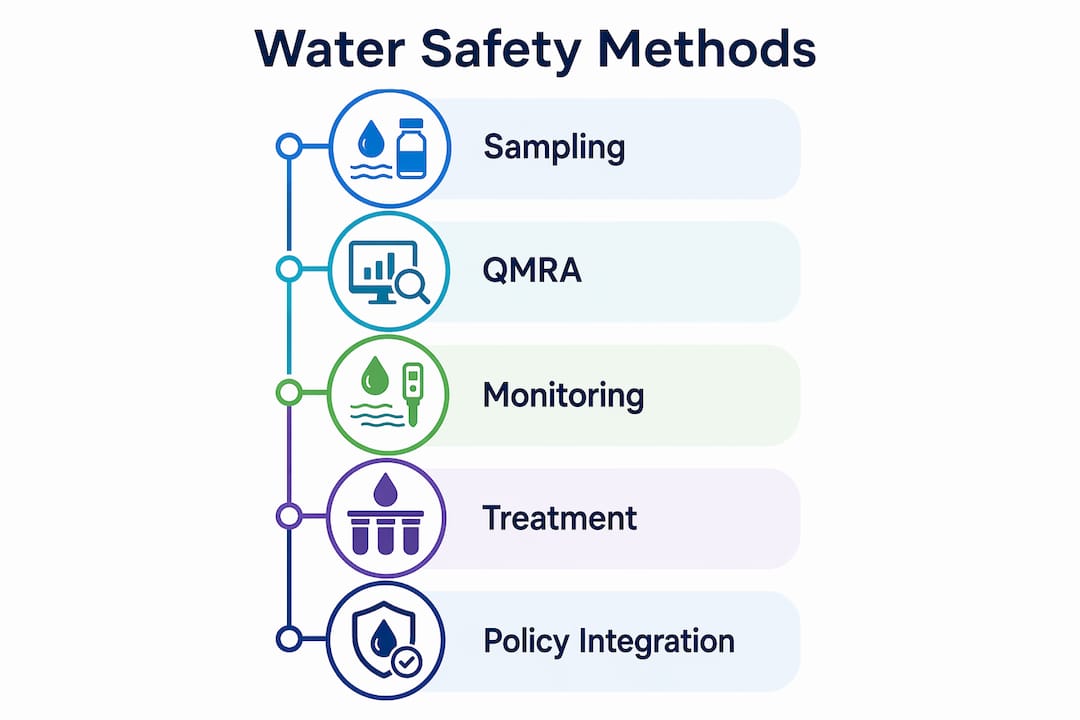
The impact of research on water security at the policy level is clearest when scientific synthesis informs standard-setting rather than individual studies doing so. WHO’s repeated emphasis on risk-based water safety plans over single-parameter testing reflects a synthesis of decades of field evidence showing that end-point testing misses the failure modes that actually cause outbreaks.
Several directions stand out for researchers and policymakers looking ahead:
- Scaling proven interventions: The umbrella review supports scaling interventions with demonstrated effectiveness even where risk attribution remains uncertain. Waiting for perfect epidemiological attribution before acting is a policy choice with real public health costs.
- Better monitoring design standards: Regulatory frameworks need to encode temporal and spatial sampling requirements for emerging contaminants rather than leaving design decisions to individual utilities.
- Interdisciplinary evidence synthesis: The gap between single-pollutant meta-analyses and real-world multi-contaminant exposures will not close without methodological investment in complex exposure modeling.
- Translating science into accessible tools: Policymakers and water managers need synthesis products, not just published studies. The IWA WSP manual is a model for what that translation looks like in practice.
- Emerging contaminant research pipelines: For compounds like PFAS, the detection science is ahead of the health evidence. Building dose-response research for novel contaminants must become a funded priority before regulatory action falls further behind contamination patterns. Connecting PFAS compliance implications to source control research is a practical starting point for water quality professionals navigating current regulatory gaps.
My perspective on bridging research and water safety practice
I’ve spent considerable time working at the intersection of water safety science and operational management, and the pattern I keep seeing is the same: the research exists, the frameworks exist, and the gap is almost always in implementation accountability.
The field has convinced itself that publishing better evidence will change practice. It rarely does on its own. What actually changes practice is embedding that evidence in documents that operators are obligated to follow, with specific triggers and named responsibilities. The IWA WSP manual gets this right. Most water safety research does not get this far.
I’ve also seen the single-sample testing trap close around otherwise capable water managers. They run their compliance tests, they pass, and they conclude the system is safe. What they miss is that compliance sampling is designed to detect chronic, widespread contamination, not emerging or episodic events. The norovirus outbreak research makes this concrete: the outbreak was underway before any compliance monitoring would have flagged it. Integrated surveillance caught it.
My honest advice to researchers who want their work to matter: design your study outputs with the IWA WSP module structure in mind from the start. If your findings cannot be translated directly into a risk table, a monitoring trigger, or a treatment target, policymakers will admire your work and file it. The science of water safety is mature enough that the next frontier is not more data. It is better translation.
— Soldierboy
How Coway water purifiers connect to water safety science
Scientific research on water safety sets the standards that filtration technologies must meet. At Cowayswaterpurifier, the purification systems are built around the same principles that research-backed frameworks use: multi-barrier treatment, validated log-reduction performance, and UV sanitization as a documented microbial control layer. Understanding how purification technologies work shows exactly where each stage maps to the contaminant categories that field research has identified as priority concerns, from Cryptosporidium and norovirus to chemical co-contaminants.
For researchers and environmental scientists evaluating point-of-use treatment as a complementary layer to system-level water safety management, Coway’s UV sanitization technology and multi-stage filtration systems offer a practical application of the same science that informs QMRA treatment barrier analysis. The research is clear that no single barrier is sufficient. Cowayswaterpurifier builds that principle directly into its product architecture.
FAQ
What is the role of scientific research in water safety?
Scientific research defines the risk frameworks, contaminant thresholds, and treatment performance standards that make water safety management evidence-based rather than assumption-based. It supplies the data inputs for tools like QMRA and informs the WHO and IWA frameworks used globally.
How does QMRA improve water safety decisions?
QMRA converts pathogen concentration and treatment performance data into probabilistic infection risk estimates, allowing water managers to evaluate whether operational conditions meet annual safety benchmarks rather than relying on pass/fail compliance tests alone.
Why is single-parameter water testing insufficient?
Single-parameter testing detects chronic, widespread contamination but misses episodic events and emerging contaminants. WHO’s guidance consistently emphasizes risk-based, system-wide approaches because outbreak investigations, including the 2024 norovirus case, show that integrated surveillance detects failures that compliance sampling misses.
What are the biggest gaps in current water safety science?
The primary gaps involve multi-contaminant chronic health effects and emerging compound dose-response data. Most existing meta-analyses focus on single pollutants, leaving policymakers without defensible evidence for standard-setting across complex real-world exposure scenarios.
How does a Water Safety Plan translate research into operations?
A Water Safety Plan uses modular risk assessment tables, documented monitoring protocols, and escalation triggers to convert scientific evidence into operational accountability. The IWA WSP manual provides the template that links risk outputs directly to the procedures water system operators must follow.
Recommended
- Water safety standards explained for healthier homes – Coway Water Purifier
- Essential Water Safety Tips for Families in 2026 – Coway Water Purifier
- Your step-by-step guide to household water safety – Coway Water Purifier
- Improve Drinking Water Safety: Essential Steps for Families – Coway Water Purifier
