
Uncategorized
Office Wellness via Air Quality: Healthier Workplaces

Feb
Poor air quality in the workplace often goes unnoticed until employees start reporting headaches, fatigue, or discomfort. For American office managers focused on wellness, setting the right air standards is more than a compliance checklist. It is about building a healthy environment where your team can thrive. This guide clarifies how different agencies and best practices define office air quality standards and what actionable steps you should consider to protect your team’s health.
Table of Contents
- Defining Office Air Quality Standards
- Common Indoor Pollutants And Health Risks
- Air Purification Technologies For Offices
- Hybrid Workspaces And Air Quality Management
- Legal Requirements And OSHA Compliance
Key Takeaways
| Point | Details |
|---|---|
| Office Air Quality Standards | Office air quality is influenced by various regulations, notably from the EPA and OSHA, which does not have specific standards for indoor air. |
| Key Pillars of Acceptable Air | Maintaining proper ventilation, controlling pollutants, and ensuring occupant comfort are essential for establishing healthy office air quality. |
| Pollutant Sources and Health Risks | Common pollutants like VOCs and particulate matter can lead to both immediate discomfort and long-term health complications for employees. |
| Hybrid Work Considerations | Managing air quality in hybrid work environments is vital, requiring attention to both office and home conditions to ensure employee wellness. |
Defining Office Air Quality Standards
Office air quality standards don’t exist in a single rulebook. Instead, they emerge from multiple sources, each addressing different aspects of workplace air safety and occupant comfort.
The foundation starts with the EPA’s National Ambient Air Quality Standards, which set limits for outdoor pollutants like ozone, particulate matter, and carbon monoxide. While these standards focus on outdoor air, offices use them as a reference point for managing indoor environments and ensuring compliance with health regulations.
OSHA takes a different approach. The agency doesn’t publish specific indoor air quality standards for offices, but its General Duty Clause requires employers to provide workplaces free from recognized hazards, including poor air quality. This means you’re responsible for maintaining acceptable air conditions even without a detailed checklist.
What Defines Acceptable Office Air
Acceptable office air quality rests on three key pillars:
- Proper ventilation ensures fresh air circulation and removes stale air
- Pollutant source control limits dust, chemicals, and other contaminants at their origin
- Occupant comfort balances temperature, humidity, and air movement
Ventilation is where most offices struggle. Building codes require specific air exchange rates, but older systems often fail to meet current standards. You need to verify your HVAC system delivers adequate fresh air while filtering recirculated air effectively.
Your ventilation system should deliver outdoor air at rates specified by building codes, typically 15-20 cubic feet per minute per occupant in office spaces.
State regulations add another layer. California and New Jersey have established their own indoor air quality rules that exceed federal minimums. If your office operates in these states, you’ll need to meet stricter requirements. Check with your local building department to confirm what applies to your facility.
Common office pollutants include volatile organic compounds (VOCs) from furniture and cleaning products, particulate matter from outdoor air entering through doors and windows, and carbon dioxide from occupant density. Each requires different control strategies.
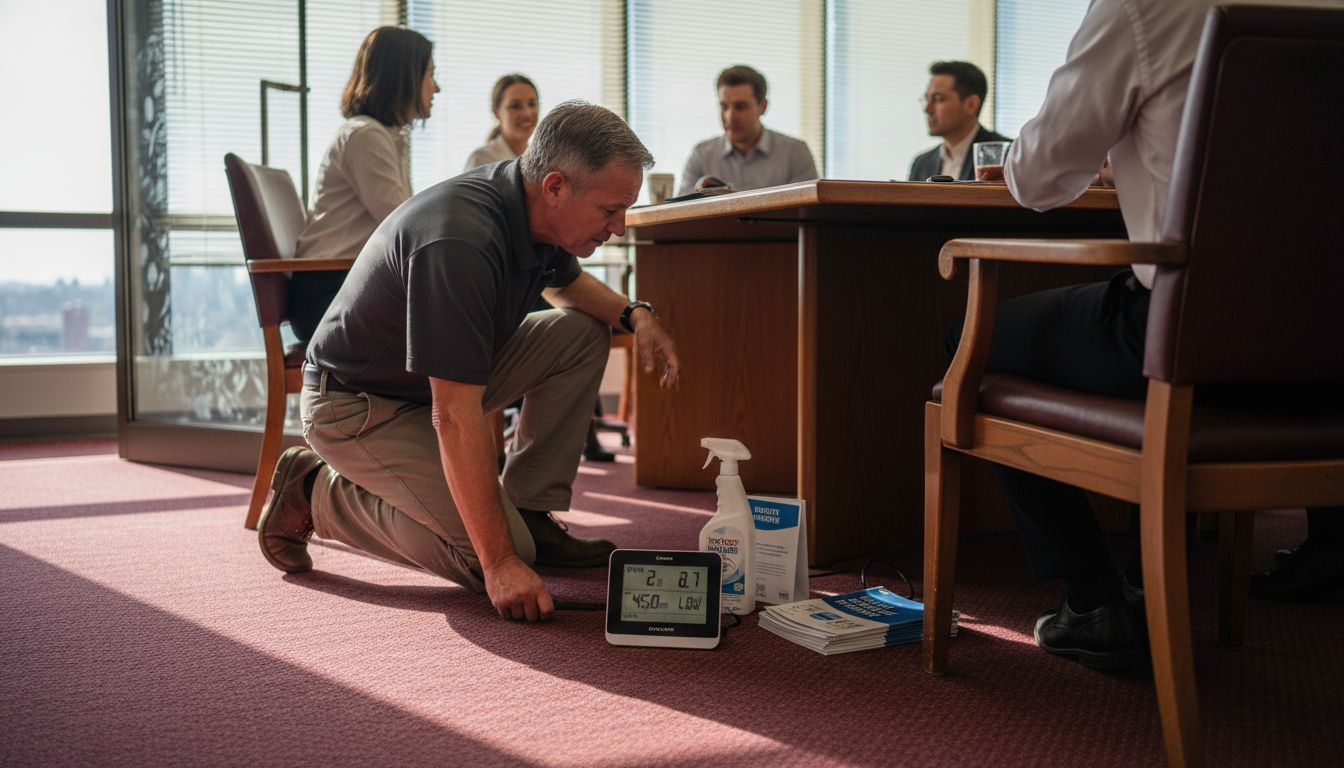
The air quality you need depends on your office type. Open-plan offices with dense occupancy need more aggressive filtration than smaller, quieter spaces. Conference rooms, break areas, and reception zones may need different standards based on usage patterns.
Practical Standards to Implement
While you wait for formal regulations, these practical benchmarks guide most modern offices:
- Carbon dioxide levels below 1,000 ppm (parts per million) in occupied spaces
- Particulate matter (PM2.5) under 35 micrograms per cubic meter annually
- Relative humidity between 30-60 percent
- Regular HVAC filter changes every 1-3 months depending on system type
- Annual air quality testing in facilities with more than 50 occupants
You don’t need expensive equipment to start. Basic air quality monitors measure CO2, temperature, and humidity for under $300. These reveal problem areas quickly and help you prioritize improvements.
Pro tip: Establish a baseline by measuring your current air quality with a portable monitor in different zones during occupied and unoccupied hours, then use that data to justify ventilation upgrades to leadership.
Common Indoor Pollutants and Health Risks
Your office air contains invisible threats that most people never think about. The pollutants floating around can cause immediate discomfort or long-term health damage, depending on exposure and concentration levels.
Americans spend roughly 90% of their time indoors, where pollutant concentrations can be 2 to 5 times higher than outdoor levels. This makes indoor air quality a serious concern for office managers responsible for employee wellness.
The Main Culprits
Common office pollutants fall into several categories:
- Combustion byproducts like carbon monoxide and particulate matter from vehicle exhaust, gas stoves, or fireplaces
- Volatile organic compounds (VOCs) released from furniture, paint, carpet, and cleaning products
- Mold and mildew thriving in humid areas or poorly ventilated spaces
- Radon seeping up from soil through foundation cracks
- Allergens including dust mites, pet dander, and pollen entering from outside
- Pesticides from landscaping or facility treatments
VOCs are especially problematic in modern offices. New furniture, fresh paint, and cleaning chemicals all emit organic compounds that irritate airways and trigger headaches. Open-plan offices amplify this effect since pollutants spread quickly across larger spaces.
Here’s a quick reference to major indoor pollutants and their primary workplace sources:
| Pollutant Type | Common Sources | Typical Office Impact |
|---|---|---|
| Combustion Byproducts | Vehicle exhaust, gas stoves | Headaches, reduced productivity |
| VOCs | Furniture, cleaning products | Airway irritation, headaches |
| Mold & Mildew | Humid areas, leaks | Allergies, respiratory issues |
| Radon | Soil, foundation cracks | Increased cancer risk |
| Allergens | Dust mites, pollen | Sneezing, asthma triggers |
| Pesticides | Landscaping treatments | Skin irritation, dizziness |
Health Impacts You Should Know
Short-term exposure to poor indoor air quality causes immediate symptoms that employees notice and report.
These include headaches, dry throat, irritated eyes, and difficulty concentrating. Employees might blame fatigue or stress when the real culprit is the air they’re breathing.
Long-term exposure presents serious risks. Respiratory and cardiovascular diseases are the most common outcomes from sustained indoor air pollution. Vulnerable populations including people with asthma, heart conditions, or compromised immune systems face disproportionate risk.
Chronic exposure to poor indoor air can contribute to asthma development, cardiovascular disease, and even cancer in extreme cases. These conditions don’t develop overnight, but weeks and months of exposure accumulate damage.
Offices with poor air quality experience measurably higher rates of sick days, reduced productivity, and employee complaints about workspace comfort.
Why Your Office Matters
Open-plan offices concentrate these risks. More people sharing the same air means pollutants accumulate faster and spread wider. Corner offices with windows and better ventilation don’t face the same exposure as central workspace areas.
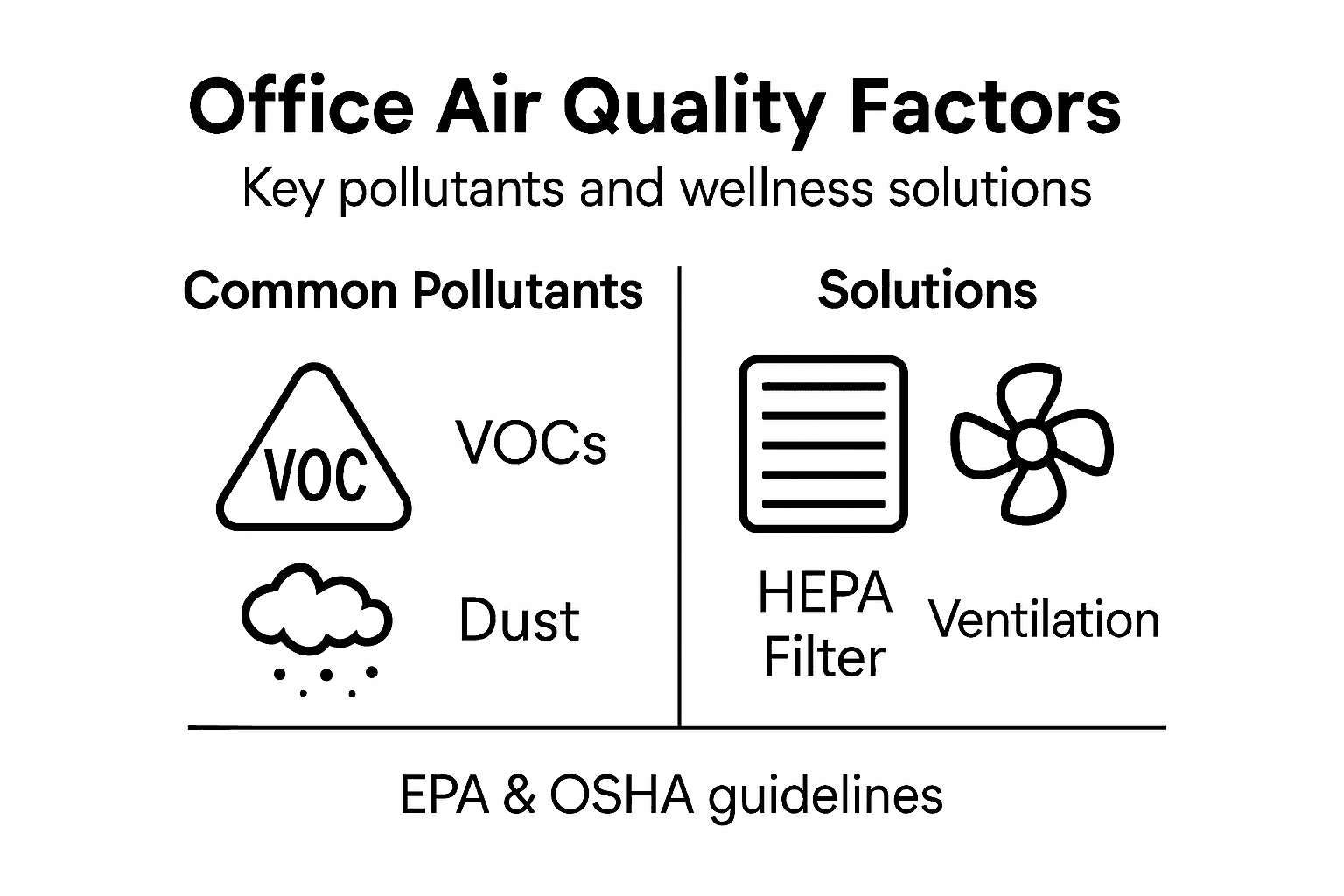
High-density areas like break rooms, conference rooms during meetings, and reception areas where outside air enters all present elevated pollutant levels. These spaces need special attention.
The solution requires multiple approaches. Source control, filtration technology, and ventilation improvements work together to reduce exposure. Single approaches fail because pollutants come from different sources requiring different mitigation strategies.
Pro tip: Track employee health complaints by location using your workplace incident reports, then cross-reference high-complaint areas with air quality measurements to identify which spaces need priority improvements.
Air Purification Technologies for Offices
Putting the right technology in place makes a real difference in office air quality. Modern purification systems work in multiple ways, so understanding your options helps you choose what fits your space and budget.
The foundation of any good air strategy involves upgrading your filtration. Standard HVAC filters capture large particles, but they miss the smaller contaminants that cause health problems. Upgrading to MERV-13 filters or higher removes significantly more airborne particles without restricting airflow too much.
Key Technologies to Consider
Several proven purification approaches work well in office environments:
- HEPA filtration captures 99.97% of particles 0.3 microns and larger, removing allergens and fine dust
- Carbon filters absorb odors and volatile organic compounds from furniture and cleaning products
- Germicidal ultraviolet (GUV) light inactivates viruses and pathogens using ultraviolet technology
- Portable air purifiers target specific zones where pollution concentrates
- HVAC-integrated systems treat all air moving through your building’s duct network
HEPA filtration works brilliantly for trapping particulate matter. It’s the gold standard for allergies and respiratory protection. However, HEPA alone won’t address odors or chemical vapors, so pairing it with carbon filters creates a more complete solution.
Germicidal ultraviolet systems offer something different. They use UV light to damage pathogen DNA, preventing viral and bacterial reproduction. These systems can install in ducts or upper-room fixtures, making them flexible for existing buildings.
For decision-makers, here’s how common office air purification technologies compare:
| Technology | Main Benefit | Typical Location | Key Limitation |
|---|---|---|---|
| HEPA Filters | Removes fine particles | HVAC, portable units | Does not remove gases and odors |
| Carbon Filters | Reduces VOCs & odors | Portable units | Limited particle removal |
| UV Systems | Inactivates pathogens | HVAC ducts, fixtures | No effect on particulates |
| Portable Purifiers | Flexible zone-based cleaning | Conference rooms | Limited coverage area |
Portable vs. Integrated Solutions
You don’t need to choose just one approach. Many offices use both.
Portable air purifiers work fast for high-traffic areas like conference rooms and break rooms. They’re easier to maintain than building-wide systems and let you address problem spots immediately. Desktop and floor-standing units provide flexibility.
Integrated HVAC systems clean all air circulating through your building. They require professional installation but provide comprehensive coverage without taking up floor space. These work best when paired with proper ventilation rates.
Professional maintenance is critical for maximizing purification benefits and safety—dirty filters reduce effectiveness and can become contamination sources themselves.
Implementation Strategy
Start by testing your current air quality to identify problem areas. High-pollutant zones need treatment first.
Then prioritize based on occupancy and health sensitivity. Conference rooms with poor ventilation, open-plan areas with high density, and spaces housing employees with respiratory conditions all warrant priority upgrades.
Budget matters, so phase your improvements. Begin with upgraded HVAC filters and portable systems in critical zones. Add integrated solutions as budget allows.
Pro tip: Document your baseline air quality measurements before implementing any technology, then retest monthly for the first three months to demonstrate improvement and justify continued investment to leadership.
Hybrid Workspaces and Air Quality Management
Hybrid work has created a new air quality challenge that most offices didn’t anticipate. Your employees now spend time in multiple environments, and you’re responsible for managing air quality across both office and home settings.
The problem is real. Home offices often lack professional ventilation systems and pollutant controls. When your team splits time between home and office, inconsistent air quality affects their health and productivity. This fragmented exposure actually increases overall risk because gaps exist in protection.
The Hybrid Challenge
Traditional office air quality strategies assumed everyone worked in the same building five days a week. Hybrid models shattered that assumption.
Now you’re managing air quality for:
- Office spaces with variable occupancy (fewer people on certain days)
- Home offices with unpredictable pollutant sources and ventilation
- Transition zones where employees move between environments
- Shared spaces like conference rooms used differently than before
Portable air purifiers and routine monitoring of CO2 levels help bridge the gap between home and office environments. You can’t control home office conditions directly, but you can support employees with information and equipment.
What You Control at the Office
Your office facility management becomes even more critical in hybrid settings. Since occupancy fluctuates, ventilation needs change throughout the week.
Monday might bring 80% of your team in. Wednesday might see 40%. This variation means your HVAC system either over-ventilates empty spaces (wasting energy) or under-ventilates crowded conference rooms (creating dead zones).
Design your office spaces strategically for variable occupancy:
- Upgrade filtration in conference rooms where multiple meetings happen
- Install portable purifiers in high-traffic areas that see fluctuating use
- Increase ventilation rates in open-plan zones where density spikes on peak days
- Create smaller collaboration spaces instead of relying on large conference rooms
Hybrid offices need flexible air quality management that adapts to changing occupancy patterns throughout the week and month.
Supporting Home Office Air Quality
You can’t mandate home office equipment, but you can educate and support.
Provide guidance on basic air quality improvements employees can implement at home. A simple portable air purifier costs far less than addressing health problems later. CO2 monitors help remote workers understand when their space needs better ventilation.
Consider these support strategies:
- Distribute information about home office air quality best practices
- Offer subsidies or bulk purchasing for portable air purifiers
- Provide CO2 monitors so employees can track their environment
- Recommend ventilation improvements like window placement and fan usage
- Create policies that require periodic office days in well-ventilated spaces
Regular office presence remains important. Even if employees work remotely most days, mandatory office time in properly managed spaces ensures they get periodic exposure to high-quality air.
Pro tip: Create a simple air quality dashboard showing real-time office measurements and email weekly summaries to hybrid workers, demonstrating your commitment to their health and encouraging peak-day attendance when air quality is optimal.
Legal Requirements and OSHA Compliance
Compliance with workplace air quality regulations isn’t optional. Understanding what OSHA requires protects your company from penalties and, more importantly, keeps your employees safe.
Here’s the reality: OSHA doesn’t have a single air quality standard that says “maintain air like this.” Instead, the agency uses multiple regulatory tools to ensure safe workplace air. This approach actually creates more responsibility for you, not less.
What OSHA Actually Requires
OSHA enforces air quality through three main mechanisms. Understanding each helps you stay compliant and avoid costly violations.
First, OSHA sets permissible exposure limits for specific airborne contaminants defined in 29 CFR 1910.1000. These limits apply to hazardous substances like asbestos, formaldehyde, and crystalline silica. If your workplace uses or generates these materials, you must monitor exposure and maintain levels below regulatory thresholds.
Second, OSHA requires proper ventilation standards. Building codes and ASHRAE guidelines define minimum ventilation rates. Your HVAC system must deliver adequate fresh air and effectively filter recirculated air. Inadequate ventilation violates OSHA requirements even without a specific air quality standard.
Third, the General Duty Clause creates a catch-all requirement. It mandates employers maintain workplaces free from recognized hazards, including poor air quality. This clause applies even when no specific standard exists.
Your Compliance Obligations
OSHA compliance requires active management, not just passive hope.
You must:
- Conduct air quality monitoring and maintain records
- Implement engineering controls like ventilation upgrades
- Use administrative controls like occupancy limits or work scheduling
- Provide personal protective equipment when needed
- Train employees about air quality hazards
- Document all corrective actions taken
Air monitoring forms the foundation. You can’t comply with standards you don’t measure. Start by testing your current conditions, identifying problem areas, and establishing baseline data.
Failure to maintain air quality documentation creates liability exposure even if your air quality is acceptable, because OSHA can cite you for lacking proof of compliance.
State and Local Requirements
Federal OSHA standards set the floor, not the ceiling. Some states impose stricter requirements.
California, New Jersey, and a few other states have established more stringent indoor air quality regulations. Check your state’s labor department requirements, not just federal standards. Local building codes may also include air quality requirements.
If your office operates in multiple states, implement standards that satisfy the strictest jurisdiction. This simplifies compliance and demonstrates commitment to employee health.
Building Your Compliance Program
Develop a structured approach rather than reactive responses.
- Assess your current air quality through professional testing
- Document all existing ventilation and filtration systems
- Identify specific hazards in your workplace
- Establish monitoring protocols and frequencies
- Create written policies addressing air quality management
- Train managers and employees on their roles
- Schedule regular audits and system maintenance
- Keep detailed compliance records for at least three years
Consult with an occupational health professional. OSHA compliance involves technical requirements that benefit from expert guidance. The cost of consultation is far less than penalties or injury claims.
Pro tip: Schedule an OSHA consultation visit through your state’s consultation program (which is free and confidential) to identify compliance gaps before an inspection, then document corrective actions to demonstrate good faith effort.
Enhance Your Office Wellness with Advanced Air Purification Solutions
Poor office air quality creates invisible health risks that impact employee wellbeing and productivity. The article highlights challenges like inadequate ventilation and airborne pollutants such as VOCs and particulate matter that contribute to discomfort and long-term health concerns. If you want to protect your team and create a healthier workplace environment, addressing these air quality issues with reliable purification technology is essential.
Elevate your office air with proven solutions from Coway, where cutting-edge filtration and UV sanitization help reduce contaminants and improve air freshness. Explore our selection of air purifiers designed to capture fine particles and remove harmful gases, ensuring cleaner air tailored for office settings. Learn more about how Coway’s innovative products support optimal air quality and workplace wellness by visiting Uncategorized Archives – Coway Water Purifier.
Ready to take control of your office air quality and boost employee health today Visit https://cowayswaterpurifier.com to explore our full range of air purifiers and water filtration systems. Empower your workplace with science-backed solutions that deliver fresh clean air and peace of mind now.
Frequently Asked Questions
What are the main pollutants in office air quality?
Common office pollutants include volatile organic compounds (VOCs) from furniture and cleaning products, combustion byproducts like carbon monoxide, particulate matter, mold, radon, allergens, and pesticides. Each type has different sources and requires specific control strategies.
How can I improve indoor air quality in my office?
To enhance indoor air quality, ensure proper ventilation, control pollutant sources, and maintain occupant comfort. Regular HVAC filter changes, using air purification technologies, and conducting air quality testing can significantly improve office air quality.
What is a practical benchmark for carbon dioxide levels in office spaces?
A practical benchmark is to maintain carbon dioxide levels below 1,000 ppm in occupied office spaces. This helps ensure a comfortable and productive work environment for employees.
What strategies can be employed for air quality management in hybrid workspaces?
In hybrid workspaces, implement flexible air quality management by upgrading filtration in high-traffic areas, using portable air purifiers, and ensuring proper ventilation rates based on variable occupancy. Providing guidance for home office air quality can also support employees effectively.
Recommended
- Role of Air Purifiers in U.S. Business Wellness – Coway Water Purifier
- Indoor Air Optimization Process for Healthier Homes – Coway Water Purifier
- Understanding Why Indoor Air Quality Matters – Coway Water Purifier
- 8 Indoor Air Quality Tips for a Healthier Home – Coway Water Purifier
