
Uncategorized
Benefits of Purified Water in Restaurants

Feb
Water might seem like a simple ingredient, but for many American restaurant owners, it shapes everything from taste to trust. Consistent quality in the kitchen and satisfaction at the table depend on more than just recipes—your water source matters. By choosing purified water free from dissolved solids and microorganisms, you protect food quality and meet strict safety standards without overspending. Discover how the right purification approach helps you balance cost, compliance, and customer experience.
Table of Contents
- Purified Water Defined for Restaurants
- Purification Methods and Their Effectiveness
- Health and Taste Impacts on Customers
- Regulatory Compliance and Safety Standards
- Cost Savings Versus Bottled Alternatives
Key Takeaways
| Point | Details |
|---|---|
| Importance of Purified Water | Purified water enhances food quality, customer safety, and operational consistency in restaurants. It significantly reduces contaminants compared to tap water. |
| Purification Methods | Restaurants can choose from several purification methods such as reverse osmosis, distillation, and deionization, each with its strengths and weaknesses. Selecting the right method depends on the local water supply’s contaminants. |
| Cost Effectiveness | On-site purified water systems are more economical over time compared to purchasing bottled water, with significant savings starting after the initial investment period. |
| Regulatory Compliance | Using purified water helps restaurants comply with health and safety standards, reducing risks of health violations and ensuring consistent quality across beverages and food. |
Purified Water Defined for Restaurants
Purified water is simply water that has been processed to remove impurities through mechanical or chemical methods. For restaurant owners, this distinction matters because the water you use directly affects your food quality, customer safety, and operational consistency.
Unlike tap water, which meets basic safety standards, purified water goes several steps further. It removes dissolved solids, chlorine, bacteria, and other contaminants that tap water might still contain. This extra level of cleanliness gives you more control over your product.
How Restaurants Get Purified Water
You have two main options for obtaining purified water in your establishment.
On-site production means installing a water purification system in your kitchen or back-of-house area. You filter your incoming tap water through equipment that removes impurities as needed.
Purchased purified water involves ordering pre-purified water delivered to your restaurant or buying it in bulk containers. This approach requires less equipment investment upfront.
Common Purification Methods
Three primary techniques are used to create purified water for commercial use:
- Reverse osmosis: Forces water through a semi-permeable membrane to remove dissolved minerals and contaminants
- Distillation: Boils water and collects the steam condensate, leaving impurities behind
- Deionization: Uses ion exchange to remove dissolved salts and minerals from water
Each method has different strengths. Reverse osmosis technology is most common in restaurants because it balances cost-effectiveness with filtration quality.
Why This Definition Matters for Your Restaurant
Restaurants operate under specific health codes. Your local health department likely has requirements about water quality for food preparation, ice making, and beverage service. Purified water ensures you meet these standards consistently.
There’s also a consistency factor. When you use purified water, your coffee tastes the same every morning. Your soup stocks develop flavor predictably. Your ice cubes stay clear.
Purified water gives you a controllable ingredient, not a variable one. This consistency keeps customers coming back.
According to standards like the U.S. Pharmacopeia definition, purified water must be free of most contaminants and meet strict product consistency requirements. This means you’re working with a standardized product whether you produce it on-site or purchase it.
Your choice between on-site purification and purchased purified water depends on your volume needs, available space, and budget. Higher-volume restaurants often invest in on-site systems to reduce per-gallon costs over time.
Pro tip: Start by testing your current tap water quality to understand what impurities you’re dealing with—this helps you decide whether on-site purification or purchased water makes better financial sense for your operation.
Purification Methods and Their Effectiveness
Not all purification methods work the same way. Your restaurant needs the right method for the contaminants in your local water supply. Understanding each approach helps you choose the best fit for your operation.
Five Key Purification Methods
Restaurants typically use one or a combination of these methods:
- Reverse osmosis: Forces water through a semi-permeable membrane under pressure, removing dissolved solids, minerals, and most contaminants
- Distillation: Boils water and collects the condensed steam, eliminating microbes and most impurities through heat
- Deionization: Uses resin beads to exchange dissolved minerals and salts, resulting in highly purified water
- Carbon filtration: Absorbs chlorine, odors, and some organic compounds but doesn’t remove all dissolved solids
- UV treatment: Uses ultraviolet light to kill bacteria and microorganisms without chemical additives
Each method has different strengths. Distillation produces exceptionally pure water/Structure_and_Reactivity_in_Organic_Biological_and_Inorganic_Chemistry_II%3A_Practical_Aspects_of_Structure_-_Purification_and_Spectroscopy/07%3A_Purification_of_Molecular_Compounds) by removing nearly all contaminants, but it’s slower and more expensive than other options.
Effectiveness for Restaurant Use
The best method depends on what you’re removing. Reverse osmosis and deionization excel at reducing total dissolved solids and organic compounds that affect taste and clarity.
UV treatment works well alongside other methods. It kills microorganisms without adding chemicals, making it popular for ice machines and beverage stations.
Carbon filtration is economical for removing chlorine taste and odors, but it won’t handle mineral buildup or bacteria as effectively as reverse osmosis.
Here’s a comparison of common water purification methods for restaurant use:
| Method | Key Benefit | Typical Limitation | Best For |
|---|---|---|---|
| Reverse Osmosis | Removes most contaminants | Requires regular maintenance | All-purpose purification |
| Distillation | Produces ultra-pure water | Energy-intensive, slower | Specialty beverages, labs |
| Deionization | Eliminates dissolved salts | Doesn’t remove microbes | Equipment and dishwashers |
| Carbon Filtration | Improves taste and odor | Limited removal of minerals | Beverage stations |
| UV Treatment | Kills microbes effectively | Doesn’t filter chemicals | Ice machines, backup safety |
The most effective approach often combines methods. Your reverse osmosis system might include UV treatment and carbon pre-filtration for comprehensive protection.
Choosing Your Method
Three factors drive your decision:
- Water quality testing: Know what contaminants you’re dealing with before investing in equipment
- Volume needs: High-volume restaurants benefit from on-site reverse osmosis systems; lower volume might use purchased purified water
- Maintenance requirements: Distillation requires monitoring and cleaning, while reverse osmosis needs regular membrane replacement
Reverse osmosis remains the most popular choice for restaurants because it balances cost, effectiveness, and reliability. It handles most contaminant types without constant oversight.
Pro tip: Have your water tested by a local lab before selecting a purification method—this shows exactly what impurities you’re fighting and prevents over-investing in unnecessary filtration stages.
Health and Taste Impacts on Customers
Your customers notice the difference between tap water and purified water. That difference affects both their health and their overall dining experience. This is where purified water delivers real value to your restaurant.
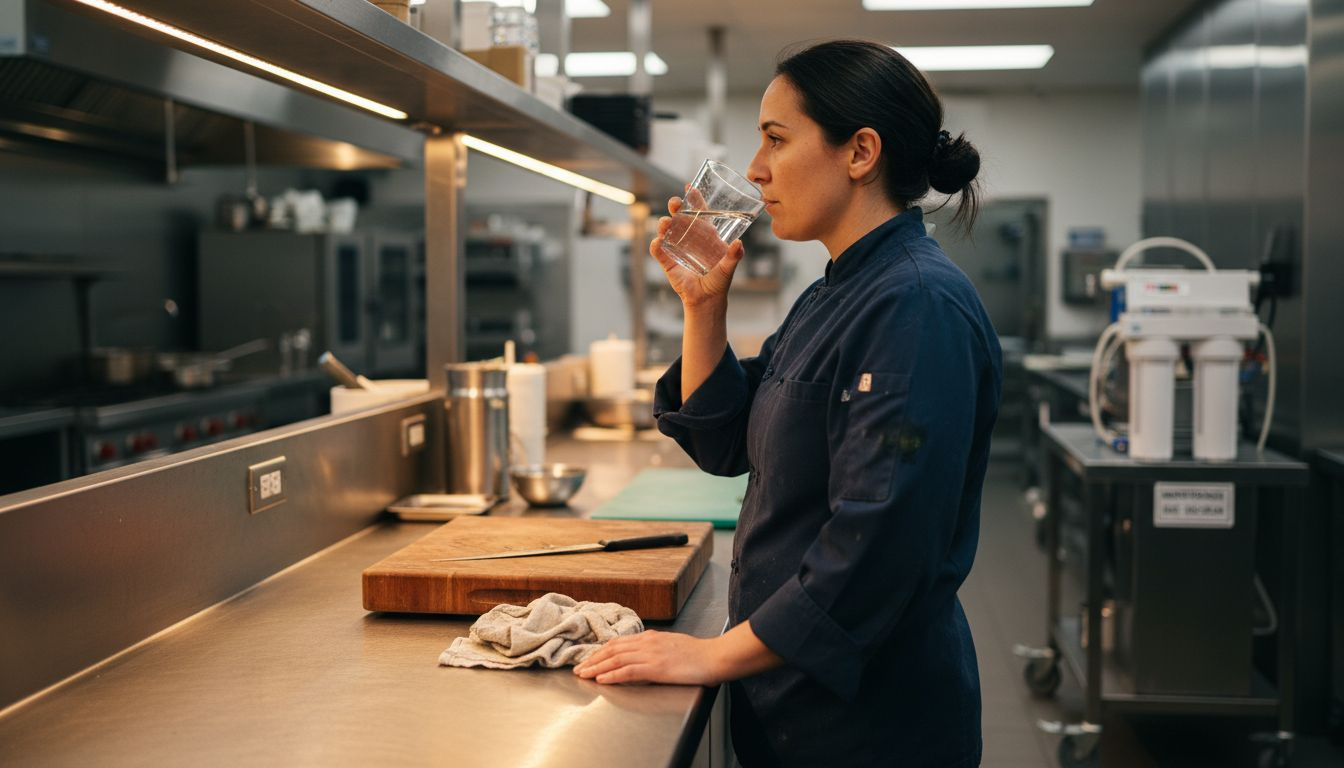
The Health Factor
Purified water reduces health risks by minimizing harmful microorganisms and chemical contaminants that can cause gastrointestinal illness. Tap water meets basic safety standards, but purified water goes much further in removing pathogens and impurities.
This matters for every beverage you serve. Coffee, tea, juice, and cocktails all start with water. When that foundation is contaminated, the entire drink is compromised.
Highly purified waters minimize microbial contamination through advanced filtration, protecting your customers from waterborne pathogens. Your restaurant’s liability decreases when you eliminate these risks.
One critical note: your purification system must be properly maintained. Neglected filters can develop microbial regrowth, defeating the entire purpose of purification. Regular maintenance schedules keep your water genuinely safe.
The Taste Experience
Customers taste chlorine in tap water immediately. It’s harsh and unmistakable. Purified water eliminates that off-flavor, creating a neutral, clean taste that customers prefer.
This affects everything you serve:
- Beverages: Coffee and tea develop their true flavor without chlorine interference
- Ice: Crystal-clear ice signals quality and cleanliness to customers
- Food preparation: Neutral water doesn’t mask or distort ingredient flavors
- Soups and stocks: The base water won’t introduce competing tastes
Purified water is generally neutral and free from mineral residues that negatively impact flavor. This contributes directly to customer satisfaction and repeat visits.
Customer Expectations
Today’s diners expect quality water. They’ve tasted filtered water at home and noticed the difference. When they order beverages at your restaurant, they unconsciously compare.
Customers connect water quality to overall restaurant quality. Clean-tasting water suggests a well-managed kitchen.
Purified water becomes part of your brand promise. It’s a touchpoint that happens multiple times during every meal.
The Bottom Line
Purified water protects health and enhances taste simultaneously. You’re not choosing between one benefit or the other. Both work together to improve customer satisfaction and reduce your operational risk.
Pro tip: Monitor your purification system maintenance schedule religiously—equipment failures can quickly undo all the health and taste benefits you’ve worked to provide.
Regulatory Compliance and Safety Standards
Compliance isn’t optional. Your local health department, state regulators, and federal agencies all have specific requirements about water quality in food service operations. Purified water helps you meet these standards consistently.
Federal Standards You Need to Know
The US Environmental Protection Agency establishes legally enforceable requirements for drinking water safety. National Primary Drinking Water Regulations set maximum contaminant levels for microorganisms, chemicals, and radioactive substances that your restaurant’s water cannot exceed.
These aren’t suggestions. They’re federal law. Your restaurant must comply or face violations, fines, and potential closure.
The EPA standards cover:
- Bacteria and viruses that cause illness
- Chemical residues from industrial sources
- Disinfection byproducts like chlorine compounds
- Inorganic minerals and salts
- Radioactive elements
Purified water systems help you stay well below these maximum contaminant levels by removing these substances before water reaches your kitchen.
Industry Standards Beyond the Minimum
Beyond federal requirements, the food service industry follows additional safety standards. NSF International develops voluntary consensus standards that restaurants adopt to exceed basic compliance.
NSF/ANSI 61 and NSF/ANSI 42 are the key standards. They guarantee that water treatment systems are safe, effective, and won’t introduce harmful materials into your water supply. These standards verify that filtration equipment actually does what manufacturers claim.
When you see NSF certification on water purification equipment, you know it meets rigorous testing requirements. This matters when health inspectors visit your restaurant.
Your Local Health Department
Your state and local health codes add additional layers on top of federal standards. These vary by location but typically address water testing frequency, system maintenance documentation, and record-keeping requirements.
Many jurisdictions require:
- Monthly or quarterly water quality testing
- Maintenance logs for purification equipment
- Backup plans if your system fails
- Staff training on water safety procedures
- Documentation of filter replacement dates
Compliance documentation protects you during inspections. Your maintenance records prove you’re taking water safety seriously.
The Risk of Non-Compliance
Health violations can devastate a restaurant. Beyond fines, violations create public relations problems, customer distrust, and potential foodborne illness liability. A single outbreak linked to contaminated water can force closure.
Purified water systems reduce this risk dramatically by preventing the contamination that causes violations in the first place.
Documentation Matters
Regulatory compliance requires proof. You need records showing your water meets standards. Purification systems with testing capabilities or regular third-party testing provide this documentation.
Pro tip: Create a simple water maintenance log showing filter replacement dates, testing results, and any system issues—this documentation becomes invaluable during health inspections and proves your commitment to compliance.
Cost Savings Versus Bottled Alternatives
Bottled water sounds convenient until you calculate what it actually costs your restaurant. On-site purified water systems deliver massive savings compared to purchasing bottled water month after month.
The Real Cost of Bottled Water
Bottled water comes with hidden expenses beyond the per-bottle price. You’re paying for production, bottling equipment, plastic containers, shipping, storage space, and handling. These costs stack up quickly in high-volume restaurants.
Consider a 150-seat restaurant serving 300 covers daily. If each customer receives one bottled water, you’re purchasing 300 bottles per day. At typical restaurant pricing, that’s roughly $90 to $150 per day, or $32,850 to $54,750 annually.
That’s just for plain drinking water. Add bottled water for kitchen use, ice machines, and coffee stations, and costs escalate dramatically.
On-Site Purification Economics
On-site purified water systems have upfront equipment costs, typically $2,000 to $8,000 depending on capacity and filtration type. But after installation, operational costs drop significantly.
Monthly expenses include:
- Filter replacements: $50 to $150 per month
- Electricity: $20 to $40 per month
- Maintenance: minimal if properly serviced
- Water usage: negligible compared to bottled purchases
Your total monthly cost runs $100 to $200. Within 12 to 24 months, you’ve recouped your equipment investment.
Long-Term Savings Comparison
On-site purified water systems cost considerably less than bottled water when evaluated over five years or longer. The mathematics strongly favor purification systems.
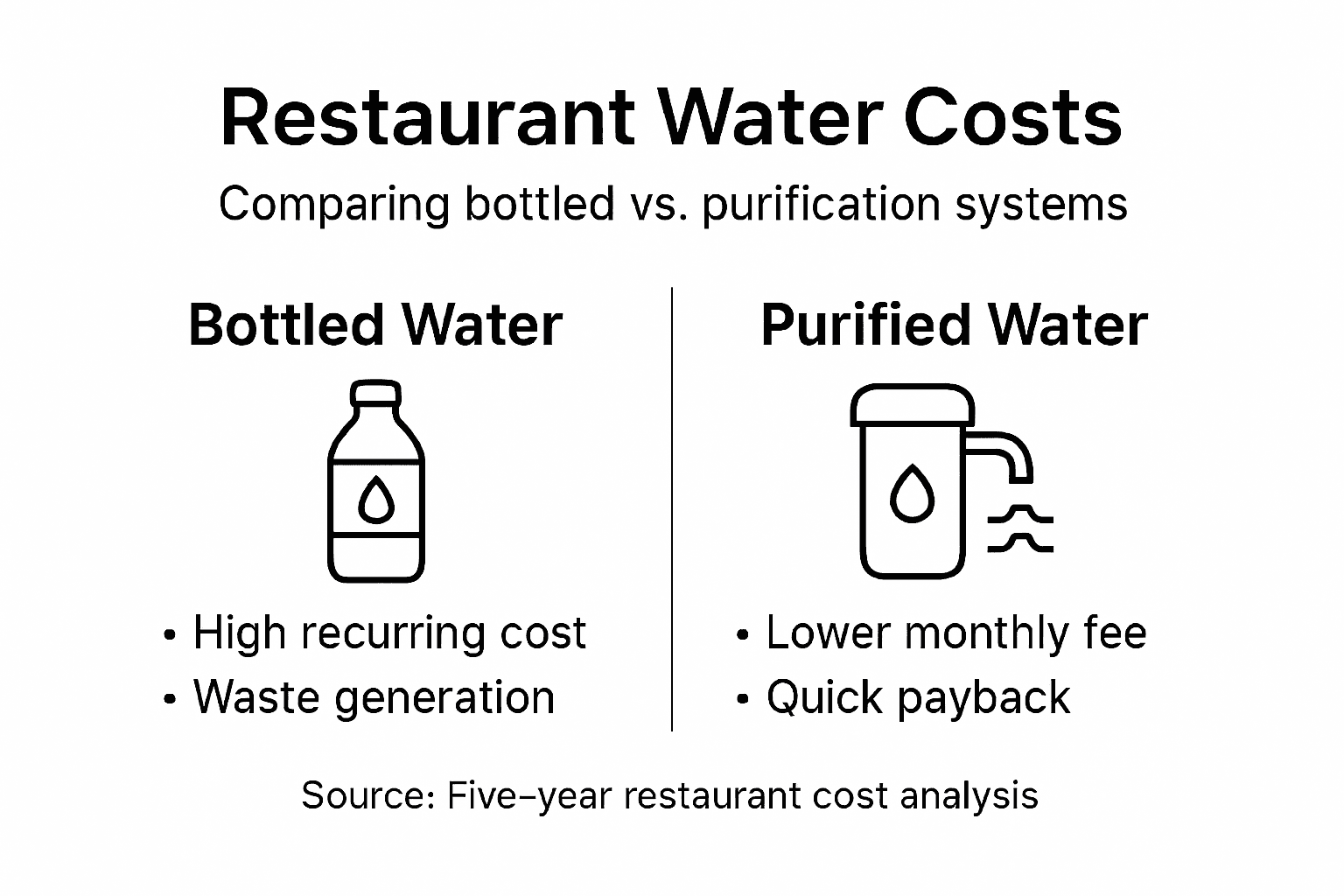
Year-by-year comparison for a typical restaurant:
| Year | Bottled Water Cost | Purified System Cost | Cumulative Savings |
|---|---|---|---|
| 1 | $45,000 | $8,000 | -$8,000 |
| 2 | $45,000 | $2,400 | $34,600 |
| 3 | $45,000 | $2,400 | $77,200 |
| 4 | $45,000 | $2,400 | $119,800 |
| 5 | $45,000 | $2,400 | $162,400 |
After year two, you’re saving roughly $42,600 annually. That money flows directly to your bottom line.
Environmental and Operational Benefits
Bottled water systems generate higher transportation and packaging costs compared to tap-based purification. You also eliminate storage space for cases of bottles and reduce staff time managing inventory.
Operational advantages include:
Here’s a summary of operational advantages of on-site purified water systems versus bottled water:
| Factor | On-Site Purification | Bottled Water |
|---|---|---|
| Ongoing Cost | Low after setup | High, recurring |
| Supply Disruption Risk | Very low | High if supply chain fails |
| Storage Requirements | Minimal | Bulky, takes space |
| Environmental Impact | Minimal waste, less CO₂ | Significant plastic waste |
- No delivery schedule dependencies
- Unlimited supply on demand
- Zero packaging waste in your operation
- Reduced refrigeration needs
- Consistent supply during shortages
After year two, an on-site system saves $40,000 to $50,000 annually compared to bottled water.
The Payback Question
If you’re hesitant about upfront costs, remember this: bottled water doesn’t pay for anything. It’s an ongoing expense with no end. A purified water system pays for itself, then generates massive savings.
Even accounting for equipment replacement after eight to ten years, you’re still ahead financially compared to buying bottled water continuously.
Pro tip: Calculate your specific bottled water spending for the last three months, multiply by four for annual costs, then compare that to equipment pricing—this reveals your actual payback timeline.
Elevate Your Restaurant’s Water Quality with Advanced Purification Solutions
Every restaurant faces the challenge of delivering consistently pure water that safeguards health, enhances taste, and complies with strict regulations. The article highlights how purified water is essential not just for customer satisfaction but also for operational safety and cost savings. If you want to eliminate chlorine tastes, reduce microbial risks, and improve your food and beverage quality, investing in a reliable purification system is critical.
At Coway, we understand these exact pain points. Our range of water purifiers combines advanced filtration technology, UV sterilization, and user-friendly maintenance to provide your restaurant with water that meets the highest standards. From compact countertop models to high-capacity units, our solutions offer consistent purity that aligns perfectly with regulatory compliance and health goals.
Explore the benefits of on-site purification today and say goodbye to bottled water costs and supply disruptions. Visit Coway Water Purifiers now to discover models designed for high-volume, health-conscious foodservice environments. Take control of your water quality and strengthen your brand’s promise to customers with clean, pure water delivered effortlessly.
Frequently Asked Questions
What is purified water and why is it important for restaurants?
Purified water is water that has been processed to remove impurities, ensuring cleaner and safer water for food preparation, beverage service, and ice making. It plays a crucial role in enhancing food quality and maintaining customer safety.
What methods are commonly used to purify water in restaurants?
Common methods include reverse osmosis, distillation, deionization, carbon filtration, and UV treatment. Each method has its strengths, and many restaurants use a combination for optimal results.
How does purified water affect the taste of food and beverages?
Purified water eliminates off-flavors like chlorine, allowing the true flavors of coffee, tea, soups, and other items to shine. This can significantly enhance the overall dining experience for customers.
What are the cost benefits of using on-site purified water systems versus bottled water?
On-site purification systems significantly reduce ongoing costs compared to bottled water, eliminating expenses related to production, shipping, and storage. After the initial investment, savings can be substantial over time, making it a more economical option in the long run.
Recommended
- Why Water Purity Matters for Food Businesses – Coway Water Purifier
- The Essential Guide to Purified Water for Offices – Coway Water Purifier
- 7 Health Benefits of Purified Water for Your Family – Coway Water Purifier
- Benefits of Pure Water for Health – Why Purity Matters – Coway Water Purifier
