
Uncategorized
How to compare filtration technologies for safer home water
Mar
Choosing the right water filtration system feels overwhelming when you’re bombarded with technical jargon and marketing claims. Most homeowners want clean, safe drinking water for their families but struggle to decode which technology actually removes the contaminants lurking in their pipes. Picking the wrong system wastes money and may leave dangerous impurities untouched. This guide walks you through testing your water, understanding filtration types, and comparing options so you can confidently select the best purifier for your home’s unique needs.
Table of Contents
- Step 1: Test Your Water To Identify Contaminants
- Step 2: Understand Key Filtration Technologies And What They Remove
- Step 3: Compare Filter Performance, Cost, And Suitability For Your Home
- Step 4: Verify Your Choice And Maintain Your Filtration System
- Discover Expert Water Purification Solutions At Coway
Key takeaways
| Point | Details |
|---|---|
| Testing water contaminants guides technology choice | Identify chlorine, heavy metals, TDS, bacteria, PFAS, and hardness before shopping for filters. |
| Main filter types target specific impurities | Activated carbon, reverse osmosis, ultrafiltration, UV, and ion exchange each excel at removing different contaminants. |
| Multi-stage filtration combines strengths effectively | Hybrid systems using sediment, carbon, RO, and UV offer comprehensive protection for diverse water quality issues. |
| NSF certification ensures verified performance | Third-party testing confirms manufacturer claims and guarantees contaminant removal rates. |
| Consider total cost and household needs for best fit | Evaluate three-year ownership expenses, family size, water source, and environmental impact when comparing systems. |
Step 1: Test your water to identify contaminants
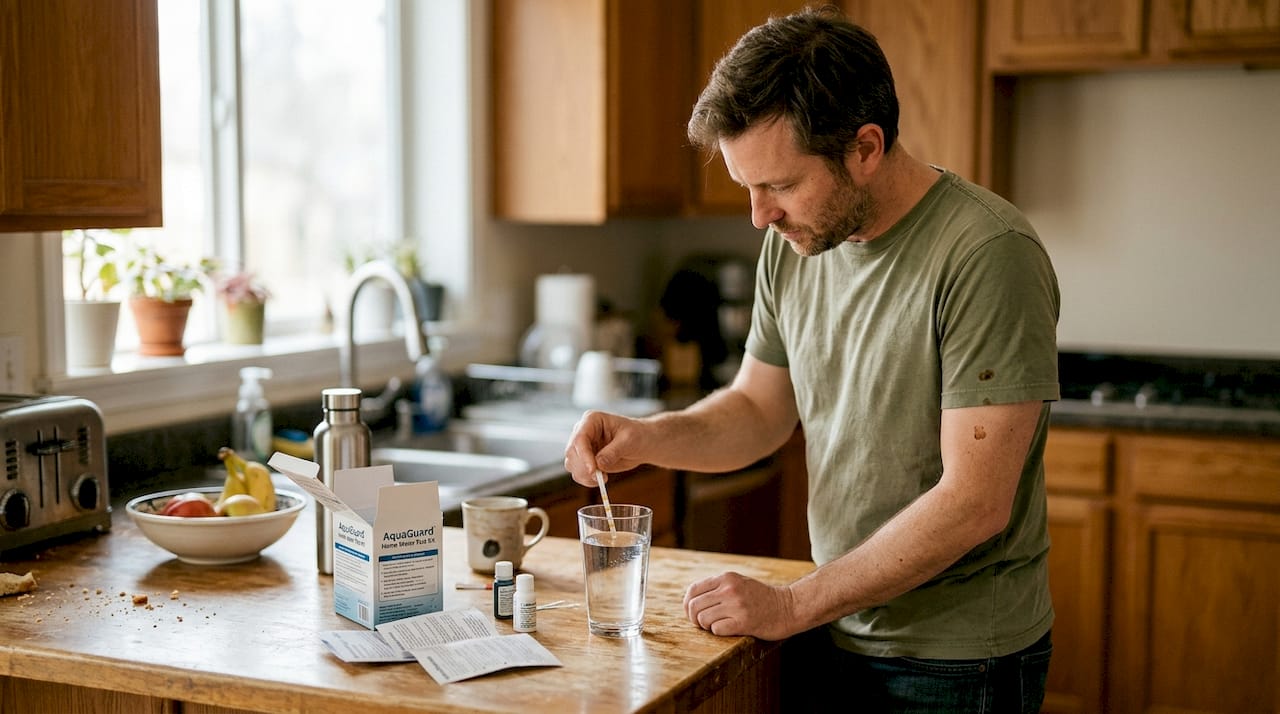
Before you spend a dollar on filtration equipment, you need to know exactly what’s in your water. Guessing leads to mismatched systems that fail to protect your family. Testing water first identifies specific contaminants like chlorine, heavy metals, total dissolved solids (TDS), bacteria, PFAS, and hardness, which determines the technologies you actually need.
Home test kits range from $20 to $200 and deliver results within minutes for common impurities. Professional lab analysis costs more but provides detailed reports on dozens of substances, including emerging contaminants like forever chemicals. Either approach gives you the baseline data to match filtration methods to real threats.
Knowing your contaminant profile prevents expensive mistakes. If your water contains high TDS and PFAS, you need reverse osmosis, not just a simple carbon filter. If bacteria are the main concern, UV sterilization becomes essential. Testing also establishes a benchmark for verifying your chosen system’s effectiveness after installation.
Common contaminants to test for include:
- Chlorine and chloramines from municipal treatment
- Lead, arsenic, and mercury from pipes or groundwater
- Total dissolved solids indicating mineral content
- Coliform bacteria and E. coli from biological contamination
- PFAS (per and polyfluoroalkyl substances) from industrial sources
- Hardness minerals like calcium and magnesium
Regularly retest your water every 12 months or after any changes in taste, odor, or appearance. Water quality shifts with seasons, infrastructure repairs, and upstream pollution events. Ongoing monitoring ensures your filtration system continues protecting your household as conditions evolve. For a deeper dive into choosing the right approach, explore our advanced water filtration guide and learn why multi-stage filtration addresses multiple threats simultaneously.
Pro Tip: Save your water test results in a folder with filter receipts and maintenance logs to track performance trends and troubleshoot issues quickly.
Step 2: Understand key filtration technologies and what they remove
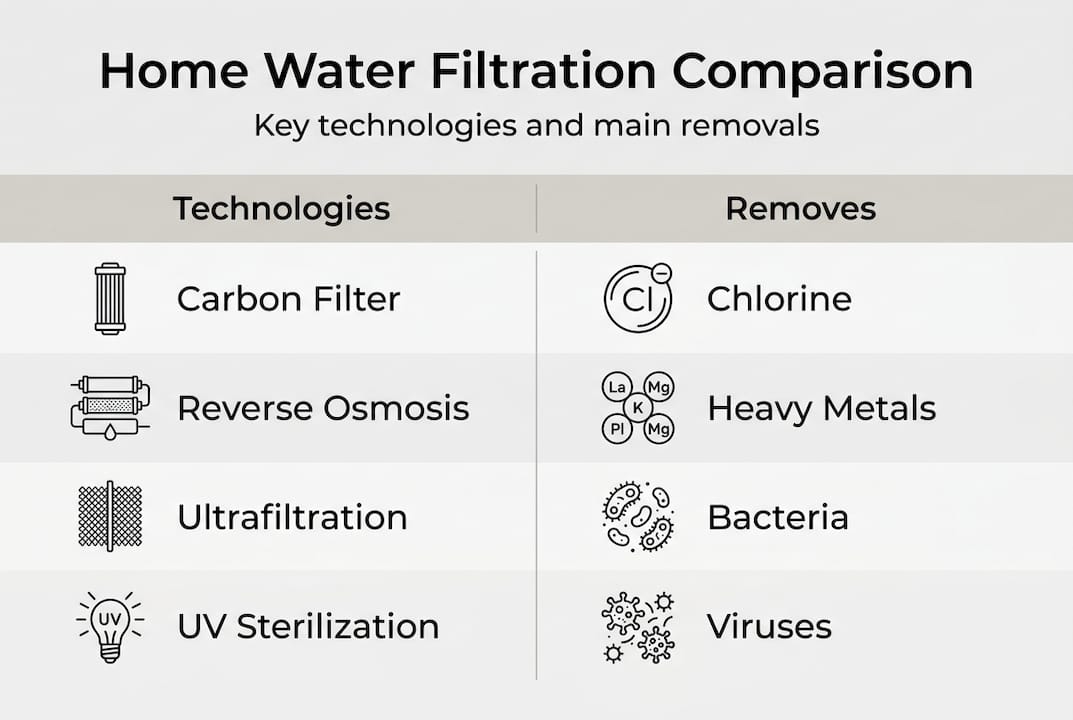
Once you’ve identified your water’s contaminants, you need to understand which technologies tackle them. Each filtration method operates differently and excels at removing specific impurities. Activated carbon adsorbs chlorine and VOCs, RO removes TDS, metals, PFAS, and microbes, UV disinfects microbes, and UF blocks bacteria and viruses while retaining beneficial minerals.
Activated carbon filters use porous material to trap chlorine, volatile organic compounds, and substances that affect taste and odor. They’re affordable and effective for improving drinking water quality in homes with municipal supplies. However, carbon alone won’t remove dissolved salts, heavy metals, or microorganisms.
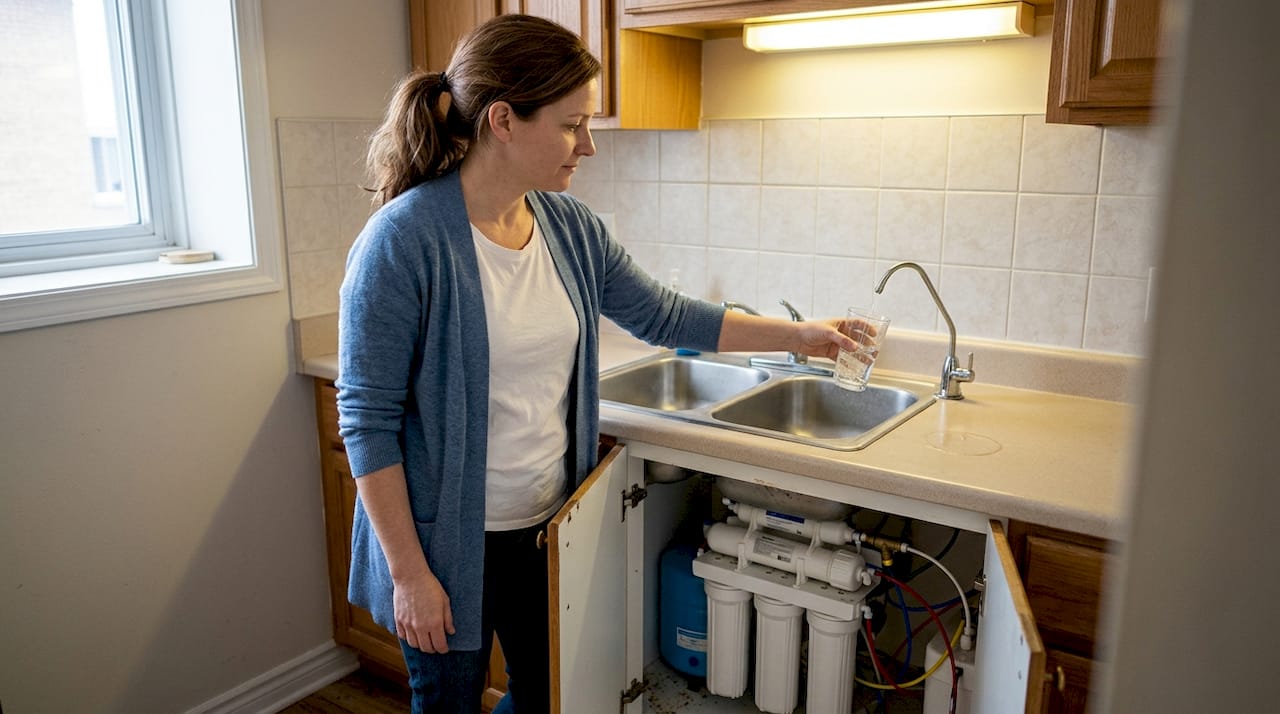
Reverse osmosis systems force water through a semipermeable membrane that blocks 90 to 99% of total dissolved solids, heavy metals, PFAS, and microbes. RO delivers the most comprehensive contaminant removal but requires water pressure, produces wastewater, and strips beneficial minerals. It’s the gold standard for homes with serious contamination or well water.
Ultrafiltration uses hollow fiber membranes with tiny pores that physically block bacteria, viruses, and suspended particles while allowing minerals to pass through. UF systems waste no water and preserve healthy mineral content, making them ideal for families who want microbial protection without demineralization.
Ultraviolet sterilization kills 99.9% of bacteria, viruses, and protozoa by damaging their DNA with UV-C light. UV units install inline and require no chemicals, but they don’t remove dissolved contaminants or particles. Pair UV with sediment and carbon filters for complete protection.
Ion exchange softens water by swapping calcium and magnesium ions for sodium, reducing scale buildup in pipes and appliances. Some ion exchange resins also capture certain PFAS compounds. This technology complements other filters when hardness is a concern.
| Technology | Primary Removal | Limitations |
|---|---|---|
| Activated Carbon | Chlorine, VOCs, taste, odor | Doesn’t remove TDS, salts, or microbes |
| Reverse Osmosis | TDS, heavy metals, PFAS, microbes | Wastes water, strips minerals, needs pressure |
| Ultrafiltration | Bacteria, viruses, particles | Doesn’t remove dissolved salts or chemicals |
| Ultraviolet | Bacteria, viruses, protozoa | Doesn’t remove particles or dissolved contaminants |
| Ion Exchange | Hardness, some PFAS | Doesn’t address microbes or organic chemicals |
NSF certifications ensure verified contaminant removal and safety claims. Look for NSF 42 for aesthetic improvements, NSF 53 for health contaminants like lead and cysts, NSF 55 for UV disinfection, and NSF 58 for reverse osmosis performance. These third-party validations give you confidence that a product delivers on its promises.
Choose technology that matches the contaminants identified in your water test. If you found high lead levels, prioritize RO or NSF 53 certified carbon. If bacteria appeared, add UV sterilization. For comprehensive coverage, consider systems that combine multiple stages. Learn more about different approaches in our filtration technologies explained guide and understand the importance of certified filtration standards when evaluating products.
Pro Tip: Don’t rely solely on marketing claims. Verify NSF or other independent certifications on the product label or manufacturer’s website before purchasing any filtration system.
Step 3: Compare filter performance, cost, and suitability for your home
Understanding technologies is one thing, but selecting the right system requires evaluating real-world performance, total costs, and how well each option fits your household’s specific situation. Start by comparing contaminant removal efficiency using lab test scores and independent reviews. RO scores highest for contaminant removal, and multi-stage setups combine benefits of different technologies to address diverse water quality challenges.
Match your filter choice to your water source. Well water often contains sediment, bacteria, and minerals, requiring sediment pre-filters, UV sterilization, and possibly softening before RO. Municipal water typically needs chlorine and taste removal, making carbon filters sufficient unless heavy metals or PFAS are present. Hard water benefits from ion exchange or salt-free conditioners upstream of RO membranes to prevent scaling and extend filter life.
Consider your family size and daily water consumption when sizing a system. A household of five uses significantly more water than a couple, so flow rate and capacity matter. Point-of-entry (POE) systems treat all water entering your home, protecting appliances and providing filtered water at every tap. Point-of-use (POU) systems like under-sink or countertop units focus on drinking and cooking water, offering targeted protection at lower cost.
Evaluate total cost of ownership over three years, not just the upfront price. Factor in replacement filters, membrane changes, electricity for UV lamps, and water waste from RO systems. A cheap pitcher filter may cost more long term if you’re replacing cartridges monthly. A pricier multi-stage system with annual filter swaps often proves more economical and convenient.
| System Type | Initial Cost | Annual Maintenance | Water Waste | Best For |
|---|---|---|---|---|
| Pitcher Filter | $20 to $50 | $60 to $120 | None | Renters, basic chlorine removal |
| Countertop Carbon | $100 to $300 | $50 to $100 | None | Small households, taste improvement |
| Under-Sink RO | $200 to $600 | $80 to $150 | 3 to 5 gallons per gallon filtered | Comprehensive contaminant removal |
| Whole-House Carbon | $500 to $1,500 | $100 to $200 | None | Chlorine removal for entire home |
| Multi-Stage Hybrid | $400 to $1,200 | $100 to $250 | Varies by RO stage | Diverse contaminants, high performance |
Understand environmental impacts when comparing systems. RO wastes water and strips minerals, though newer models improve efficiency. UF and carbon filters retain beneficial minerals and produce no wastewater, making them greener choices when microbial and chemical removal suffice. Balancing health protection with sustainability often leads families toward hybrid approaches.
Multi-stage hybrid filtration combining sediment, carbon, RO, or UV is optimal for home use because it addresses multiple contaminant categories in one compact system. A typical setup includes sediment pre-filtration to protect downstream components, activated carbon for chlorine and organics, RO or UF for dissolved solids and microbes, and sometimes UV for final disinfection. This layered defense delivers comprehensive safety without relying on a single technology’s limitations.
Certification and verified test scores increase confidence in performance. Products with NSF, WQA, or independent lab validation prove they meet advertised removal rates. Read third-party reviews and compare test results across brands to identify consistently high performers. For more insights on emerging trends and technologies, check our water filtration trends guide and detailed advice on how to choose a water purifier. If heavy metals are a concern, our guide on how filters remove heavy metals breaks down the science.
Pro Tip: Calculate cost per gallon over three years to compare systems fairly. Divide total ownership cost (purchase plus maintenance) by estimated gallons filtered to see which option delivers the best value.
Step 4: Verify your choice and maintain your filtration system
After selecting a filtration system, confirming its authenticity and maintaining it properly ensures long-term water safety. Start by verifying NSF certification to ensure filter claims are backed by independent testing. Check the product label, packaging, or manufacturer’s website for certification marks and registration numbers you can validate online.
Review consumer feedback and lab test data if available. Real-world user experiences reveal performance issues, installation challenges, and customer service quality that spec sheets don’t capture. Independent testing organizations publish comparative reviews that highlight top performers and expose underperformers.
Follow manufacturer guidelines for filter replacement schedules religiously. Carbon filters typically need changing every six to twelve months, RO membranes every two to three years, and UV lamps annually. Ignoring replacement intervals allows contaminants to break through and can foster bacterial growth inside the system. Set calendar reminders or use smart filter monitors that track usage and alert you when changes are due.
Schedule periodic water testing after installation to monitor effectiveness. Regular water testing and filter maintenance ensure ongoing water safety by catching performance degradation early. Test three months post-installation to establish a filtered baseline, then annually or whenever you notice taste, odor, or flow changes. Compare results to your pre-filter test to confirm the system is working as expected.
Maintain detailed records of filter changes and water quality results:
- Log installation date and initial water test results
- Record each filter replacement with date and cartridge model
- Note any system cleaning or sanitization procedures
- Document follow-up water tests and compare to baseline
- Track warranty information and service contacts
Keep system components clean to prevent microbial growth and scaling. Sanitize housings during filter changes using manufacturer-recommended solutions. Inspect O-rings and seals for wear, replacing them as needed to prevent leaks. Flush RO systems after long periods of non-use to clear stagnant water.
If you notice declining flow rate, strange tastes, or cloudiness, troubleshoot immediately. These symptoms often indicate clogged filters, membrane fouling, or bacterial contamination. Don’t wait for scheduled maintenance if performance drops. For ongoing guidance, revisit our how to choose a water purifier resource and the multi-stage filtration guide for troubleshooting tips.
Discover expert water purification solutions at Coway
Now that you understand how to test, compare, and maintain water filtration systems, it’s time to explore products that meet the highest standards. Coway offers NSF-certified water purifiers designed to match diverse home needs, from compact countertop models to powerful under-sink systems. Each unit combines advanced multi-stage filtration with user-friendly features, delivering healthier drinking water without guesswork.
Whether you need comprehensive contaminant removal or targeted solutions for specific water quality issues, Coway’s range includes certified technologies you can trust. Explore our water purification process guide to see how our systems work, compare top under-sink water purifiers for installation flexibility, or discover the convenience of our countertop ice water purifier for instant refreshment. Invest in your family’s health with filtration solutions backed by science and certified performance.
FAQ
Which filtration technology is best for removing lead?
Reverse osmosis and activated carbon filters with NSF 53 certification are most effective for lead removal. RO and NSF 53 certified carbon remove over 99% of lead from drinking water. Always verify certification on the product label to ensure the system has been independently tested for lead reduction, as not all carbon filters meet this standard.
How often should I test my water after installing a filtration system?
Water should be tested at least annually, or more frequently if you notice changes in source, taste, or odor. Initial testing three months after installation establishes a performance baseline. Retest whenever you replace major components like RO membranes or if local water quality advisories are issued.
What are the benefits of multi-stage filtration systems?
Multi-stage filters combine sediment, carbon, RO or UV/UF, providing broad contaminant removal and improved taste. They address multiple water quality issues simultaneously, from sediment and chlorine to heavy metals and microbes. This comprehensive approach delivers safer, better-tasting water than single-technology systems. Learn more in our detailed multi-stage filtration guide.
Can renters use effective water filtration without installation?
Portable pitchers and ultrafiltration systems offer effective filtration without plumbing changes, ideal for renters. Countertop units connect to faucets with adapters you can remove when moving. These renter-friendly options provide significant contaminant reduction for chlorine, taste, odor, and some microbes without permanent modifications or landlord approval.
Recommended
- 7 Key Examples of Filtration Methods for Safer Home Water – Coway Water Purifier
- Role of Filtration Stages: Improving Home Water Safety – Coway Water Purifier
- Role of Microfiltration in Safer Home Water – Coway Water Purifier
- 7-Step Home Water Filtration Checklist for Safer Drinking – Coway Water Purifier
- 20-micron pro plunge lite cold plunge filter – Coldture Wellness
