
Uncategorized
Why Regular Filter Replacement Matters for Families
Jan
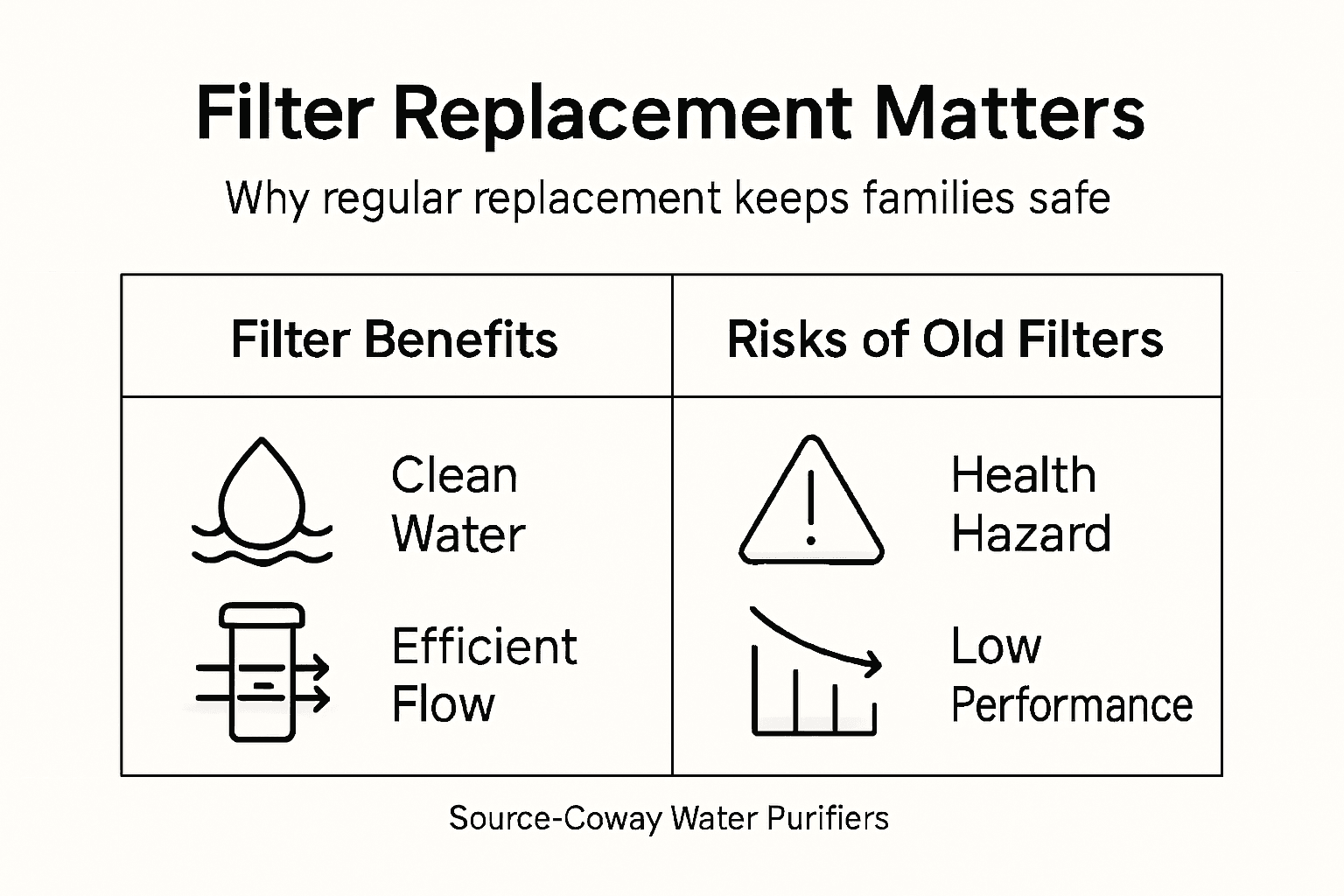
Clean water is a top priority for families living in cities across the United States, but even quality municipal supplies can carry chlorine, sediment, and invisible contaminants into your home. Ignoring timely filter changes means relying on a system that may no longer shield your loved ones, because clogged filters reduce filtration efficiency and put your household at risk. By understanding regular filter replacement, you protect your family’s health and continuously enjoy the benefits of truly fresh, purified water.
Table of Contents
- What Regular Filter Replacement Means
- Main Types of Water and Air Filters
- How Dirty Filters Affect Water Quality
- Health and Safety Risks of Old Filters
- Cost, Maintenance, and Efficiency Factors
Key Takeaways
| Point | Details |
|---|---|
| Regular filter replacement is essential | Changing filters on schedule ensures protection against contaminants and maintains water quality. |
| Dirty filters pose health risks | Saturated filters allow harmful substances to bypass filtration, increasing health concerns for vulnerable family members. |
| Maintenance impacts costs | Regular filter changes prevent higher energy consumption and extend the lifespan of your filtration system, lowering overall expenses. |
| Different filters have unique requirements | Understanding the types of filters in your home helps you adhere to their specific replacement schedules for optimal performance. |
What Regular Filter Replacement Means
Regular filter replacement means changing your water filter system’s components before they become saturated with contaminants and lose their ability to protect your family. Think of it like this: a filter works by capturing sediments, chlorine, bacteria, and other particles as water passes through. Over time, the filter fills up with these trapped materials until it can no longer function effectively. At that point, you’re no longer filtering anything; you’re just running unfiltered water through your tap. For families in urban areas relying on municipal water supplies, this matters significantly because even treated tap water contains residual chlorine, sediment, and sometimes trace contaminants that a functioning filter removes.
When you replace filters on schedule, you maintain the system’s ability to deliver clean water consistently. Clogged filters reduce filtration efficiency and force your system to work harder, which increases energy consumption and can strain the equipment. In reverse osmosis systems specifically, replacing pre-filters prevents sediment damage to the main membrane and maintains water quality. The replacement frequency depends on several factors: your household’s water usage, local water quality, and the specific filter type you’re using. Most pre-filters need changing every 3 to 6 months in standard households, though families with higher water usage or harder water may need more frequent replacements.
Understanding what regular replacement means also includes recognizing the signs that your filter needs changing sooner. Water flow might decrease noticeably, or you might detect an odor or taste change even though you expect clean water. Some systems include indicator lights or digital displays that alert you when replacement is due. Rather than guessing, check your system’s documentation for specific replacement schedules. Tracking these dates prevents situations where you’re unknowingly drinking water that passes through a compromised filter. For health-conscious families, this isn’t just maintenance; it’s a commitment to knowing exactly what’s in the water your household drinks and uses daily.
Pro tip: Set phone reminders for your filter replacement dates based on your system’s specifications, and keep receipts of replacements you’ve made so you can track patterns in how often your household actually needs new filters.
Main Types of Water and Air Filters
Your home likely uses multiple types of filters, and understanding what each one does helps you maintain them properly. Water filters come in several varieties, each designed to remove specific contaminants from your tap water. Activated carbon filters capture chlorine, sediment, and some chemical compounds that affect taste and odor. These work well for basic filtration and are often the first stage in multi-stage systems. Reverse osmosis systems use membrane technology to remove a broad range of contaminants including dissolved salts, fluoride, and some heavy metals, making them popular with health-conscious families in urban areas who want comprehensive protection. Ultraviolet (UV) treatment doesn’t filter particles but rather disinfects water by eliminating bacteria and viruses without using chemicals. Water softeners specifically target hardness minerals like calcium and magnesium, preventing scale buildup in pipes and appliances.
Air filters operate on different principles and ratings than water filters. Most household HVAC systems use MERV-rated filters, which range from MERV 1 (lowest efficiency) to MERV 16 (highest). MERV 13 or higher filters are recommended for capturing airborne particles, including infectious particles and fine dust that bothers families with allergies or respiratory sensitivities. HEPA filters represent the gold standard for air purification, capturing 99.97% of particles as small as 0.3 microns, including pollen, pet dander, and some bacteria. These are commonly found in standalone air purifier units rather than traditional HVAC systems. The key difference between water and air filters lies in their target contaminants and replacement needs. Water filters trap physical particles and chemical compounds, while air filters focus on airborne particulates and microorganisms.
For your family, knowing these types matters because different filters have different replacement schedules and costs. Standard activated carbon water filters might need replacing every 3 to 6 months depending on usage and water quality. HEPA air filters typically last 6 to 12 months before clogging reduces their effectiveness. Some systems combine multiple filter types for comprehensive protection. A reverse osmosis system might have a sediment pre-filter, an activated carbon filter, and the main RO membrane, each requiring replacement at different intervals. Your specific system’s manual will tell you exactly what types you have and when to replace them. Taking the time to understand your filter types now prevents confusion and missed replacement dates later.
Pro tip: Create a simple spreadsheet or note on your phone listing each filter type in your home, its location, replacement cost, and the date you last replaced it, so you never guess about maintenance again.
Here’s a summary of common household filter types and their main purposes:
| Filter Type | Main Function | Typical Replacement Schedule |
|---|---|---|
| Activated Carbon | Removes chlorine, odors, and sediments | 3–6 months |
| Reverse Osmosis Membrane | Eliminates dissolved salts, heavy metals | 12–24 months |
| UV Treatment | Disinfects bacteria and viruses | 12 months (lamp) |
| Water Softener Resin | Reduces water hardness (calcium, magnesium) | 3–5 years |
| MERV 13+ Air Filter | Captures allergens and fine dust | 3–9 months |
| HEPA Air Filter | Removes 99.97% of small particles | 6–12 months |
How Dirty Filters Affect Water Quality
A dirty filter stops protecting your family the moment it becomes saturated with contaminants. When a filter clogs with sediment, bacteria, and chemical buildup, it loses its ability to remove harmful substances from your water. Instead of filtering out contaminants, the filter becomes a barrier that slows water flow to a trickle while potentially allowing pollutants to pass through anyway. Think of it like trying to strain pasta through a cloth so full of holes that pasta pieces fall through. The water that comes out may look clear, but that appearance is deceiving. Your family could be drinking water that contains bacteria, parasites, or chemical compounds like PFAS without realizing it because the filter is no longer doing its job.
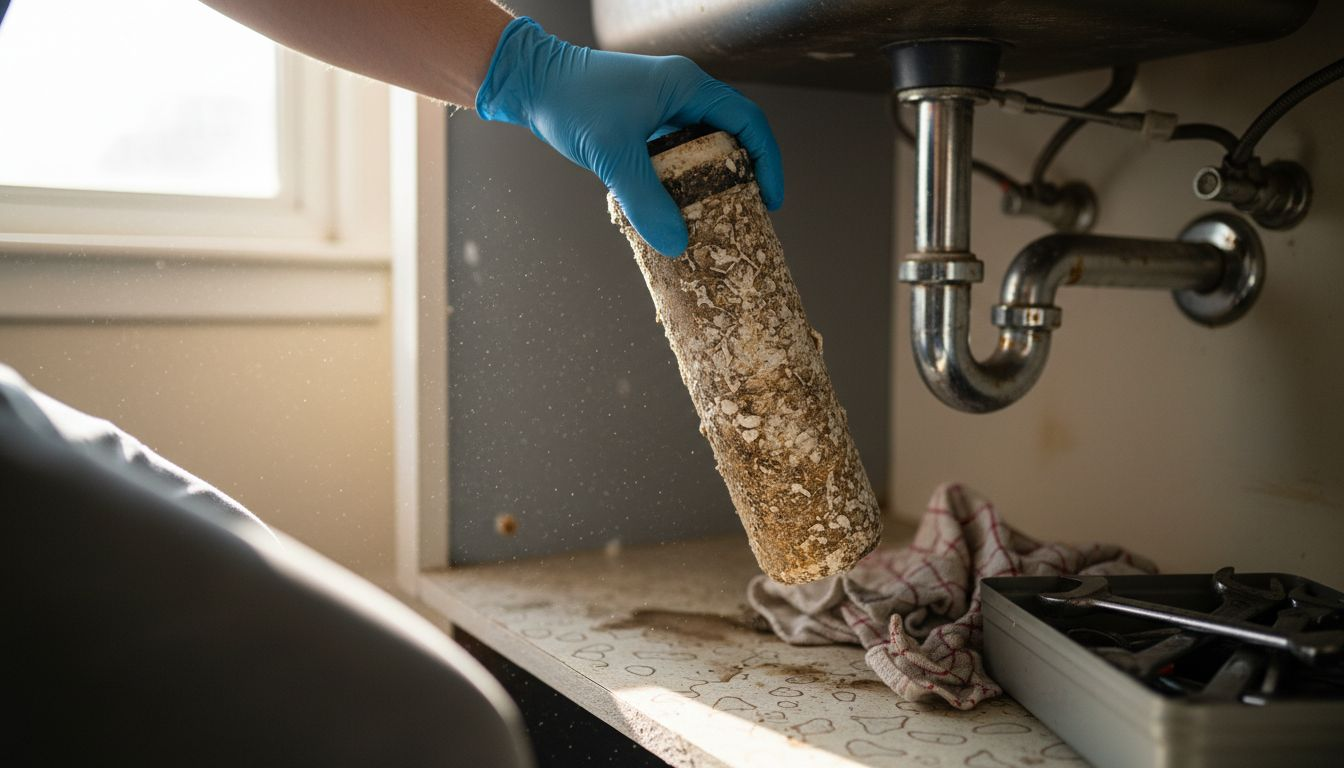
Dirty filters can actually make your water quality worse than if you had no filter at all. Clogged filters reduce water flow and filtration performance, which means contaminants bypass the filter instead of being trapped. In some cases, a deteriorating filter can cause previously trapped contaminants to dislodge and reenter your water supply. For families with young children, elderly members, or anyone with compromised immunity, this becomes a serious health concern. Microbial threats like Cryptosporidium are particularly dangerous because dirty filters lose their ability to remove these pathogens as their micropore structure deteriorates. A filter that worked perfectly for six months becomes useless on month seven if you haven’t replaced it.
The problem worsens because you typically cannot see or taste the difference until it’s too late. Water flowing from your tap might taste fine and look clear even though a dirty filter has stopped removing harmful substances. You rely on the filter to do its job silently in the background, which means the only way to ensure protection is through disciplined replacement schedules. Urban families in particular benefit from knowing their filter status because municipal water systems, while regulated, still contain residual chlorine and sediment that filtered water removes. Once your filter reaches its replacement date, that protective advantage disappears instantly. Your water quality doesn’t gradually decline; it drops off a cliff the moment the filter becomes too saturated to function.
Compare how dirty vs. clean filters impact your household water system:
| Condition | Water Quality Impact | System Performance | Health Risk Level |
|---|---|---|---|
| Clean Filter | Contaminants removed effectively | Optimal flow, less energy used | Low, filter protects household |
| Dirty Filter | Contaminant removal fails | Slow flow, higher energy use | High, increased exposure |
Pro tip: Don’t wait for visible signs like cloudy water or slow flow to replace your filter because by then the filter has already stopped protecting against invisible pathogens and chemical contaminants—stick to your system’s recommended replacement schedule regardless of how the water looks or tastes.
Health and Safety Risks of Old Filters
Using old filters beyond their recommended replacement date exposes your family to health hazards you cannot see, smell, or taste. When filters age, they accumulate trapped contaminants and lose their structural integrity. This creates a dual problem: the filter can no longer capture new pollutants effectively, and the contaminants already trapped inside can break free and contaminate your water or air again. For families in urban areas where tap water quality varies by neighborhood and season, this breakdown becomes particularly dangerous. A filter that provided excellent protection in month three might be actively harming your health by month nine if you haven’t replaced it.
The specific health risks depend on what your filter was removing. Water filters that fail to function properly allow harmful substances like PFAS to pass through into your drinking water and cooking supplies. PFAS chemicals accumulate in your body over time and have been linked to kidney disease, thyroid problems, and developmental issues in children. When your filter stops working, prolonged exposure to these toxins increases family risk significantly. For air filters, old and saturated filters harbor microbial growth and reduce airflow, making it easier for viruses and bacteria to circulate through your home. Households with children, elderly members, or anyone with respiratory conditions face heightened vulnerability when air quality deteriorates.
Young children represent the most at-risk group because their bodies are still developing and their immune systems are immature. A child drinking contaminated water or breathing contaminated air for months before you notice the problem faces consequences that might not appear until years later. Similarly, elderly family members with weakened immunity cannot fight off infections as effectively as younger adults, making them more susceptible to waterborne or airborne illnesses. Pregnant women also need particular protection because contaminants in water can affect fetal development. The challenge is that symptoms often develop slowly and subtly, making it difficult to connect health problems to old filters. You might attribute your child’s recurring respiratory infections or digestive issues to other causes when the real culprit has been sitting in your home the entire time.
Beyond specific contaminants, old filters create an environment where harmful microorganisms thrive. A saturated filter becomes a breeding ground for bacteria and mold, transforming a safety device into a contamination source. Some families don’t realize this is happening because the water still flows and looks relatively clear. Only when someone gets sick do they suspect something is wrong, and by then the exposure has already occurred. This is why professional health organizations recommend strict adherence to replacement schedules rather than waiting for visible problems to appear.
Pro tip: Set calendar reminders three weeks before your filter replacement date so you can order a replacement in advance, ensuring you never run out and are forced to use an overdue filter while waiting for delivery.
Cost, Maintenance, and Efficiency Factors
Filter replacement involves more than just buying a new cartridge every few months. You need to understand how maintenance decisions impact your household budget, system efficiency, and long-term costs. Many families initially resist regular filter replacement because they see it as an additional expense, but this perspective ignores the hidden costs of skipping replacements. A clogged filter forces your water purification system to work harder, consuming more electricity and straining the pump and motor components. Over time, this increased energy consumption adds dollars to your utility bills every single month. Meanwhile, the strain on mechanical parts accelerates wear and tear, leading to expensive repairs or complete system replacement years before the equipment should need replacing.
The math becomes clear when you compare upfront filter costs against repair and replacement expenses. A replacement filter might cost between 50 and 300 dollars depending on your system type, while a new pump or membrane can cost 500 to 2,000 dollars. Regular filter changes prevent increased energy costs and extend system life, meaning the money you spend on filters now saves you significantly more money later. For families on tight budgets, this might feel counterintuitive, but spreading small replacement costs throughout the year costs far less than handling a major repair emergency. Additionally, most quality filtration systems come with warranties that require you to follow the manufacturer’s maintenance schedule. Skip your filter replacements and you void that warranty, leaving you responsible for any mechanical failures.
Efficiency directly connects to cost management in ways many homeowners overlook. A clean filter allows water to flow at proper pressure, using just enough energy to move water through the system. A dirty filter requires the pump to work significantly harder to push water through the clogged media, consuming 30 to 50 percent more electricity. Over a year, this extra energy consumption costs your family real money on your utility bill. Worse, reduced water flow becomes annoying for daily use. You get slower-flowing taps and reduced water pressure for showers and washing, which contradicts the whole point of having a quality water purification system. Balancing cost with timely maintenance ensures effective removal of contaminants like PFAS while avoiding unnecessary expenses from system failures.
Think about maintenance as preventative investment rather than recurring expense. Urban families with hard water or sediment-heavy municipal supplies might need filter replacements every three months instead of six months. This means higher annual filter costs but lower overall expenses because they avoid premature system failure. Families with excellent municipal water quality might stretch filters to eight months or longer, reducing replacement costs but still following the safe limits recommended by manufacturers. The key is understanding your specific situation and budgeting accordingly. Track your actual water quality indicators and usage patterns so you can estimate realistic annual maintenance costs. This planning prevents the shock of unexpected repairs and helps you allocate household resources appropriately.
Pro tip: Calculate your annual filter replacement cost by multiplying the filter price by how many replacements you need yearly, then compare that number to one month of your typical utility bill to see how much efficiency gains save you compared to running a system with clogged filters.
Protect Your Family with Timely Filter Replacement and Advanced Purification Solutions
Regular filter replacement is essential to ensure your family’s health and safety by maintaining clean water and air at home. This article highlights how old or clogged filters can fail to remove harmful contaminants like bacteria, chemicals, and PFAS, increasing exposure risks especially for vulnerable family members. It also explains how neglecting replacement schedules can reduce system efficiency and lead to costly repairs. If you want peace of mind and reliable protection, you need purification systems designed to support easy and timely maintenance.
Take control of your home’s health environment today by choosing purifier models that combine efficiency, comfort, and comprehensive service support including free delivery and installation. Visit Coway Water Purifier to explore product details, compare models that suit your family’s needs, and get yours delivered fast. Regular maintenance does not have to be a burden when you partner with experts dedicated to your safety.
Discover simple ways to keep your filters replaced on time and learn more on our Uncategorized Archives – Coway Water Purifier. Start protecting your family now and experience the difference of a cleaner, healthier home environment.
Frequently Asked Questions
What is regular filter replacement, and why is it important?
Regular filter replacement involves changing your water filter’s components before they become saturated with contaminants. It’s crucial because clogged filters can fail to remove harmful substances from your water, posing health risks to your family.
How often should I replace my water filters?
Most pre-filters typically need replacing every 3 to 6 months in standard households. However, families with higher water usage or harder water may require more frequent replacements. Always check your system’s documentation for specific recommendations.
What are the signs that my filter needs to be changed sooner?
Signs that your filter needs changing sooner include a noticeable decrease in water flow, unusual odors, or changes in taste, even if water looks clear. Some systems have indicator lights that alert you when replacement is due.
What are the health risks of using old or dirty filters?
Using old filters exposes your family to health hazards like bacteria, chemicals, and viruses that the filters are supposed to remove. Dirty filters can break down, allowing contaminants that were previously trapped to re-enter your water supply.
Recommended
- Importance of Regular Filter Replacement – Safeguarding Health at Home – Coway Water Purifier
- Filter Replacement Cycles: Why Timing Matters – Coway Water Purifier
- Filter Replacement – Why Timely Changes Matter – Coway Water Purifier
- What Triggers Filter Replacement – Safeguarding Home Water Quality – Coway Water Purifier
- Why cruise with family: Everything you need to know
- Diesel Particulate Filter Protector – My Company
