
Uncategorized
Water Efficiency Explained: Better Home, Less Waste
Feb
Every American family wants water that is clean, safe, and used wisely in the home. Facing confusing terms and common myths about water efficiency can make it tough to choose the best filtration system for your loved ones. This guide clarifies optimizing water usage, helping health-conscious homeowners understand the true meaning of water efficiency and why advanced filtration matters for both quality and savings.
Table of Contents
- Defining Water Efficiency And Its Misconceptions
- Types Of Water Efficiency Methods For Homes
- How Water-Efficient Technologies Work
- Key Benefits For Health, Savings, And The Environment
- Common Challenges And What To Avoid
- Comparing Water Efficiency And Conservation
Key Takeaways
| Point | Details |
|---|---|
| Understanding Water Efficiency | Water efficiency is about optimizing usage, not merely reducing consumption, focusing on maximizing outputs while minimizing waste. |
| Holistic Approach | True efficiency requires a comprehensive understanding of water’s value across diverse systems, including ecological and economic impacts. |
| Technological Integration | Advanced technologies play a crucial role in enhancing water efficiency by monitoring, controlling, and reducing waste in water systems. |
| Behavioral Change | Combining technological upgrades with personal conservation habits is essential for maximizing sustainable water resource management. |
Defining Water Efficiency And Its Misconceptions
Water efficiency represents a complex strategy far beyond simply reducing water consumption. It’s about optimizing water usage across residential, commercial, and environmental systems to maximize beneficial outcomes while minimizing waste. Comprehensive water valuation integrates ecological, social, and economic perspectives, challenging traditional narrow definitions.
Common misconceptions about water efficiency often stem from oversimplified understanding. Many people assume efficiency means strictly cutting water use, but experts argue it’s more nuanced. Strategies to improve water efficiency highlight key distinctions between mere reduction and strategic optimization:
- Reducing total water consumption isn’t always the primary goal
- Efficiency involves maximizing beneficial water outputs
- Minimizing systemic losses like runoff and evaporation matters more than blanket consumption cuts
- Context-specific water management trumps universal reduction strategies
True water efficiency requires holistic thinking. It demands understanding water’s multifaceted value across different systems – from household appliances to agricultural irrigation. The approach necessitates analyzing:

Here is how common water efficiency misconceptions differ from actual best practices:
| Misconception | Reality | Why It Matters |
|---|---|---|
| Efficiency means strict reduction | True efficiency optimizes usage | Prevents under-serving key needs |
| One-size-fits-all strategies | Context matters for every system | Solutions must fit local needs |
| Cutting consumption is always best | Minimizing waste is critical | Reduces losses like runoff and evaporation |
| Focus only on immediate use | Consider inputs, outputs, and impacts | Delivers broad ecological and social benefits |
- Total water inputs
- Beneficial water outputs
- Systemic waste points
- Ecological impact
- Economic considerations
Water efficiency isn’t about using less water, but using water more intelligently.
Pro tip: Track your water usage patterns through smart meters or dedicated monitoring apps to understand your specific efficiency opportunities.
Types Of Water Efficiency Methods For Homes
Water efficiency in residential settings involves strategic approaches to reduce water consumption while maintaining optimal performance. WaterSense-labeled fixtures represent a cornerstone of modern home water management, offering homeowners practical methods to minimize waste without sacrificing functionality.
Homeowners can implement multiple water efficiency techniques across different home systems:
- Kitchen water conservation
- Bathroom fixture upgrades
- Intelligent irrigation strategies
- Advanced water heating technologies
- Leak detection and prevention systems
In the bathroom, water-efficient fixtures play a critical role. Tankless water heaters offer an innovative solution by providing hot water on demand, eliminating the energy waste associated with traditional storage tank systems. These technologies can significantly reduce both water and energy consumption, particularly in smaller households.
Comprehensive water efficiency requires a multi-pronged approach that goes beyond simple fixture replacements. Homeowners should consider:
- Installing low-flow showerheads
- Replacing older toilets with water-saving models
- Using smart irrigation controllers
- Implementing greywater recycling systems
- Monitoring water usage through digital tracking
Water efficiency is a continuous journey of smart technology and conscious consumption.
Pro tip: Conduct a home water audit annually to identify and address potential efficiency improvements in your water systems.
How Water-Efficient Technologies Work
Modern water-efficient technologies represent a sophisticated approach to managing water resources through intelligent design and advanced engineering. Water systems can now dynamically balance energy consumption, creating flexible infrastructure that minimizes waste and maximizes resource utilization across residential and industrial applications.
These technologies operate through several key mechanisms:
- Real-time consumption monitoring
- Smart sensor integration
- Adaptive flow control systems
- Automated leak detection
- Precision water treatment processes
Innovative water reuse technologies are transforming traditional water management paradigms. Onsite wastewater treatment systems now enable comprehensive resource recovery, converting waste streams into valuable byproducts while dramatically reducing overall water consumption. These systems employ multi-stage filtration and biochemical processes to reclaim water for non-potable applications.
Comprehensive water-efficient technologies typically integrate multiple advanced components:
- Sensor networks for continuous monitoring
- Machine learning algorithms for predictive maintenance
- Advanced filtration membranes
- Energy-efficient pumping systems
- Digital tracking and reporting platforms
Efficient water technologies transform waste streams into opportunities for sustainable resource management.
Pro tip: Invest in smart water monitoring devices that provide real-time consumption data and automated leak alerts.
Key Benefits For Health, Savings, And The Environment
Clean water access fundamentally transforms human health, economic potential, and environmental sustainability. Water efficiency transcends simple resource management, representing a holistic approach to improving individual and community well-being through intelligent resource utilization.
The multifaceted benefits of water efficiency encompass several critical domains:
- Improved personal and community health
- Significant household financial savings
- Reduced environmental degradation
- Enhanced ecosystem preservation
- Climate change mitigation strategies
Health benefits emerge from strategic water management. Efficient water systems reduce disease transmission, particularly among vulnerable populations like children and elderly individuals. By minimizing contamination risks and ensuring consistent water quality, these technologies protect communities from waterborne illnesses and support overall public health.
Environmental and economic advantages include:
- Lowering carbon footprint through reduced water treatment
- Protecting natural habitats from excessive resource extraction
- Decreasing household utility expenses
- Supporting sustainable infrastructure development
- Creating resilient community water management systems
Water efficiency represents an investment in human and environmental prosperity.
Pro tip: Conduct a comprehensive home water audit to identify specific efficiency improvement opportunities and potential cost savings.
Common Challenges And What To Avoid
Water efficiency efforts face complex challenges that demand strategic, holistic approaches beyond simplistic conservation methods. Understanding these obstacles is crucial for developing effective water management strategies that balance technological innovation, environmental sustainability, and community needs.
Key challenges in water efficiency include:
- Increasing population and industrial water demands
- Climate change-induced water scarcity
- Infrastructure deterioration
- Uneven resource distribution
- Complex governance and policy barriers
Governance issues represent a significant impediment to effective water efficiency. Many regions struggle with fragmented management approaches that fail to integrate technological solutions with comprehensive policy frameworks. Integrated water resource management becomes critical in addressing these systemic challenges, requiring collaborative strategies across multiple stakeholder groups.
Critical mistakes to avoid in water efficiency include:
- Ignoring local ecological contexts
- Implementing one-size-fits-all conservation strategies
- Neglecting infrastructure maintenance
- Overlooking vulnerable population needs
- Failing to invest in adaptive technologies
Sustainable water efficiency demands understanding complexity, not pursuing simplistic solutions.
Pro tip: Develop a comprehensive water management plan that considers local ecological, economic, and social dynamics.
Comparing Water Efficiency And Conservation
Water efficiency and conservation strategies represent complementary approaches to managing water resources, each with distinct methodological characteristics and environmental impacts. Understanding their nuanced differences is crucial for implementing comprehensive water management solutions that balance technological innovation with behavioral change.
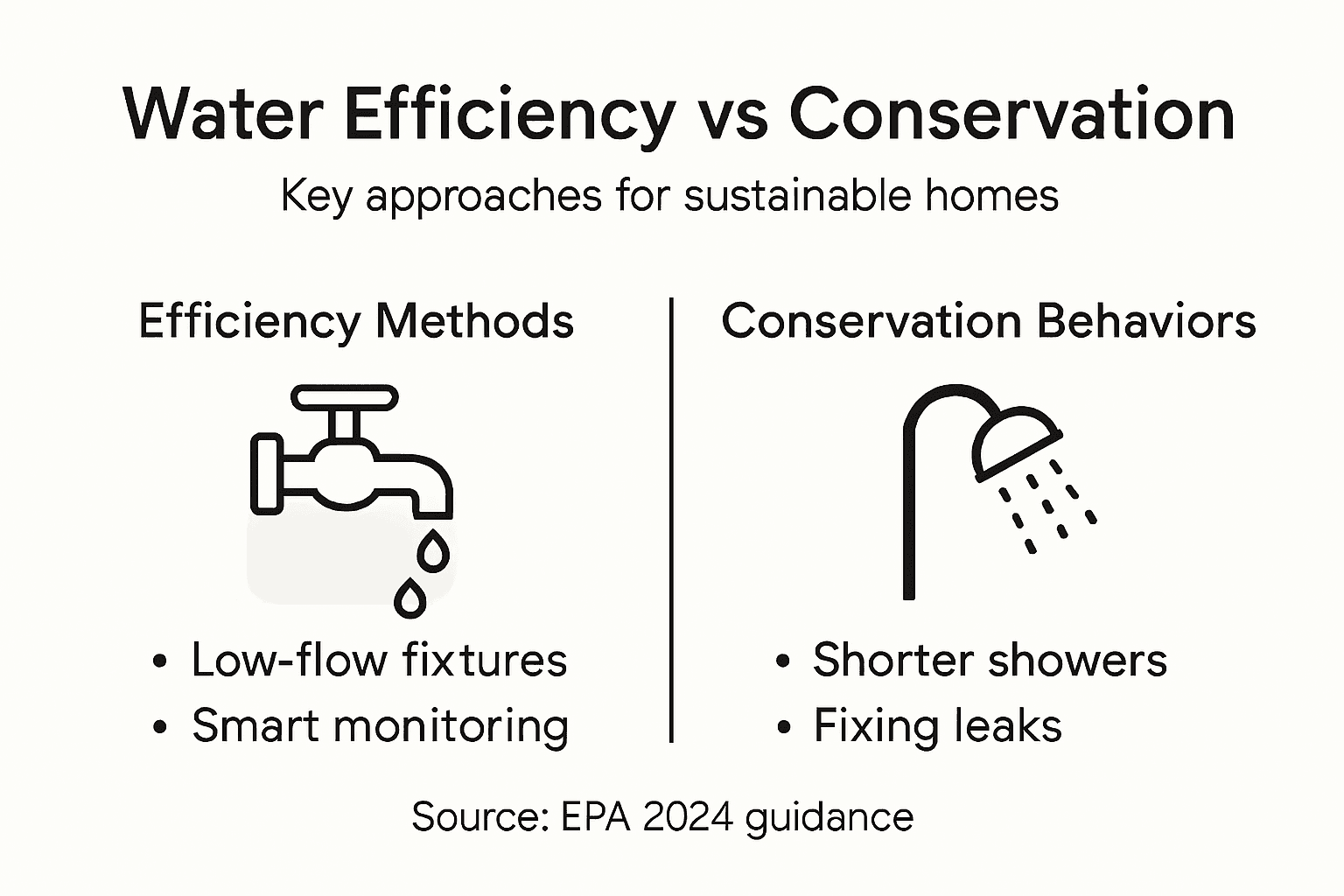
Key distinctions between water efficiency and conservation include:
Below is a concise comparison of water efficiency versus water conservation approaches:
| Aspect | Water Efficiency | Water Conservation |
|---|---|---|
| Main Focus | Optimizing system performance | Reducing total usage |
| Typical Methods | Advanced technologies | Behavioral changes |
| Impact Duration | Long-term improvements | Short-term savings |
| Resource Outcome | More output, less waste | Preserved resources, less output |
- Technological approach vs. behavioral modification
- Performance maintenance vs. total consumption reduction
- Systemic improvements vs. individual actions
- Long-term infrastructure investment vs. immediate usage restrictions
- Quantitative output optimization vs. qualitative resource preservation
Technological interventions play a pivotal role in water efficiency. Unlike traditional conservation methods that primarily focus on restricting usage, efficiency strategies aim to maximize output while minimizing resource consumption. Water management strategies demonstrate that these approaches are not mutually exclusive but rather interdependent components of sustainable resource management.
Comprehensive water resource management typically involves:
- Implementing advanced water-saving technologies
- Developing behavioral change education programs
- Creating adaptive policy frameworks
- Investing in infrastructure upgrades
- Monitoring and adjusting resource utilization
Effective water management integrates efficiency and conservation into a holistic strategy.
Pro tip: Combine technological upgrades with personal conservation habits to maximize water resource sustainability.
Make Your Home Water-Efficient and Healthier Today
Understanding the true meaning of water efficiency means going beyond just using less water — it is about optimizing every drop for better health, savings, and environmental impact. If you want to reduce systemic water waste in your home while enjoying clean, safe drinking water, advanced filtration technologies and smart water management solutions are essential. The article highlights the importance of precise monitoring and minimizing waste which aligns perfectly with home water purifiers that provide both purification and efficiency.
Discover how Coway’s cutting-edge water purifiers bring strategic water efficiency into your daily life by filtering water effectively and reducing contamination risks. Visit our website to explore models that fit your household needs whether you prefer countertop, under-sink units, or large-capacity purifiers. Act now to experience healthier water and start saving by combining scientific innovation with practical water efficiency. Don’t wait — optimize your water use intelligently with Coway Water Purifiers.
Stay informed about smart home water solutions and take a step towards sustainable living by exploring more on https://cowayswaterpurifier.com today.
Frequently Asked Questions
What is water efficiency, and why is it important?
Water efficiency involves optimizing water usage to maximize beneficial outcomes while minimizing waste. It is important because it helps ensure sustainable water resources, reduces environmental impact, and can lead to significant cost savings for households and communities.
How can I improve water efficiency in my home?
You can improve water efficiency by installing WaterSense-labeled fixtures, using low-flow showerheads, upgrading to water-saving toilets, implementing smart irrigation systems, and conducting regular home water audits to identify ways to reduce consumption and waste.
What are some common misconceptions about water efficiency?
Common misconceptions include believing that efficiency only means reducing total water use, that one-size-fits-all solutions apply, and that simply cutting consumption is always the best approach. True efficiency focuses on optimizing water use and minimizing waste based on specific contexts and needs.
How do water-efficient technologies work in managing water resources?
Water-efficient technologies use mechanisms like real-time consumption monitoring, smart sensors, adaptive flow control, and automated leak detection to manage water resources efficiently. They help balance energy consumption and reduce overall water use by automatically adjusting flows and detecting issues in real-time.
Recommended
- Energy-Efficient Purification: Cleaner Air and Water at Home – Coway Water Purifier
- Role of Sustainability in Water Purification: Complete Guide – Coway Water Purifier
- Eco-Friendly Filtration: Health And Environmental Impact – Coway Water Purifier
- 7 Key Benefits of Water Purification for Your Home – Coway Water Purifier
